Proof Questions in A-Level Maths Mocks: A Clear Guide
Proof questions in A-Level Maths mocks explained through worked examples, common mistakes and focused revision. Build your next targeted practice paper.
The unsettling thing about proof questions in A-Level Maths mocks is that you can understand every line of a solution and still struggle to write the first line yourself. The way forward is to identify what must be established, choose a suitable proof method, and make each logical step explicit.
Imagine a sixth-form student opening a mock paper after an evening spent revising differentiation. The calculations feel familiar. Then comes “prove that”, with no obvious procedure attached. That pause is understandable: proof asks you to construct an argument, rather than follow a calculation to an answer.
Here is how to turn that pause into a starting point, then use your mock results to make your next revision session more focused.
Before you start writing
Give yourself a short checklist:
- Identify the claim and its domain: integers, positive integers or real numbers, for example.
- Notice whether the question specifies a method.
- Translate the relevant definitions into algebra.
- Decide what your final line needs to establish.
The domain matters. A statement about integers may depend on divisibility or parity. A statement about real numbers needs an argument that also covers fractions and irrational values.
Edexcel’s A Level specification includes deduction, exhaustion, disproof by counterexample and contradiction. Check your own specification and your teacher’s mock coverage, particularly if your class has not yet completed the course. MathsGenie’s AQA proof revision resources provide a focused starting point for that board.
Proof by deduction: make the general case visible
Back at the mock desk, our imagined student tries a few numbers. This can help reveal a pattern, but a universal claim needs an argument covering every permitted value.
Deduction starts from definitions or established facts and follows logical steps to a conclusion.
Worked example: consecutive integers
Prove that the product of two consecutive integers is even.
Let the integers be nnn and n+1n+1n+1, where n∈Zn\in\mathbb{Z}n∈Z.
Every integer is either even or odd, so there are two cases.
If n=2kn=2kn=2k for some integer kkk, then
n(n+1)=2k(2k+1)=2(k(2k+1)).n(n+1)=2k(2k+1)=2\bigl(k(2k+1)\bigr).n(n+1)=2k(2k+1)=2(k(2k+1)).The expression in brackets is an integer, so the product is even.
If n=2k+1n=2k+1n=2k+1 for some integer kkk, then
n(n+1)=(2k+1)(2k+2)=2((2k+1)(k+1)).n(n+1)=(2k+1)(2k+2)=2\bigl((2k+1)(k+1)\bigr).n(n+1)=(2k+1)(2k+2)=2((2k+1)(k+1)).Again, the product is even. These cases cover every integer, so the result follows.
The decisive step is explaining why the factor of 222 establishes evenness. Algebra supports the argument; the final sentence completes it.
Exhaustion and counterexamples: know what checking can establish
Proof by exhaustion checks every possibility in a complete, finite collection of cases. If a question restricts an integer to a short interval, checking every permitted value can establish the result. You must explain why your checks cover the whole domain.
Testing a handful of values from an infinite domain cannot establish a universal statement. However, one valid failure is enough to disprove it.
Worked example: disproof by counterexample
Disprove the claim that n2+n+41n^2+n+41n2+n+41 is prime for every positive integer nnn.
Choose n=41n=41n=41. Then
412+41+41=41(41+1+1)=41×43.41^2+41+41=41(41+1+1)=41\times43.412+41+41=41(41+1+1)=41×43.This is a product of two integers greater than 111, so it is composite. Since 414141 is a permitted positive integer, the universal claim is false.
There is no need to find every value that fails. The task is complete once you provide one valid counterexample and explain why it contradicts the claim.
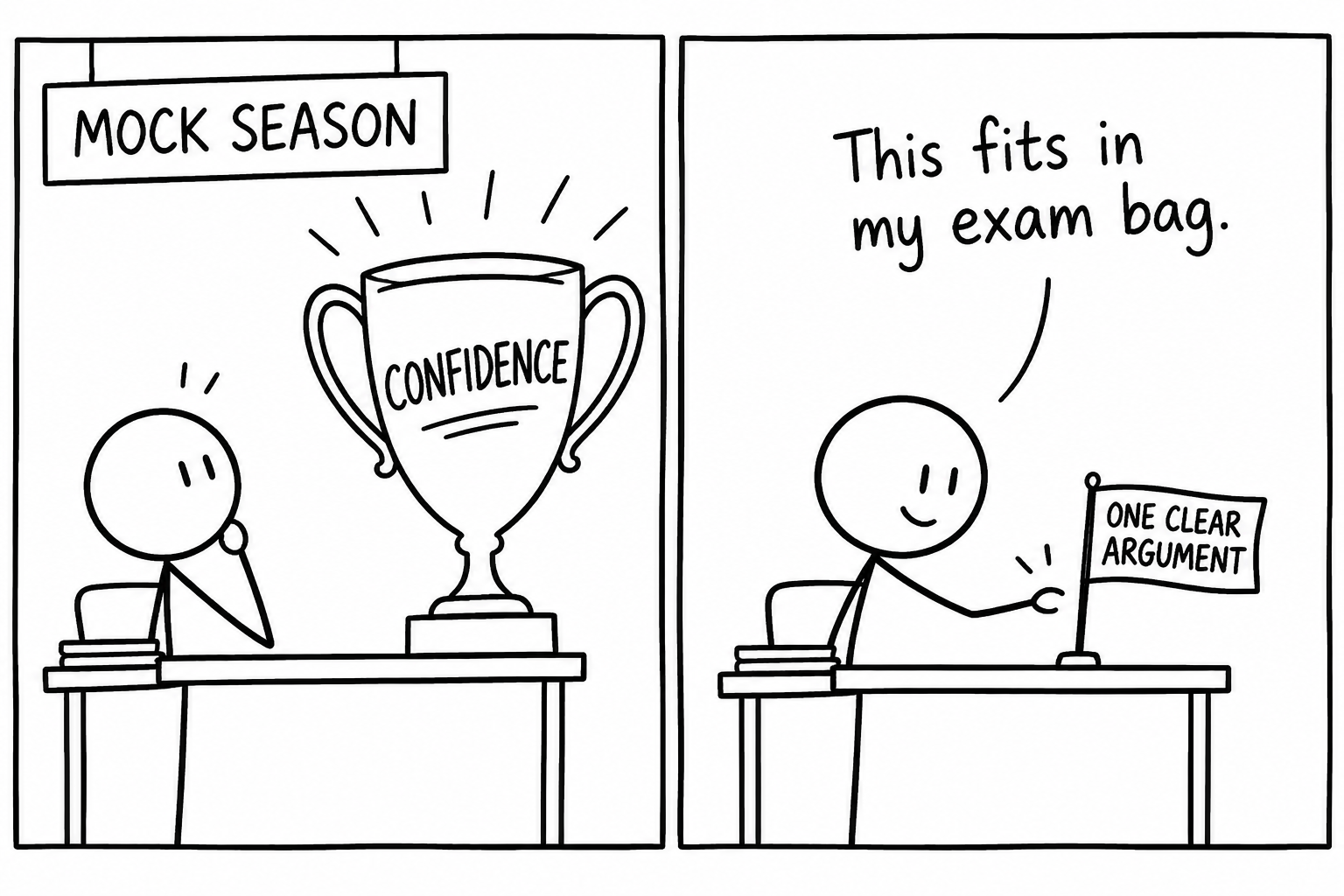 A stick-figure student swaps an enormous confidence trophy for a small flag labelled one clear argument.
Proof by contradiction: make the assumption precise
Contradiction can feel unfamiliar during A-Level maths mocks because you begin by assuming the opposite of what you want to establish. You then show that this assumption leads to something impossible.
Worked example: an irrational number
Prove that 2\sqrt{2}2 is irrational.
Assume that 2\sqrt{2}2 is rational. Then it can be written as
2=ab,\sqrt{2}=\frac{a}{b},2=ba,where aaa and bbb are positive integers with no common factor greater than 111.
Squaring and rearranging gives
a2=2b2.a^2=2b^2.a2=2b2.Therefore a2a^2a2 is even, which means aaa is even: the square of an odd integer is odd. Write a=2ka=2ka=2k, where kkk is an integer. Substituting gives
4k2=2b2⟹b2=2k2.4k^2=2b^2 \quad\Longrightarrow\quad b^2=2k^2.4k2=2b2⟹b2=2k2.Thus bbb is also even. Both aaa and bbb have a common factor of 222, contradicting the assumption that the fraction was in its lowest terms. Therefore 2\sqrt{2}2 is irrational.
The lowest-terms condition makes the contradiction possible. When practising, identify exactly which assumption your final lines contradict. MathsGenie’s AQA contradiction practice questions offer an opportunity to practise writing that structure independently.
Common mistakes that weaken a proof
When our imagined student reviews the mock, the useful question is: “Where did my argument stop being convincing?”
Using examples as universal evidence. Several successful substitutions suggest a pattern. They do not cover infinitely many possibilities.
Leaving variables undefined. State that kkk is an integer when writing an even number as 2k2k2k. That condition gives the expression its meaning.
Assuming the conclusion. Start from the given information or an explicitly stated contradiction assumption. Avoid treating the desired result as an established fact.
Losing the domain. Check that a counterexample satisfies every restriction in the question.
Stopping at the algebra. Finish by connecting your result to the original claim. In contradiction, name the inconsistency before rejecting the assumption.
Turn your mock into targeted A-Level maths revision
After marking, classify each difficulty: choosing the method, setting up the algebra, justifying a step or writing the conclusion. That tells you what to practise next.
Use MathsGenie’s revision resources to revisit the relevant lesson, then attempt a fresh question without looking at the solution. Compare your reasoning with the mark scheme and any available video solution. For Edexcel students, the A Level Maths revision collection brings together topic practice and past papers.
Next, mix proof with other topics so you practise recognising the method without a chapter heading giving it away. Keep a brief record of the missing step rather than copying an entire model answer.
Your next step is concrete: use Mock Exam Builder to choose topics, length and difficulty, and build a targeted practice paper. Start from the A Level exam builder, select your subject and board, and focus on the weaknesses your mock revealed. A clear argument, written independently, is useful evidence that your revision is working.