

A Two-Week IGCSE Maths Revision Plan
A two-week IGCSE Maths revision plan for Edexcel or Cambridge, with daily topic repair, timed papers, mark-scheme review and a realistic timetable.
Two weeks before an IGCSE Maths exam, the syllabus can feel larger than it did all year. A missed question can make everything seem urgent. Usually, it is not.
A two-week IGCSE Maths revision plan should identify the topics costing you marks, repair those gaps and leave time for timed papers. This timetable works for Edexcel or Cambridge students, provided your questions match the correct specification, tier and paper format.
The aim is not to squeeze an entire course into fourteen days. It is to use those days where they can make the greatest difference.
Your two-week revision checklist
Before beginning, collect:
- your exam board, syllabus code and tier
- the current specification or topic list
- recent past papers and corresponding mark schemes
- a notebook for mistakes and corrections
- your calculator and normal exam equipment
- a realistic list of available revision times
Edexcel linear Mathematics A students should confirm their Foundation or Higher entry for 4MA1. Both papers last two hours, are equally weighted and permit calculators. Cambridge IGCSE Mathematics 0580 students should check their Core or Extended entry. Under the 2025-2027 syllabus, each route includes a non-calculator paper and a calculator paper.
Check your entry information rather than assuming any online paper matches. Start with the Edexcel IGCSE Maths revision hub for topic organisation. The IGCSE Maths revision guide explains how topic practice and past papers fit together.
A two-week IGCSE Maths revision plan by day
Allow 60-90 minutes for ordinary sessions. Full-paper days need the official paper time plus at least 30 minutes for marking; allow longer for corrections when necessary.
| Day | Main focus | What to do |
|---|---|---|
| 1 | Diagnose | Attempt part of a recent paper without notes. Classify mistakes by topic, method, accuracy and timing. |
| 2 | Number | Practise fractions, percentages, ratio, bounds and standard form at your tier. |
| 3 | Algebra | Review manipulation, equations, inequalities, sequences and rearranging formulae. |
| 4 | Graphs | Practise coordinates, straight-line graphs and other required graph types. |
| 5 | Geometry | Revise angles, similarity, congruence, transformations and relevant circle facts. |
| 6 | Measures and trigonometry | Practise area, volume, Pythagoras and trigonometry. Check units and rounding. |
| 7 | Mixed mini test | Complete timed mixed questions, then revisit your weakest skills. |
| 8 | Statistics | Review averages, charts and data interpretation, including histograms where required. |
| 9 | Probability | Practise sample spaces, tree diagrams and combined events at your level. |
| 10 | Weak-topic repair | Revisit your two costliest topics using lessons, videos and fresh questions. |
| 11 | Full timed paper | Use exam conditions and follow the paper's calculator rules. |
| 12 | Paper review | Mark answers, correct methods and practise recurring weaknesses. |
| 13 | Second timed paper | Choose another paper, covering your other paper format where possible. |
| 14 | Light consolidation | Review mistakes, key facts and equipment. Finish early enough to rest. |
These are prompts, not equal priorities. Replace a secure topic with a weaker one when your diagnostic evidence supports it.
Organise sessions using the MathsGenie Revision Planner, without letting planning replace practice.
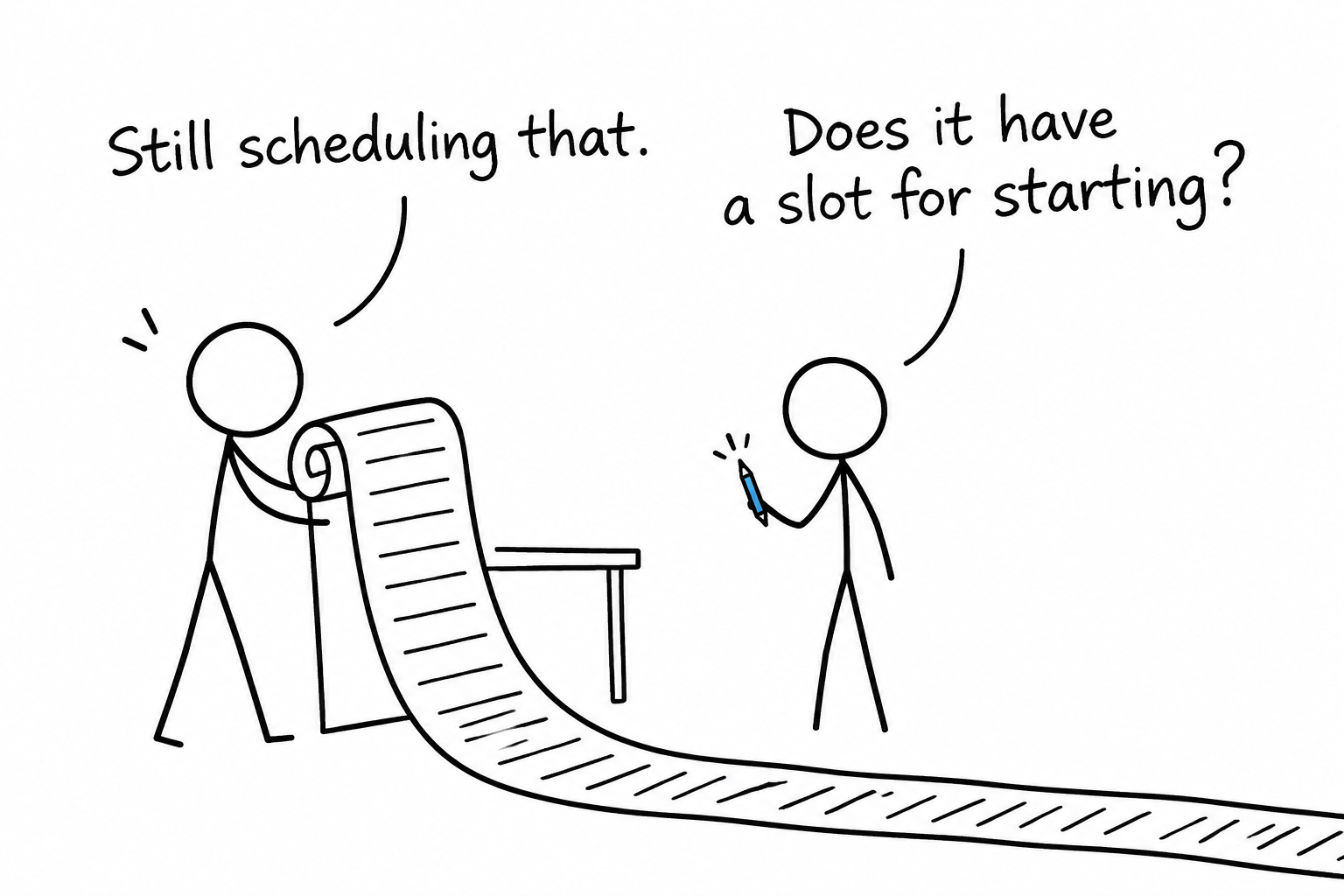 Stick-figure students discover that planning revision can become a way to postpone starting
Make each revision session useful
Watching a video can clarify a method. Answering questions without guidance reveals whether you can use it independently.
Follow a simple cycle:
- Retrieve: answer familiar questions from memory for 5-10 minutes.
- Repair: use a revision lesson or video solution for one weak method.
- Practise: attempt questions without viewing solutions.
- Check: mark your work and identify why marks were lost.
- Repeat: attempt similar questions later in the week.
MathsGenie's revision lessons, practice questions, video solutions and mini tests support this movement from explanation to independent practice. Predicted papers can add variety, but should supplement official past papers, not encourage guesses about exam content.
Balancing several subjects? The guide to how many hours to revise for GCSEs offers scheduling principles that also help with IGCSE revision.
Let mistakes set your priorities
A score tells you how a paper went. A mistake log tells you what to do next. Use four labels:
- Knowledge: you did not know a fact, rule or formula.
- Method: you recognised the topic but could not complete the process.
- Accuracy: arithmetic, signs, units or rounding caused the error.
- Exam technique: you misread instructions, omitted working or ran short of time.
Knowledge and method gaps need explanation followed by practice. Accuracy problems need clearer working and deliberate checks. Timing problems need timed sections and decisions about when to move on.
Read the mark scheme, write the correction, then attempt the question again without copying. Later, test the same skill with a different question.
Match practice to your exam board
For Edexcel 4MA1, develop calculator fluency throughout the fortnight. Practise brackets, accurate entry and retaining unrounded values during calculations.
For Cambridge 0580, include non-calculator practice alongside calculator work. Written reasoning matters in both conditions.
The GCSE vs IGCSE Maths comparison explains broader differences. Your specification, school entry and official timetable remain the final authority.
Common mistakes to avoid
Revising only comfortable topics
Familiar questions feel reassuring, but diagnostic evidence should determine your priorities. Give avoided topics manageable sessions rather than ignoring them.
Completing papers without reviewing them
Repeated papers can repeat the same errors. Protect time for corrections and follow-up questions before starting another paper.
Making every day too ambitious
One completed session beats several postponed ones. Keep some flexibility for other subjects and difficult days.
Memorising solutions and sacrificing rest
Recognising a method is not independent understanding. Close the notes and try again. Avoid exhausting late-night sessions, especially before the exam.
Build your two-week schedule
Start with evidence, choose your priorities and keep checking whether your practice is working. Use MathsGenie's free resources to turn each identified weakness into a clear next step. Build your two-week IGCSE Maths schedule in the Revision Planner, then begin with your diagnostic questions.















