

GCSE vs IGCSE Maths: What’s the Difference?
GCSE vs IGCSE maths explained for UK students: grading, papers, topics and revision tactics. Use Maths Genie lessons, past papers and mark schemes.
The question behind the question
If you’re revising for GCSE maths, “GCSE vs IGCSE” can feel like one of those distractions that pretends to be important. Someone in your class says IGCSE is “harder”. A cousin says GCSE is “more wordy”. Your teacher mentions Edexcel or AQA and suddenly it sounds like you’ve wandered into a conversation you missed the start of.
But usually, when a student asks about GCSE, they’re not really asking about the letters. They’re asking: What do I need to do to get the grade I want, and what will actually come up? The calming truth is that the maths underneath is familiar. The strategic truth is that the exam style matters, and your revision should match it.
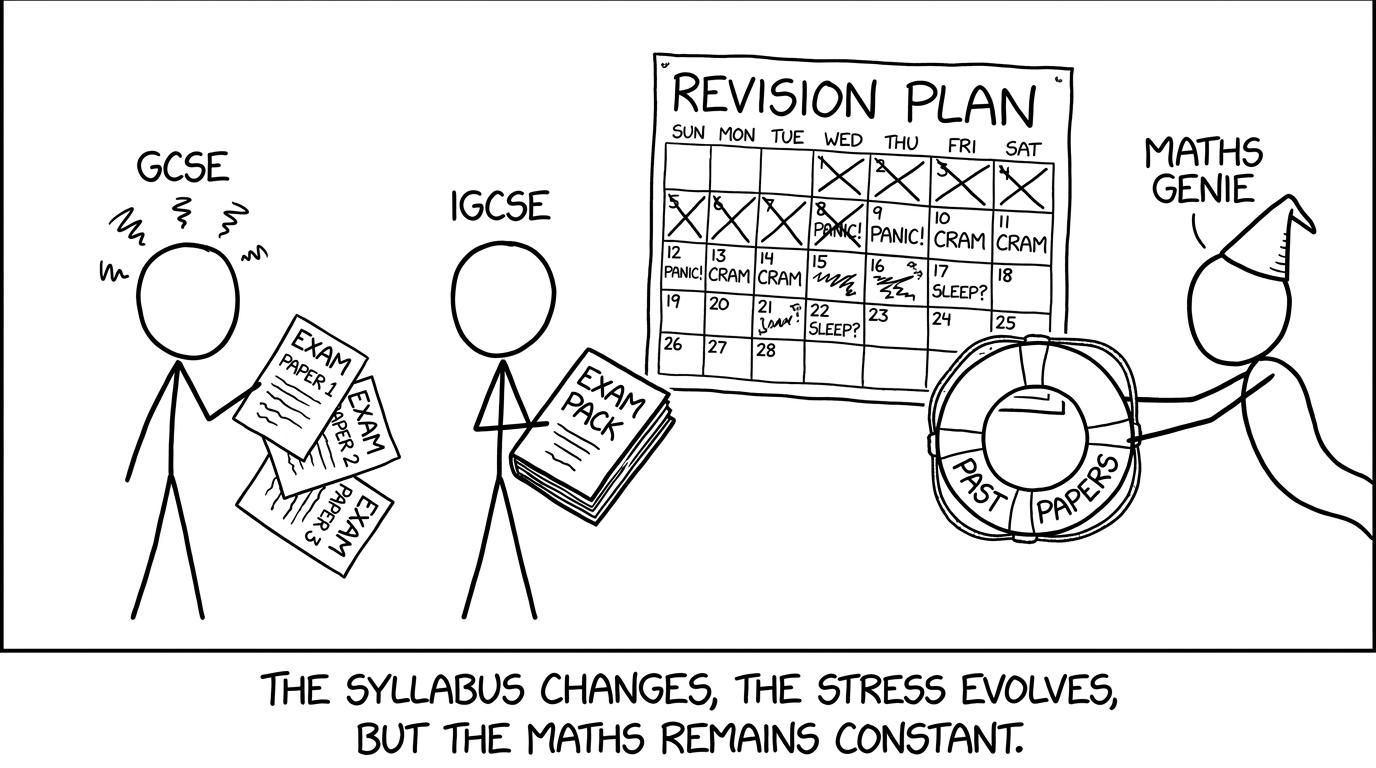 Two exams, one calendar
This guide explains GCSE vs IGCSE through a revision lens: what changes, what doesn’t, and how to use Maths Genie to practise the right skills efficiently.
GCSE vs IGCSE maths at a glance
Use this checklist to orient yourself quickly:
- Where you sit them: GCSE is standard in UK state schools; IGCSE is common in independent schools and international schools.
- Exam boards: GCSE commonly includes AQA, Edexcel, OCR, Eduqas; IGCSE is often Cambridge (CAIE) or Pearson Edexcel International GCSE.
- Grading: GCSE in England uses grades 9-1 (with 9 highest). Many IGCSEs use A to G* (some have 9-1 depending on board).
- Tiering: GCSE maths usually has foundation and higher tiers; many IGCSE routes have different paper options rather than the same tier structure.
- Content overlap: Big overlap in algebra, number, ratio, geometry, graphs, probability and statistics. Differences are usually in emphasis and question style.
- Revision approach: your best move is still the same: learn methods, then practise exam questions with mark schemes.
For UK-focused revision lessons and practice by topic, Maths Genie’s GCSE learning journey is the quickest way to structure your GCSE revision: Edexcel GCSE Maths learning journey.
What actually changes between GCSE and IGCSE?
The maths is similar, but the storytelling changes
Most students are surprised by this: GCSE vs IGCSE is less about “new maths” and more about how the maths is wrapped.
- GCSE questions often lean into UK contexts and problem-solving wording. You’ll see more multi-step “show that” or “explain” style prompts at higher tier.
- IGCSE questions can feel more direct and procedural in places, but may include topics or techniques earlier, depending on specification.
That’s why the best revision is not just re-reading notes. It’s seeing the same method in many disguises.
Maths Genie helps because you can go straight from lesson to exam-style practice questions and solutions. For example, if algebra is the make-or-break area for your GCSE grade, you can practise topics like collecting like terms and substitution in a structured way across stages.
Papers, time, and the “feel” of the room
GCSE maths in England typically means three papers (mix of calculator and non-calculator depending on board), with foundation and higher tiers. IGCSE paper structures vary by board.
So when someone says “IGCSE is harder”, what they often mean is: the paper I saw had unfamiliar timing, unfamiliar mark allocations, or unfamiliar question rhythm. That’s a revision issue, not a talent issue.
If you’re sitting GCSE, your most reliable practice is GCSE papers for your board. Maths Genie hosts large collections with mark schemes:
- AQA GCSE past papers (foundation and higher)
- GCSE predicted papers and resources
- Maths Genie predicted papers page
Grading: don’t translate, calibrate
In “GCSE vs IGCSE” conversations, students often try to translate grades like currency. But revision doesn’t work like exchange rates. Instead of translating, calibrate: do a paper, mark it, and see what you’re currently scoring.
On a GCSE paper, your grade is built from marks. That is wonderfully practical: you can literally earn your next grade through methods you can train.
Maths Genie’s topic practice makes that training concrete. For example, a single weak topic can cost repeated marks across a paper. Fixing it once can pay you back multiple times.
 Plot twist: it’s still maths
The GCSE topics that matter most (and why IGCSE comparisons distract you)
There are a handful of GCSE topics that appear again and again because they are “connective tissue” across the course. They show up in number, algebra, geometry, graphs, and problem solving.
Here are three that are worth prioritising for GCSE revision (and are also highly transferable if you’re comparing GCSE vs IGCSE):
Algebra with fractions (the quiet grade booster)
Students often lose marks not because they can’t do algebra, but because fractions make them rush.
Worked example
Simplify 3x4−x6\frac{3x}{4} - \frac{x}{6}43x−6x.
Find the common denominator: lcm(4,6)=12\text{lcm}(4,6)=12lcm(4,6)=12.
3x4=9x12,x6=2x12\frac{3x}{4} = \frac{9x}{12},\qquad \frac{x}{6} = \frac{2x}{12}43x=129x,6x=122xSo,
3x4−x6=9x12−2x12=7x12.\frac{3x}{4} - \frac{x}{6} = \frac{9x}{12} - \frac{2x}{12} = \frac{7x}{12}.43x−6x=129x−122x=127x.This exact skill shows up in GCSE algebra manipulation, solving equations, and even rearranging formulae. It also travels well across GCSE vs IGCSE because algebraic fluency is never wasted.
To build this steadily, use stage-based practice so you’re not randomly revising. Start from your current stage and move forward: Edexcel GCSE Maths learning journey.
Ratio and proportion (where wording hides the method)
“Best buys”, recipe questions, scaling, unit rates; GCSE loves them because they test maths and reading at the same time.
Worked example
A paint is mixed in the ratio red:blue =3:5= 3:5=3:5.
If the mixture contains 606060 ml of blue paint, how much red paint is there?
The 555 parts correspond to 606060 ml, so 111 part is 605=12\frac{60}{5}=12560=12 ml.
Red is 333 parts, so red is 3×12=363 \times 12 = 363×12=36 ml.
When students say “IGCSE is easier because it’s less wordy”, what they usually mean is that GCSE proportion questions sometimes bury the ratio inside a story. The fix is not panic; it’s practise with exam questions and mark schemes.
Angles and geometry (fast marks if you’re methodical)
Angles questions are often “free” marks if you annotate clearly and use facts you know.
If you want a structured route through geometry and shape topics (very common in GCSE), Maths Genie’s shape revision hub is a strong starting point: GCSE shape revision topics.
How to revise effectively when people keep talking about GCSE vs IGCSE
Match your revision to your paper
If you’re sitting GCSE, prioritise GCSE-style questions. Use:
- topic lessons for weak areas
- exam questions by topic with solutions
- full past papers under timed conditions
- mark schemes to learn how marks are awarded
On Maths Genie you can combine these quickly. For example, practise individual topics until your method is stable, then switch to papers for stamina and timing: AQA GCSE past papers.
Use predicted papers properly
Predicted papers are useful when used with the right mindset: not as a prophecy, but as focused extra practice.
If you’re revising for GCSE, use predicted papers to:
- identify gaps in commonly tested skills
- practise exam layout and timing
- rehearse non-calculator arithmetic under pressure
Start here: Maths Genie predicted papers.
Do fewer things, better
In the GCSE vs IGCSE debate, the loudest advice is often the least actionable. Quiet progress comes from repetition. Choose a short list of topics, practise them until you can do them without help, then move on.
A surprisingly effective pattern is:
- Watch or read the revision lesson.
- Do exam questions immediately.
- Mark with solutions and write down the exact step you missed.
- Re-do a similar question the next day.
That loop is how you turn GCSE maths into muscle memory.
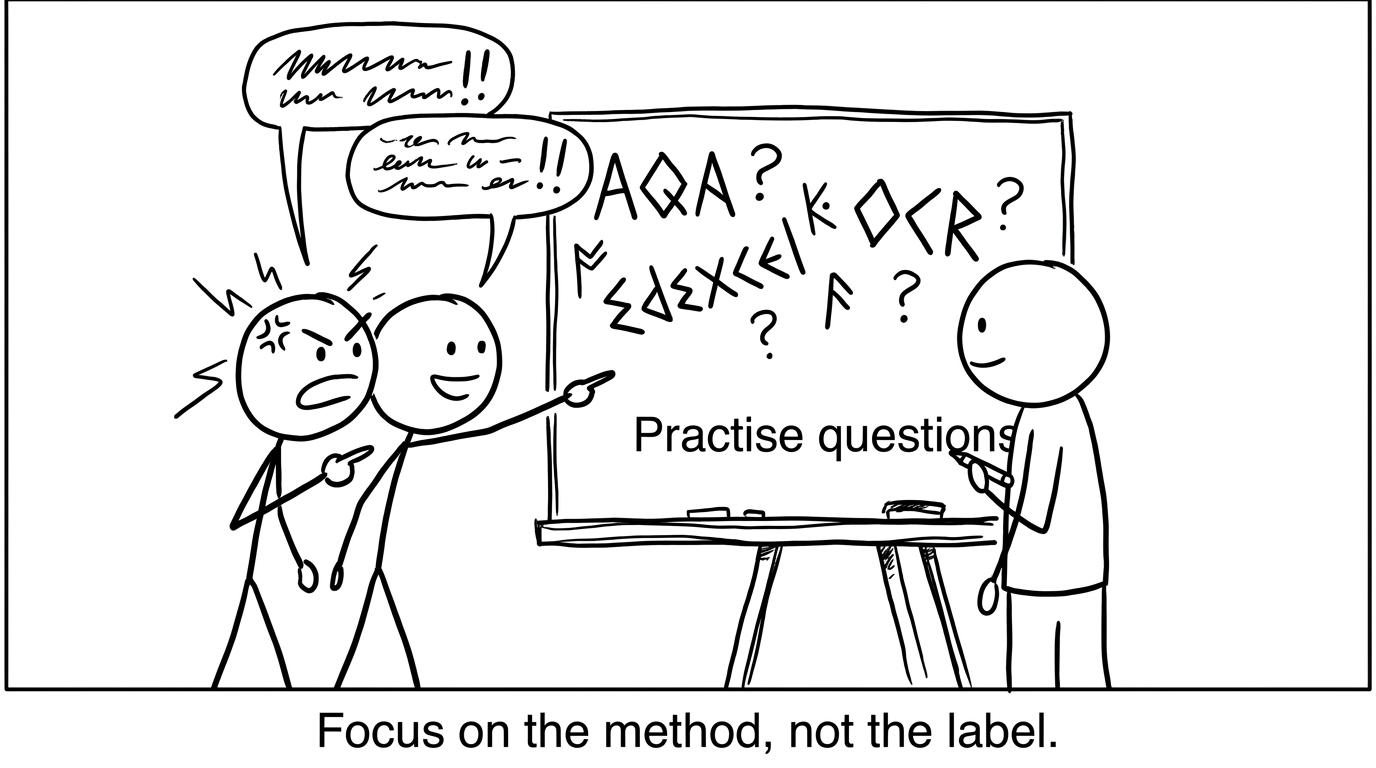 Exam boards as mysterious runes
Common mistakes students make with GCSE revision (especially when comparing GCSE vs IGCSE)
- Revising the label instead of the skill: Spending time debating GCSE vs IGCSE doesn’t earn marks. Practising algebra, graphs, and ratio does.
- Ignoring the mark scheme language: GCSE mark schemes reward method. If you skip steps, you can lose method marks even with the right final answer.
- Treating non-calculator work as “just harder calculator work”: Non-calculator GCSE questions often rely on number sense (factors, multiples, fractions). You need specific practice.
- Over-focusing on “hard topics”: Many GCSE grades are built from consistent accuracy on core topics (percentages, equations, angles). Don’t abandon these.
- Doing papers without reflection: A past paper only helps if you analyse mistakes, then go back to topic practice.
Closing thoughts: focus on the GCSE you’re sitting
GCSE vs IGCSE is an interesting comparison, but your grade is built in quieter moments: the Tuesday evening when you finally stop losing negative signs, the Saturday morning you do a full paper and realise timing is a skill, not a personality trait.
If you’re sitting GCSE maths, let your revision be specific and practical. Use Maths Genie to move from revision lessons to exam questions to mark schemes, then build confidence with full papers and predicted papers:
- Start structured topic revision: Edexcel GCSE Maths learning journey
- Build exam practice and stamina: AQA GCSE past papers
- Add focused extra practice: Maths Genie predicted papers
- Strengthen key geometry content: GCSE shape revision topics
Whatever course title is printed at the top of your paper, the path is the same: practise, mark, reflect, repeat. Maths Genie is here to make that path clear, free, and doable, right up to the exam.










