

How to Win IGCSE Maths: A Calm Revision Strategy
How to win IGCSE maths with a simple plan: topic gaps, past papers, mark schemes and predicted papers. Use YesGenie to push your grade up.
If you’ve ever walked out of a maths exam thinking, “I knew that topic… until it was on the paper”, you’re not alone. How to win IGCSE isn’t about being naturally quick, or memorising a thousand tricks. It’s about building reliability. The kind where you see a question, recognise the structure, and calmly collect method marks even when you’re not fully sure.
In this guide on How to win IGCSE, you’ll get a practical strategy you can use for IGCSE Maths revision (and it also works brilliantly for UK GCSE students). We’ll focus on what actually moves grades: tight topic coverage, past-paper fluency, mark-scheme thinking, and a routine you can repeat without burning out.
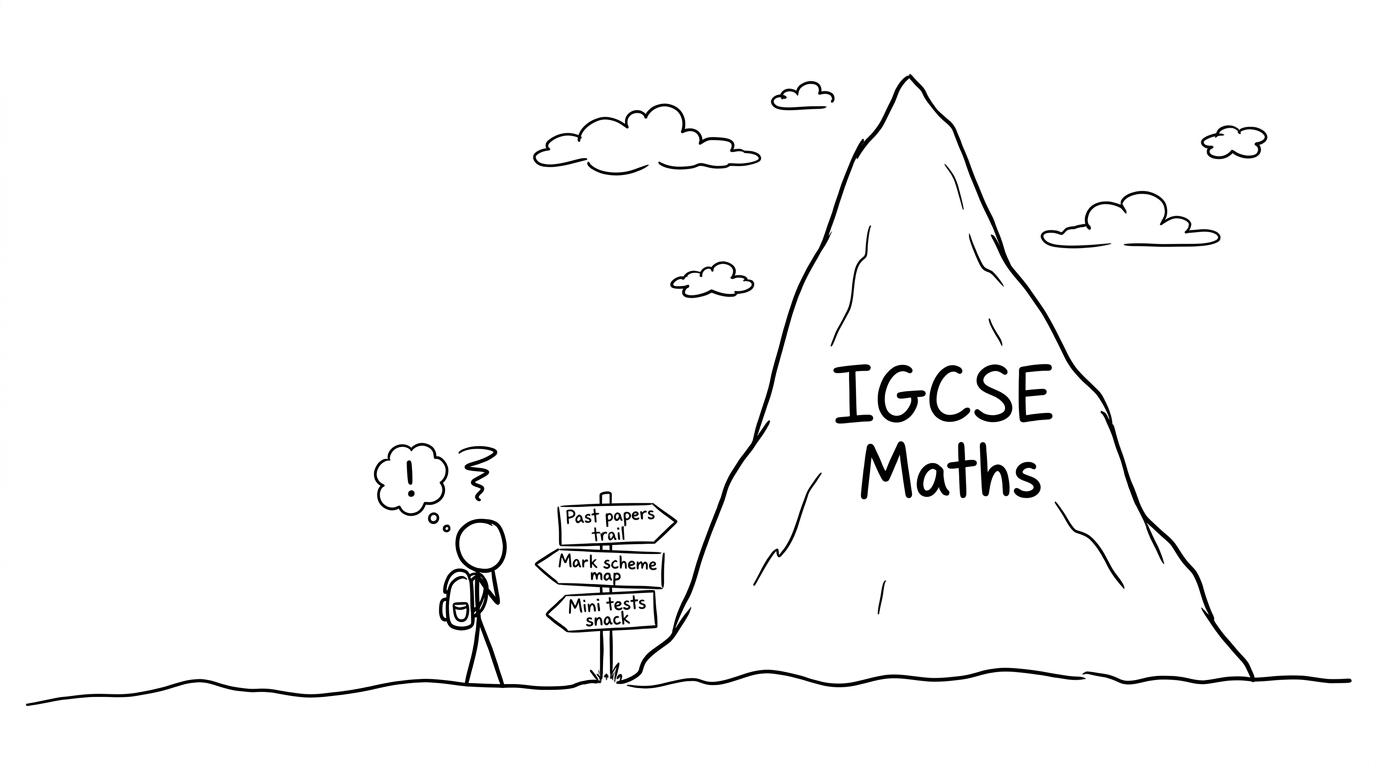 Student climbing the IGCSE maths mountain
How to win IGCSE with a simple checklist
Winning an exam is rarely dramatic. It’s usually quiet: a handful of habits done consistently.
- Know your spec and tier: IGCSE Maths can be structured differently from GCSE, but the skill set overlaps heavily.
- Fix gaps by topic: short lessons, immediate practice, then a mixed set.
- Switch early to exam style: practise with past papers and mark schemes.
- Collect method marks on purpose: write the line the examiner wants.
- Use predicted papers wisely: as a final rehearsal, not your whole revision.
YesGenie makes this easier because you can jump between revision lessons, revision guides, practice questions, mini tests, past papers, and predicted papers depending on what you need that day.
Useful starting points:
- Edexcel IGCSE Maths Revision
- Edexcel GCSE Maths Revision Hub
- GCSE Past Papers
- Edexcel GCSE Maths Predicted Papers
- Resources (Mini tests, predicted papers, more)
How to win IGCSE by thinking in “methods”, not topics
A lot of students revise in topic boxes: “today I do fractions”, “tomorrow I do simultaneous equations”. That’s not wrong, but it can hide the real game.
Exams reward methods.
A method is a repeatable chain: recognise the question type, set it up, execute cleanly, present it the way the mark scheme expects. When students say “I panicked”, what they often mean is: they couldn’t see the next line.
So, to How to win IGCSE, you revise methods until your next line becomes automatic.
Worked example: linear equations (method marks you can bank)
Solve 3(2x−5)=4x+73(2x-5)=4x+73(2x−5)=4x+7.
Expand first:
6x−15=4x+7 6x-15=4x+7 6x−15=4x+7Collect xxx terms on one side:
6x−4x=7+15 6x-4x=7+15 6x−4x=7+15Simplify:
2x=22 2x=22 2x=22Divide by 222:
x=11 x=11 x=11Why this wins marks: every line is “mark-scheme shaped”. Even if you slip at the end, the examiner can see the method.
If you want structured practice on this style of algebra, use the topic lists inside the Edexcel GCSE Maths Revision Hub (GCSE and IGCSE skills overlap strongly, especially for algebra, number, and graph work).
How to win IGCSE using the mark scheme as your coach
There’s a moment in revision where you stop asking, “What’s the answer?” and start asking, “What would get me the marks?” That moment changes everything.
Mark schemes aren’t just for checking. They’re a language guide:
- what counts as a method,
- what can be implied vs must be written,
- when a calculator approximation is acceptable,
- and which forms (exact, simplified, units) the examiner expects.
On YesGenie past papers, you can practise with mark schemes and then watch video solutions when you get stuck.
Try:
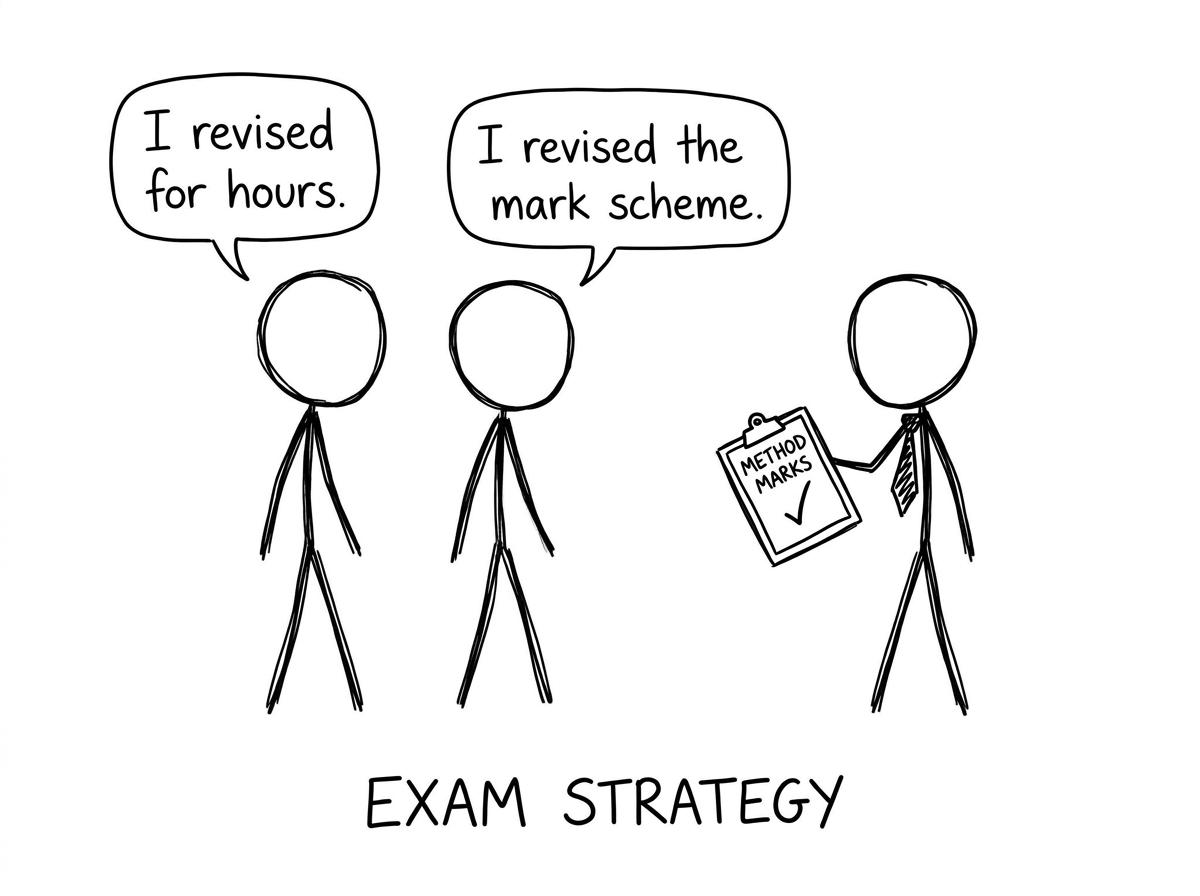 Revising the mark scheme vs revising for hours
How to win IGCSE with high-yield topics (the ones that keep returning)
Different boards (Edexcel, AQA, OCR, Eduqas for GCSE; Edexcel and Cambridge-style routes for IGCSE) package papers differently, but the high-frequency ideas are familiar:
- Algebra: rearranging, solving, sequences, graphs
- Number: fractions/percentages, standard form, bounds
- Geometry: angle facts, Pythagoras, trigonometry, circle theorems
- Statistics/probability: averages, scatter graphs, cumulative frequency, conditional probability
The trick is not “do everything once”. It’s “do the core ideas until you stop dropping silly marks”.
For a structured list of topics with notes and worked examples, use:
Worked example: bounds (classic exam phrasing)
A length is measured as 8.2 cm8.2\text{ cm}8.2 cm correct to 111 decimal place.
That means the true value LLL lies in:
8.15≤L<8.25 8.15 \le L < 8.25 8.15≤L<8.25If another length is 3.6 cm3.6\text{ cm}3.6 cm correct to 111 decimal place, then:
3.55≤W<3.65 3.55 \le W < 3.65 3.55≤W<3.65For the area A=L×WA=L\times WA=L×W:
Lower bound:
Amin=8.15×3.55=28.9325 A_{\min}=8.15\times 3.55=28.9325 Amin=8.15×3.55=28.9325Upper bound:
Amax=8.25×3.65=30.1125 A_{\max}=8.25\times 3.65=30.1125 Amax=8.25×3.65=30.1125So:
28.9325≤A<30.1125 28.9325 \le A < 30.1125 28.9325≤A<30.1125This is a “win marks” topic because the method is predictable, and the examiner awards steps.
How to win IGCSE by training like it’s the real exam
Here’s a calm approach that works:
Build your weekly cycle
- Two days: topic fixing (lessons + a short set of questions)
- Two days: mixed practice (mini tests or mixed exam questions)
- One day: an exam section under time (half paper, or timed set)
- One day: review mistakes, rewrite model solutions
- One day: rest or light recall (flashcards/notes)
YesGenie tools that fit this:
Worked example: non-calculator skills (exact answers matter)
Simplify 34+56\frac{3}{4}+\frac{5}{6}43+65.
Common denominator is 121212:
34=912,56=1012 \frac{3}{4}=\frac{9}{12},\quad \frac{5}{6}=\frac{10}{12} 43=129,65=1210Add:
912+1012=1912 \frac{9}{12}+\frac{10}{12}=\frac{19}{12} 129+1210=1219Convert to a mixed number if needed:
1912=1712 \frac{19}{12}=1\frac{7}{12} 1219=1127In many mark schemes, both 1912\frac{19}{12}1219 and 17121\frac{7}{12}1127 can be acceptable depending on the question. The “win” move is checking what form they asked for.
How to win IGCSE with predicted papers (without fooling yourself)
Predicted papers are powerful for confidence because they simulate the emotional experience: time pressure, mixed topics, and the fear of blank space.
But they’re not a replacement for coverage.
Use predicted papers when:
- you’ve already worked through the main topics,
- you want to practise timing,
- you want to rehearse exam-day routines.
On YesGenie, predicted papers are organised clearly and paired with worked support:
A good rule: after any predicted paper, write down the three methods you lost marks on and spend the next session fixing just those.
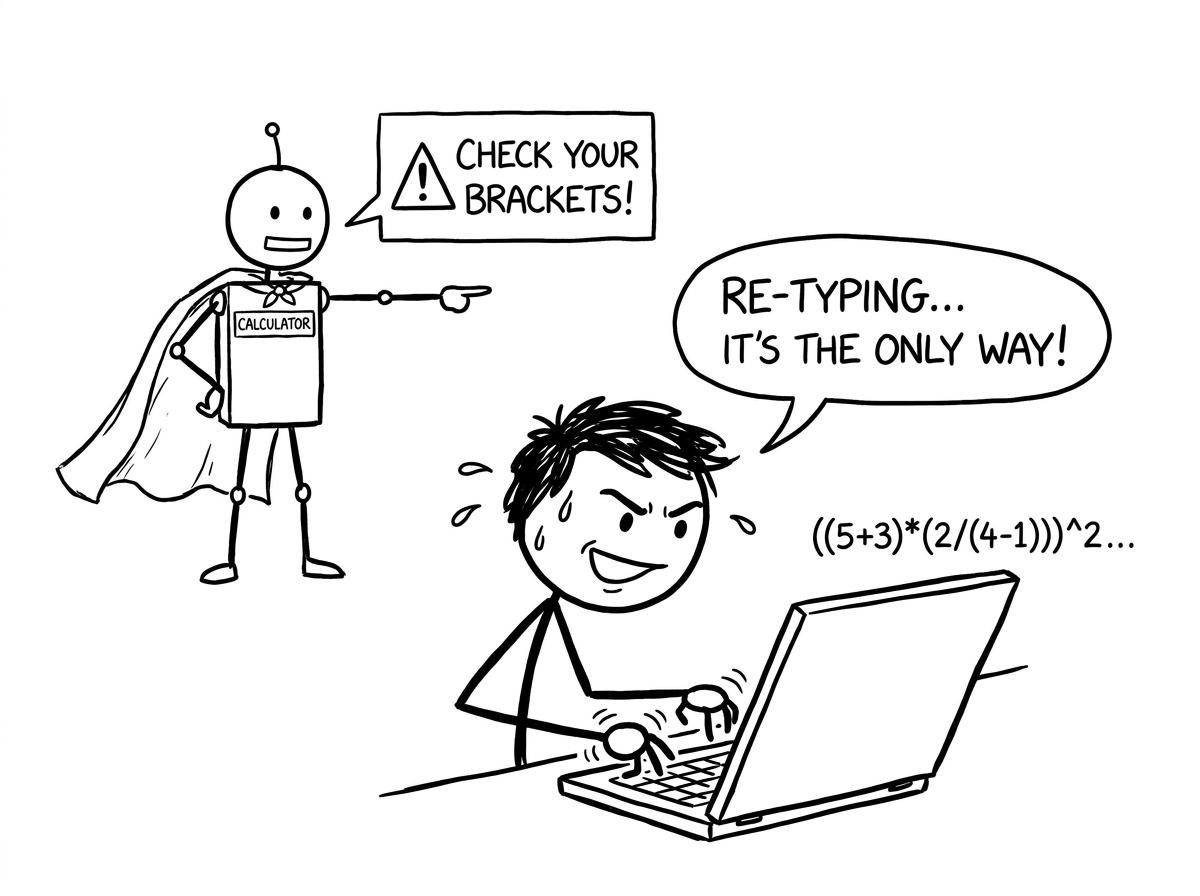 Calculator superhero reminding you about brackets
Common mistakes that stop students winning IGCSE
These are the errors that quietly cap grades, even when you “know the topic”.
Dropping method marks by skipping lines
If you do everything in your head, the examiner can’t award what they can’t see. Write the rearrangement. Write the substitution. Write the formula before numbers.
Rounding too early
If a question expects accuracy, keep full calculator values until the end. If you round intermediate values, you can drift outside the accepted range.
Not answering the question asked
A lot of marks disappear here: “Give your answer to 333 significant figures”, “write down the inequality”, “state the equation of the line”. Circle the command word.
Mixing up exact and approximate forms
For surds, exact trigonometric values, and algebraic simplification, the mark scheme often wants an exact final form. Know when to leave 2\sqrt{2}2 and when a decimal is acceptable.
Revising comfortably instead of strategically
If you only do the topics you like, your confidence rises but your grade doesn’t. Winning revision targets discomfort in small, manageable doses.
How to win IGCSE: the finish-line strategy
The final weeks before the exam often feel like a narrowing corridor. You want certainty, but you mostly get noise: advice, panic, and the occasional miraculous “hack”. Ignore the hacks. Winning comes from doing a few things relentlessly well.
Use YesGenie to run the loop:
- learn and refresh with Edexcel GCSE Maths Lessons,
- lock in methods with Edexcel GCSE Maths Revision Guides,
- pressure-test with GCSE Past Papers,
- rehearse with Edexcel GCSE Maths Predicted Papers,
- and keep your weaknesses visible with mini tests from Edexcel GCSE Maths Mini Tests.
If you want one sentence to carry into your next session, make it this: How to win IGCSE is to turn weak topics into reliable methods, then prove it under timed papers. Open YesGenie, pick one gap, and start collecting marks on purpose.










