

Two-Week A-Level Maths Mock Plan
Two-week A-Level maths mock plan with daily tasks, timed papers and targeted practice to improve pure, statistics and mechanics before mocks.
Mock season often arrives quietly. One week, lessons feel normal. The next, a sixth-form student is looking at a calendar and wondering how an entire A-Level Maths course is supposed to fit into fourteen days.
The answer is that it does not. A useful two-week A-Level maths mock plan is not an attempt to relearn everything. It is a system for finding the topics costing you marks, repairing the most important gaps and practising under realistic conditions.
Imagine a student called Sam. The scenario is hypothetical, but the problem is familiar: Sam understands most lessons, yet mixed questions feel harder than exercises grouped neatly by topic. Over the next two weeks, Sam will alternate diagnosis, targeted practice and timed papers. You can follow the same structure using the free A-Level Maths revision resources on MathsGenie.
Your two-week plan at a glance
Each revision session has one clear purpose:
- Days 1-3: diagnose weaknesses and repair essential knowledge
- Days 4-6: practise pure maths, statistics and mechanics
- Day 7: complete and review a timed paper
- Days 8-10: target errors revealed by that paper
- Days 11-12: complete further timed practice
- Day 13: consolidate methods and calculator skills
- Day 14: complete light retrieval practice and prepare calmly
Aim for one or two focused sessions each day. A session of around 454545-606060 minutes with careful marking is usually more valuable than several distracted hours.
Days 1-3: diagnose before revising
Sam's first instinct is to begin with differentiation because it feels productive. Instead, Sam completes a mixed set of questions and marks every answer honestly.
That choice matters. Revision should respond to evidence, not mood.
Start with a past paper or mixed assessment appropriate to the content your class has covered. You can choose your board through MathsGenie's A-Level Maths exam board hub, or go directly to the Edexcel A-Level Maths resources if that is your specification.
Create three lists while marking:
| Category | What to record |
|---|---|
| Knowledge gap | A formula, definition or method you could not recall |
| Application gap | A topic you knew but could not recognise in context |
| Accuracy gap | An algebraic, calculator, notation or sign error |
On days 222 and 333, tackle the highest-value weaknesses. Prioritise topics that appear across several areas. Algebraic manipulation, trigonometry, exponentials and logarithms, differentiation and integration often support longer chains of reasoning.
For each weak area, use this sequence:
- Review the method.
- Complete a small set of focused questions.
- Mark them immediately.
- Redo incorrect questions without looking at the solution.
- Write one sentence explaining the cause of each error.
That final step prevents “I understand it now” from becoming a substitute for being able to do it independently.
Days 4-6: rotate through the course
A-Level maths mocks reward switching between ideas. Your revision should practise that switch.
Day 4: pure maths
Choose two weaker pure topics and one stronger topic. The stronger topic provides retrieval practice, while the weaker topics receive most of your time.
Suppose Sam has forgotten how to find a stationary point. A short worked example restores the process:
For
y=x3−3x2−9x+4,y=x^3-3x^2-9x+4,y=x3−3x2−9x+4,differentiate:
dydx=3x2−6x−9.\frac{dy}{dx}=3x^2-6x-9.dxdy=3x2−6x−9.At a stationary point, dydx=0\frac{dy}{dx}=0dxdy=0, so
3x2−6x−9=0.3x^2-6x-9=0.3x2−6x−9=0.Dividing by 333 gives
x2−2x−3=0,x^2-2x-3=0,x2−2x−3=0,and factorising gives
(x−3)(x+1)=0.(x-3)(x+1)=0.(x−3)(x+1)=0.Therefore, x=3x=3x=3 or x=−1x=-1x=−1. Sam would then substitute these values into the original function if the coordinates were required.
The important revision habit is not copying the example. Close it, change the coefficients and reproduce the method from memory.
Day 5: statistics
Review the statistical content taught by your school, including the large data set where it applies to your exam board. Practise choosing methods, interpreting results in context and using your calculator efficiently.
Do not stop once you obtain a value. Statistical questions often require a conclusion connected to the scenario. If a hypothesis test is involved, distinguish between the mathematical decision and what the available evidence suggests.
Day 6: mechanics
Mechanics errors frequently begin before any calculation. Draw a diagram, define a positive direction and identify the model being used.
For constant acceleration, you may need an equation such as
v=u+at.v=u+at.v=u+at.If upward is positive, acceleration due to gravity is negative. Choosing downward as positive is also valid, provided every sign follows that decision. Consistency earns marks; changing direction halfway through a solution does not.
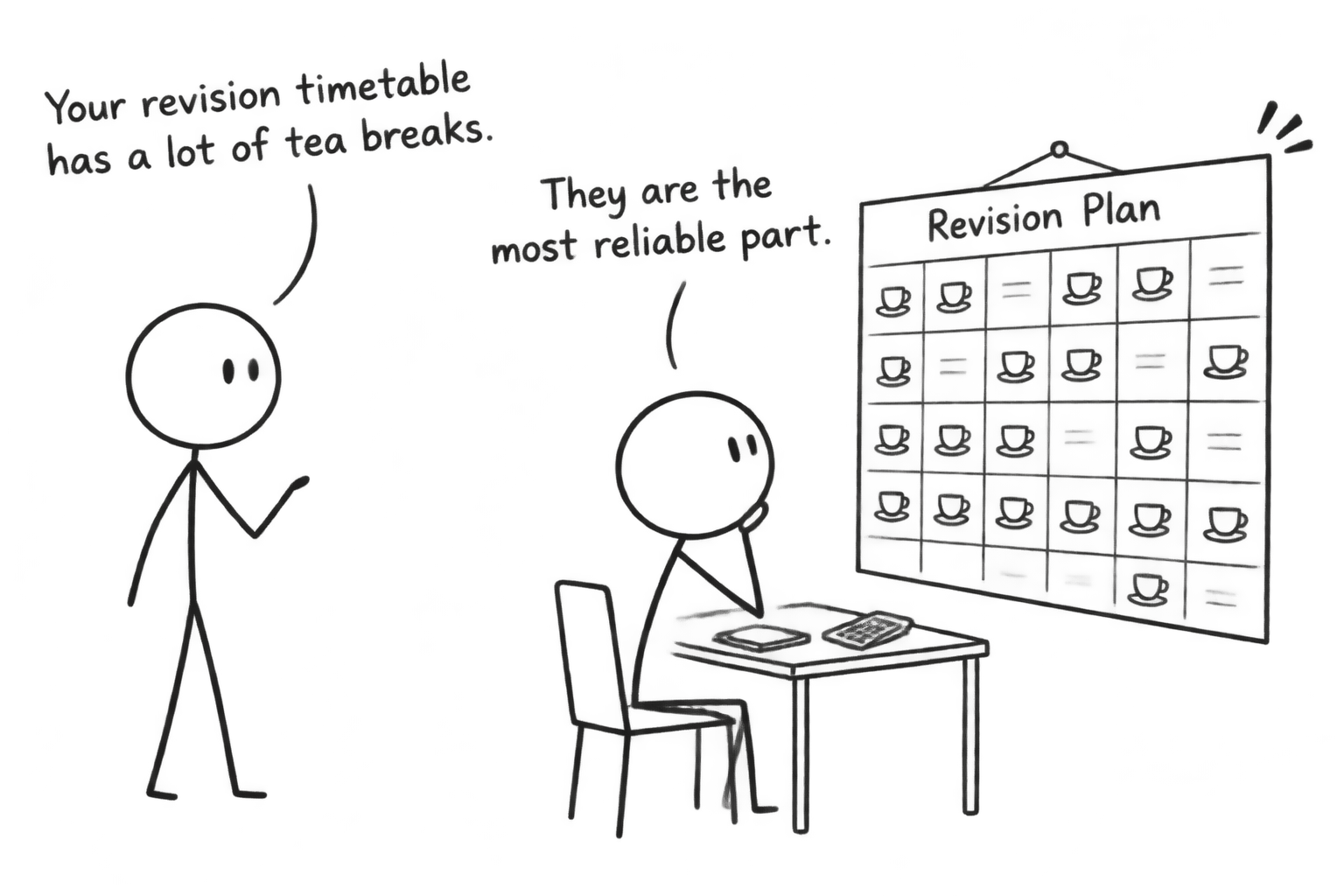 A sixth-form student's tea-break-heavy revision timetable
Day 7: sit and analyse a timed paper
Now Sam sits a paper under realistic conditions. The desk is clear, the phone is elsewhere and the timer is visible.
Use a paper that matches your exam board and the content covered by your mock. MathsGenie provides free past papers and mark schemes through its A-Level Maths revision page. If you are still completing first-year content, the AS Level Maths resources may offer more appropriate practice.
Mark the paper on the same day if possible. Record:
- the topic behind every lost mark;
- whether the error was knowledge, application or accuracy;
- questions that took too long;
- marks lost through incomplete working or poor notation;
- any calculator process that needs practice.
Your score is useful, but the error pattern is more useful. It tells you what days 888-101010 should contain.
Days 8-10: let the mistakes choose the work
By the second week, Sam's plan becomes more personal. If implicit differentiation was secure, it leaves the schedule. If connected particles caused trouble, they enter it.
Choose up to three priorities from the timed paper. For each one, complete a short revision lesson followed by progressively less guided practice. Finish with at least one exam-style question that combines the topic with another idea.
Maintain an error log with four columns:
| Question or topic | What went wrong | Correct method | Recheck date |
|---|---|---|---|
| Example entry | Sign changed incorrectly | Define the positive direction first | Day 121212 |
The recheck date is essential. A corrected solution shows that you understand the feedback today. Repeating it later shows that the learning has lasted.
Days 11-12: return to timed conditions
Complete another substantial timed section or full paper. If your mock includes separate papers or content areas, choose the one that has received less timed practice.
Use the mark scheme carefully. A correct final answer may hide fragile reasoning, while an incorrect answer may still contain valid method marks. Compare every line rather than looking only at the answer.
Then complete a short correction session. Redo questions from a blank page and use video solutions where available to compare the structure of your working. Keep the focus narrow: these days test whether your targeted revision has changed your performance.
Days 13-14: consolidate, do not cram
On day 131313, revisit the error log, key formulae and calculator procedures. Complete a mixed mini test, then stop and mark it. Avoid opening several new topics simply because they exist on the specification.
On day 141414, keep revision light. Retrieve a few methods from memory, review recurring errors and prepare the equipment permitted for your mock. Sleep and a calm start are part of exam preparation, not time stolen from it.
Common mistakes during A-Level maths revision
Revising only comfortable topics
Familiar questions feel fluent, which can be mistaken for progress. Keep some strengths active, but give most practice time to weaknesses identified through marking.
Reading solutions instead of producing them
A solution can look obvious after someone else has built it. Attempt each question first, then close the solution and reproduce the method independently.
Completing papers without analysing them
A stack of marked papers is not automatically useful. Every paper should create a short, specific list of actions.
Ignoring exact values and mathematical communication
Keep exact forms such as 3π4\frac{3\pi}{4}43π or 232\sqrt{3}23 unless a decimal is requested. Show enough working for a marker to follow your method, especially in multi-step questions.
Treating the timetable as a test of character
Missing one session does not ruin the fortnight. Move the highest-priority task forward and remove something less valuable. A revision plan is a decision-making tool, not a promise that every day will be perfect.
Turn the plan into targeted practice
After fourteen days, Sam has not revised every page equally. That was never the goal. The result is better: weaknesses have names, errors have explanations and timed practice has made the mock feel less unfamiliar.
Begin with the free A-Level Maths resources on MathsGenie, use past papers and mark schemes to diagnose your needs, then build a targeted practice paper in Mock Exam Builder. Choose the topics revealed by your error log and make your next paper answer the question that matters most: what should I practise now?















