

Trigonometry in A-Level Maths Mocks: Revision Guide
Trigonometry in A-Level Maths mocks made manageable: revise radians, identities and equations, avoid common errors, and build targeted practice today.
Mock season has a habit of making familiar mathematics feel unfamiliar. A sixth-form student can recognise every identity on the page, then hesitate when a question combines three of them.
The best way to prepare for trigonometry in A-Level Maths mocks is to practise choosing methods, not merely recalling formulas. You need to recognise when to use an identity, work confidently in radians, find every solution in an interval and interpret trigonometric models. Then you need to practise those decisions under timed conditions.
Imagine a student called Sam. The scenario is hypothetical, but the problem is common. Sam has revised each chapter separately. In the mock, however, trigonometry appears inside algebra, differentiation and modelling. The topic is no longer wearing a helpful label.
Your trigonometry mock checklist
Before the mock, check that you can:
- use exact values without reaching immediately for a calculator
- move confidently between degrees and radians
- recognise the graphs, periods and symmetries of trigonometric functions
- solve equations over a stated interval
- apply identities without changing only one part of an expression
- use compound-angle and double-angle formulas
- rewrite acosx+bsinxa\cos x+b\sin xacosx+bsinx in a single trigonometric form
- interpret trigonometric models in context
- show enough working for a mark scheme to follow
Start with the relevant A-Level Maths revision hub, where you can select your exam board. The precise organisation varies between specifications, but radians, identities, equations, graphs and modelling are central areas of A-Level trigonometry.
Why trigonometry becomes harder in a mock
In a lesson, the heading often suggests the method. A mock removes that clue.
Sam may know the identity
sin2x+cos2x≡1,\sin^2 x+\cos^2 x\equiv 1,sin2x+cos2x≡1,but the exam is testing whether Sam notices that it turns an equation containing both sine and cosine into a quadratic involving one function.
That distinction matters. Knowledge is remembering the tool. Exam technique is recognising the moment to use it.
A useful first question is therefore not, “Which formula do I remember?” It is, “What form would make this expression easier?”
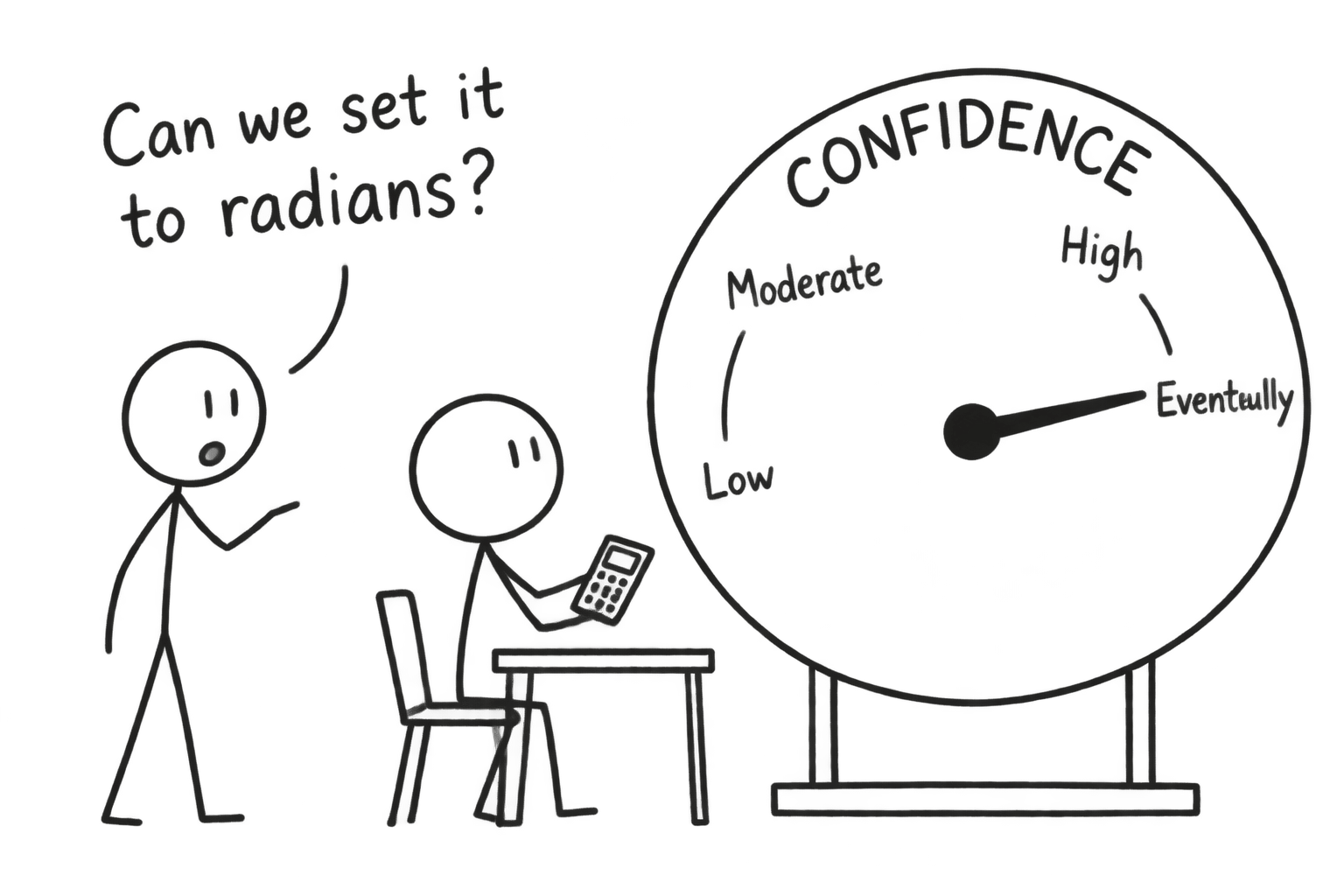 A sixth-form student asks whether confidence can be set to radians
The areas to prioritise in A-Level Maths revision
Radians and calculator mode
Radians connect trigonometry with calculus and circular measure. You should know that
180∘=π radians,180^\circ=\pi\text{ radians},180∘=π radians,along with
s=rθs=r\thetas=rθand
A=12r2θ,A=\frac{1}{2}r^2\theta,A=21r2θ,where θ\thetaθ is measured in radians.
Sam’s simplest mock-season habit is to write the calculator mode at the top of the page whenever an angle question appears. A correct method performed in degree mode can produce a completely wrong answer.
Use the radian measure revision lesson to revisit the reasoning, then practise with the A-Level exam booklets. If you follow another board, select it from the main revision hub rather than assuming the Edexcel topic order matches your course.
Identities and equations
This is where many mock questions become multi-step problems. Useful identities include
tanx≡sinxcosx,\tan x\equiv\frac{\sin x}{\cos x},tanx≡cosxsinx, 1+tan2x≡sec2x,1+\tan^2x\equiv\sec^2x,1+tan2x≡sec2x,and
sin2x≡2sinxcosx.\sin 2x\equiv2\sin x\cos x.sin2x≡2sinxcosx.The trigonometric identities and equations revision page brings lessons, questions and videos together, while its interactive trigonometry lessons are useful when a method still feels uncertain.
Consider this worked example.
Solve
2cos2x−3sinx=02\cos^2x-3\sin x=02cos2x−3sinx=0for 0≤x<2π0\leq x<2\pi0≤x<2π.
Because the equation contains cos2x\cos^2xcos2x and sinx\sin xsinx, use
cos2x=1−sin2x.\cos^2x=1-\sin^2x.cos2x=1−sin2x.Then
2(1−sin2x)−3sinx=0.2(1-\sin^2x)-3\sin x=0.2(1−sin2x)−3sinx=0.Rearranging gives
2sin2x+3sinx−2=0.2\sin^2x+3\sin x-2=0.2sin2x+3sinx−2=0.Factorise:
(2sinx−1)(sinx+2)=0.(2\sin x-1)(\sin x+2)=0.(2sinx−1)(sinx+2)=0.Therefore
sinx=12\sin x=\frac{1}{2}sinx=21or
sinx=−2.\sin x=-2.sinx=−2.The second result is impossible because −1≤sinx≤1-1\leq\sin x\leq1−1≤sinx≤1. Within the stated interval,
x=π6, 5π6.x=\frac{\pi}{6},\ \frac{5\pi}{6}.x=6π, 65π.The important step was not the factorisation. It was recognising that the identity would produce a quadratic in sinx\sin xsinx.
Trigonometric modelling
A model such as
h(t)=a+bsin(ct+d)h(t)=a+b\sin(ct+d)h(t)=a+bsin(ct+d)may describe periodic height, displacement or another repeating quantity. Mock questions can ask for amplitude, period, maximum value or the meaning of a parameter.
Another common technique is combining two terms. Rewrite
3cosθ+4sinθ3\cos\theta+4\sin\theta3cosθ+4sinθin the form Rcos(θ−α)R\cos(\theta-\alpha)Rcos(θ−α).
Expand the target form:
Rcos(θ−α)=Rcosθcosα+Rsinθsinα.R\cos(\theta-\alpha)=R\cos\theta\cos\alpha+R\sin\theta\sin\alpha.Rcos(θ−α)=Rcosθcosα+Rsinθsinα.Comparing coefficients gives
Rcosα=3R\cos\alpha=3Rcosα=3and
Rsinα=4.R\sin\alpha=4.Rsinα=4.Hence
R=32+42=5R=\sqrt{3^2+4^2}=5R=32+42=5and
α=tan−1(43).\alpha=\tan^{-1}\left(\frac{4}{3}\right).α=tan−1(34).Therefore
3cosθ+4sinθ=5cos(θ−tan−1(43)).3\cos\theta+4\sin\theta=5\cos\left(\theta-\tan^{-1}\left(\frac{4}{3}\right)\right).3cosθ+4sinθ=5cos(θ−tan−1(34)).This also reveals immediately that the maximum value is 555. Explore further applications through the trigonometry and modelling video solutions.
How Sam turns revision into mock performance
Sam’s early revision is passive: watching a solution, nodding, then moving on. It feels fluent because every step makes sense once it has been shown.
A stronger routine has four stages:
- attempt a small set without notes
- mark it carefully and classify each error
- revisit the lesson only for the weak skill
- answer a fresh question under timed conditions
Error labels should be specific. “Trig mistake” tells Sam very little. “Missed the second solution”, “used degrees instead of radians” or “could not select an identity” gives the next revision session a purpose.
After topic practice, use Edexcel A-Level Maths past papers and mark schemes, or choose the equivalent page for your board. Full papers test whether you can recognise trigonometry when it appears among unrelated topics.
Common mistakes in trigonometry questions
Missing solutions
An inverse trigonometric calculation usually gives one principal value, not necessarily every answer in the interval. Use the graph, symmetry or a CAST-style quadrant method, then check every answer against the original interval.
Dividing by a trigonometric expression
Dividing both sides by sinx\sin xsinx or cosx\cos xcosx can remove valid solutions when that expression equals zero. Factorise first and consider each factor separately.
Mixing degrees and radians
Read the interval before calculating. An interval involving π\piπ almost always signals radians, while a degree symbol signals degrees.
Rounding too early
Keep exact values such as 32\frac{\sqrt{3}}{2}23 or an inverse-trigonometric expression until the final line. Premature rounding can affect later marks and accuracy.
Treating an identity proof like an equation
For a proof, begin with one side and transform it into the other. Avoid manipulating both sides simultaneously, because that can hide circular reasoning.
Build the practice paper you actually need
By the end of mock season, Sam does not need another random collection of questions. Sam needs a paper concentrated on missed solutions, identities, radians and modelling.
That is the value of the MathsGenie Mock Exam Builder. Build a targeted practice paper from past-paper questions, sit it without notes, then review the methods that cost you marks. Combine it with MathsGenie revision lessons, practice questions, mark schemes and video solutions.
A mock is not a verdict. It is unusually clear feedback. Use it to identify the next skill, build the exact practice you need and make trigonometry feel less like a memory test and more like a set of decisions you know how to make.















