Too Late to Revise GCSE Biblical Hebrew?
Too late to revise GCSE Biblical Hebrew? Learn what late revision can still change, what to prioritise and how to balance it calmly with GCSE maths.

There is a particular kind of panic that arrives when the exam timetable stops looking distant. Biblical Hebrew is still unfinished. Maths needs attention. Other subjects are competing for the same evenings. Suddenly, revision feels less like a plan and more like a queue.
If you are wondering whether it is too late to revise GCSE Biblical Hebrew, the useful answer is no. You may not have time to master every detail, but focused revision can still improve vocabulary recall, grammatical recognition, translation accuracy, set-text knowledge and exam decisions. The closer the exam is, the more selective you must become.
Late revision cannot manufacture unlimited time. It can, however, stop the time you have from being wasted.
Your late-revision checklist
Start with these actions:
- Confirm that you are taking Pearson Edexcel GCSE Biblical Hebrew, specification 1BH0.
- Check the examination dates and current set texts with your school.
- Attempt part of a paper before deciding what to revise.
- Separate language weaknesses from literature weaknesses.
- Prioritise recurring vocabulary, grammar and set-text passages.
- Mark every attempt and keep a short error log.
- Protect time for GCSE maths and your other subjects.
- Replace vague intentions with named tasks in your timetable.
The Edexcel GCSE Biblical Hebrew revision hub is a sensible starting point for finding relevant resources without opening twenty unrelated tabs.
 A student asks a wall clock whether it is too late to begin revising
Know what the GCSE Biblical Hebrew exam requires
Late revision becomes much easier once you stop treating the course as one enormous subject.
Pearson Edexcel GCSE Biblical Hebrew consists of two externally examined components. Each is worth 50%50\%50% of the qualification, lasts two hours and carries 100100100 marks. All assessment is completed in the same May or June series.
Component 1: Language
The language paper tests your ability to read and understand unseen Biblical Hebrew and translate passages into English. It includes comprehension and translation, alongside an optional route involving either grammatical analysis or translation from English into pointed Biblical Hebrew.
This tells you something important about revision priorities. Vocabulary matters, but vocabulary alone is not enough. You also need to recognise morphology and syntax, follow the structure of a passage and express its meaning in natural English.
The specification contains a defined core vocabulary list. Words outside that list are generally glossed in the assessment unless they have an obvious cognate relationship with listed vocabulary. That makes the official list a much better late-revision target than an unstructured collection of rare words.
Component 2: Literature
The literature paper assesses knowledge, understanding, analysis and evaluation of two prescribed texts. You must be able to translate extracts, understand their content and context, identify grammatical and literary features, and support conclusions with evidence.
For examinations from 2026 to 2028, the specification identifies passages from Genesis chapters 41 to 43, concerning Joseph’s rise to power, and Kings chapters 4 to 7, concerning the miracles of Elisha. Always confirm the precise prescribed material for your examination year with your teacher and the current specification.
This is Biblical Hebrew, not AQA GCSE Modern Hebrew. It does not use the same listening, speaking, reading and writing structure, and you should not apply foundation or higher-tier assumptions from GCSE maths or modern languages to it.
How much difference can late revision realistically make?
The honest answer depends less on the calendar than on your starting point.
A student who has attended lessons but forgotten details may recover knowledge relatively quickly. A student who cannot yet recognise common forms or follow the set texts has a larger gap. Neither situation is helped by panic, but they require different targets.
If you have several weeks
You still have time to run a complete cycle:
- diagnose weaknesses with paper questions;
- rebuild essential vocabulary and grammar;
- revise each set-text section;
- complete timed practice;
- correct and revisit errors.
Do not spend the opening week producing beautiful notes. Start with retrieval and questions. The purpose of the first paper is not to predict your final grade; it is to reveal where the next marks may come from.
Maths students can use the same diagnostic principle through GCSE maths past papers, where official mark schemes and worked solutions make weaknesses easier to identify.
If you have one to three weeks
Breadth must now give way to priority.
Focus first on core vocabulary, high-frequency grammatical forms, secure translation habits and accurate knowledge of the prescribed texts. For literature, make sure you can place extracts in context and connect observations to precise evidence. For language, practise recognising forms inside passages rather than studying every rule in isolation.
Divide revision sessions by outcome. “Revise Hebrew” is too vague. “Test twenty core vocabulary items, analyse five forms and retrieve the sequence of one set-text passage” gives you something you can finish and assess.
If maths is also approaching, use a similarly narrow loop through the GCSE maths revision hub: choose a topic, use a revision lesson, answer practice questions, mark them and retest the weakness.
If the exam is only days away
The aim is no longer complete coverage. It is damage limitation and reliable execution.
Prioritise:
- vocabulary you almost know;
- forms that repeatedly cause errors;
- the structure and key details of set-text passages;
- familiarisation with question wording;
- short, timed translation and comprehension sections;
- sleep, equipment and a calm exam routine.
Do not attempt to relearn the entire grammar in one night. Secure distinctions you are likely to use, review your error log and rehearse what the paper asks you to do.
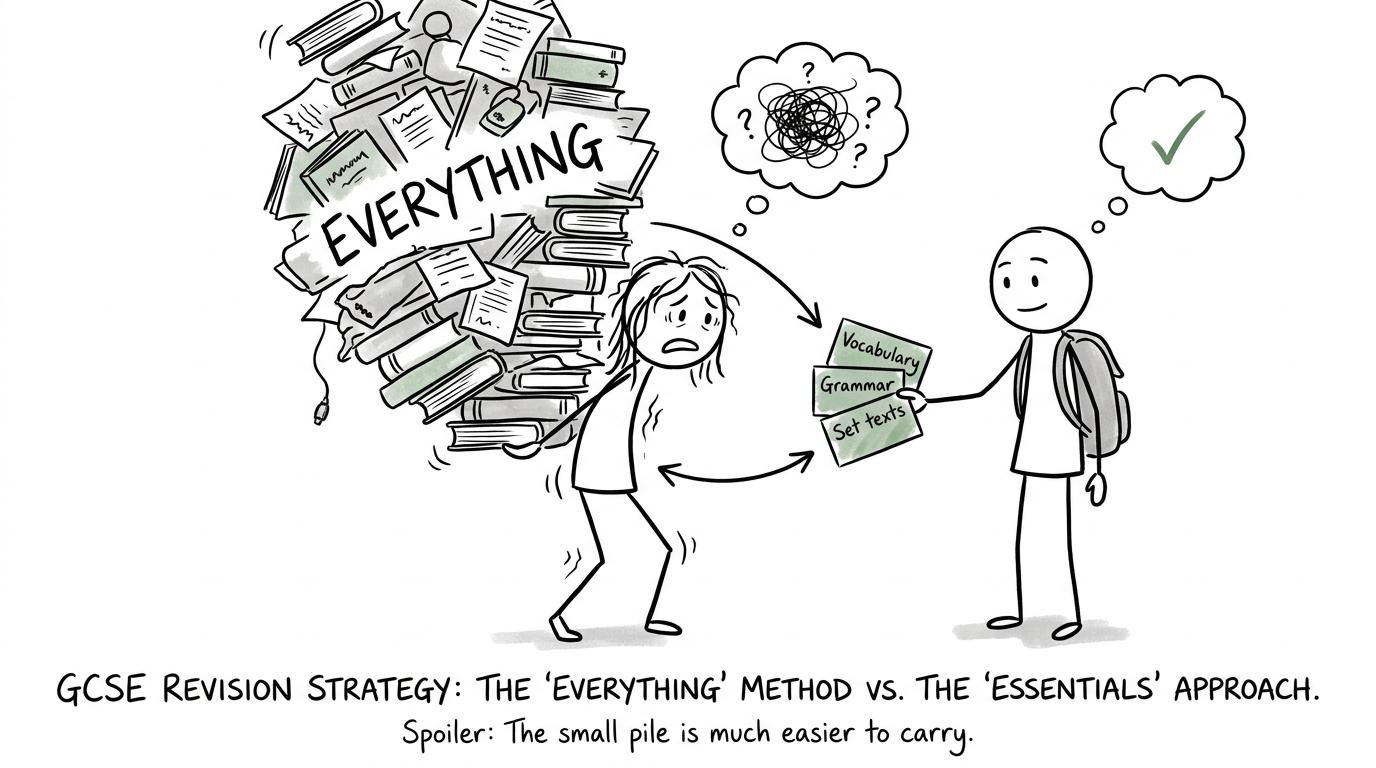 A student replaces an enormous pile called everything with three manageable revision priorities
Build a revision plan around marks, not guilt
Guilt measures how late you feel. A useful plan measures what you will do next.
Begin with one section from the Edexcel GCSE Biblical Hebrew past-paper collection. Work without notes where possible, then mark it carefully. Sort each lost mark into one of these categories:
- vocabulary not recalled;
- form or construction not recognised;
- Hebrew understood but translated awkwardly;
- question misread;
- set-text knowledge missing;
- evidence too general;
- time used poorly.
Now choose the three categories costing you the most. These become your priorities. A specific weakness is encouraging because it gives tomorrow’s session a purpose.
Use a repeatable daily structure
A manageable session might contain:
- brief retrieval of vocabulary and forms;
- one focused language or literature task;
- immediate marking;
- correction of the most important error;
- a short review of an older topic.
If your concentration is fading, stop extending the session and make the task smaller. Consistent, completed blocks are more useful than an ambitious timetable you avoid.
The same structure can protect your maths revision. MathsGenie’s twenty-minute GCSE routine shows how a short session can include recall, exam-style practice and immediate feedback.
Balance Biblical Hebrew with GCSE maths
Students rarely revise one subject in isolation. The danger is allowing the subject that feels most alarming to consume every evening, while maths quietly loses momentum.
Use separate kinds of sessions. Biblical Hebrew benefits from frequent retrieval, close reading and translation practice. Maths needs active problem-solving, written working and repeated contact with methods. Simply reading either subject creates a misleading sense of familiarity.
A balanced week could include shorter Hebrew recall sessions on several days, deeper language and literature blocks, and protected maths sessions for weak topics and timed questions. The exact balance should reflect your exam order, current performance and teacher advice.
For maths, choose resources for your actual exam board and tier. MathsGenie supports Edexcel, AQA, OCR and Eduqas revision, among others. You can use GCSE revision guides to refresh methods, then move quickly to questions. If you take Edexcel, GCSE maths mini tests provide shorter timed practice when a full paper would be unrealistic.
Make past papers produce improvement
Completing a paper is not the final step. The revision happens when you use its evidence.
After marking, write one correction for each important error. Then revise the underlying skill and try a comparable task later without notes. A paper that sits in a folder changes little; a paper that alters your next session becomes valuable.
Do not use a recent paper merely to collect a score. Inspect where the marks went. Translation errors may come from vocabulary, grammar, English expression or rushing. Literature answers may lose credit because they retell the passage without analysing it. Those causes require different fixes.
This attempt, mark, fix and retest cycle is explained further in MathsGenie’s guide to using GCSE past papers properly.
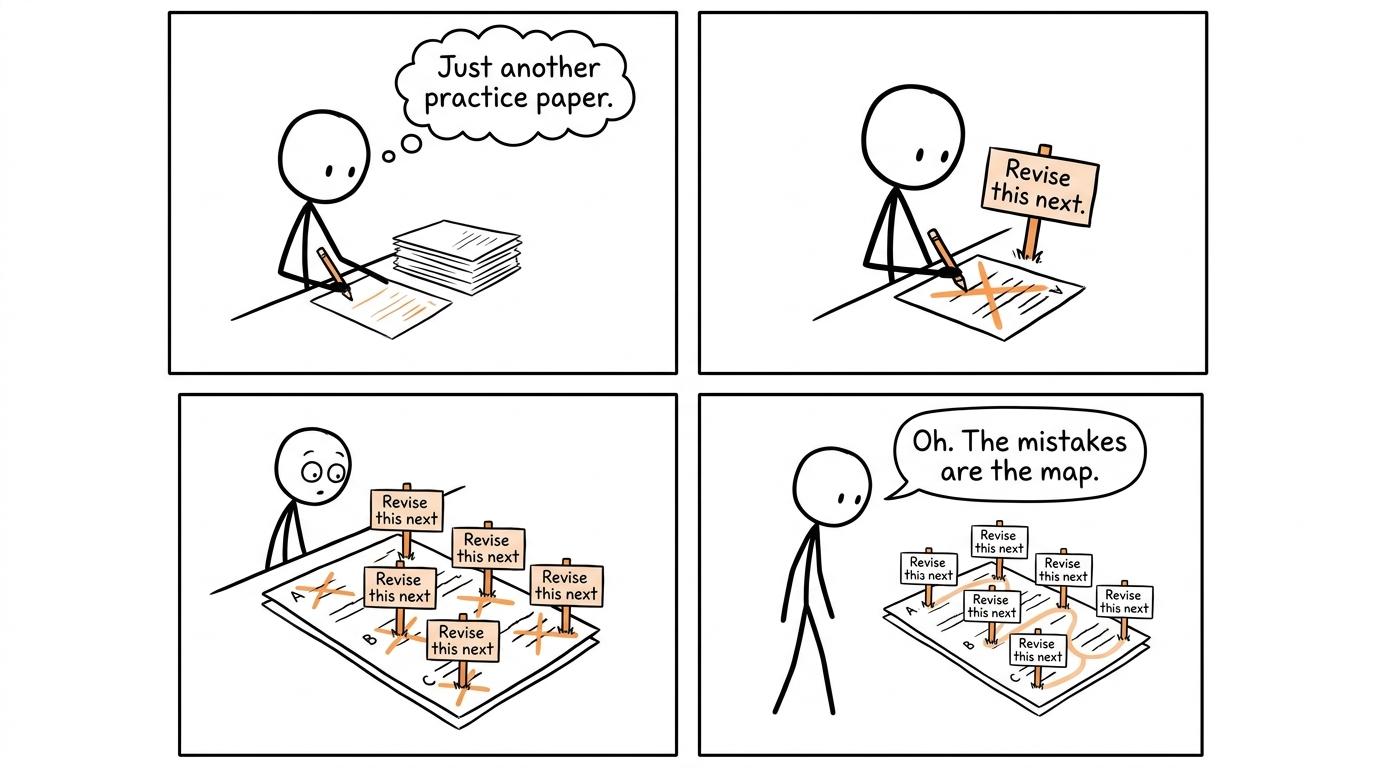 A student discovers that mistakes on a practice paper are signposts for the next revision task
Common mistakes in late Biblical Hebrew revision
Trying to cover everything equally
Not every gap deserves the same amount of time. Use attempted questions and teacher feedback to identify where improvement is most realistic.
Revising vocabulary without context
Word lists are useful, but the examination asks you to understand passages. Regularly meet vocabulary inside sentences and extracts so that recognition survives contact with grammar.
Neglecting English translation quality
A word-for-word rendering may preserve Hebrew structure but sound unnatural or obscure the meaning. Aim for accurate, idiomatic English while remaining faithful to the passage.
Rereading set texts passively
Familiarity is not recall. Close the text and retrieve the sequence, context, key expressions, literary features and supporting evidence before checking what you missed.
Ignoring the choice on the language paper
Know whether grammar analysis or translation into pointed Biblical Hebrew is the stronger route for you. Practise the chosen skill and discuss the decision with your teacher rather than making it for the first time under examination pressure.
Abandoning maths because Hebrew feels urgent
One approaching paper should not erase every other subject. Keep maths alive with compact topic practice, mini tests or paper sections. Near the examination, Edexcel GCSE maths predicted papers can provide fresh rehearsal, but they should supplement rather than replace official past papers.
Start with the next useful action
It may be late enough that your original revision plan is no longer possible. That does not mean revision is pointless. It means the plan must become smaller, sharper and more honest.
Open the Biblical Hebrew specification and confirm your set texts. Attempt a paper section. Mark it. Identify the three largest weaknesses. Then complete one focused repair task today.
For maths, keep MathsGenie beside that plan. Use the free revision lessons and practice questions to repair individual topics, mini tests to check recall, and past papers, predicted papers, mark schemes and video solutions to build exam readiness. You do not need a perfect beginning. You need a repeatable next step.