A Three-Month IGCSE Maths Revision Plan
A three-month IGCSE Maths revision plan with weekly phases, realistic sessions and past-paper practice for Cambridge or Edexcel students today.
Three months can feel like plenty of time until you open the specification and see how much it contains. Number, algebra, graphs, geometry, probability and statistics all compete for attention. The natural response is to revise whatever feels urgent that evening.
A three-month IGCSE Maths revision plan replaces that uncertainty with three clear phases: rebuild weak topics, develop exam technique, then practise complete papers under timed conditions. It works for Cambridge IGCSE and Pearson Edexcel International GCSE students, provided you follow the topics and paper requirements for your own specification.
Imagine a student beginning with twelve blank weeks. Their first instinct might be to divide the textbook into equal sections. But revision is not about giving every topic equal time. It is about giving the next hour to the work most likely to improve the next paper.
For broader planning advice, read the GCSE Maths revision timetable pillar guide alongside this plan.
Your three-month plan at a glance
Use the following structure as the foundation of your IGCSE revision timetable:
| Period | Main purpose | Typical work |
|---|---|---|
| Weeks 1-4 | Diagnose and rebuild | Topic checks, revision lessons and focused questions |
| Weeks 5-8 | Mix topics and improve technique | Mini tests, mixed practice and timed sections |
| Weeks 9-11 | Rehearse the examination | Complete past papers, marking and corrections |
| Week 12 | Consolidate calmly | Short reviews, selected questions and formula recall |
Before starting, complete this checklist:
- Confirm whether you take Cambridge or Pearson Edexcel International GCSE Maths.
- Check your tier. Cambridge uses Core and Extended, while Pearson Edexcel Mathematics A uses Foundation and Higher.
- Record the dates and requirements of every paper from your school or exam board.
- Gather the correct specification, past papers and mark schemes.
- List topics as secure, uncertain or weak.
- Protect several realistic revision sessions each week rather than relying on one long weekend session.
Your board matters. Under the current Cambridge IGCSE Mathematics syllabus, Core and Extended candidates prepare for calculator and non-calculator assessment. Pearson Edexcel International GCSE Mathematics A has its own tiered papers and specification. Never assume that a paper found online matches your course simply because it says “IGCSE Maths”.
Month one: find the gaps and rebuild them
The first month is diagnostic. Begin with a short mixed assessment or a recent classroom paper and mark it carefully. Do not turn the result into a judgement about your ability. Its purpose is to show you where to begin.
Create three lists:
- Secure: you can answer unfamiliar questions without notes.
- Uncertain: you understand the method but make errors or need prompting.
- Weak: you cannot yet choose or complete the method independently.
Spend most of the month on weak and uncertain areas. A useful weekly pattern is three topic sessions followed by one mixed review. For example, you might revise algebra on Monday, ratio on Wednesday and geometry on Friday, then complete mixed questions at the weekend.
Each topic session should have a definite finish line:
- Review the method using a MathsGenie revision lesson or video solution.
- Complete practice questions without copying the example.
- Mark every answer.
- Correct errors in a different colour.
- Return to two or three similar questions later that week.
This last step matters. Seeing a solution can create the feeling of understanding, but independent retrieval tests whether the method is actually available when the notes disappear.
If fitting maths around other subjects is difficult, the revision timetable that you can realistically follow explains how to protect manageable sessions without filling every evening.
Month two: connect topics and build exam technique
By week five, revision should become less predictable. Real papers do not announce that the next question requires simultaneous equations, trigonometry or bounds. You must identify the method yourself.
Keep repairing individual topics, but add mixed practice and mini tests. A balanced week might contain:
- one weak-topic session;
- one mixed set of questions;
- one timed section from a past paper;
- one correction and retrieval session.
When marking, classify each lost mark. Was it caused by missing knowledge, choosing the wrong method, inaccurate calculation, incomplete working or misreading the question? The category suggests the remedy. A knowledge gap needs teaching and practice. A timing problem needs shorter timed sets. A recurring sign error needs slower, more visible working.
Keep an error log, but make it brief. Record the topic, what went wrong and what you will do differently. “Be more careful” is not a useful correction. “Write the substitution on a separate line before simplifying” is specific enough to change your next attempt.
At this point, setting up twelve weeks by hand can become another revision task, so build your schedule in the Revision Planner and turn the structure into a day-by-day plan.
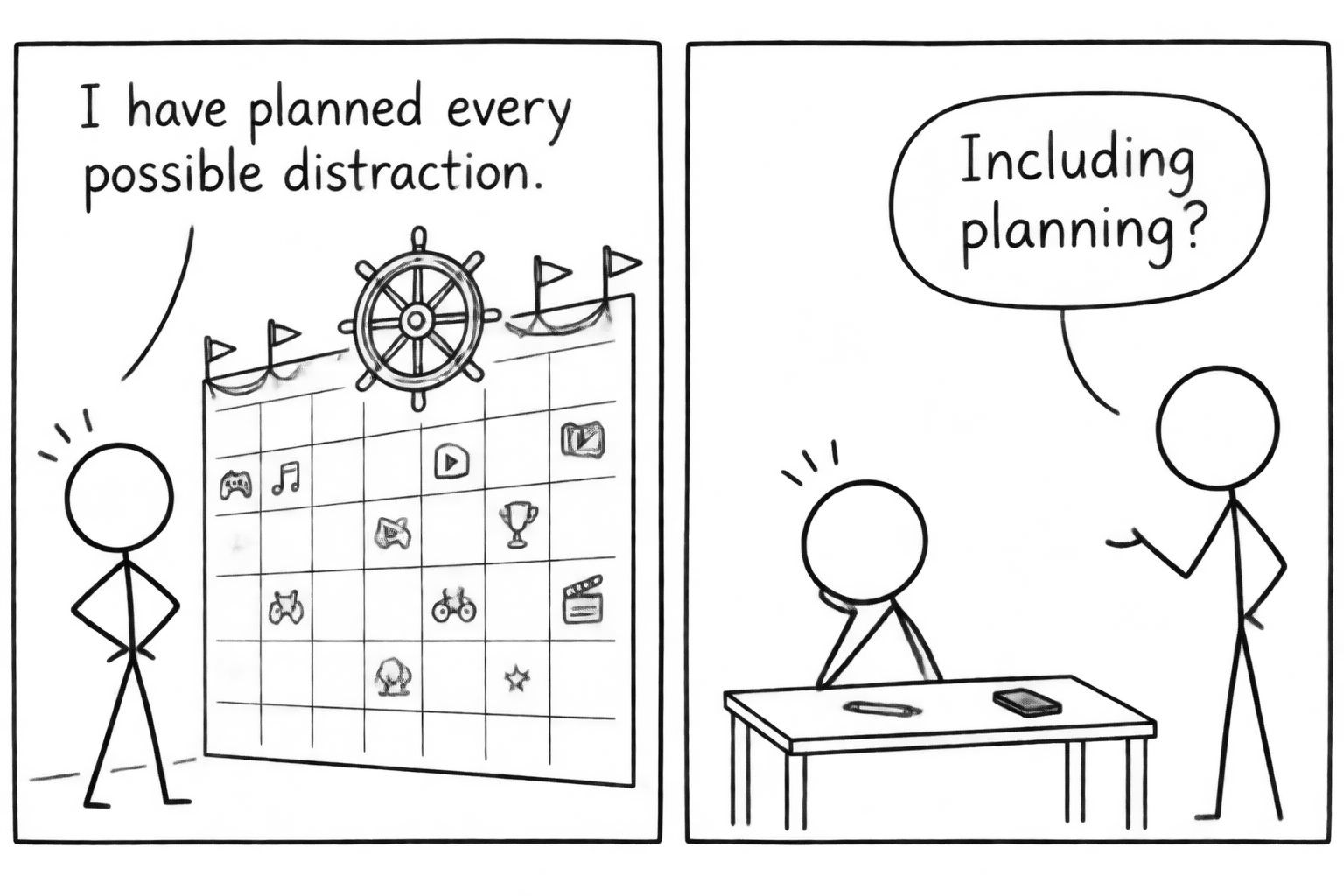 A stick-figure student discovers that planning revision can become a distraction from revision
Month three: turn preparation into rehearsal
The final month should increasingly resemble the examination. During weeks nine to eleven, complete full papers or substantial timed sections using the conditions required for your course. Use the correct calculator rules, equipment and time limit.
Mark each paper with the official mark scheme. Award marks honestly, including method marks where the scheme permits them. Then divide your follow-up work into three stages:
- correct the question with the mark scheme;
- close the mark scheme and solve it again;
- attempt a similar question several days later.
A paper is not finished when it has been marked. It is finished when its errors have influenced the next week of revision.
Do not measure progress only by the total mark. Paper difficulty varies, and one score can hide important changes. Look for patterns such as fewer unanswered questions, stronger algebraic working and better decisions about when to move on.
During week twelve, reduce the volume. Review your error log, revisit a small number of weak areas and complete selected questions. Avoid trying to relearn the entire specification in the final days. Sleep, equipment and knowing the correct examination time are part of preparation too.
MathsGenie can support each phase with free revision lessons, practice questions, mini tests, past papers, mark schemes and video solutions. The important habit is to use these resources as a cycle: learn, attempt, mark, correct and return.
How long should each revision session be?
A session only works if it fits your actual week. For many students, several focused sessions are more sustainable than an ambitious timetable that collapses after a few days.
Try a structure with:
- five minutes of retrieval from an earlier topic;
- twenty-five to forty minutes of focused questions;
- ten minutes for marking and corrections;
- a written note of what to revisit.
The exact length is less important than the outcome. “Revise algebra” is too vague. “Complete and mark ten factorising questions, then retry every error” gives the session a visible endpoint.
Your timetable must also leave room for schoolwork, other IGCSE subjects and rest. The MathsGenie guide to building a workable GCSE revision timetable can help you balance those demands.
Common mistakes in IGCSE Maths revision
Revising only comfortable topics
Familiar questions feel productive because progress is quick. Keep secure topics active, but give more time to areas that currently cost marks.
Watching without attempting
A video solution can explain a method clearly, but recognition is not recall. Pause before the solution and attempt the question independently.
Saving past papers until the final week
Past papers reveal problems with timing, interpretation and topic selection. Introduce timed sections during month two, then use complete papers in month three.
Recording marks without correcting errors
A score describes what happened. Corrections help change what happens next. Every marked paper should produce a short list of follow-up topics.
Using resources for the wrong specification
Cambridge and Edexcel overlap substantially, but their content, terminology and assessment arrangements are not identical. Check the paper code, tier and current specification before beginning.
Planning every minute
A timetable needs flexibility. Keep one catch-up space each week so illness, homework or a difficult topic does not derail the entire plan.
Turn the twelve weeks into your schedule
The student with the blank calendar does not need a more elaborate plan. They need a realistic sequence they can keep following when school becomes busy. You have now seen how the three-month structure works; the remaining gap is turning it into specific sessions and protecting them each week.
Build your three-month IGCSE Maths schedule in the Revision Planner.