

How to Use Teaching Someone Else for GCSE Maths
How to use teaching someone else for GCSE Maths: turn explanations into active revision, expose weak spots and follow a practical weekly plan with care.
A student can read the same page three times and feel increasingly familiar with it. Then the practice question changes slightly, and the method disappears.
That gap between recognition and recall is why learning how to use teaching someone else for GCSE Maths can be so useful. Instead of looking at a completed method and thinking, “That makes sense”, you close the notes and explain what to do, why it works and how to recognise when to use it.
You do not need a willing classmate for every session. You can teach a parent, a friend, a sibling, a toy or an imaginary student. The important part is producing the explanation from memory and testing it with questions.
The method at a glance
A useful teaching session follows a simple sequence:
- Choose one narrow GCSE Maths skill.
- Review the method briefly.
- Close your notes and teach it aloud.
- Demonstrate the method with a question.
- Ask your “student” to challenge each decision.
- Check your explanation against a solution or mark scheme.
- Record the gaps and return to them later.
This is not a replacement for solving questions. It is a way to make question practice more thoughtful.
Why teaching someone else can improve revision
Imagine a student called Maya. The scenario is hypothetical, but the problem is familiar. Maya spends Monday rereading notes about simultaneous equations. Everything looks understandable because the worked solutions are already on the page.
On Tuesday, she tries to teach the topic without looking. Within a minute, she cannot explain why multiplying an equation can help eliminate a variable. That uncomfortable pause is useful information. Rereading concealed the gap; teaching exposed it.
Research into learning by teaching generally points towards three connected processes.
Retrieval
Teaching without notes requires you to retrieve information from memory. Retrieval practice is more demanding than rereading, but that effort helps reveal what you can genuinely recall.
In maths, retrieval includes more than remembering a formula. You may need to recall:
- the conditions under which a method applies;
- the order of the steps;
- the meaning of the notation;
- the reason a step is valid;
- the checks that can catch an error.
Organisation
You cannot explain a topic clearly if your knowledge is only a collection of disconnected rules. Preparing an explanation forces you to put ideas into a sensible order.
For example, teaching probability trees may require you to distinguish between multiplying along branches and adding separate outcomes. Organising those ideas can make the method easier to retrieve during an exam.
Elaboration
A good explanation connects a procedure to reasons, examples and prior knowledge. Instead of saying, “Move the 555 to the other side”, you might explain that you subtract 555 from both sides to preserve equality.
However, the evidence should not be stretched into a miracle claim. Teaching is not automatically effective. Reading notes aloud, copying a solution or confidently repeating an incorrect rule may add little. The value comes from retrieval, explanation, correction and subsequent practice.
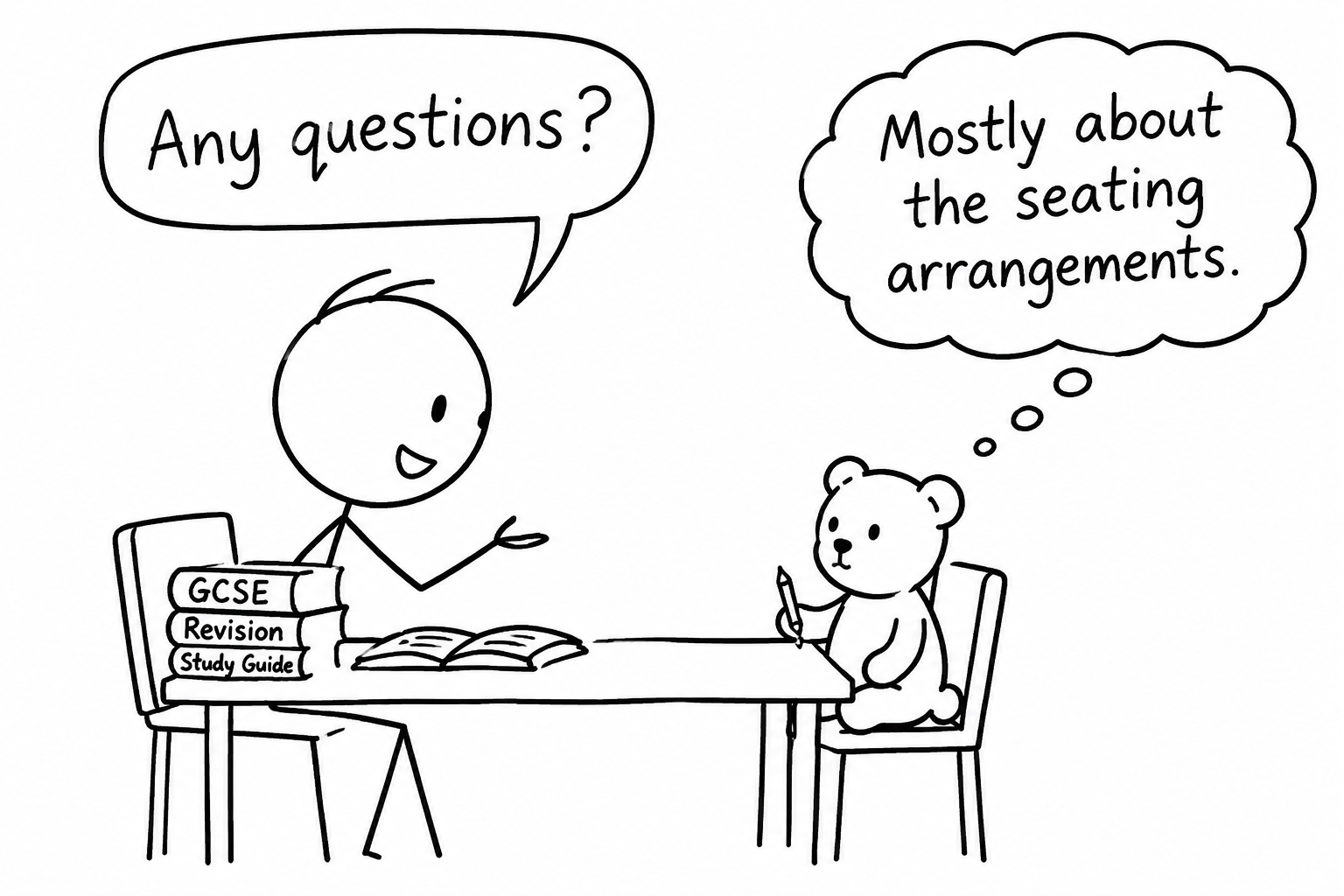 A student teaching GCSE revision to a teddy bear
How to use teaching someone else for GCSE Maths
Start with the broader GCSE Maths revision guide, then choose one precise skill rather than an entire chapter. “Algebra” is too broad. “Solving linear equations with the unknown on both sides” is manageable.
Learn just enough to begin
Use a revision lesson or video solution to refresh the method. Keep this stage short. If all your time goes into reviewing, the teaching stage becomes another form of passive revision.
Then close the resource. A closed book matters because an open page can create the illusion that the knowledge is yours when the page is doing the remembering.
Teach using four questions
Build your explanation around these prompts:
- What kind of problem is this? Identify the clues in the question.
- What method should we use? Name the method and its purpose.
- Why is each step valid? Explain rather than recite.
- How can we check the answer? Substitute, estimate or use an inverse operation where appropriate.
Suppose you are teaching how to solve:
3x+5=203x+5=203x+5=20A weak explanation says, “Move the 555, then divide by 333.” A stronger explanation says that equality must be maintained, so subtract 555 from both sides:
3x+5−5=20−53x+5-5=20-53x+5−5=20−5Therefore:
3x=153x=153x=15Divide both sides by 333:
x=5x=5x=5Finally, substitute x=5x=5x=5 into the original equation:
3(5)+5=203(5)+5=203(5)+5=20The check confirms that the solution works. This version teaches the mathematical reason, not merely a phrase that may fail on a less familiar equation.
Add questions that resist memorisation
After your first explanation, solve at least two questions without support:
- one standard question;
- one question with a change, such as fractions, negative values or unfamiliar wording.
Use GCSE Maths practice resources to choose questions at an appropriate level. Students working towards key foundation skills can also use the focused Grade 4 revision topics, while those developing higher-tier fluency may find the Grade 5 revision topics helpful.
Correct the lesson, not just the answer
Compare your work with the solution or mark scheme. If an answer is wrong, locate the first incorrect decision. Then reteach that exact step.
This distinction matters. Writing the correct answer underneath an error does not necessarily change the thinking that produced it. Explaining the correction makes you confront the misconception.
Once you have the method in hand, you can build the teaching sessions into the Revision Planner rather than organising every return visit on paper.
A sample week of teaching someone else revision
The sessions below can fit alongside homework and other subjects. Adjust the topics to match your specification, tier and current weaknesses.
| Day | Teaching task | Follow-up |
|---|---|---|
| Monday | Teach one algebra method for 101010 minutes | Complete three related questions |
| Tuesday | Teach one ratio or percentage method | Write down any step you could not justify |
| Wednesday | Reteach Monday’s algebra from memory | Attempt a mixed question without notes |
| Thursday | Teach one geometry topic, including when a formula applies | Check units, notation and calculator use |
| Friday | Teach your weakest topic from the week | Complete a short mini test |
| Saturday | Explain two errors from an exam paper | Redo the questions without the mark scheme |
| Sunday | Give a 555-minute summary of the week | Select next week’s topics |
The spacing is deliberate. Maya does not teach simultaneous equations once and declare them finished. She returns to the topic after a gap, when retrieval requires more effort.
At the weekend, a section from GCSE Maths past papers can test whether the explanation transfers to exam-style questions. Closer to the examination period, GCSE predicted papers can provide further mixed practice, but they should complement broad specification coverage rather than encourage guesses about exact questions.
When the technique works best
Teaching someone else is especially useful when you need to:
- distinguish between similar methods;
- understand why a procedure works;
- remember a sequence of steps;
- diagnose repeated mistakes;
- practise mathematical vocabulary;
- prepare to answer unfamiliar questions.
It is less suitable as the only activity in a session. GCSE Maths examinations require independent problem solving under time pressure, so teaching must eventually lead to written questions and exam practice.
Your listener also does not need to be a maths expert. A non-expert may ask valuable questions such as, “Why did you divide there?” But use trusted solutions to verify your lesson, because your listener may not notice a mathematical error.
Common mistakes to avoid
Keeping the notes open
Looking down whenever you hesitate turns retrieval into reading. Teach first, mark gaps on a blank sheet and check them afterwards.
Choosing a topic that is too broad
Trying to teach all of trigonometry creates a shallow summary. Teach one skill, such as selecting sine, cosine or tangent in a right-angled triangle.
Explaining without solving
Maths is performed as well as described. Every explanation should lead to questions completed independently.
Rehearsing an incorrect method
Confidence does not prove correctness. Check your reasoning using MathsGenie video solutions, answers or mark schemes, then reteach any corrected step.
Letting the listener take over
If a knowledgeable friend supplies every missing step, they are doing the retrieval. Ask them to wait, prompt you with a question and let you complete the reasoning.
Turn the method into a routine
Maya’s important change is not that every explanation becomes perfect. It is that her revision starts producing evidence. A pause reveals a memory gap. A confused listener reveals an unclear reason. A wrong practice answer reveals what must be taught again.
Knowing the routine is easier than scheduling it consistently, especially when GCSE exams have fixed dates and several subjects compete for your week. You have seen how a teaching-based week works; now build your schedule in the Revision Planner, place your weakest topics first and turn each one into a teach, practise and revisit session.















