

Teaching Someone Else for A-Level Maths
How to use teaching someone else for A-Level Maths: turn explanations into active recall, expose gaps and follow a practical weekly revision plan.

A student can reread a page on differentiation and feel that every line makes sense. Then someone asks, “Why does that step work?” Suddenly, the certainty disappears.
That uncomfortable pause is the value of teaching. If you want to know how to use teaching someone else for A-Level Maths, the short answer is this: learn a small topic, explain it aloud without notes, answer questions, check what you missed, and then complete exam questions independently. Teaching is not a replacement for solving problems. It is a way to expose what problem practice should target.
Imagine a student called Sam. Sam usually spends revision sessions rereading notes and watching familiar examples. This week, Sam swaps part of that routine for teaching a friend. The friend does not need to take A-Level Maths. Their most useful job is simply to interrupt whenever an explanation stops making sense.
The teaching someone else revision checklist
Use this sequence for one focused topic:
- Choose a narrow idea, not an entire chapter.
- Review it with the expectation that you will teach it.
- Close your notes and explain the idea aloud.
- Include the meaning, method and conditions for using it.
- Invite questions and admit when you cannot answer.
- Check your explanation against trusted revision material.
- Complete exam-style questions without help.
- Record the gaps and revisit them later.
A teaching session can take around 303030 minutes: 101010 minutes to prepare, 101010 minutes to explain and 101010 minutes to test the learning. More difficult topics may need longer, but the explanation itself should remain focused.
What research says about learning by teaching
Research on learning by teaching suggests that preparing to teach and producing an explanation can support learning. Several processes may contribute.
First, expecting to teach can change how you prepare. Instead of merely recognising familiar lines, you look for structure: what comes first, why it works and what another person might misunderstand.
Second, explaining without notes involves retrieval. You must bring definitions, connections and methods back from memory rather than seeing them on a page. Research reviews describe retrieval as a plausible part of the benefit, although it does not explain every finding.
Third, a listener’s questions can reveal hidden gaps. You may know how to follow a procedure but not why a condition matters. Interactive teaching appears promising because questions force you to clarify and adapt your explanation.
There are important limits. Findings vary across studies, tasks and forms of explanation. Research has not shown that casually talking through a topic will always outperform another strong method. Written explanations may not have the same effects as oral explanations, and much of the evidence is not specific to UK A-Level Maths students.
The sensible conclusion is modest: teaching someone else can be an effective A-Level maths study technique when it produces retrieval, explanation and feedback. It becomes weak when it is just notes read aloud.
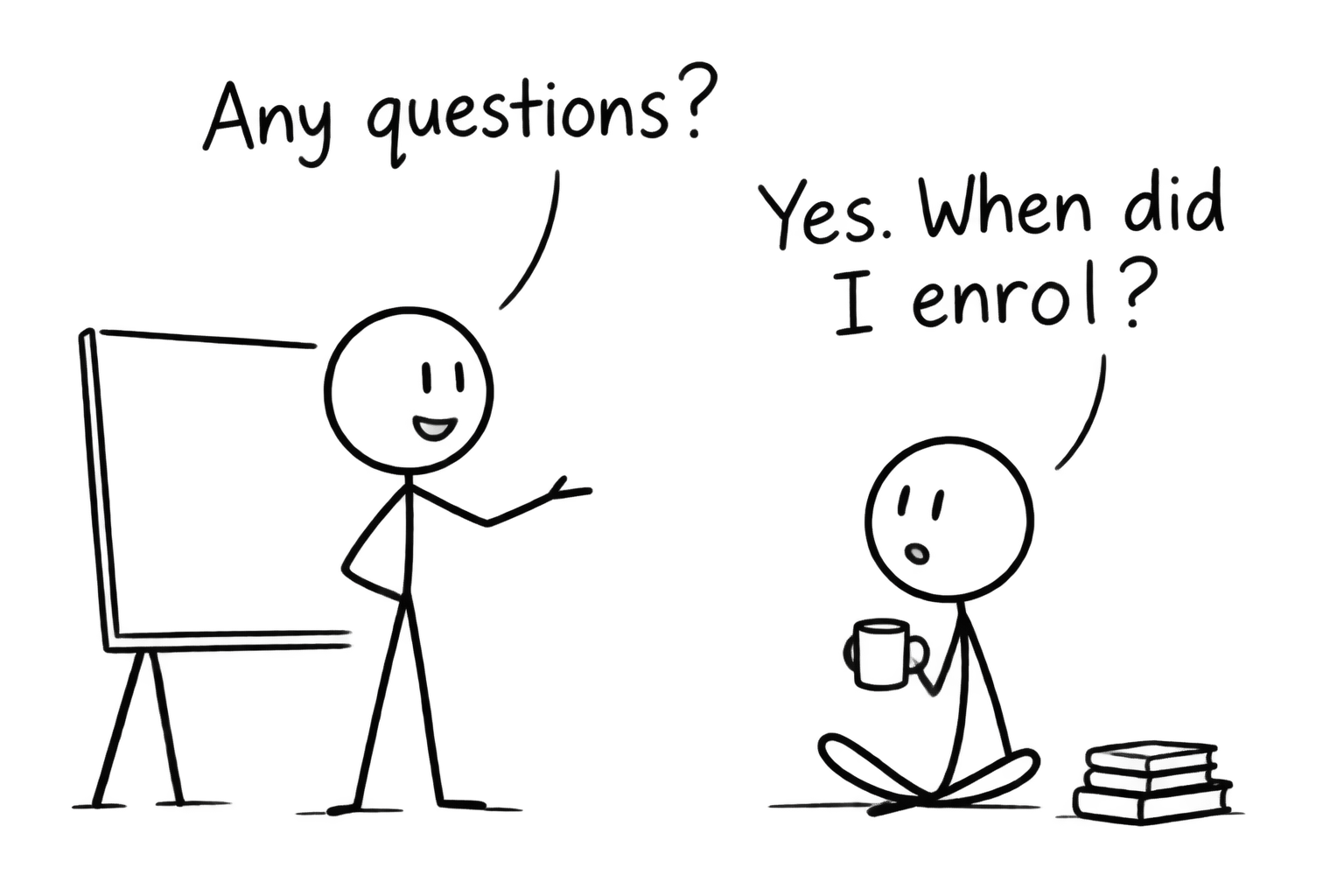 A stick-figure student discovers that recruiting a revision pupil may require some explanation
How to teach A-Level Maths rather than recite it
Maths creates a particular challenge. A polished explanation can sound convincing even when you cannot solve an unfamiliar question. Good teaching therefore has three layers.
Explain the concept
Begin with meaning. If the topic is differentiation, explain that the derivative represents a rate of change and gives the gradient of a curve at a point. If it is hypothesis testing, explain what the null hypothesis represents before discussing calculations.
Sam uses four prompts:
- What does this idea mean?
- When can it be used?
- Why does the method work?
- How could an exam question disguise it?
These questions prevent “knowledge telling”, where the teacher simply repeats memorised steps.
Demonstrate one relevant method
Use one example that belongs to the topic and specification. For instance, while teaching the product rule, Sam explains that if
y=(x2+1)ex, y=(x^2+1)e^x, y=(x2+1)ex,then both factors depend on xxx, so
dydx=2xex+(x2+1)ex. \frac{dy}{dx}=2xe^x+(x^2+1)e^x. dxdy=2xex+(x2+1)ex.The useful part is not performing the algebra quickly. It is explaining why differentiating only one factor would be incomplete.
Keep examples limited. If preparation becomes a search for the perfect demonstration, the technique turns back into passive revision.
Test the teacher independently
After teaching, the teacher should answer fresh questions alone. Use the relevant A-Level Maths revision resources, then mark the work carefully. Later in the revision cycle, use A-Level Maths past papers to test whether the understanding transfers across mixed topics.
A useful record has three headings:
| Explained securely | Needed a prompt | Could not justify |
|---|---|---|
| Meaning and basic method | One condition or algebraic step | A reason, proof or unfamiliar application |
The last two columns determine the next session. Confidence does not.
Once these teaching sessions begin to multiply across pure maths, statistics and mechanics, build them into the MathsGenie Revision Planner rather than trying to hold the whole timetable in your head.
A sample week using teaching someone else
Sam chooses three weak areas from recent classwork and assessed questions. Each session ends with independent practice, because explaining and doing are related but different skills.
| Day | Teaching task | Independent check |
|---|---|---|
| Monday | Teach the meaning of differentiation and connect gradients to rates of change | Complete several short differentiation questions |
| Tuesday | Teach conditional probability using a tree or table | Answer one unfamiliar probability question without notes |
| Wednesday | No teaching; correct Monday and Tuesday errors | Redo missed questions from a blank page |
| Thursday | Teach forces, signs and modelling assumptions | Complete a mechanics question independently |
| Friday | Give a five-minute explanation of the week’s weakest idea | Mark a short mixed set and log errors |
| Saturday | Swap roles with a classmate and ask each other clarification questions | Attempt part of a past paper under timed conditions |
| Sunday | Review the error log and choose next week’s topics | Plan the next spaced return to each topic |
This works even without a willing classmate. Sam can teach an empty chair, make an audio recording or explain to a family member. A real listener may supply better questions, but pretending to address a novice still requires the explanation to have an audience.
Keep the audience low stakes. The listener is not there to award marks or confirm that every claim is correct. Use MathsGenie revision lessons and mark schemes for that check.
Common mistakes when learning by teaching
Keeping the notes open
Constantly looking down reduces retrieval. Prepare first, then close the notes. If you become completely stuck, mark the gap, check it and restart that part.
Choosing a topic that is too broad
“Teach all of trigonometry” is not a realistic session. “Explain when to use the small-angle approximations and their conditions” is specific enough to reveal understanding.
Mistaking fluency for exam readiness
Speaking smoothly is not evidence that you can select a method under pressure. Every teaching session needs unseen practice and honest marking.
Teaching an incorrect method confidently
Your listener may not recognise an error. Check definitions, notation and conditions against the specification, revision materials and official-style mark schemes after the explanation.
Letting preparation consume the session
Slides, colour coding and scripts can feel productive while removing the difficult work. Use a short prompt card at most. The explanation should come largely from memory.
Be honest about what teaching cannot do
Teaching someone else will not cover the whole demands of A-Level Maths. It cannot replace algebraic fluency, repeated problem solving, timed papers or learning how mark schemes reward reasoning. It is also less suitable when you have not yet learnt the material accurately. In that case, begin with a lesson and guided examples before trying to teach it.
Nor should every topic receive equal time. If exam questions show that integration is secure but vectors remain weak, teach vectors. Revision should follow evidence, not habit.
The strongest routine is a cycle:
learn→retrieve and teach→practise→mark→revisit. \text{learn}\rightarrow\text{retrieve and teach}\rightarrow\text{practise}\rightarrow\text{mark}\rightarrow\text{revisit}. learn→retrieve and teach→practise→mark→revisit.Teaching sits inside the cycle. It is not the entire cycle.
Turn the method into a schedule
Sam’s improvement begins with a smaller change than it first appears: rereading is no longer the end of revision. Each explanation now leads to questions, marking and a planned return. Knowing that structure is easy; following it across pure maths, statistics and mechanics every week is harder.
You have seen how the one-week plan works. Your exams have fixed dates, so every unplanned week reduces the time available to revisit weak topics. Build your teaching sessions into the MathsGenie Revision Planner.















