

Surds Exam Questions: Three Worked Examples
Surds exam questions explained through three GCSE examples. Learn to simplify, calculate exactly and rationalise denominators for valuable method marks.
A surds question can look strangely unfinished. You simplify a square root, reach an answer containing another square root, and wonder whether you should turn it into a decimal. Usually, you should not.
The key to surds exam questions is recognising that a surd is often the exact answer the examiner wants. At GCSE Higher tier, you may need to simplify surds, combine like surds, expand brackets or rationalise a denominator. The arithmetic is rarely the hardest part. The challenge is knowing which move to make and showing enough working to earn the method marks.
Imagine a student, Maya, working through three exam-style questions. She begins with a basic simplification, moves on to collecting surds, then finishes with a rationalised denominator. Her aim is not merely to reach the answer. It is to leave a trail that a mark scheme can reward.
A quick checklist for surds exam questions
Before doing any calculation, ask what the command word requires.
- Simplify by finding the largest square factor inside the root.
- Calculate exactly by keeping surds in the answer rather than using rounded decimals.
- Collect like surds only when their square-root parts match.
- Rationalise the denominator so that no surd remains underneath the fraction line.
- Show each important transformation, even if you could perform it mentally.
- Check that the final surd is fully simplified.
The central rule for simplifying is:
ab=ab\sqrt{ab}=\sqrt{a}\sqrt{b}ab=abThis becomes useful when either aaa or bbb is a square number. For example, separating 727272 into 36×236\times236×2 exposes a root that can be evaluated exactly.
Start with the matching Edexcel surds lesson or AQA surds lesson, then use the question bank to apply this checklist while every step is still fresh.
Question one: simplifying a single surd
Maya's first question is:
Simplify 72\sqrt{72}72.
She looks for the largest square number that divides 727272. Since 72=36×272=36\times272=36×2, she writes:
72=36×2\sqrt{72}=\sqrt{36\times2}72=36×2She then separates the factors:
36×2=362\sqrt{36\times2}=\sqrt{36}\sqrt{2}36×2=362Therefore:
72=62\sqrt{72}=6\sqrt{2}72=62Where the method marks may come from
For a typical 2-mark question, an illustrative allocation could be:
- M1M1M1 for identifying a suitable square factor, such as 36×2\sqrt{36\times2}36×2
- A1A1A1 for the fully simplified answer 626\sqrt{2}62
The exact allocation depends on the exam board and paper, but this explains why writing the factorisation matters. If Maya made a small arithmetic error at the end, the correct method could still be visible.
She could also use 72=9×872=9\times872=9×8, but that produces 383\sqrt{8}38, which still needs simplifying. Choosing the largest square factor makes the route shorter and reduces the chance of stopping too early.
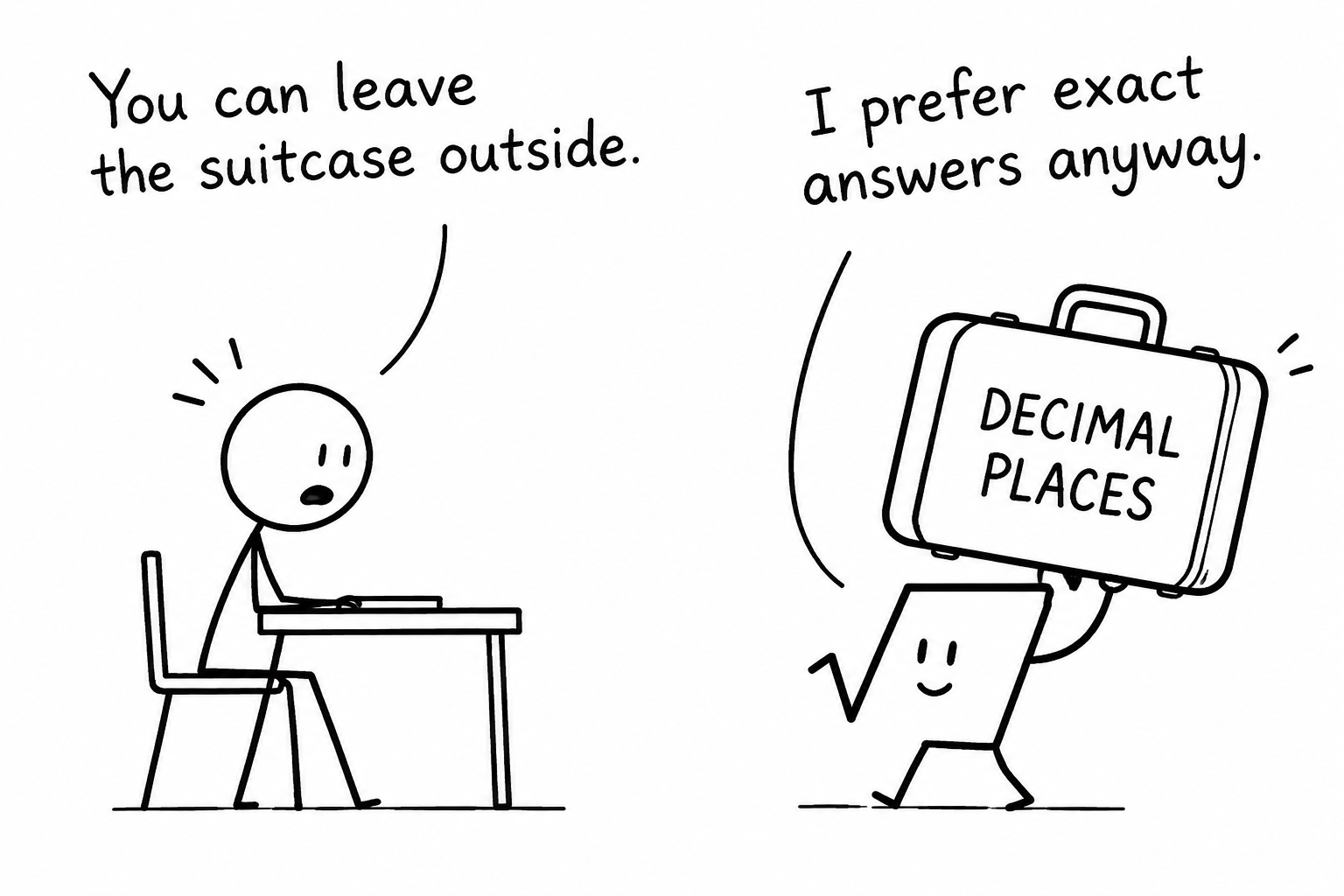 A square-root creature leaves its decimal suitcase outside while a GCSE student keeps the answer exact
Question two: simplifying and collecting surds
The next question contains two different-looking roots:
Simplify 38+183\sqrt{8}+\sqrt{18}38+18.
Maya cannot immediately add 8\sqrt{8}8 and 18\sqrt{18}18. They are not yet like surds. She simplifies each one separately.
First:
8=4×2=22\sqrt{8}=\sqrt{4\times2}=2\sqrt{2}8=4×2=22So:
38=3×22=623\sqrt{8}=3\times2\sqrt{2}=6\sqrt{2}38=3×22=62Next:
18=9×2=32\sqrt{18}=\sqrt{9\times2}=3\sqrt{2}18=9×2=32The expression has now become:
62+326\sqrt{2}+3\sqrt{2}62+32These are like surds, so Maya adds their coefficients:
62+32=926\sqrt{2}+3\sqrt{2}=9\sqrt{2}62+32=92Where the method marks may come from
A typical 3-mark structure might reward:
- M1M1M1 for correctly simplifying one or both original surds
- M1M1M1 for reaching an expression involving like surds, such as 62+326\sqrt{2}+3\sqrt{2}62+32
- A1A1A1 for the final answer 929\sqrt{2}92
The important habit is to keep the coefficient and the root separate. In an expression such as 62+326\sqrt{2}+3\sqrt{2}62+32, only the coefficients are added. The value under the root remains unchanged.
This is a common pattern in a surds GCSE exam: expressions that initially look incompatible often become like terms after simplification. The Maths Genie surds revision guide provides further notes and examples for recognising that structure.
Question three: rationalising a binomial denominator
Maya's final question is more demanding:
Rationalise the denominator and simplify:
53−1\frac{5}{\sqrt{3}-1}3−15A denominator containing two terms requires the conjugate. The conjugate of 3−1\sqrt{3}-13−1 is 3+1\sqrt{3}+13+1. Maya multiplies the numerator and denominator by that expression:
53−1×3+13+1\frac{5}{\sqrt{3}-1}\times\frac{\sqrt{3}+1}{\sqrt{3}+1}3−15×3+13+1The numerator becomes:
5(3+1)5(\sqrt{3}+1)5(3+1)For the denominator, Maya uses the difference of two squares:
(3−1)(3+1)=(3)2−12(\sqrt{3}-1)(\sqrt{3}+1)=(\sqrt{3})^2-1^2(3−1)(3+1)=(3)2−12Therefore:
(3)2−12=3−1=2(\sqrt{3})^2-1^2=3-1=2(3)2−12=3−1=2Her exact answer is:
5(3+1)2\frac{5(\sqrt{3}+1)}{2}25(3+1)This is fully simplified, and the denominator is rational.
Where the method marks may come from
An illustrative 3-mark allocation could be:
- M1M1M1 for multiplying by the correct conjugate
- M1M1M1 for expanding the denominator correctly to obtain 222
- A1A1A1 for the exact simplified answer 5(3+1)2\frac{5(\sqrt{3}+1)}{2}25(3+1)
Writing the conjugate fraction is especially valuable. If Maya later makes a sign error, the examiner can still see that she selected the right rationalising method. The Maths Genie guide to simplifying and rationalising surds explains the distinction between single-term and binomial denominators.
How to practise surds past paper questions
Reading a worked solution can create the feeling that a method is familiar. An exam asks for something harder: recalling that method without being prompted.
Use this short practice cycle:
- Complete one question without notes.
- Mark every line, not only the final answer.
- Identify the first line where your method changed direction.
- Correct the solution in full.
- Attempt a similar question later without copying the correction.
Try these exam-style prompts:
- Simplify 98\sqrt{98}98.
- Simplify 212+272\sqrt{12}+\sqrt{27}212+27.
- Expand and simplify (5+2)(5−2)(\sqrt{5}+2)(\sqrt{5}-2)(5+2)(5−2).
- Rationalise and simplify 47+1\frac{4}{\sqrt{7}+1}7+14.
The answers are 727\sqrt{2}72, 737\sqrt{3}73, 111 and 2(7−1)3\frac{2(\sqrt{7}-1)}{3}32(7−1) respectively. Your working should explain how each answer was obtained.
Use the surds exam-style question bank for worked solutions and mark schemes, or complete the printable surds exam booklet when you want a longer set under exam conditions. When using actual surds past paper questions, always judge your work against the mark scheme for that specific paper because mark allocations can vary.
Common mistakes in surds questions
Turning an exact answer into a decimal
If the question asks for an exact value, a rounded decimal is not an acceptable replacement for a surd. Keep values such as 323\sqrt{2}32 in exact form unless the question specifically requests a decimal approximation.
Adding unlike surds
The expression 23+522\sqrt{3}+5\sqrt{2}23+52 cannot be collected because the roots differ. Simplify each root first, then check whether their square-root parts match.
Stopping before the surd is fully simplified
An answer such as 383\sqrt{8}38 is equivalent to 626\sqrt{2}62, but it is not fully simplified. Check whether the number inside every square root still has a square factor greater than 111.
Using the wrong sign in a conjugate
To rationalise a+b\sqrt{a}+ba+b, multiply by a−b\sqrt{a}-ba−b. To rationalise a−b\sqrt{a}-ba−b, multiply by a+b\sqrt{a}+ba+b. Changing the sign creates a difference of two squares and removes the surd from the denominator.
Hiding the method
A correct unsupported answer may lose access to method marks when the question requires working. Show the square factor, the simplified like surds or the conjugate multiplication. These lines are brief, but they make your reasoning visible.
Turn the method into exam confidence
Maya's progress came from making the same decisions repeatedly: find square factors, simplify before collecting, and use a conjugate when the denominator has two terms. Knowing those decisions is the first step; recalling them under timed conditions requires deliberate practice. Start the matching Maths Genie lesson, then work through the Surds Question Bank until you can show every mark-earning line without a prompt.















