

Study Playlists: GCSE English Language and Literature Focus
Study playlists GCSE English Language and Literature focus: see whether music helps reading and memory, then build a stronger revision routine today.
Revision can look productive before it becomes productive. The desk is cleared, the headphones are charged and a carefully curated playlist is waiting. Twenty minutes later, you are still choosing between “deep focus” and “rainy library”.
When students ask whether study playlists improve GCSE English Language and Literature focus, the honest answer is: sometimes they make starting easier, but there is little evidence that music itself reliably improves learning. Lyrics are particularly likely to interfere with reading, verbal memory and writing. Quiet instrumental music may be neutral for some students, while silence remains the safest choice for demanding language work and exam practice.
The playlist may still have value. Just not always for the reason its title promises.
The quick verdict on study playlists
Use this checklist before pressing play:
- Choose silence for close reading, quotation recall and timed essays.
- If silence feels uncomfortable, test quiet instrumental music without lyrics.
- Keep the volume low enough that the music stays in the background.
- Avoid familiar songs that invite singing, anticipation or track-skipping.
- Use one prepared playlist rather than searching for music during revision.
- Measure completed questions, recall and written quality, not how focused you felt.
- Regularly practise in silence because that is closer to normal written exam conditions.
A playlist can be a useful starting ritual. It cannot analyse an extract, retrieve a quotation or improve a paragraph for you.
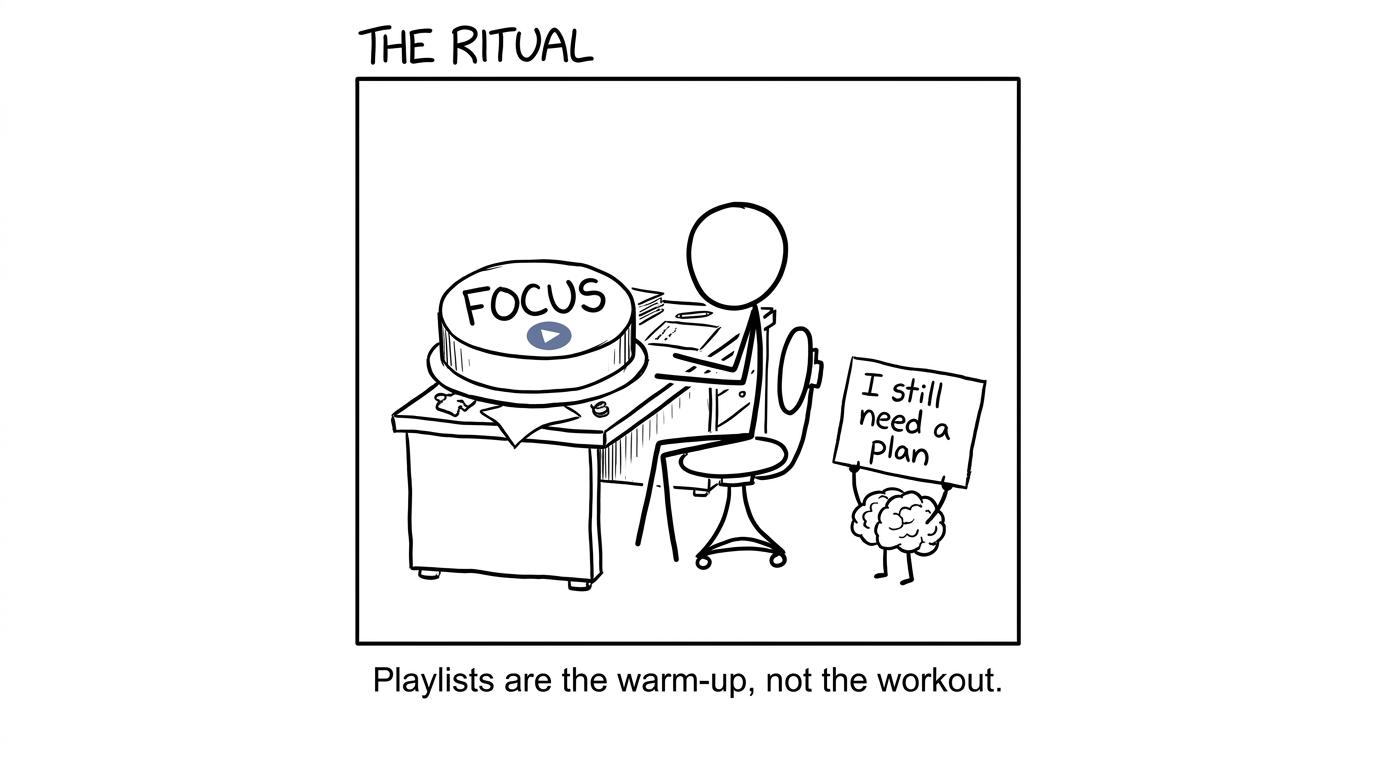 A GCSE student presses a dramatic focus button while their brain asks for a plan
What does the research say about music and focus?
The evidence is more restrained than playlist names such as “instant concentration” suggest.
A systematic review examining research across memory, language, attention and problem-solving found that the results varied with the task, the music and the people involved. Overall, background music tended to be unhelpful for memory and language-related work. Music containing lyrics was more disruptive than instrumental music, particularly for reading comprehension.
A controlled study published in 2023 compared silence, instrumental lo-fi music and music with lyrics while university students completed verbal memory, visual memory, reading comprehension and arithmetic tasks. Lyrics hindered several kinds of performance. Instrumental music did not reliably improve performance compared with silence, although participants sometimes believed it had helped.
A 2024 reading-comprehension study also found poorer performance with lyrical music than with no music. Songs in the same language as the text were especially distracting.
These studies mainly involved adults or university students, not pupils sitting GCSE examinations, so they should not be treated as a precise prediction for every teenager. Nevertheless, they support a sensible principle: when the task and the background sound both contain language, they compete for attention.
Why lyrics are risky for English revision
GCSE English Language and Literature place heavy demands on verbal processing. Depending on the specification and paper, students may need to:
- read unfamiliar prose carefully;
- distinguish explicit information from inference;
- analyse language and structure;
- compare viewpoints or texts;
- remember quotations and contextual connections;
- plan sustained analytical or creative writing;
- check vocabulary, spelling, punctuation and grammar.
Edexcel, AQA, OCR and Eduqas organise their papers differently, but these are all language-rich activities. A song lyric introduces another stream of words. Even if you think you are ignoring it, part of your attention may follow the voice, recognise a phrase or anticipate the chorus.
That does not mean everyone experiences identical disruption. It means lyrical music adds a risk without offering a dependable academic advantage.
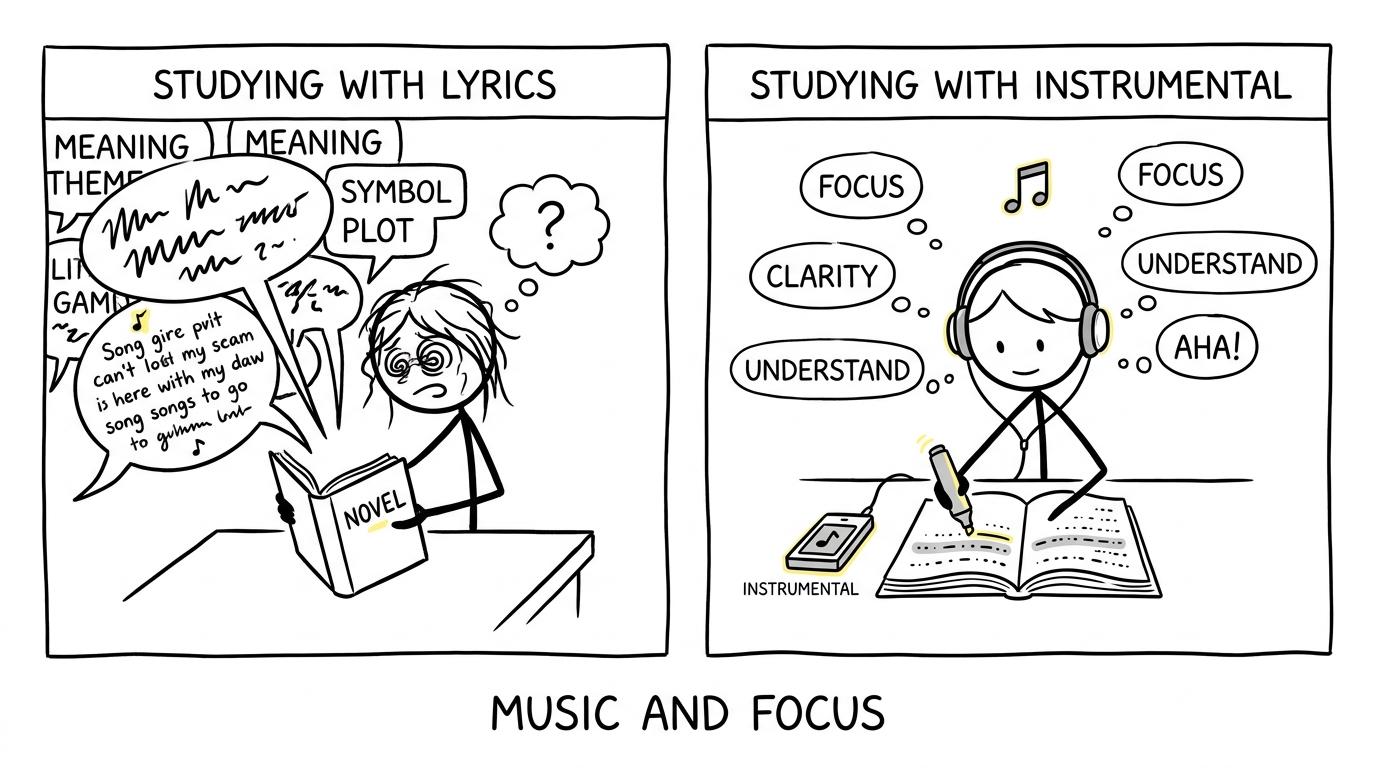 Song lyrics compete with a book in one panel while quiet instrumental music stays in the background in another
Why a playlist can still feel helpful
If instrumental music is often neutral, why do so many students value it?
Because revision has two separate problems: beginning the session and performing the task.
A familiar playlist can reduce the friction of beginning. Pressing play may act as a cue that tells you it is time to work. It can mask unpredictable household noise, make an ordinary desk feel calmer and provide a natural boundary for a revision block.
Those are genuine practical benefits. They are not the same as improved comprehension or memory.
Imagine that a playlist helps you sit down instead of scrolling on your phone. It has helped your behaviour, even if it has not directly made your brain process a novel more efficiently. Rituals matter because good revision must first happen. The danger comes when preparing the ritual replaces the work.
The useful question is therefore not, “Does this playlist make me feel studious?” It is, “Do I produce better work with it?”
Match the sound to the English task
Different revision activities create different levels of risk.
Close reading and language analysis
Use silence first. You need to notice individual words, patterns, shifts in tone and structural decisions. Lyrics can occupy the same verbal attention needed to inspect the text.
If your surroundings are noisy, try quiet instrumental audio or a steady, non-verbal background sound. Avoid tracks with speech samples, dramatic changes or vocals disguised as ambience.
Learning quotations
Silence is usually the stronger default because quotation learning depends on accurate verbal recall. Test yourself with the text closed rather than repeatedly rereading highlighted lines.
Music can be used as a short break between retrieval rounds, but familiar lyrics during recall may make it harder to tell whether the quotation is secure.
Essay planning and writing
Instrumental music may feel manageable during an initial brainstorm. Once you begin constructing an argument, selecting evidence and refining sentences, silence provides a cleaner environment.
Timed essays should usually be completed without music. The aim is not only to write a good response but to make that performance repeatable under examination conditions.
Administrative revision tasks
Music is less risky while organising folders, preparing flashcards or updating a revision planner. These tasks are useful, but they should lead quickly into retrieval or exam questions.
The same distinction helps with maths revision. Music may be harmless while arranging resources, yet demanding unfamiliar problems deserve your full attention. The free GCSE maths revision hub gives you a clear task before the music begins: choose your exam board, tier and topic, then start practising.
Test whether your playlist actually works
Personal preference matters, but preference should be tested against performance. Run a simple comparison over several revision sessions.
Choose two similar English tasks, such as two unseen extracts of comparable difficulty or two quotation-retrieval sets. Complete one in silence and one with your usual playlist. Keep the time, phone access and working environment as similar as possible.
After each session, record:
- how much work you completed;
- how accurately you recalled the material;
- how many times you changed track or touched your phone;
- the quality of your written response after checking it;
- whether you could explain the material without notes.
Repeat the comparison rather than trusting one unusually good or bad day. If music feels pleasant but your recall, accuracy or writing deteriorates, it is not helping the outcome that matters.
This evidence-led approach transfers neatly to maths. A timed Edexcel GCSE Maths mini test gives you an objective result to compare. For longer practice, use the Edexcel GCSE Maths past papers, checking the mark scheme after each attempt.
Build a routine stronger than the playlist
A reliable revision session needs a specific task, active effort and feedback. Music is optional.
Before starting, write one outcome such as “retrieve quotations for one character” or “complete and check one timed reading response”. Then put your phone out of reach, open only the resources you need and begin with the hardest thinking while your attention is fresh.
For a wider GCSE schedule, use the free MathsGenie revision planner. The planner can help you allocate time across subjects so that English revision does not quietly displace maths, or vice versa.
Maths students can follow the same learn, practise, mark and repair cycle. The GCSE one-month revision plan shows how to combine focused topic sessions with retrieval and paper practice. If choosing music becomes another form of indecision, the plan chooses the next action for you.
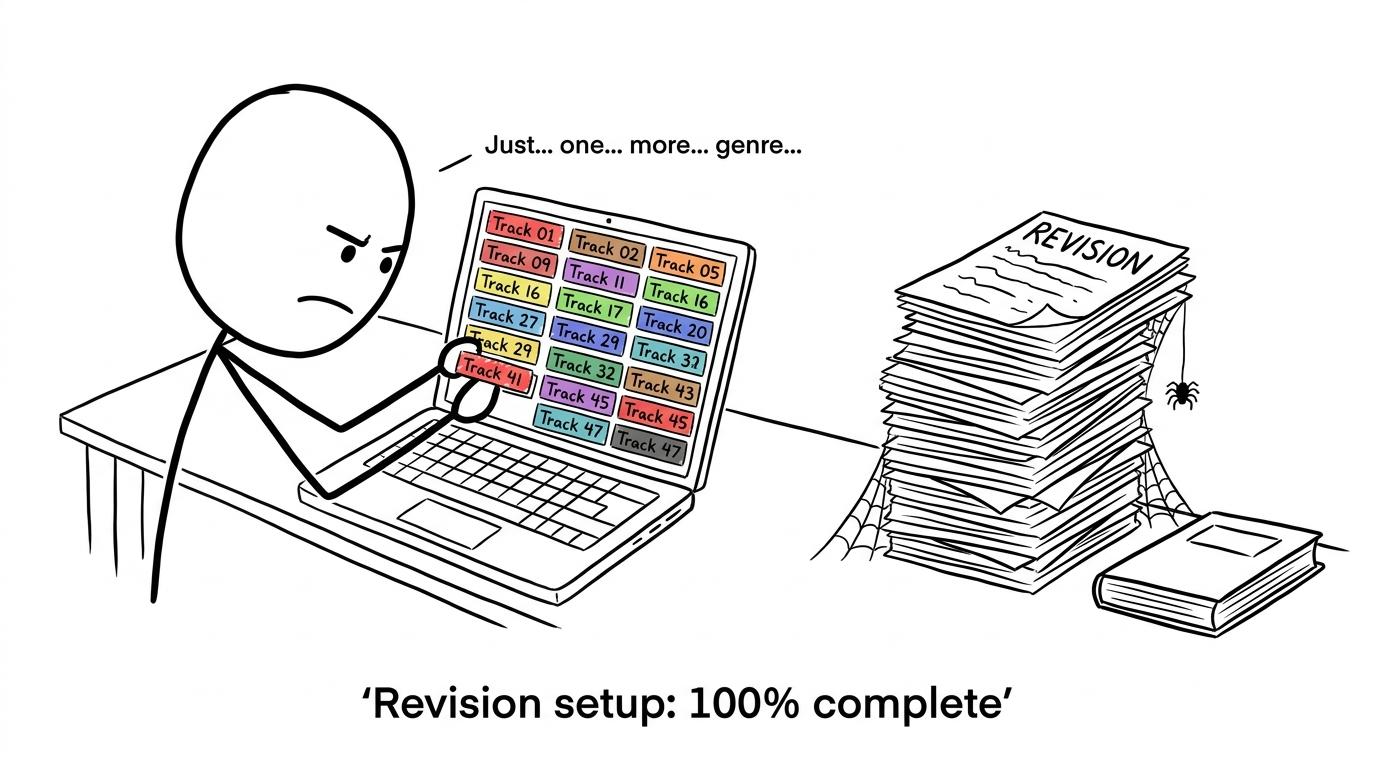 A student perfects a colour-coded playlist while untouched revision papers gather cobwebs
Common mistakes with GCSE study playlists
Treating enjoyment as proof of learning
Music can improve the mood of a session without improving what you remember. Check your work afterwards. Feeling absorbed is not the same as producing an accurate answer.
Choosing songs with “quiet” lyrics
Soft vocals are still words. If you are reading, recalling quotations or writing analytically, the problem is not only volume but linguistic competition.
Constantly editing the playlist
Searching, skipping and rearranging tracks fragments attention. Prepare one short playlist in advance, or remove the choice by using silence.
Using music for every task
A soundtrack that feels harmless during basic organisation may become distracting during a difficult unseen extract or unfamiliar maths problem. Match the environment to the cognitive demand.
Never practising under exam conditions
Revision should eventually resemble performance. Complete some English responses and maths papers in timed silence. MathsGenie explains how to create a useful paper-and-feedback cycle in its guide to using GCSE past papers properly.
Letting the ritual replace active practice
Creating notes, arranging stationery and selecting music can all feel safe because they avoid being tested. Real revision includes retrieval, questions, marking and correction. For maths, turning notes into active recall is a better use of attention than repeatedly rereading them.
The final verdict
Curated study playlists are not a reliable shortcut to stronger GCSE English Language and Literature focus. Music with lyrics is a poor match for reading, verbal memory and sustained writing. Instrumental music may provide a calm routine or cover disruptive noise, but research does not show a consistent learning advantage over silence.
Keep a playlist if it helps you begin and your results remain strong. Remove it when the task becomes verbally demanding. Most importantly, test the outcome rather than trusting the atmosphere.
Then carry that discipline into maths revision. Open the MathsGenie GCSE maths revision resources, choose one weak topic and begin. Use free revision lessons and practice questions to rebuild the method, mini tests to check recall, and past papers or predicted papers to practise under pressure. Mark every attempt, use the video solutions when you are stuck and turn each lost mark into a clear next action.
The best revision soundtrack is optional. The feedback loop is not.










