

Standard Form GCSE Maths Explained
Standard form GCSE maths made clear with simple rules, worked examples, common mistakes and exam-style questions to build your confidence.
A student can understand powers of ten, move a decimal point correctly and still lose marks on standard form. The problem is usually not the size of the numbers. It is knowing which direction to move, what sign the power needs and whether the first number is allowed.
This guide makes standard form GCSE maths manageable. The rule is simple: write a number as a value between 111 and 101010, multiplied by a power of 101010. Once each part has a purpose, the collection of apparently separate rules begins to click.
Imagine a student who keeps writing 45×10345 \times 10^345×103 and wondering why the mark scheme disagrees. The number has the right value, but it is not in standard form. That small distinction is where we will begin.
Standard form checklist
Standard form has the structure:
a×10na \times 10^na×10nwhere:
- 1≤∣a∣<101 \leq |a| < 101≤∣a∣<10
- nnn is an integer
- a positive power represents a large number
- a negative power represents a small number between 000 and 111
Before accepting an answer, check three things:
- Is the first number at least 111 but less than 101010?
- Is the second part a power of 101010?
- Does the sign of the power make sense for the size of the original number?
You can review the method alongside the video and practice resources in the Maths Genie Standard Form lesson.
What standard form actually means
The power tells you how many places separate the decimal point in the first number from its position in the ordinary number.
For example:
3.6×104=36 0003.6 \times 10^4 = 36\,0003.6×104=36000The positive power tells us that the ordinary number is large. Multiplying by 10410^4104 moves the decimal point four places to the right.
Now consider:
3.6×10−4=0.000363.6 \times 10^{-4} = 0.000363.6×10−4=0.00036The negative power produces a value between 000 and 111. This time, the decimal point moves four places to the left.
The student in our example had been trying to memorise two disconnected commands: left for one kind of question and right for another. A more reliable question is: should the answer be large or small? That quick estimate helps you choose the sign before counting any places.
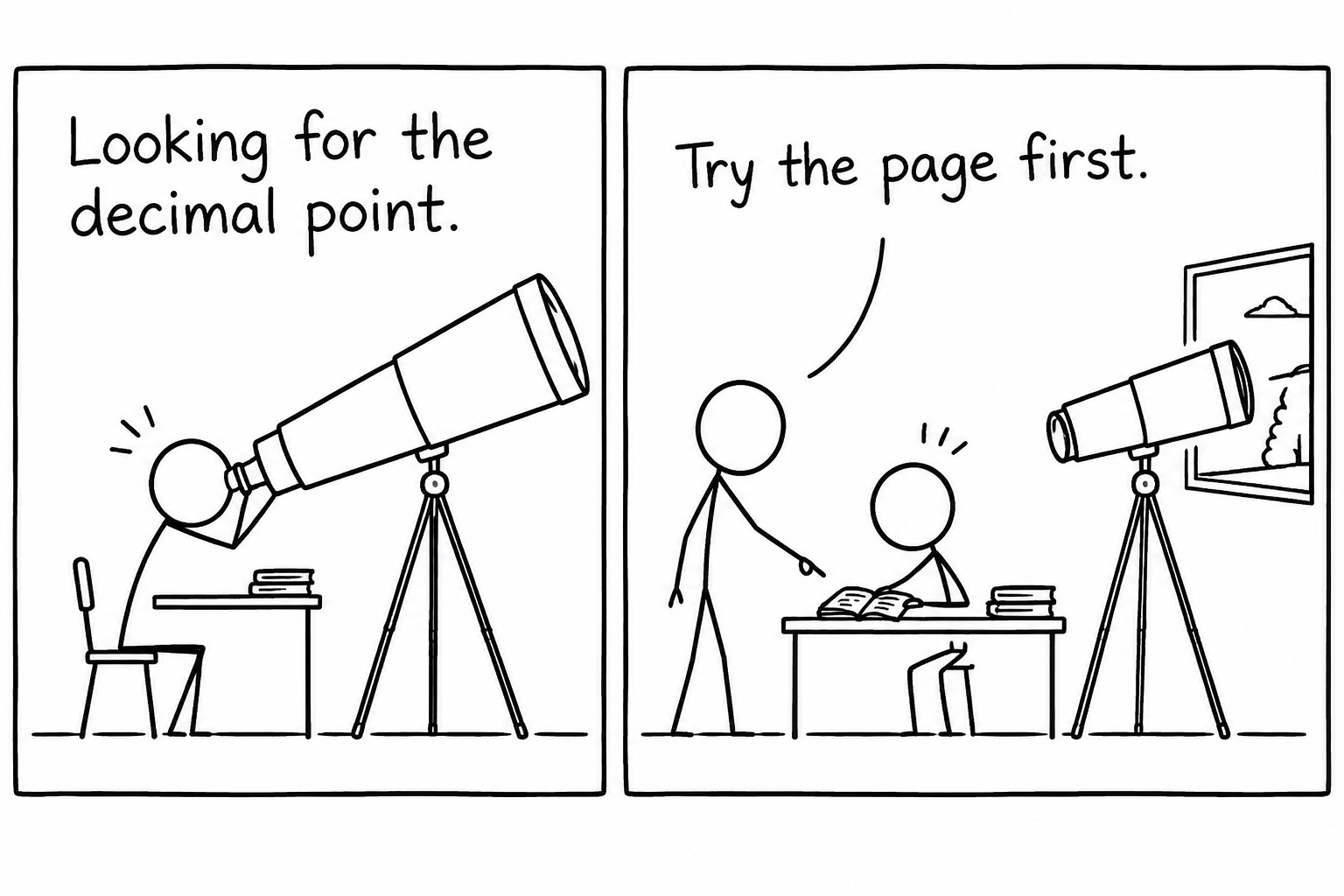 A student searches for a decimal point with a telescope
Standard form worked examples
Writing a large number in standard form
Write 5 720 0005\,720\,0005720000 in standard form.
First, place the decimal point after the first non-zero digit:
5.725.725.72Next, count how many places the decimal point has moved. It has moved six places to the left. Because the original number is large, the power is positive:
5 720 000=5.72×1065\,720\,000 = 5.72 \times 10^65720000=5.72×10⁶A quick check confirms that 5.725.725.72 is between 111 and 101010.
Writing a small number in standard form
Write 0.0004830.0004830.000483 in standard form.
Move the decimal point until the first number is between 111 and 101010:
4.834.834.83The decimal point moves four places to the right. Since the original value is smaller than 111, the power is negative:
0.000483=4.83×10−40.000483 = 4.83 \times 10^{-4}0.000483=4.83×10⁻⁴The movement used to create 4.834.834.83 was to the right, but the power is negative. This often feels backwards at first. Remember what the power describes: multiplying 4.834.834.83 by 10−410^{-4}10−4 must return it to a small value.
Converting back to an ordinary number
Write 7.04×1057.04 \times 10^57.04×10⁵ as an ordinary number.
The positive power means move the decimal point five places to the right:
7.04×105=704 0007.04 \times 10^5 = 704\,0007.04×105=704000For 6.2×10−36.2 \times 10^{-3}6.2×10⁻³, move three places to the left:
6.2×10−3=0.00626.2 \times 10^{-3} = 0.00626.2×10−3=0.0062Zeros act as placeholders. They are not optional, because removing one changes the value.
You now have the core method, so use the Standard Form lesson and its questions when you want the steps and practice kept together.
Calculating with standard form
Multiplication
Multiply the ordinary numbers, then add the powers:
(4×10⁶)(3×10⁵)(4 \times 10^6)(3 \times 10^5)(4×10⁶)(3×10⁵) 4×3=124 \times 3 = 124×3=12 106×105=101110^6 \times 10^5 = 10^{11}106×105=1011This gives:
12×101112 \times 10^{11}12×1011The calculation is correct, but the first number is not between 111 and 101010. Rewrite it:
12×1011=1.2×101212 \times 10^{11} = 1.2 \times 10^{12}12×1011=1.2×10¹²This final adjustment is easy to miss. If the first number becomes ten times smaller, the power must increase by 111 to preserve the value.
Division
Divide the ordinary numbers, then subtract the powers:
8.4×1072.1×103\frac{8.4 \times 10^7}{2.1 \times 10^3}2.1×1038.4×107 8.42.1=4\frac{8.4}{2.1} = 42.18.4=4 107103=107−3=104\frac{10^7}{10^3} = 10^{7-3} = 10^4103107=107−3=104Therefore:
8.4×1072.1×103=4×10⁴\frac{8.4 \times 10^7}{2.1 \times 10^3} = 4 \times 10^42.1×1038.4×107=4×10⁴Addition and subtraction
You can only combine the first numbers directly when the powers are equal. Consider:
3.2×10⁵+4.7×1043.2 \times 10^5 + 4.7 \times 10^43.2×10⁵+4.7×10⁴Rewrite the second term using 10510^5105:
4.7×104=0.47×1054.7 \times 10^4 = 0.47 \times 10^54.7×104=0.47×10⁵Now add:
3.2×10⁵+0.47×105=3.67×1053.2 \times 10^5 + 0.47 \times 10^5 = 3.67 \times 10^53.2×10⁵+0.47×105=3.67×10⁵Adding the powers here would be wrong. Powers are added during multiplication, not addition.
Common mistakes with standard form
The first number is outside the permitted range
An answer such as 43×10643 \times 10^643×106 has the correct kind of structure, but it is not standard form because 434343 is not less than 101010.
Rewrite it as:
43×106=4.3×10743 \times 10^6 = 4.3 \times 10^743×106=4.3×10⁷The power has the wrong sign
A large ordinary number should have a positive power when written in standard form. A small positive number below 111 should have a negative power.
Estimation exposes many sign errors. For example, 8.1×10−68.1 \times 10^{-6}8.1×10⁻⁶ must be tiny, so it cannot represent 8 100 0008\,100\,0008100000.
The decimal places are counted incorrectly
Count movements, not digits. Writing the starting and finishing decimal positions can prevent an off-by-one error.
The answer is not converted back into standard form
A calculation may produce 18×10718 \times 10^718×107. That is an intermediate result, not a finished standard form answer:
18×107=1.8×10818 \times 10^7 = 1.8 \times 10^818×107=1.8×10⁸Calculator notation is copied incorrectly
Calculators may display standard form using an exponent key or a format such as an E. Treat this as calculator notation, not the format to copy blindly. In written working, give the answer as a×10na \times 10^na×10n and check the required degree of accuracy.
Exam-style standard form questions
Try these without looking back at the examples. The GCSE Maths Question Bank can then give you further topic practice.
- Write 6 430 0006\,430\,0006430000 in standard form.
- Write 0.00007150.00007150.0000715 in standard form.
- Write 9.02×1049.02 \times 10^49.02×10⁴ as an ordinary number.
- Calculate (2×10⁷)(3.5×10⁴)(2 \times 10^7)(3.5 \times 10^4)(2×10⁷)(3.5×10⁴), giving your answer in standard form.
- Calculate 5.6×10⁶+8.3×1055.6 \times 10^6 + 8.3 \times 10^55.6×10⁶+8.3×10⁵, giving your answer in standard form.
Answers
6 430 000=6.43×1066\,430\,000 = 6.43 \times 10^66430000=6.43×10⁶ 0.0000715=7.15×10−50.0000715 = 7.15 \times 10^{-5}0.0000715=7.15×10⁻⁵ 9.02×104=90 2009.02 \times 10^4 = 90\,2009.02×104=90200 (2×10⁷)(3.5×10⁴)=7×10¹¹(2 \times 10^7)(3.5 \times 10^4) = 7 \times 10^{11}(2×10⁷)(3.5×10⁴)=7×10¹¹For the final question, first match the powers:
8.3×105=0.83×1068.3 \times 10^5 = 0.83 \times 10^68.3×105=0.83×10⁶Then calculate:
5.6×10⁶+0.83×106=6.43×1065.6 \times 10^6 + 0.83 \times 10^6 = 6.43 \times 10^65.6×10⁶+0.83×106=6.43×10⁶Do not only count correct answers. Identify the exact step behind each error: choosing the sign, counting places, applying index laws or checking the first number. That diagnosis tells you what to practise next.
Turn the method into marks
The student who kept writing 45×10345 \times 10^345×103 did not need another shortcut. They needed a final check: first number between 111 and 101010, sensible sign, correct value. Knowing that check is useful, but using it consistently under exam pressure requires practice.
Start your next revision session with the Maths Genie Standard Form lesson, then turn the method into a habit with the GCSE Maths Question Bank.















