

Standard Form Exam Questions: GCSE Worked Guide
Standard form exam questions explained through three GCSE worked examples, with method marks, common mistakes and targeted free MathsGenie practice.

A standard form question can look deceptively short. There may be only two numbers, one operation and a small answer space. Yet several decisions are hidden inside it: what to do with the ordinary numbers, what to do with the powers, and whether the final answer is genuinely in standard form.
The reliable approach to standard form exam questions is to separate those decisions. Calculate the number parts, apply the index laws, then check that the coefficient is at least 111 but less than 101010. This guide follows a GCSE student through three questions of rising difficulty, showing the working that could earn method marks even when the final answer goes wrong.
The standard form checklist
A number is in standard form when it is written as
a×10na \times 10^na×10nwhere
1≤a<101 \leq a < 101≤a<10and nnn is an integer.
Before answering a question, use this checklist:
- identify whether you are converting, multiplying, dividing, adding or subtracting;
- deal with the coefficients and powers separately where appropriate;
- use the index laws accurately;
- rewrite the result if its coefficient is not between 111 and 101010;
- copy the requested units into the final answer;
- show enough working for a marker to follow your method.
The MathsGenie standard form revision lesson reviews these foundations, while the standard form video lessons demonstrate the methods in action.
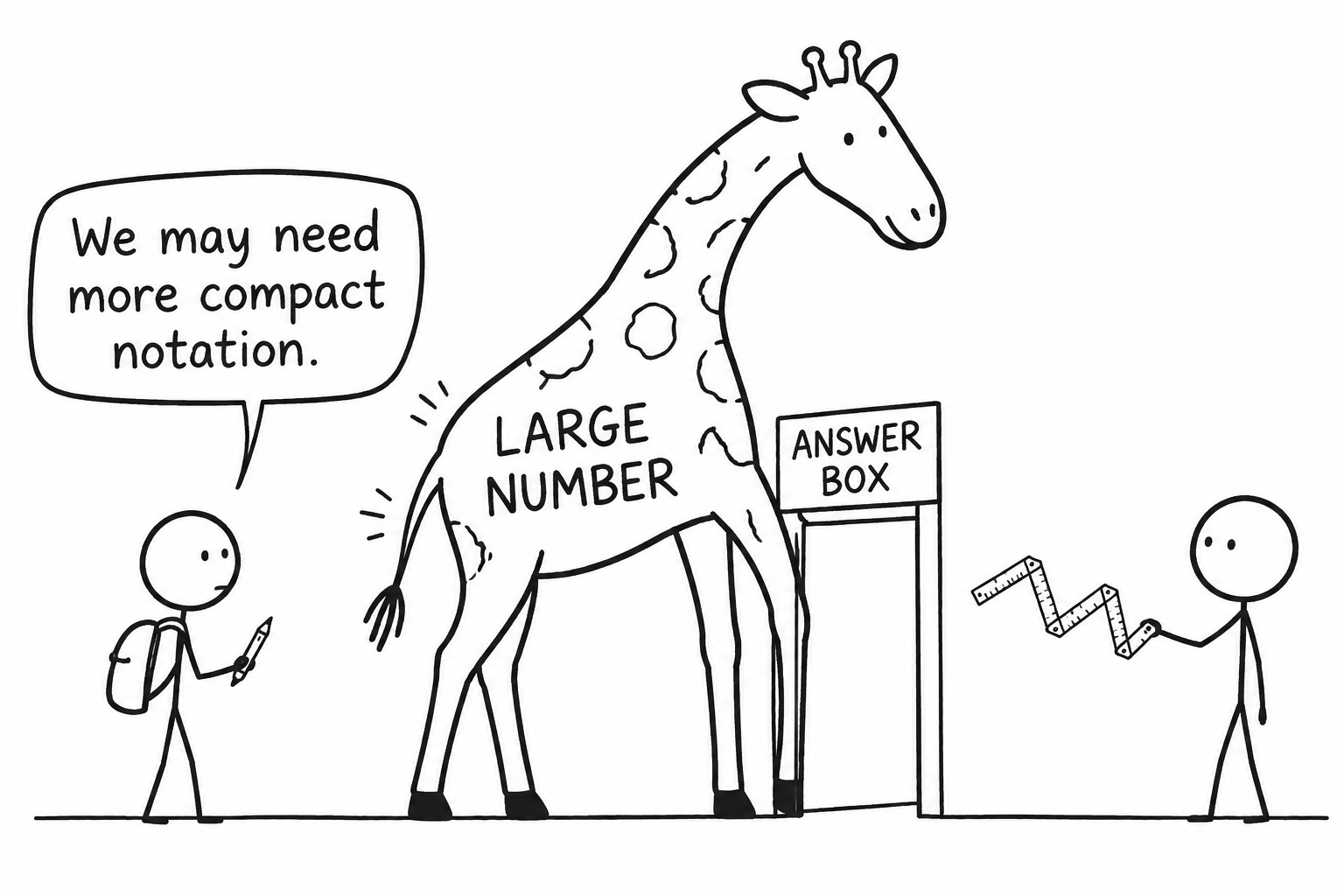 A student trying to fit a very large number into a tiny answer box
Question one: converting a small number
Imagine a student, Maya, beginning with a conversion question.
Write 0.0000720.0000720.000072 in standard form.
Maya first moves the decimal point until the number in front lies between 111 and 101010:
0.000072⟶7.20.000072 \longrightarrow 7.20.000072⟶7.2The decimal point has moved 555 places to the right. Because the original number is smaller than 111, the power is negative:
0.000072=7.2×10−50.000072 = 7.2 \times 10^{-5}0.000072=7.2×10⁻⁵Where the marks may come from
A typical question might award one mark for reaching the correct coefficient and another for the correct power. Exact allocations vary between papers, so the live mark scheme always decides, but visible working gives the examiner evidence of Maya's method.
Her quick check is to recognise that 10−510^{-5}10−5 represents a very small place value. A positive exponent would make the number large, so it cannot be right here.
This is an important habit for any standard form GCSE exam: do not rely only on counting jumps. Ask whether the sign of the exponent makes sense.
Question two: multiplying in standard form
Maya's next question requires calculation.
Work out (3×10⁴)(6×10³)(3 \times 10^4)(6 \times 10^3)(3×10⁴)(6×10³). Give your answer in standard form.
She separates the coefficients from the powers:
(3×6)×(104×103)(3 \times 6) \times (10^4 \times 10^3)(3×6)×(104×103)She multiplies the coefficients and adds the indices:
18×10718 \times 10^718×107That calculation is correct, but it is not yet standard form because 181818 is not less than 101010. Maya rewrites 181818 as 1.8×101.8 \times 101.8×10:
18×107=1.8×101×10718 \times 10^7 = 1.8 \times 10^1 \times 10^718×107=1.8×101×107Therefore,
18×107=1.8×10818 \times 10^7 = 1.8 \times 10^818×107=1.8×10⁸Where the marks may come from
Possible marking stages include:
- multiplying 333 and 666 correctly;
- using 104×103=10710^4 \times 10^3 = 10^7104×103=107;
- converting 18×10718 \times 10^718×107 into valid standard form.
If Maya wrote 18×10718 \times 10^718×107 and stopped, she might have demonstrated most of the method but lost the final accuracy mark. The instruction to give the answer in standard form is part of the mathematics, not merely presentation.
You now have the method in hand, so use the MathsGenie standard form lesson and practice booklet when you want Lessons and Question Bank practice without assembling questions yourself.
Question three: a multi-step division problem
The third question combines interpretation, division and standard form.
A spacecraft travels 7.2×1087.2 \times 10^87.2×10⁸ metres in 3×1043 \times 10^43×104 seconds. Calculate its average speed in metres per second. Give your answer in standard form.
Maya starts with the relationship
speed=distancetime\text{speed} = \frac{\text{distance}}{\text{time}}speed=timedistanceShe substitutes the values:
speed=7.2×1083×104\text{speed} = \frac{7.2 \times 10^8}{3 \times 10^4}speed=3×1047.2×108Next, she divides the coefficients and subtracts the indices:
speed=7.23×10⁸−4\text{speed} = \frac{7.2}{3} \times 10^{8-4}speed=37.2×10⁸−4 speed=2.4×10⁴\text{speed} = 2.4 \times 10^4speed=2.4×10⁴The coefficient 2.42.42.4 is already between 111 and 101010, so no further adjustment is required. Maya includes the units:
2.4×10⁴ m/s\boxed{2.4 \times 10^4\text{ m/s}}2.4×104 m/sWhere the marks may come from
A longer GCSE question may recognise several pieces of valid work:
- selecting or using the correct speed relationship;
- substituting the distance and time correctly;
- dividing the coefficients;
- subtracting the indices;
- giving a valid standard form answer with units.
This is why one unclear calculator line can be risky. If the final answer is mistyped, there may be little visible evidence of the correct approach. Structured working protects the method.
For more calculations involving different operations, read how to calculate with numbers in standard form.
How the operation changes the method
Multiplication and division allow the powers of 101010 to be handled with index laws:
10a×10b=10a+b10^a \times 10^b = 10^{a+b}10a×10b=10a+b 10a10b=10a−b\frac{10^a}{10^b} = 10^{a-b}10b10a=10a−bAddition and subtraction are different. The powers must match before the coefficients can be combined. For example,
3.2×10⁵+4.7×1043.2 \times 10^5 + 4.7 \times 10^43.2×10⁵+4.7×10⁴can be rewritten as
3.2×10⁵+0.47×1053.2 \times 10^5 + 0.47 \times 10^53.2×10⁵+0.47×10⁵and then calculated as
3.67×1053.67 \times 10^53.67×10⁵Adding the indices here would be incorrect. The operation between the original numbers determines the method.
Common mistakes in standard form exam questions
Forgetting the coefficient rule
An answer such as 23×10623 \times 10^623×106 is not in standard form. Rewrite it as 2.3×1072.3 \times 10^72.3×10⁷.
Giving a negative exponent to every decimal
The sign depends on the size of the original number. Numbers between 000 and 111 have a negative power when written in standard form. A large decimal number, such as 450000450000450000, has a positive power:
450000=4.5×105450000 = 4.5 \times 10^5450000=4.5×10⁵Using the wrong index law
Multiply powers with the same base by adding indices. Divide them by subtracting indices. Do not multiply or divide the indices themselves.
Combining unlike powers in addition
Before adding or subtracting standard form numbers, rewrite them using the same power of 101010.
Hiding every step in a calculator
A calculator is useful for checking coefficients, but method marks depend on visible mathematical evidence. Write the substitution and the index step before recording the final answer.
Ignoring units or rounding instructions
Read the final sentence again. A correct numerical value can still be incomplete if the question requires units, a particular degree of accuracy or standard form.
Practise like the exam
Standard form past paper questions vary in appearance. Some ask for direct conversion; others place the same skill inside area, speed, population or scientific contexts. The surrounding words change, but the underlying decisions remain stable.
Practise in three stages:
- begin with conversions to secure the meaning of the exponent;
- move to multiplication, division, addition and subtraction;
- finish with mixed exam-style problems where you must choose the operation.
After each attempt, compare your working with the solution rather than checking only the final number. The MathsGenie standard form Question Bank provides exam-style questions with worked solutions and mark schemes, helping you see both what works and where marks may be lost.
Turn the method into marks
Maya's progress did not depend on a shortcut. She learned to separate coefficients from powers, normalise the final answer and leave a clear trail of working. Knowing those steps is useful; following them consistently under exam pressure is what turns the knowledge into marks.
Build that consistency now with MathsGenie's Lessons and Question Bank, working from direct conversions towards the mixed standard form exam questions that demand several decisions. Start the standard form Lessons and Question Bank.















