

Square Roots and Cube Roots GCSE Maths Explained
Square roots and cube roots GCSE maths explained with step-by-step examples, common mistakes and exam-style questions for focused, confident revision.
A student can understand multiplication perfectly well and still freeze when a root symbol appears. Imagine someone called Sam. Every time Sam sees 49\sqrt{49}49, the same doubts arrive: do I divide by 222? Is the answer 777 or −7-7−7? What does the little 333 on a cube root mean?
The good news is that square roots and cube roots GCSE maths questions become much easier once you see roots as the reverse of powers. A square root reverses squaring. A cube root reverses cubing. Most questions then come down to recognising familiar square and cube numbers, using a calculator correctly and keeping signs under control.
This topic appears within the number content studied for GCSE Maths, including foundation and higher tier courses. The underlying method is consistent across Edexcel, AQA, OCR and Eduqas specifications.
Your roots checklist
Before answering a question, ask:
- Is this a square root or a cube root?
- Which number, multiplied by itself the required number of times, gives the value inside the root?
- Is the answer exact, or will I need a calculator?
- Does the question involve a negative number?
- Am I finding a root, or solving an equation involving a power?
That final distinction matters more than it first appears.
What is a square root?
Squaring a number means multiplying it by itself:
62=6×6=366^2 = 6 \times 6 = 3662=6×6=36A square root reverses this operation:
36=6\sqrt{36} = 636=6The symbol x\sqrt{\phantom{x}}x is called the square root symbol. When it is used on its own, it asks for the principal square root, which is the non-negative answer. Therefore:
49=7\sqrt{49} = 749=7It is not written as ±7\pm 7±7. However, the equation x2=49x^2=49x2=49 has two solutions because both a positive and a negative number square to make 494949:
x=7orx=−7x=7 \quad \text{or} \quad x=-7x=7orx=−7This is where Sam kept losing marks. The calculations were not the problem. Two questions that looked similar were asking different things.
Square roots worked example
Find 121\sqrt{121}121.
Think of a number which multiplies by itself to make 121121121:
11×11=12111 \times 11 = 12111×11=121Therefore:
121=11\sqrt{121} = 11121=11You can check the answer by reversing your calculation:
112=12111^2 = 121112=121Learning the square numbers from 121^212 to 15215^2152 makes many non-calculator questions quicker. The MathsGenie Powers and Roots lesson brings the key facts, explanations and practice together.
What is a cube root?
Cubing a number means multiplying it by itself three times:
43=4×4×4=644^3 = 4 \times 4 \times 4 = 6443=4×4×4=64A cube root reverses cubing:
643=4\sqrt[3]{64} = 4364=4The small 333 tells you that this is a cube root. It does not mean that you multiply the answer by 333 or divide the number inside by 333.
Unlike square roots in the real number system, cube roots can be taken directly from negative numbers. For example:
(−5)3=(−5)×(−5)×(−5)=−125(-5)^3 = (-5) \times (-5) \times (-5) = -125(−5)3=(−5)×(−5)×(−5)=−125So:
−1253=−5\sqrt[3]{-125} = -53−125=−5Cube roots worked example
Find 2163\sqrt[3]{216}3216.
Look for a number which can be multiplied by itself three times to make 216216216:
6×6×6=2166 \times 6 \times 6 = 2166×6×6=216Therefore:
2163=6\sqrt[3]{216} = 63216=6Check by cubing the answer:
63=2166^3 = 21663=216Sam’s turning point was simple: instead of staring at the root symbol, Sam rewrote the question in words. For 2163\sqrt[3]{216}3216, that became, “What number cubed gives 216216216?” The notation stopped feeling mysterious because the question underneath it was familiar.
Start the Powers and Roots Lessons and Question Bank when you want to turn this reverse-operation method into a repeatable exam habit.
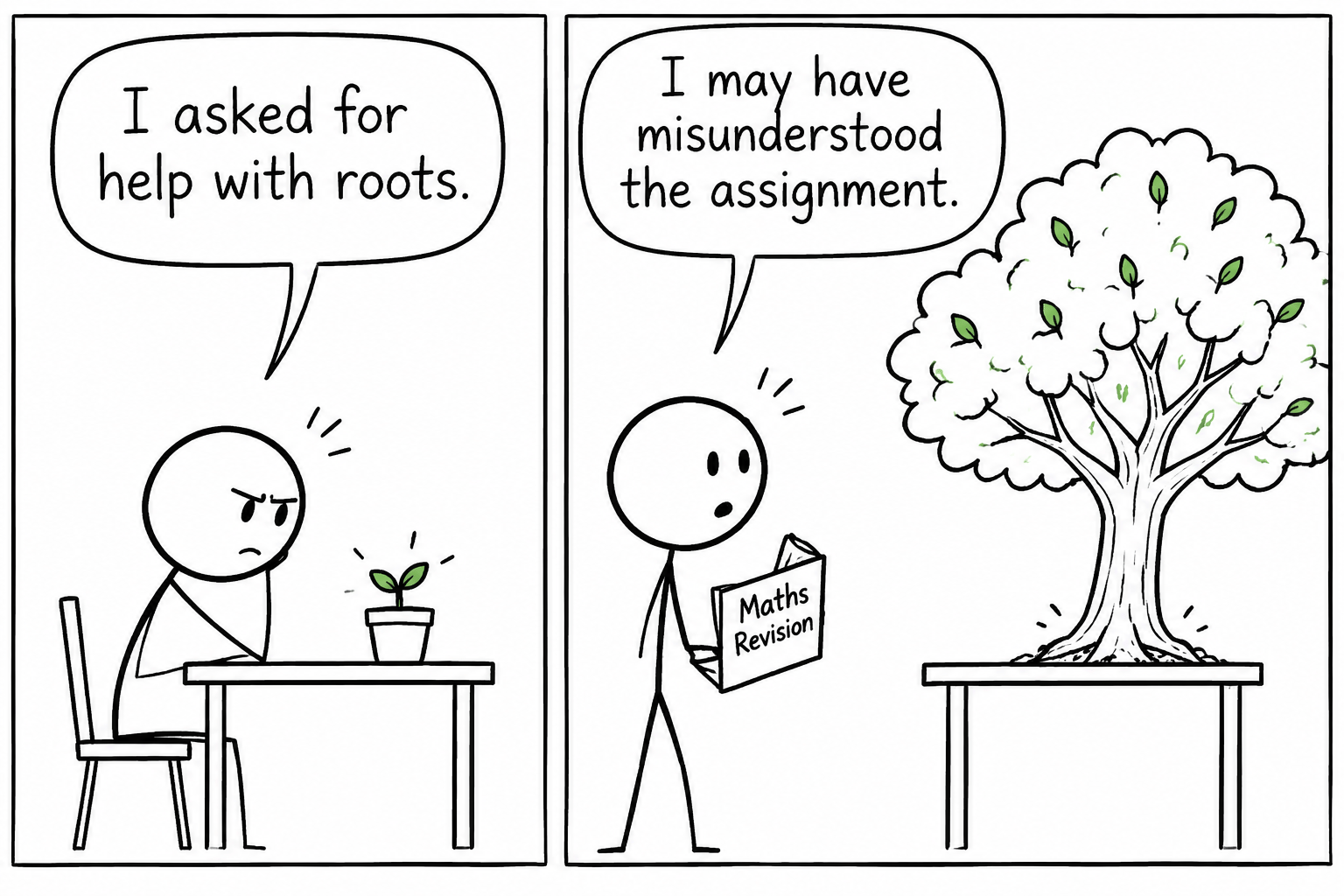 A student asks for help with roots and receives a tree
When the answer is not a whole number
Not every number has an integer square root or cube root. For example, 505050 is not a square number, so 50\sqrt{50}50 is not an integer.
If a question asks for a decimal answer, use a calculator and round only at the end. For example, to 333 significant figures:
50=7.071…≈7.07\sqrt{50} = 7.071\ldots \approx 7.0750=7.071…≈7.07Keep the full calculator value during any later stages of a calculation. Early rounding can make the final answer inaccurate.
On a calculator, check carefully whether you need the square root key or the cube root function. The Using a Calculator lesson helps with roots, powers, brackets and interpreting a calculator display.
At higher tier, some roots may need to remain exact or be simplified as surds. That is a later extension of the same central idea: roots reverse powers. Index notation develops this relationship further, so the GCSE Indices lesson is a useful next step.
Exam-style square roots and cube roots questions
Try these without looking at the answers first.
Question A
Work out:
169\sqrt{169}169Since 132=16913^2=169132=169:
169=13\sqrt{169}=13169=13Question B
Work out:
−3433\sqrt[3]{-343}3−343Since (−7)3=−343(-7)^3=-343(−7)3=−343:
−3433=−7\sqrt[3]{-343}=-73−343=−7Question C
Solve:
x2=81x^2=81x2=81Both 999 and −9-9−9 satisfy the equation:
x=9orx=−9x=9 \quad \text{or} \quad x=-9x=9orx=−9Question D
A cube has volume 512 cm3512\text{ cm}^3512 cm3. Find its side length.
If the side length is sss, then:
s3=512s^3=512s3=512Take the cube root:
s=5123=8s=\sqrt[3]{512}=8s=3512=8The side length is 8 cm8\text{ cm}8 cm. Notice that the unit is centimetres, not cubic centimetres, because the question asks for a length.
Once these methods feel secure, use the Powers and Roots exam booklet for more square roots and cube roots questions with answers. You can then move into mixed revision through the Edexcel GCSE Maths revision hub, where past papers and mark schemes show how number skills are combined in complete papers.
Common mistakes with roots
Dividing instead of finding the inverse power
A square root does not mean divide by 222:
64=8\sqrt{64}=864=8This is because 82=648^2=6482=64, not because 64÷2=864\div2=864÷2=8.
Similarly, a cube root does not mean divide by 333.
Writing two answers for an ordinary square root
The value of 25\sqrt{25}25 is 555. The equation x2=25x^2=25x2=25 has the two solutions x=5x=5x=5 and x=−5x=-5x=−5. Read what the question actually asks.
Losing the negative sign in a cube root
Odd powers preserve a negative sign:
−83=−2\sqrt[3]{-8}=-23−8=−2Check by calculating (−2)3=−8(-2)^3=-8(−2)3=−8.
Assuming roots must be integers
Values such as 2\sqrt{2}2 and 103\sqrt[3]{10}310 are valid even though they are not integers. Follow the instruction about exact form, decimal places or significant figures.
Forgetting units
A cube-root calculation may convert a volume into a length. Write the unit requested, rather than copying the original unit from the question.
Make the method stick
Sam did not improve by memorising more symbols. The improvement came from using one dependable question: “Which power would reverse this root?” Knowing the method is the first step, but following it under exam pressure takes deliberate practice with immediate checking.
Your turn. Start the MathsGenie Powers and Roots Lessons and Question Bank and practise until choosing the correct inverse operation feels automatic.















