

Square Roots and Cube Roots Exam Questions
Square roots and cube roots exam questions made clear with three worked GCSE examples, indicative method marks, common mistakes and practice advice too.
A square root question can look almost too easy. That is often where the trouble begins. A student recognises the number, writes an answer quickly, and only later notices that the question involved a negative cube, an equation or an extra operation.
The reliable way to answer square roots and cube roots exam questions is to identify the operation, recall the relevant square or cube number, show any necessary working and check by reversing the calculation. This article follows an imaginary GCSE student through three questions of rising difficulty, showing how marks may be earned along the way.
Marking varies between exam boards and papers, so the allocations below are indicative rather than official mark schemes. However, the habits apply across Edexcel, AQA, OCR and Eduqas GCSE Maths.
The roots checklist
Before answering, ask four questions:
- Is it a square root or a cube root?
- Is the number positive or negative?
- Is the question asking for a root or asking you to solve an equation?
- Are there other operations that require careful ordering?
A square root reverses squaring:
a=bmeansb2=a\sqrt{a}=b \quad \text{means} \quad b^2=aa=bmeansb2=aA cube root reverses cubing:
a3=bmeansb3=a\sqrt[3]{a}=b \quad \text{means} \quad b^3=a3a=bmeansb3=aIt helps to know the common square numbers up to at least 15215^2152 and the common cube numbers up to at least 10310^3103. You can review these ideas in the Powers and Roots lesson.
Now that you have the method, use the Maths Genie Powers and Roots Lessons and GCSE Question Bank to apply it to fresh exam-style questions.
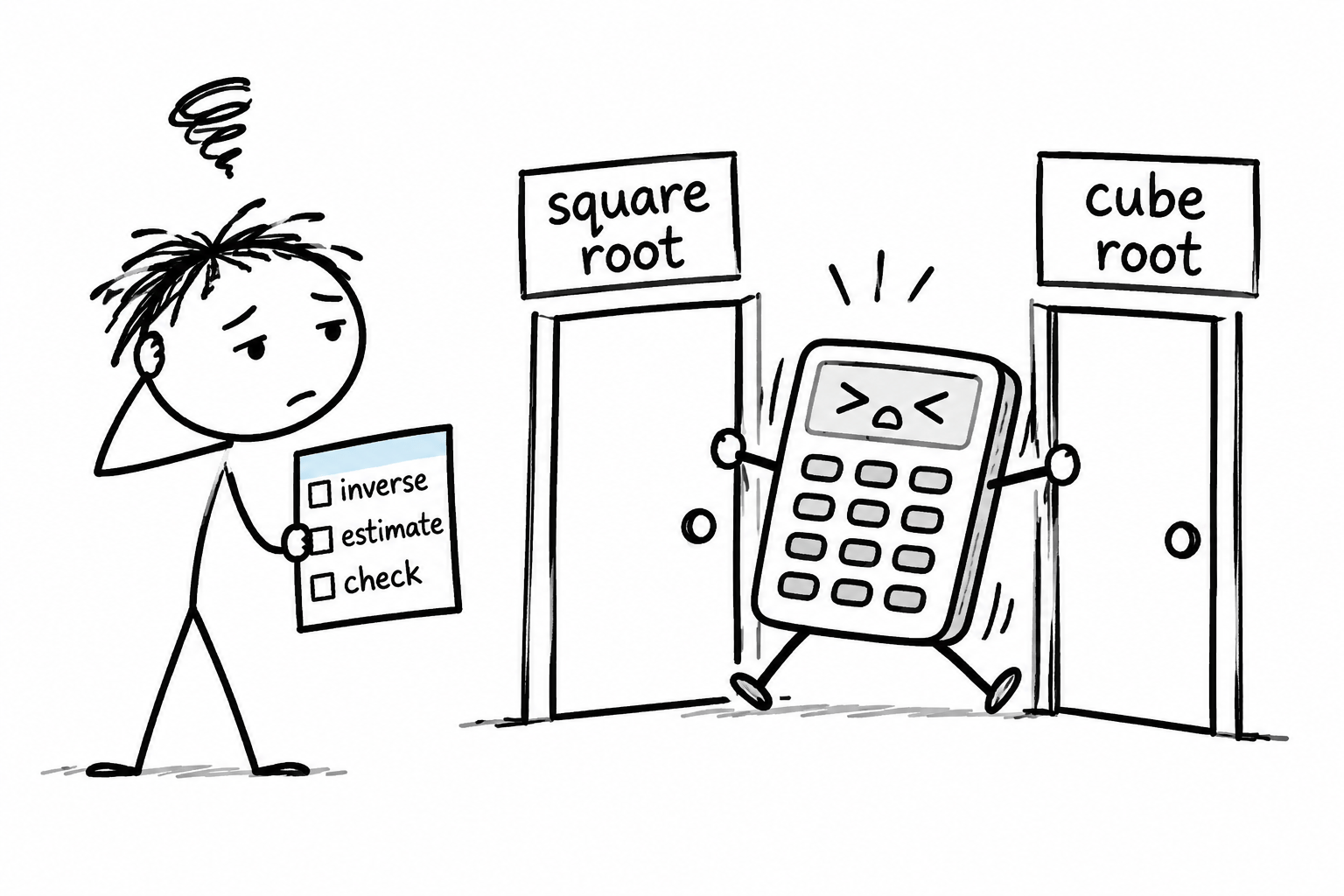 A GCSE student, a calculator and two root doors
Question one: recalling exact roots
Imagine a student called Sam beginning with this question.
Work out 196\sqrt{196}196 and 1253\sqrt[3]{125}3125
This is a direct recall question. Sam asks which positive number squares to make 196196196:
142=14×14=19614^2=14\times14=196142=14×14=196Therefore:
196=14\sqrt{196}=14196=14For the cube root, Sam asks which number multiplies by itself three times to make 125125125:
53=5×5×5=1255^3=5\times5\times5=12553=5×5×5=125Therefore:
1253=5\sqrt[3]{125}=53125=5Answer: 141414 and 555.
On a typical 2-mark question, each correct answer could receive one independent accuracy mark. Direct recall questions may not carry a separate method mark, so clear and correct answers matter. Writing the checking calculations is still sensible, particularly on a non-calculator paper or when you are not completely certain.
Sam does not try to divide 196196196 by 222 or 125125125 by 333. A root is an inverse power, not ordinary division.
Question two: using a root to solve an equation
The next question looks similar, but its wording changes what Sam must do.
Solve x3=512x^3=512x3=512
To undo a cube, take the cube root of both sides:
x33=5123\sqrt[3]{x^3}=\sqrt[3]{512}3x3=3512This gives:
x=5123x=\sqrt[3]{512}x=3512Sam recalls that:
83=8×8×8=5128^3=8\times8\times8=51283=8×8×8=512So:
x=8x=8x=8Answer: x=8x=8x=8.
An indicative 2-mark scheme might award:
- one method mark for applying a cube root or showing that 83=5128^3=51283=512;
- one accuracy mark for x=8x=8x=8.
This is why working can matter. If Sam makes an arithmetic slip after choosing the correct inverse operation, the examiner may still be able to credit the method where the official mark scheme permits it.
There is only one real solution here. Odd powers preserve the sign of a number, so a cube equation of this form has one real cube root. For example:
x3=−512⇒x=−8x^3=-512 \quad \Rightarrow \quad x=-8x3=−512⇒x=−8This differs from solving a square equation. If the question were:
x2=64x^2=64x2=64then both 888 and −8-8−8 work, giving:
x=±8x=\pm8x=±8However, the symbol 64\sqrt{64}64 means the principal, non-negative square root, so:
64=8\sqrt{64}=864=8That distinction appears frequently in square roots and cube roots GCSE exam questions.
Question three: combining roots and operation order
Sam now reaches a question where rushing is more dangerous than forgetting a fact.
Work out 324−−2163×49\sqrt{324}-\sqrt[3]{-216}\times\sqrt{49}324−3−216×49
First, evaluate each root separately:
324=18\sqrt{324}=18324=18 −2163=−6\sqrt[3]{-216}=-63−216=−6 49=7\sqrt{49}=749=7The expression becomes:
18−(−6)×718-(-6)\times718−(−6)×7Multiplication comes before subtraction:
(−6)×7=−42(-6)\times7=-42(−6)×7=−42Therefore:
18−(−42)=18+42=6018-(-42)=18+42=6018−(−42)=18+42=60Answer: 606060.
An indicative 3-mark scheme could award:
- one mark for correctly evaluating the three roots;
- one method mark for correctly handling the multiplication and negative value;
- one accuracy mark for the final answer of 606060.
The important moment is not the final addition. It is recognising that the cube root of a negative number can be negative:
(−6)3=−216(-6)^3=-216(−6)3=−216Sam also keeps brackets around −6-6−6. Without them, the two negative signs are easy to misread.
Questions that combine roots with powers are connected to the wider rules covered in the Indices revision lesson. The same calm approach applies: simplify one part at a time, preserve signs and follow the order of operations.
How to practise exam-style root questions
Reading a worked example can create a feeling of familiarity, but recognition is not the same as recall. Close the solution and reproduce each method from memory.
A useful practice routine is:
- revise common squares and cubes;
- answer a short set without notes;
- mark every answer immediately;
- classify each error as recall, sign, operation order or calculator use;
- retry the incorrect questions later without looking at the solution.
The Powers and Roots exam booklet provides focused questions with answers. For broader mixed practice, use the GCSE exam booklets and the main GCSE Maths revision area.
When working through square roots and cube roots past paper questions, pay attention to command words. Work out usually requires a numerical result. Solve requires the value of an unknown. Show that requires a chain of reasoning that reaches the stated result. The underlying arithmetic may be similar, but the evidence expected on the page can differ.
Common mistakes with roots
Treating a root as division
The cube root of 646464 is not 64÷364\div364÷3. Instead:
643=4\sqrt[3]{64}=4364=4because 43=644^3=6443=64.
Giving two answers for an ordinary square root
For the principal square root:
81=9\sqrt{81}=981=9Do not write ±9\pm9±9 unless you are solving an equation such as x2=81x^2=81x2=81.
Rejecting a negative cube root
Negative numbers have real cube roots:
−273=−3\sqrt[3]{-27}=-33−27=−3because (−3)3=−27(-3)^3=-27(−3)3=−27.
Ignoring the order of operations
Evaluate roots as powers, then apply multiplication or division before addition or subtraction. Use brackets around negative results.
Entering the calculation incorrectly
On a calculator paper, check that the root bar covers the intended number or expression. Calculator models vary, so inspect the displayed input before pressing the equals key. An estimate also helps: since 122=14412^2=144122=144 and 132=16913^2=169132=169, a displayed value of 125125125 for 156\sqrt{156}156 cannot be reasonable.
Turn the method into marks
Sam's progress came from slowing down at the exact places where marks are commonly lost: choosing the inverse operation, preserving a negative sign and showing enough working for the method to be visible. Knowing the method is the first step; following it reliably under exam pressure requires deliberate practice. Start your square roots and cube roots revision with the Maths Genie Lessons and Question Bank.















