

Simplifying Surds GCSE Maths: A Clear Guide
Simplifying surds GCSE maths made clear with a simple method, worked examples, common mistakes and exam-style questions for Higher tier revision.
A student can understand surds perfectly well and still keep simplifying them incorrectly. That is what happens in our hypothetical lesson: each answer looks nearly right, but a square factor has been missed or a root has been split in a way that is not allowed.
Then one idea clicks. Simplifying surds GCSE maths questions is mostly about finding the largest square number hidden inside the root. Once you can spot that factor, the process becomes much more predictable.
This is a GCSE Higher tier skill. Surds appear in the algebra content of GCSE specifications, including simplifying expressions involving them. Here is the method, followed by worked examples and exam-style practice.
The simplifying surds checklist
Use this routine whenever you are asked to simplify a surd:
- Find the largest square number that divides the number under the root.
- Write the number as that square factor multiplied by another factor.
- Use the product rule to split the root.
- Evaluate the square root of the square number.
- Check that the remaining surd cannot be simplified again.
The key rule is:
ab=a×b\sqrt{ab}=\sqrt{a}\times\sqrt{b}ab=a×bFor example, if aaa is a square number, then a\sqrt{a}a becomes an integer. This is what allows part of the expression to move outside the square root.
If setting up that routine for several topics feels like a lot, use the Maths Genie GCSE lessons and Question Bank to move directly from the surds lesson into focused practice.
What is a surd?
A surd is an irrational root written exactly. For instance, 2\sqrt{2}2 is a surd because it cannot be expressed as a terminating or recurring decimal.
A calculator gives an approximation:
2≈1.414\sqrt{2}\approx1.4142≈1.414The surd 2\sqrt{2}2 is the exact value. The decimal is only an approximation.
Not every square root is a surd. For example:
49=7\sqrt{49}=749=7This is an integer, so it is not a surd. By contrast, 12\sqrt{12}12 is a surd, but it is not in its simplest form because 121212 contains the square factor 444.
The square numbers you need to recognise
Simplifying surds becomes much easier when common square numbers are familiar:
1, 4, 9, 16, 25, 36, 49, 64, 81, 1001,\ 4,\ 9,\ 16,\ 25,\ 36,\ 49,\ 64,\ 81,\ 1001, 4, 9, 16, 25, 36, 49, 64, 81, 100Our student had originally tried random factor pairs. That sometimes worked, but it created unnecessary steps. Looking specifically for the largest square factor made the method quicker and reduced the opportunity for errors.
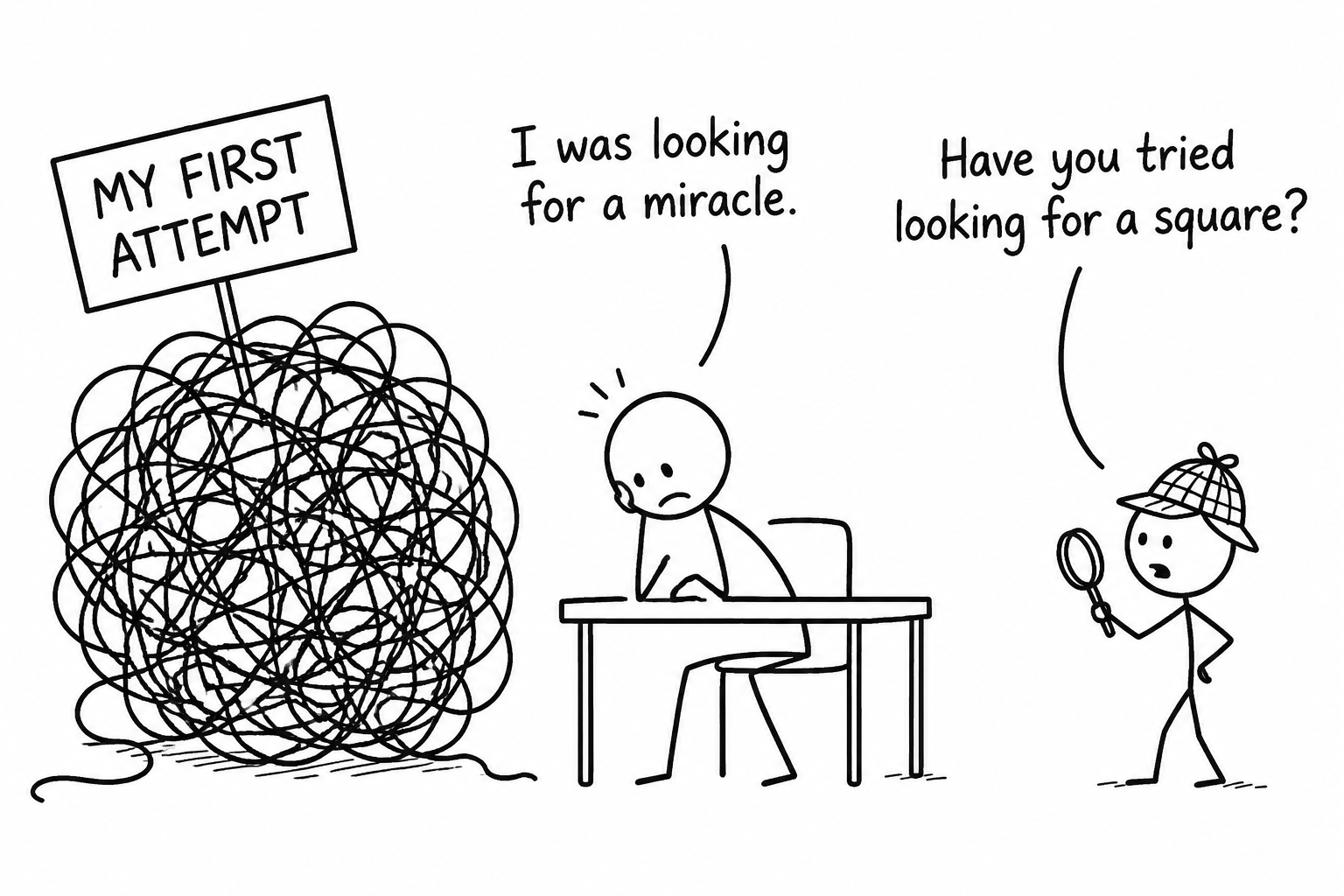 A student searches for a square factor while hoping for a miracle
Simplifying surds worked examples
Example: simplify 20\sqrt{20}20
The largest square factor of 202020 is 444:
20=4×5\sqrt{20}=\sqrt{4\times5}20=4×5Split the root:
20=4×5\sqrt{20}=\sqrt{4}\times\sqrt{5}20=4×5Since 4=2\sqrt{4}=24=2:
20=25\boxed{\sqrt{20}=2\sqrt{5}}20=25The remaining number, 555, has no square factor greater than 111, so the answer is fully simplified.
Example: simplify 72\sqrt{72}72
The largest square factor of 727272 is 363636:
72=36×2\sqrt{72}=\sqrt{36\times2}72=36×2Therefore:
72=36×2\sqrt{72}=\sqrt{36}\times\sqrt{2}72=36×2 72=62\boxed{\sqrt{72}=6\sqrt{2}}72=62Choosing 4×184\times184×18 would not be incorrect, but it would require another simplification. Choosing the largest square factor reaches the answer directly.
Example: simplify 3453\sqrt{45}345
First simplify the surd itself. The largest square factor of 454545 is 999:
345=39×53\sqrt{45}=3\sqrt{9\times5}345=39×5 =3×35=3\times3\sqrt{5}=3×35Multiply the integers outside the root:
345=95\boxed{3\sqrt{45}=9\sqrt{5}}345=95This is where our student had often stopped at 3×353\times3\sqrt{5}3×35. That expression is equivalent, but it has not been fully simplified because the ordinary integers can still be multiplied.
Example: simplify 48+27\sqrt{48}+\sqrt{27}48+27
Simplify each surd separately:
48=16×3=43\sqrt{48}=\sqrt{16\times3}=4\sqrt{3}48=16×3=43 27=9×3=33\sqrt{27}=\sqrt{9\times3}=3\sqrt{3}27=9×3=33The surds are now like terms, so their coefficients can be added:
43+33=734\sqrt{3}+3\sqrt{3}=7\sqrt{3}43+33=73Therefore:
48+27=73\boxed{\sqrt{48}+\sqrt{27}=7\sqrt{3}}48+27=73The important shift is simple: expressions that did not initially look alike can become like surds after simplification.
Why the method works
A square root reverses squaring. When a number under the root contains a square factor, that part can be evaluated exactly.
In general:
a2b=a2b=ab\sqrt{a^2b}=\sqrt{a^2}\sqrt{b}=a\sqrt{b}a2b=a2b=abFor GCSE questions, the values involved are usually selected so that recognising square factors is the efficient route. You are not changing the value of the expression. You are writing the same exact value in a simpler form.
A quick calculator check can confirm equality. However, it does not replace the algebraic working that an exam question asking you to simplify is designed to assess.
Common mistakes when simplifying surds
Splitting addition inside a root
This is not a valid rule:
a+b≠a+b\sqrt{a+b}\ne\sqrt{a}+\sqrt{b}a+b=a+bFor example:
9+16=5\sqrt{9+16}=59+16=5but
9+16=7\sqrt{9}+\sqrt{16}=79+16=7The product rule works for multiplication under suitable GCSE conditions. It does not become an addition rule.
Taking a non-square factor outside
From 12\sqrt{12}12, you cannot simply move the 333 outside. Only a factor with an exact square root can be evaluated:
12=4×3=23\sqrt{12}=\sqrt{4\times3}=2\sqrt{3}12=4×3=23Stopping before the answer is fully simplified
The expression 2122\sqrt{12}212 still contains a square factor inside the root:
212=24×3=432\sqrt{12}=2\sqrt{4\times3}=4\sqrt{3}212=24×3=43Always inspect the number remaining under the root.
Adding unlike surds
The expression 23+522\sqrt{3}+5\sqrt{2}23+52 cannot be combined because the surd parts are different. Surds behave like algebraic terms: just as 2x+5y2x+5y2x+5y cannot become 7xy7xy7xy, unlike surds must remain separate.
Giving a decimal instead of an exact value
If a question says “simplify”, leave the answer as an exact surd unless it explicitly requests a decimal approximation.
Simplifying surds questions for exam practice
Try these without a calculator. Show the square factor you use in each one.
- Simplify 28\sqrt{28}28.
- Simplify 75\sqrt{75}75.
- Simplify 2322\sqrt{32}232.
- Simplify 50+8\sqrt{50}+\sqrt{8}50+8.
- Simplify 312−273\sqrt{12}-\sqrt{27}312−27.
Answers:
- 272\sqrt{7}27
- 535\sqrt{3}53
- 828\sqrt{2}82
- 727\sqrt{2}72
- 333\sqrt{3}33
If an answer is wrong, do not merely copy the correction. Return to the first line and identify the square factor you missed. That diagnosis matters more than the score from one short set. You can then reinforce the technique through GCSE past papers, where surds may appear within broader algebra questions.
Make the method stick
Our student did not improve by memorising five finished answers. The change came from repeating one decision: what is the largest square factor? That question turned an unfamiliar root into a familiar process.
A useful practice cycle is:
- simplify one surd slowly;
- check every algebraic line;
- complete several similar questions without notes;
- mark the work;
- redo errors from a blank page.
Maths Genie supports that cycle with free lessons, practice questions, mark schemes and video solutions. Knowing the rule is the beginning; applying it accurately under exam conditions is the real goal.
Turn surds into reliable marks
You now have the method, but it only becomes dependable when you use it across different simplifying surds questions. Follow the student’s final step: stop guessing factor pairs and practise finding the largest square factor every time. Start the matching lesson in Maths Genie’s GCSE Lessons and Question Bank, then complete the surds questions.















