Should You Get a GCSE Bengali Tutor?
GCSE Bengali tutor guide: learn when support is worthwhile, how to diagnose your needs and what to check before choosing the right tutor for you.

The hardest tutoring decision is rarely whether more help would be useful. More help is almost always useful. The real question is whether paying for a GCSE Bengali tutor will solve the particular problem standing between you and the grade you want.
The short answer is this: consider a tutor if you have a clear weakness that independent practice and school support have not fixed, especially in speaking, writing or exam technique. If you already communicate confidently in Bengali but have done little timed practice, you may need a structured revision plan rather than weekly tuition.
Before deciding, diagnose the gap. A tutor should be a targeted intervention, not a purchase made from panic.
A quick decision checklist
A tutor may be worthwhile if several of these statements apply:
- You are preparing independently or receive limited Bengali teaching at school.
- You speak Bengali at home but struggle to read or write it accurately.
- You understand the language but do not know the assessment format.
- You cannot get regular, specific feedback on speaking or extended writing.
- Your marks have stopped improving despite consistent practice.
- You find it difficult to organise revision alongside GCSE maths and other subjects.
- You need structured accountability to practise every week.
You may not need regular tuition if you understand the specification, can obtain reliable feedback through school and are improving through focused practice. In that case, an occasional assessment session may be more useful than an open-ended weekly commitment.
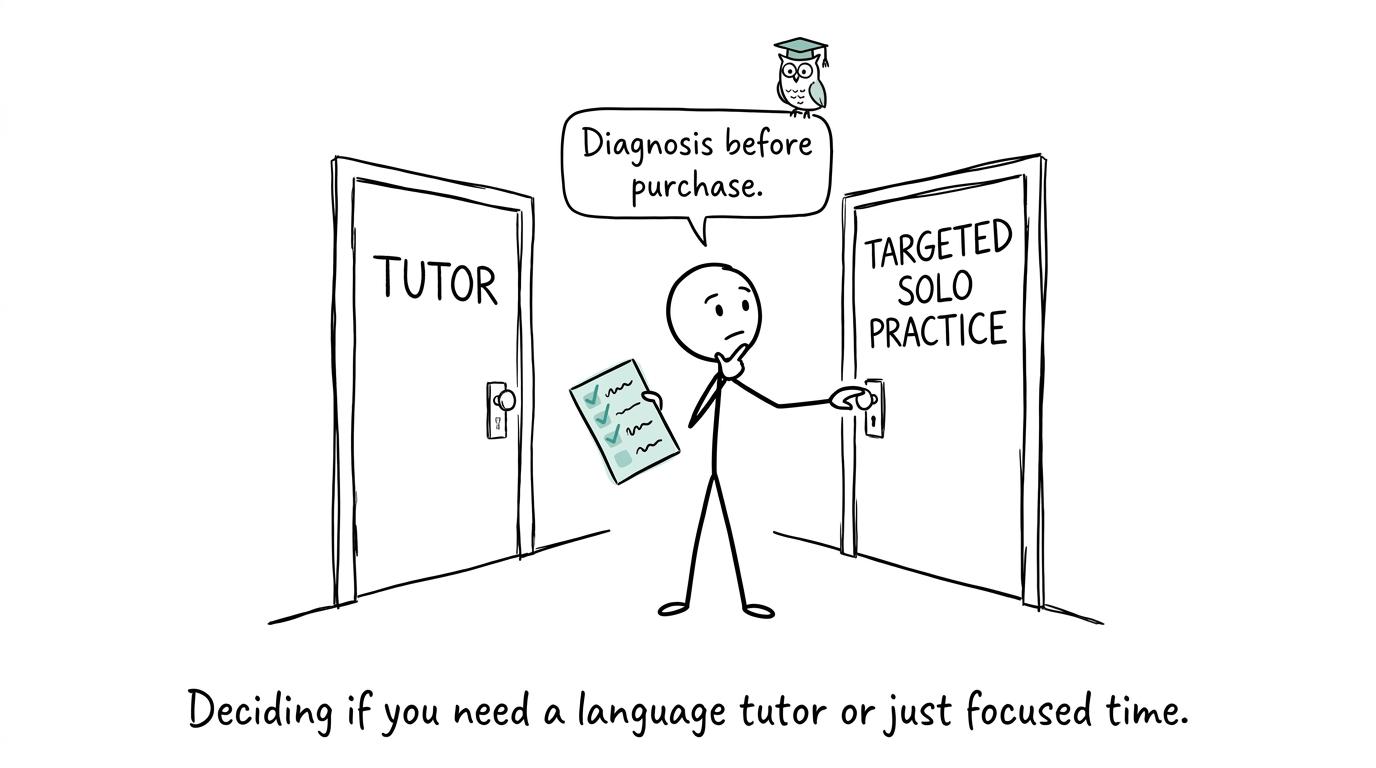 A student calmly chooses between tutoring and targeted independent practice
Start by confirming which qualification you take
Before contacting tutors, ask your school or examination centre for the exact qualification title, exam board and tier. Similar names can hide important differences.
AQA GCSE Bengali currently assesses four skills: listening, speaking, reading and writing. Each contributes approximately 25%25\%25% of the qualification. It is a linear GCSE, so the assessments are completed in the same examination series. Foundation tier covers grades 1-5, while higher tier covers grades 4-9, and students take all four components at the same tier.
Pearson Edexcel also offers an International GCSE in Bangla. That is a different qualification with its own specification and assessment structure. It focuses on reading, writing and translation in one externally assessed written paper rather than following the four-component AQA GCSE structure.
This distinction matters. A tutor who understands conversational Bengali but prepares you for the wrong assessment cannot provide properly targeted support. Ask any prospective tutor to identify your specification and explain how lessons will reflect it.
How to tell whether a GCSE Bengali tutor would help
Diagnose performance by skill
A total mock mark gives you a result, but not a diagnosis. Separate your performance into the skills your qualification assesses.
For AQA GCSE Bengali, consider:
- Listening: Can you follow speech at examination speed and distinguish important details from distractors?
- Speaking: Can you respond spontaneously rather than relying entirely on memorised answers?
- Reading: Can you understand unfamiliar passages and translate meaning accurately?
- Writing: Can you address every task requirement while using an appropriate range of vocabulary and structures?
- Exam technique: Do you understand timings, instructions, task types and what the mark scheme rewards?
Complete an appropriate specimen or past assessment under realistic conditions, then classify each lost mark. Was it caused by missing vocabulary, weak literacy, inaccurate grammar, misunderstood instructions, limited fluency or poor timing?
This is the same principle that makes effective maths revision work. A label such as “bad at algebra” is too broad to guide your next session; “cannot rearrange formulae containing fractions” is actionable. The MathsGenie guide to finding your weakest topics explains how to turn marks into specific revision priorities.
Check whether your difficulty requires human feedback
Some gaps are well suited to independent revision. Vocabulary can be retrieved with flashcards. Reading can be practised regularly. Timings can be trained with past papers.
Other areas are harder to judge alone. Speaking is the clearest example: you may not notice unclear pronunciation, unnatural pauses or answers that do not fully address the prompt. Writing also benefits from someone identifying recurring errors and explaining how to improve the response rather than merely correcting it.
A tutor is most valuable where the feedback loop is missing. Their purpose is not simply to give you more work. It is to notice what you cannot yet notice yourself.
Run a short independent trial first
Unless the examination is very close or you have no teaching support, try two or three weeks of disciplined revision before committing to tuition.
During the trial:
- practise each assessed skill rather than revising only vocabulary;
- complete at least one timed task;
- use the official specification and mark scheme for your qualification;
- record repeated errors;
- seek feedback from your teacher where possible;
- repeat a comparable task at the end.
If performance improves and you know what to do next, independent preparation may be enough. If you remain stuck, cannot evaluate your work or repeatedly avoid a weak skill, tutoring has a clearer job to do.
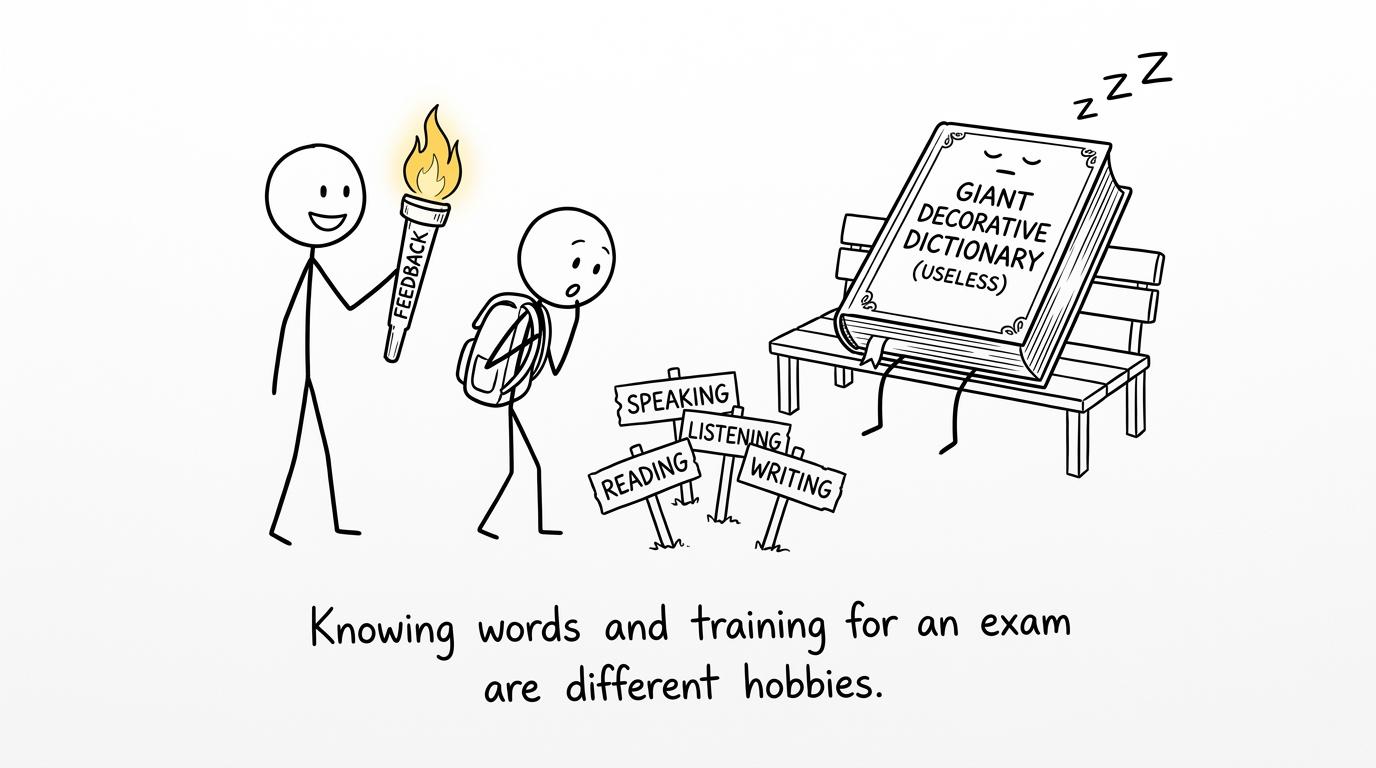 A tutor uses feedback to illuminate four language skills while a giant dictionary sleeps
What to look for in a GCSE Bengali tutor
Current specification knowledge
Ask which Bengali or Bangla qualifications the tutor currently teaches. They should be able to distinguish AQA GCSE Bengali from Pearson Edexcel International GCSE Bangla and describe the components relevant to you.
Useful questions include:
- Which specification will we follow?
- How will you assess my starting point?
- How do you teach speaking, listening, reading and writing?
- How do you use official mark schemes and examiner materials?
- How will we measure progress?
Clear, specific answers matter more than an impressive but general claim of language fluency.
Strong Bengali and strong teaching
Knowing a language and teaching an examination course are related, but different, abilities. A useful tutor should explain errors clearly, adapt work to your current level and show you how to improve independently.
For heritage speakers, this distinction can be particularly important. Everyday conversation may be comfortable while formal reading, spelling, grammar or extended writing remains less secure. A good tutor will respect the language you already have without assuming that fluency in one setting guarantees examination readiness.
Evidence of a structured plan
The first lesson should establish what support you need. After that, the tutor should be able to outline priorities, suitable practice and a review point.
A sensible plan might identify one primary weakness, one supporting weakness and a date for reassessment. Be cautious if every lesson is improvised, consists mainly of casual conversation or produces large amounts of homework without useful feedback.
Feedback you can act on
“Improve your grammar” is not enough. Feedback should identify a recurring issue, explain why it matters and give you a manageable action for the next task.
You should leave lessons knowing:
- what you did successfully;
- which error pattern matters most;
- what to practise before the next session;
- how improvement will be checked.
That principle also applies in maths. Using GCSE mark schemes properly turns a score into a correction plan rather than a judgement.
Practical arrangements and safeguarding
Discuss lesson length, frequency, cancellation arrangements, resources and total cost before beginning. If you are under 181818, a parent or carer should be involved in choosing and contacting a private tutor. For online sessions, agree how communication, lesson links, recordings and shared documents will be handled.
Qualifications, references, relevant experience and appropriate safeguarding arrangements can all help inform the decision. No single credential guarantees excellent teaching, so combine these checks with a trial lesson and specific questions about your course.
How to test a tutor before making a long commitment
Treat the first few sessions as a trial with a defined purpose. Give the tutor your exact specification, recent work and honest account of the areas you avoid.
After two or three sessions, ask yourself:
- Has the tutor identified a more precise problem than I could identify alone?
- Am I receiving feedback linked to the assessment?
- Do I understand how to practise between lessons?
- Is my performance changing on comparable tasks?
- Does the support fit alongside my other GCSE commitments?
Do not judge only by whether the lesson felt comfortable. Useful teaching sometimes reveals weaknesses. The better measure is whether you can do something independently that you could not do before.
Protect your GCSE maths revision time
A Bengali tutor should reduce uncertainty, not consume every available evening. If you are also preparing for maths, give each subject a clear place in your week.
Use the free GCSE Maths revision hub to choose your exam board and tier, then organise sessions around actual weaknesses. The GCSE maths revision timetable guide can help you balance topic practice, paper work and rest.
A simple rhythm is:
- reserve one fixed slot for Bengali tuition or feedback;
- schedule one short follow-up session while the advice is fresh;
- protect separate maths sessions for lessons and practice questions;
- review both subjects weekly rather than reacting to whichever feels most urgent.
MathsGenie offers board-specific support such as AQA GCSE Maths revision, alongside the wider revision resources hub. As exams approach, use GCSE past papers with mark schemes to make your maths priorities visible.
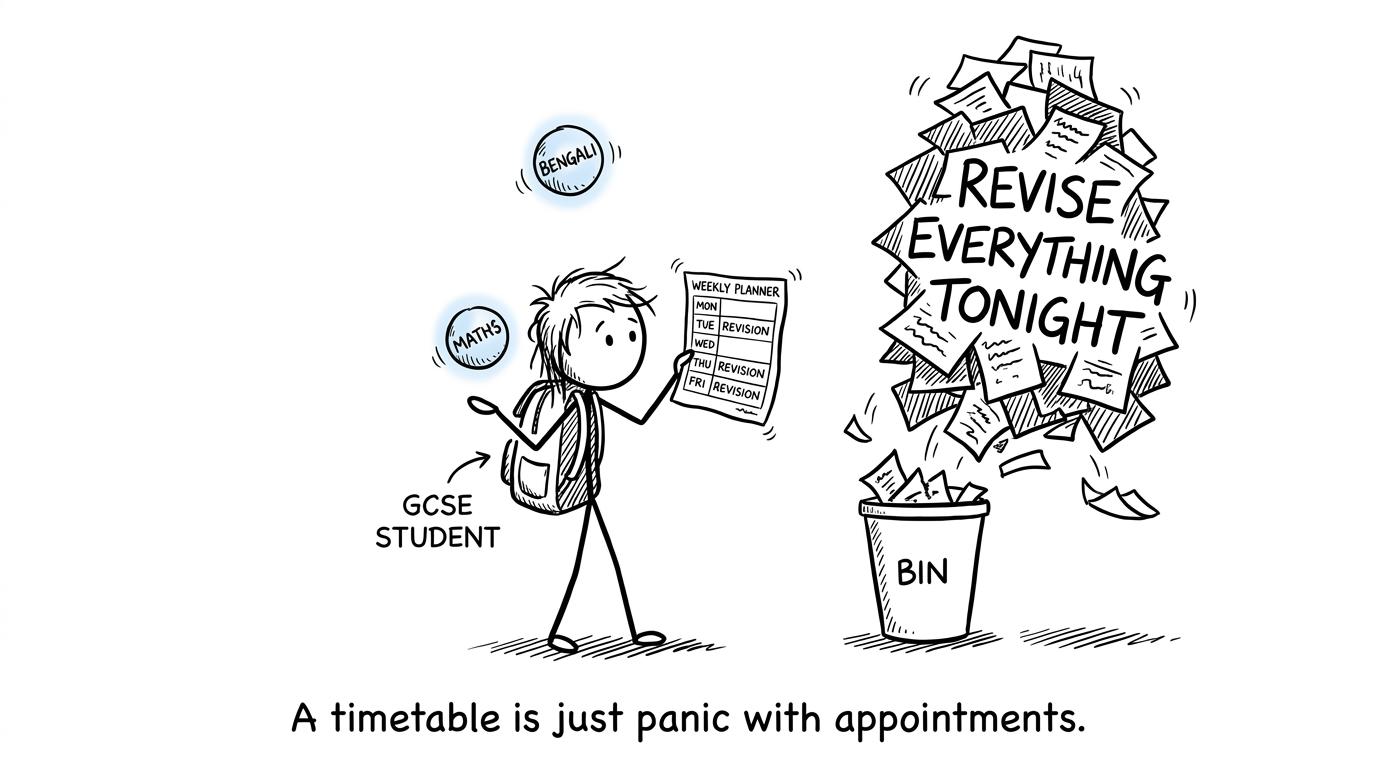 A student balances Bengali and maths while an unrealistic revision pile falls into a bin
Common mistakes when choosing Bengali tuition
Hiring before diagnosing
“Need help with Bengali” is too vague. Complete a diagnostic task first so that you can search for the right expertise and explain what must improve.
Assuming a fluent speaker is automatically an exam tutor
Fluency matters, but so do teaching skill, specification knowledge, feedback and familiarity with assessment materials.
Revising only comfortable skills
Students who enjoy conversation may neglect writing. Strong readers may avoid spontaneous speaking. Tuition should spend proportionate time on the skills that lose marks, not merely those that make lessons pleasant.
Expecting the lesson to replace practice
A tutor can guide, correct and structure your work. They cannot perform the repetitions for you. Progress depends on completing focused practice between sessions.
Continuing without reviewing progress
Set a review point. If several weeks pass without clearer feedback, greater independence or improved performance on comparable tasks, discuss the plan or consider a different arrangement.
Letting one subject take over the timetable
Urgency expands to fill whatever time you give it. Keep Bengali, maths and your other GCSE subjects visible in one revision planner. For maths, the one-month GCSE revision plan offers a practical structure when examination time is close.
Make the decision from evidence, not anxiety
You should get a GCSE Bengali tutor when there is a defined gap that skilled, specification-aware feedback can realistically close. You should not feel obliged to hire one simply because the examination matters or other students receive tuition.
Confirm your qualification. Diagnose each skill. Try a short period of structured independent work. If the same barrier remains, choose a tutor who understands your assessment, provides actionable feedback and measures whether you are becoming more independent.
Then protect the rest of your revision. For GCSE maths, make MathsGenie your free starting point: use revision lessons and practice questions to repair individual topics, mini tests to check recall, and past papers, predicted papers, mark schemes and video solutions to prepare for the real examination. Start with one weakness today and let the evidence decide what comes next.