Should I Take GCSE Biblical Hebrew? Honest Questions
Should I take GCSE Biblical Hebrew? Explore the course, exams, workload and honest questions to ask before committing space on your GCSE timetable.
Choosing GCSE options can feel strangely permanent. A subject that sounds fascinating in Year 9 may feel very different when it shares a revision timetable with maths, English and science two years later. If you are asking should I take GCSE Biblical Hebrew, the short answer is this: choose it if you are genuinely interested in close reading, grammar, translation and set texts, and if your school can provide strong teaching support. Do not choose it merely because it sounds impressive or familiar.
The right question is not simply, “Could I pass?” It is, “Will I still be willing to practise this when several other exams need my attention?”
A quick decision checklist
Before placing Biblical Hebrew on your options form, check whether you can honestly say yes to most of these:
- I enjoy analysing how language works.
- I am prepared to learn vocabulary and grammatical forms consistently.
- I am interested in reading Biblical texts closely, not only knowing their stories.
- I understand that Biblical Hebrew and Modern Hebrew are different GCSE subjects.
- I have asked who will teach the course and how often lessons will run.
- I know which exam board, specification and examination year apply to me.
- I have considered the effect on my wider GCSE revision timetable.
- I am choosing the subject for myself rather than to satisfy someone else.
One uncertain answer does not mean you should reject the course. Several uncertain answers mean you need more information before committing.
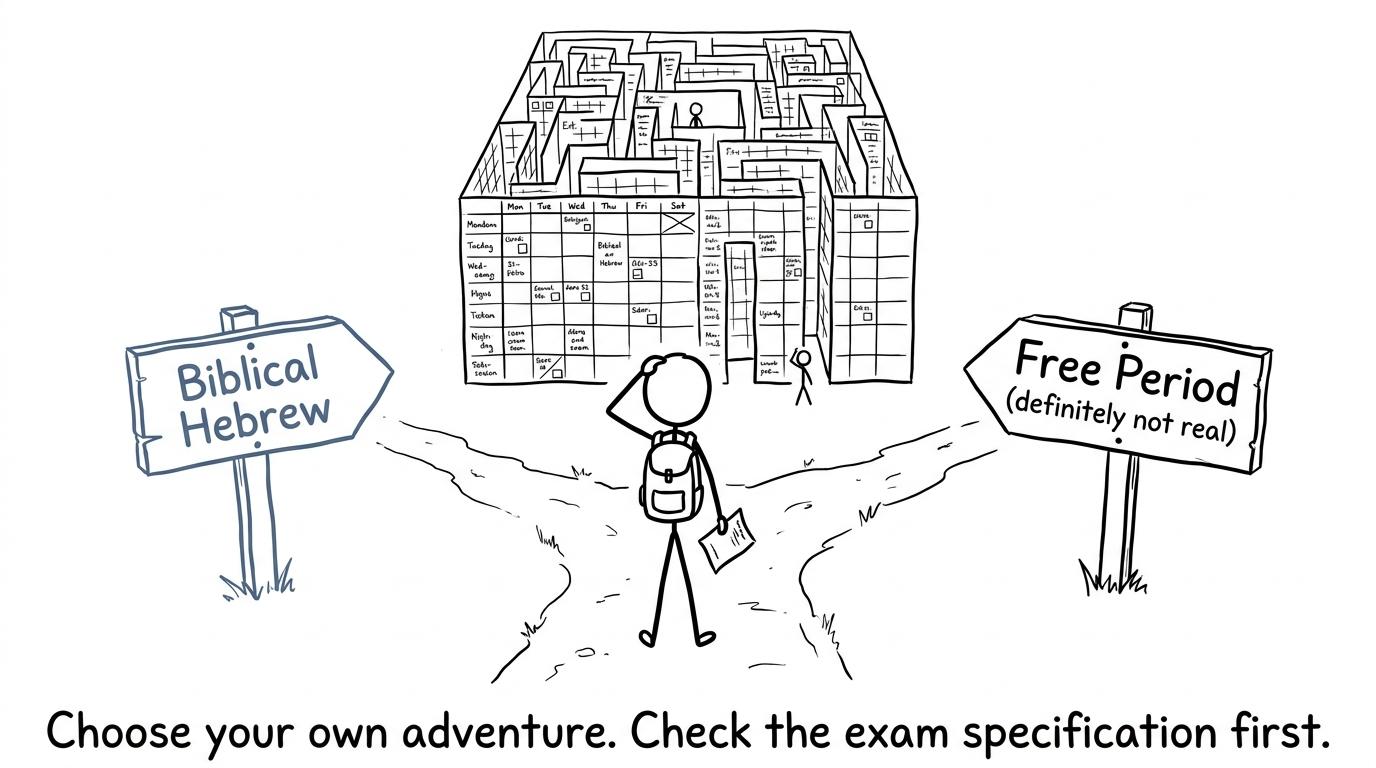 A student choosing between GCSE options while a timetable looms in the background
Do you know what GCSE Biblical Hebrew actually involves?
GCSE Biblical Hebrew is an ancient-language qualification. It is not a conversational course built around speaking, listening or everyday situations. The emphasis is on understanding written Biblical Hebrew, translating unseen passages, applying grammar and responding to literature.
At the time of writing, the approved GCSE in England is Pearson Edexcel Biblical Hebrew, qualification code 1BH0. It is a linear, untiered qualification, so students take all assessment at the end of the course and there is no separate foundation or higher tier.
The current structure contains two externally examined components:
| Component | Main focus | Current weighting |
|---|---|---|
| Language | Unseen comprehension, translation into English and grammatical understanding or translation into Biblical Hebrew | 50%50\%50% |
| Literature | Knowledge, translation, analysis and evaluation of prescribed set texts | 50%50\%50% |
Each written examination is currently 222 hours. There is no coursework or controlled assessment. That matters because your final result depends on performing under timed conditions rather than accumulating marks through the course.
For examinations from 2026 to 2028, Pearson currently prescribes passages concerning Joseph’s rise to power from Genesis and the miracles of Elisha from Kings. Set texts can change between examination cycles, so confirm the texts for your own cohort with your teacher and the latest specification rather than relying on an older student’s notes.
Are you interested in language, or only in the stories?
Recognising a narrative is not the same as being able to translate its language.
You may already know what happens in a passage. That background can support understanding, but the examination also tests whether you can identify vocabulary, verb forms, syntax and literary effects. Familiarity with the story cannot replace grammatical accuracy.
Ask yourself what you enjoy when reading a text. Do you like noticing why a particular word was chosen? Are you curious about sentence structure? Can you tolerate spending time on a short passage until every part makes sense?
If so, Biblical Hebrew may suit you very well. It rewards careful attention. There is something satisfying about moving from a page that initially looks dense to one whose structure you can recognise.
If you mainly enjoy discussing broad religious themes but dislike detailed language work, look closely at the course materials before deciding. Your interest may be better matched by another subject. GCSE Biblical Hebrew includes literary interpretation, but language knowledge accounts for half of the qualification.
Will you practise vocabulary and grammar regularly?
Some subjects allow you to recover after a quiet fortnight. Languages are less forgiving. Vocabulary and grammatical forms accumulate, and later passages depend on earlier knowledge.
This does not mean you need endless revision sessions. It means you need repeatable ones. Short, frequent retrieval is usually more manageable than attempting to relearn months of material before a test.
A realistic weekly routine might include:
- recalling vocabulary without looking at the answer first;
- identifying grammatical forms in short passages;
- translating a small amount accurately;
- revisiting set-text notes;
- correcting errors from marked work.
Notice the similarity to effective maths revision. Watching somebody else solve an equation can feel clear without proving that you can solve the next one. Reading a Hebrew translation can create the same illusion. In both subjects, independent practice reveals what you actually know.
MathsGenie’s guide to turning revision into a workable timetable can help you protect regular maths sessions while adding another demanding subject. The free MathsGenie revision planner is also useful for seeing whether your proposed week is genuinely realistic.
What teaching support will you have?
A subject can be right for you but wrong in a particular setting.
Biblical Hebrew is a specialist course, so ask practical questions before choosing it:
- Will lessons appear inside the normal timetable?
- Is the teacher experienced with the current Pearson Edexcel specification?
- How many taught hours will you receive?
- Will you have regular marked translation practice?
- What happens if a lesson clashes with another option?
- Are past papers and specification materials provided?
- Who can answer questions between lessons?
If the course is taught after school, independently or in a very small group, that is not automatically a disadvantage. Small classes can offer focused support. But an unusual arrangement changes the amount of organisation required from you.
Ask to see a sample passage and recent assessment material. You are choosing the daily work, not the course title.
How will it fit beside GCSE maths and your other subjects?
Every option has an opportunity cost. Time spent revising one course cannot be spent twice.
That does not mean you should choose only subjects that appear easy. A subject you value can be worth substantial effort. The danger is ignoring how that effort will sit beside compulsory subjects and other content-heavy options.
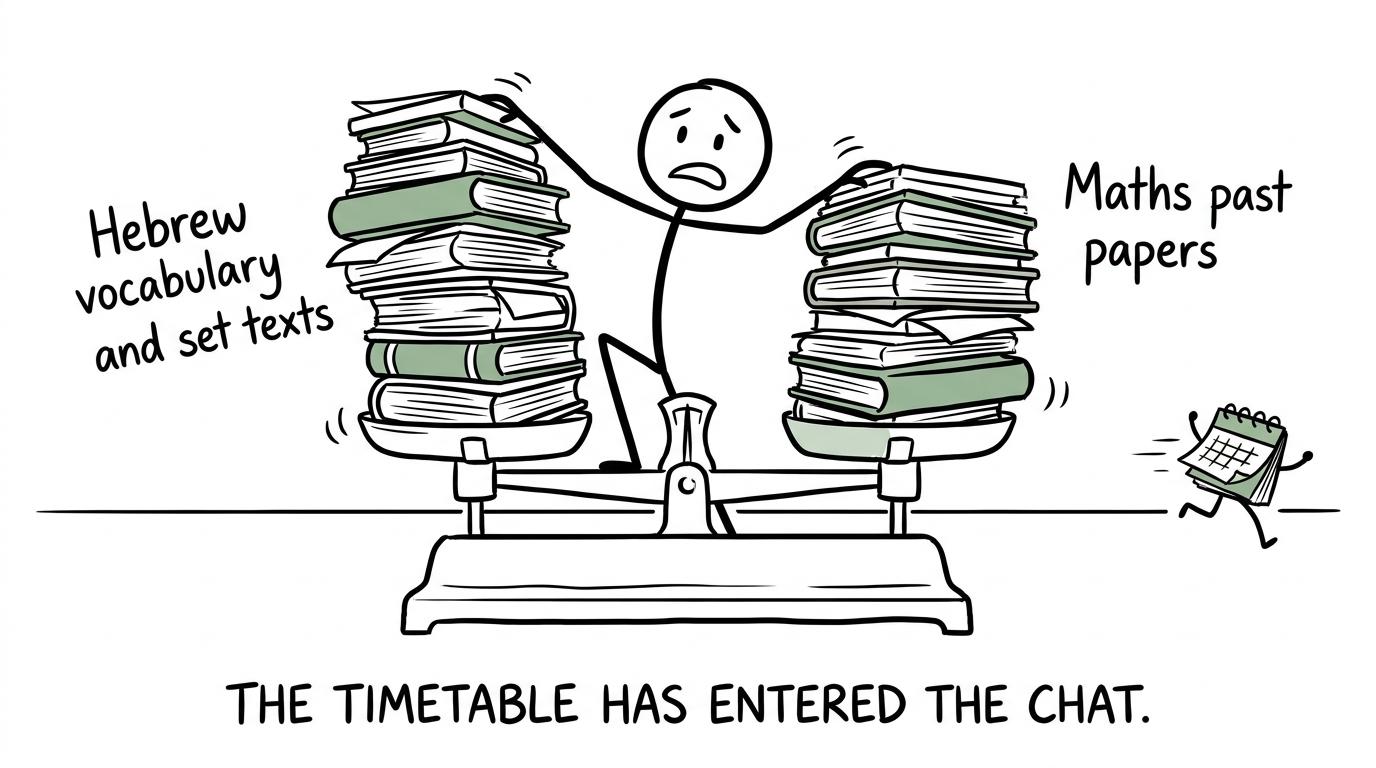 A revision timetable struggles to balance Hebrew set texts and maths papers
Sketch a normal week rather than an imaginary perfect week. Include school, homework, travel, family commitments, rest and activities. Then give Biblical Hebrew a regular slot and preserve time for maths.
For maths, start from the GCSE Maths revision hub, where you can choose resources for Edexcel, AQA, OCR, Eduqas, WJEC or CCEA. If you study Edexcel, the Edexcel GCSE Maths revision area brings lessons, questions and papers together for both foundation and higher tier.
The purpose is not to fill every empty space. A timetable with no spare capacity collapses as soon as a test, illness or difficult week appears. Leave room to catch up.
Are you choosing it for the right reason?
Good reasons can include intellectual curiosity, enjoyment of language, a wish to read Biblical texts more closely or an intention to continue with related study. Existing familiarity may help too, provided you still respect the demands of the specification.
Less reliable reasons include:
- “It must be easy because I recognise some of it.”
- “It will look unusual on an application.”
- “My friends are taking it.”
- “Someone else expects me to choose it.”
- “It has no speaking examination, so revision will be light.”
An untiered written course may remove speaking and listening assessments, but it replaces them with sustained translation, grammar and literary analysis. Different does not mean effortless.
Try one simple thought experiment: imagine that nobody else could see the subject name on your results sheet. Would you still want to learn it? If the answer is yes, your motivation is probably coming from a durable place.
Can you handle the examination style?
Both current papers are long written examinations. Success therefore involves more than knowing content. You must retrieve vocabulary, read accurately, manage time and write clear analytical responses while the clock is running.
Past-paper practice matters because it exposes the gap between untimed understanding and timed performance. The same principle applies in maths. MathsGenie’s guide to using GCSE past papers properly explains a useful cycle: attempt, mark, diagnose, repair and retest.
For your maths preparation, use GCSE predicted papers after topic revision rather than treating them as replacements for official past papers. Mark schemes and video solutions can then show whether you lost marks through knowledge, accuracy or exam technique.
A student who dislikes every form of timed writing should not immediately rule out Biblical Hebrew. Exam stamina can be trained. But you should know what you are agreeing to train for.
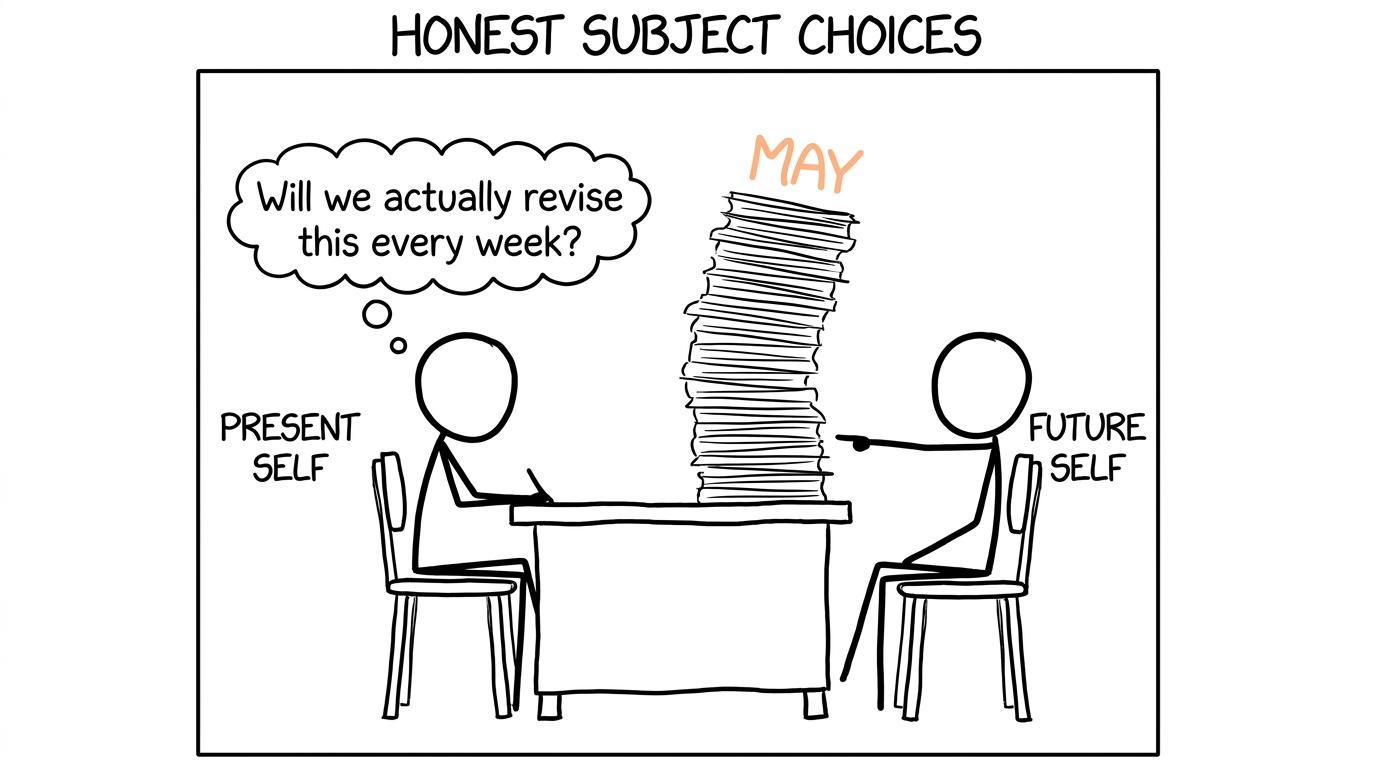 A GCSE student asks their future self whether weekly revision will really happen
Common mistakes when choosing GCSE Biblical Hebrew
Confusing Biblical Hebrew with Modern Hebrew
Modern Hebrew GCSE typically assesses contemporary communication through skills such as listening, speaking, reading and writing. Biblical Hebrew is treated as an ancient language and centres on written language and literature. Check the exact title and qualification code on your school’s option information.
Assuming prior familiarity guarantees a high grade
Recognising vocabulary, prayers or narratives can provide a useful starting point. It does not remove the need to master the prescribed grammar, unseen translation and examination technique.
Ignoring the set texts
The literature paper is not an optional extra. Under the current specification, it contributes 50%50\%50% of the qualification and requires detailed knowledge alongside analysis and evaluation.
Choosing before checking the timetable
Find out whether the course replaces another option, runs after school or creates clashes. Regret often begins with practical details that could have been checked early.
Planning revision as though maths will take care of itself
Maths improves through continued question practice. Do not pause it for months while another subject becomes urgent. A one-month GCSE maths revision plan can help later, but steady work throughout the course is safer than a last-minute rescue.
A final way to make the decision
Speak to the teacher, inspect the latest specification, look at a sample paper and try a short piece of real course material. Then ask three final questions:
- Am I interested in the work itself?
- Can I support that interest with regular practice?
- Does the course fit honestly into my timetable?
If your answers are yes, GCSE Biblical Hebrew could be a thoughtful and rewarding option. If they are no, declining it is not a failure. A good option choice is one you can sustain, not one that merely sounds impressive in September.
Whatever you decide, keep compulsory maths revision stable. Use MathsGenie for free revision lessons and practice questions, then check progress with mini tests, past papers, mark schemes and video solutions. As the exams approach, add predicted papers to sharpen your technique. Start with the GCSE Maths revision hub, choose your board and tier, and make a plan your future self can actually follow.