

Sharing in a Ratio Exam Questions: GCSE Guide
Sharing in a ratio exam questions explained through three worked examples. Learn clear methods, avoid common mistakes and practise GCSE questions confidently.
A student can understand ratios in a lesson, then freeze when an exam question wraps the same idea in a story about money. Sharing in a ratio exam questions become easier when you identify what the given amount represents: the total, one share, or the difference between shares. Match that amount to the correct number of ratio parts, find one part, then calculate the shares.
Imagine a student working through three questions of increasing difficulty. Their breakthrough is learning to pause before dividing. Below, you can follow that approach, see which working demonstrates the method, and then practise independently.
The sharing method to remember
A ratio describes relative amounts. In the ratio 2:52:52:5, the first person receives two equal parts and the second receives five equal parts. Those parts have the same value.
Before calculating, use this checklist:
- Label who receives each share.
- Identify whether the given amount is a total, a share or a difference.
- Match that amount to its number of parts.
- Divide to find one part, then multiply for the required shares.
- Check your answer against the original information.
Sharing quantities in a ratio is GCSE content for both foundation and higher tier. More demanding questions often disguise which parts the given amount represents.
You can revisit the explanation through the Lessons on MathsGenie's Edexcel GCSE ratio topic page.
Sharing in a ratio exam questions: three worked examples
These are original exam-style questions, rather than reproduced past paper questions. The marking comments explain useful working; exact mark allocations depend on the question and its mark scheme.
Question one: the total is given
Amira and Ben share £84£84£84 in the ratio 2:52:52:5. Work out how much each receives.
Our student writes the names above the ratio. This small step protects against giving the correct amounts to the wrong people.
Find the total number of parts:
2+5=72+5=72+5=7Find the value of one part:
£84÷7=£12£84\div7=£12£84÷7=£12Calculate both shares:
Amira=2×£12=£24\text{Amira}=2\times£12=£24Amira=2×£12=£24 Ben=5×£12=£60\text{Ben}=5\times£12=£60Ben=5×£12=£60Check the total:
£24+£60=£84£24+£60=£84£24+£60=£84The calculation 84÷784\div784÷7 makes the sharing method visible. Multiplying that value by the ratio numbers shows how the student obtains each share. These are the kinds of steps that can support method credit, even if a later arithmetic slip affects an answer.
Question two: one person's share is given
Chloe and Daniel share some money in the ratio 3:73:73:7. Chloe receives £45£45£45. How much does Daniel receive?
The student nearly adds the ratio numbers automatically. Then they notice that £45£45£45 belongs to Chloe alone. It represents three parts, rather than the whole amount.
Match Chloe's share to her parts:
3 parts=£453\text{ parts}=£453 parts=£45Find one part:
£45÷3=£15£45\div3=£15£45÷3=£15Calculate Daniel's seven parts:
7×£15=£1057\times£15=£1057×£15=£105Daniel receives £105£105£105.
Here, 45÷345\div345÷3 is the key method step. Dividing by the total number of parts would answer a different question, because the total amount has not been given.
The student can check the relationship by simplifying 45:10545:10545:105 to 3:73:73:7. If this checking step feels uncertain, use the writing and simplifying ratio questions.
Once you can match the given amount to its parts, use the Lessons and Question Bank on MathsGenie's AQA ratio page to practise that decision with different wording.
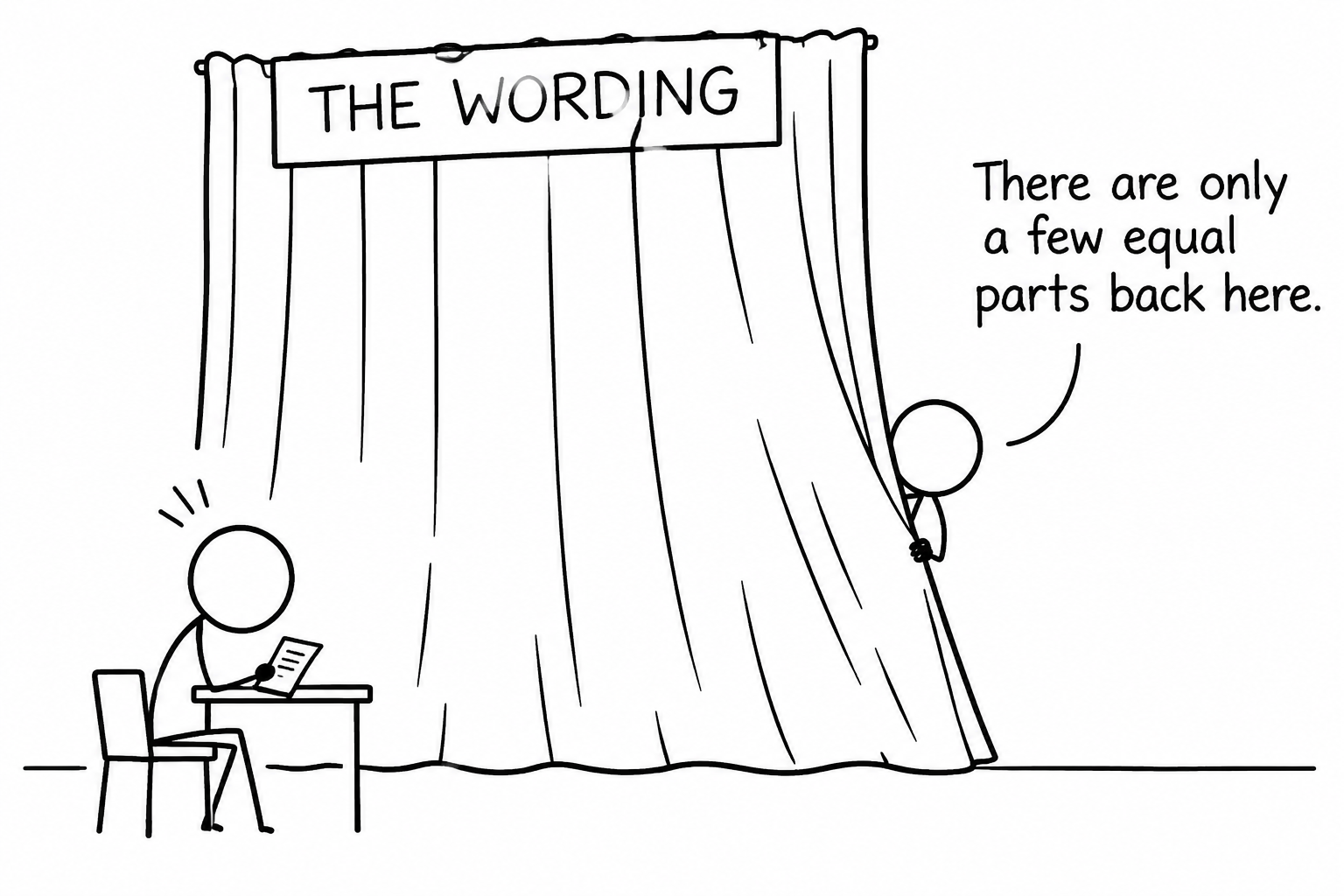 A stick-figure student discovers that intimidating question wording hides only a few equal parts.
Question three: the difference is given
Ellis and Farah share some money in the ratio 4:74:74:7. Farah receives £36£36£36 more than Ellis. Work out both shares.
This time, the student underlines “more than”. The given amount describes the gap between the shares.
Find the difference in parts:
7−4=37-4=37−4=3Match the difference to the money:
3 parts=£363\text{ parts}=£363 parts=£36Find one part:
£36÷3=£12£36\div3=£12£36÷3=£12Calculate both shares:
Ellis=4×£12=£48\text{Ellis}=4\times£12=£48Ellis=4×£12=£48 Farah=7×£12=£84\text{Farah}=7\times£12=£84Farah=7×£12=£84Check the stated difference:
£84−£48=£36£84-£48=£36£84−£48=£36The crucial reasoning is connecting 7−47-47−4 with £36£36£36. Writing both the subtraction and the division exposes that reasoning to the examiner. A bare answer hides it.
Where method marks come from
For sharing in a ratio GCSE exam questions, clear working records the relationship you have recognised. Write the calculation used to find one part, followed by the multiplication needed for the requested share.
Avoid filling the page with disconnected arithmetic. Labels such as “one part” and the recipients' names help make your solution readable. Include units in your final answer and answer exactly what was asked: one share, both shares or the total.
Compare your working with the worked solution and mark scheme attached to a MathsGenie ratio question. Use the question's own marking guidance rather than assuming every ratio problem awards marks identically.
Common mistakes to avoid
Always adding the ratio numbers. Addition finds the total parts. Use it when the given amount is the total; use the relevant share or difference otherwise.
Dividing by the number of people. Equal sharing and sharing in a ratio are different instructions. The ratio determines how many equal parts each person receives.
Reversing the shares. Keep names in the same order as the ratio throughout your working.
Checking the wrong thing. If the question gives a difference, check the difference. A plausible total does not establish that your answer satisfies the question.
Exam-style practice
Before searching for sharing in a ratio past paper questions, try these original questions without looking back at the examples:
- Share £96£96£96 between Aisha and Blake in the ratio 3:53:53:5.
- Two lengths are in the ratio 2:72:72:7. The longer length is 56 cm56\text{ cm}56 cm. Find the shorter length.
- Two amounts are in the ratio 3:53:53:5. Their difference is 202020. Find both amounts.
Answers: Aisha receives £36£36£36 and Blake receives £60£60£60; the shorter length is 16 cm16\text{ cm}16 cm; the amounts are 303030 and 505050.
If an answer differs, inspect your first division. Ask what the given amount represents before repeating the arithmetic.
Turn the method into a habit
Our imagined student now pauses to identify the given amount before calculating. You have the same method; the next step is recognising it independently when the wording changes. Start with ratio Lessons, then practise choosing the correct parts in the MathsGenie Question Bank.















