Self Study GCSE English Literature: A Realistic Plan
Self study GCSE English Literature with a realistic twelve-week plan covering set texts, quotations, essays, past papers and independent exam entry in the UK.
The hardest part of learning English Literature alone is not reading the books. It is knowing whether your interpretation is good enough when no teacher is standing beside you.
The short answer is yes: you can self study GCSE English Literature outside school. The qualification is assessed through written examinations, and private candidates can enter through an approved exam centre. But success requires more than reading summaries and memorising quotations. You need the correct set texts, a clear understanding of your exam board, regular analytical writing and an honest feedback system.
This guide gives you a realistic twelve-week plan. It is particularly designed for students who must fit English Literature around GCSE maths and other subjects without allowing one demanding subject to consume the entire timetable.
Your self-study checklist
Before beginning, make sure you can answer these questions:
- Which exam board are you taking: AQA, Edexcel, OCR or Eduqas?
- Which specification and set texts apply to your exam series?
- Are you already entered through a school, or must you find a private candidate centre?
- Do you own the correct editions of every play, novel and poetry anthology?
- Can you access official past papers, mark schemes and examiner reports?
- When will you complete timed essays and full papers?
- Who can give occasional feedback on your writing?
That final question matters. Self-study means directing your own course, not refusing all outside help. A teacher, tutor or knowledgeable adult who reviews even a few essays can help you notice weaknesses that are difficult to see alone.
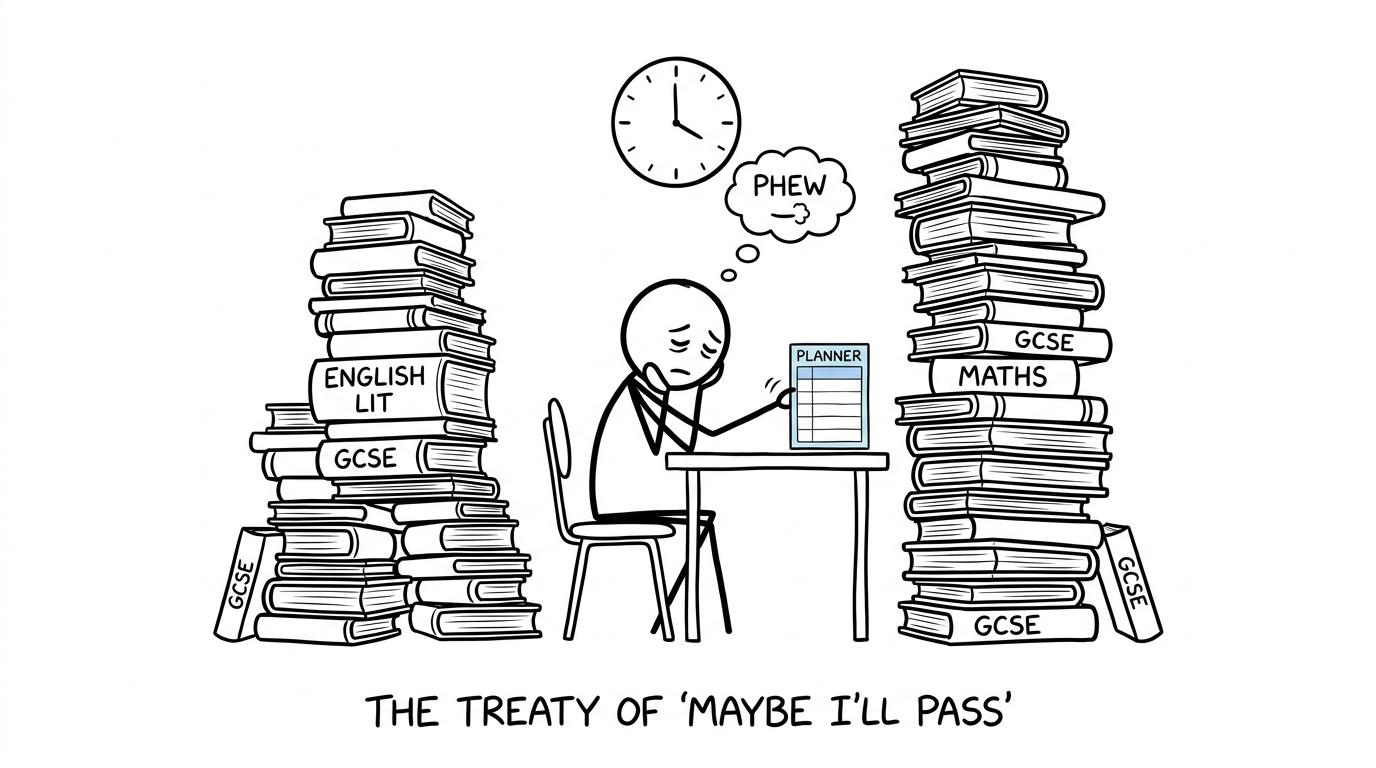 A GCSE student balancing English Literature and maths revision with a small weekly planner
Is GCSE English Literature genuinely possible outside school?
It is possible because the destination is clearly defined. Exam boards publish specifications, assessment objectives, sample materials, past papers and mark schemes. You are not trying to guess what the course contains.
GCSE English Literature is also untiered. Unlike GCSE maths, there is no foundation or higher paper. Students sit the same qualification and receive a grade on the grades 999 to 111 scale.
However, the route is demanding for three reasons.
First, every board has its own set texts and paper structure. AQA, for example, assesses Shakespeare, a nineteenth-century novel, a modern text, anthology poetry and unseen poetry. OCR, Edexcel and Eduqas organise their components differently. Never buy books or begin a poetry cluster until you have checked the current specification for your board and exam series.
Second, literature is a performance subject. Knowing the plot is not the same as producing a focused argument under time pressure. You must repeatedly turn ideas into paragraphs and complete responses.
Third, feedback is less immediate than it is in maths. In maths, a mark scheme can often confirm whether a method and answer are correct. Literary responses may allow several valid interpretations, provided they are well supported and relevant to the question.
The solution is not to make your plan more complicated. It is to build a better feedback loop.
Set up the course before you start revising
If you attend school and are simply learning the subject independently, confirm your exam board, entry and texts with your exams officer. Do not assume that a friend at another school studies the same books.
If you are completely independent, you will normally be a private candidate. An awarding body does not take your entry directly. You need an approved school, college or examination centre willing to enter private candidates. Contact centres early, ask which boards they offer, confirm all fees and discuss access arrangements at the time of entry if you need them.
English Literature should not be confused with English Language. They are separate GCSE qualifications, with different content and assessment arrangements. Check exactly which qualification codes you are entering.
Once the administration is secure, assemble a small working library:
- the current specification;
- the correct set texts and anthology;
- official past papers and mark schemes;
- examiner reports or published exemplars where available;
- one notebook or digital document for themes, quotations and essay feedback;
- a calendar containing both English and maths commitments.
For maths, the GCSE Maths revision hub keeps board-specific lessons, questions and papers together. Keeping your maths resources organised reduces the number of decisions competing with your English plan.
What you actually need to learn
The assessment objectives are broadly consistent across GCSE English Literature specifications, although their application and weighting vary by paper. In practical terms, you need to develop four connected abilities.
Knowledge and a personal argument
You must understand the texts, answer the precise question and support your interpretation with relevant references. Retelling the story is not enough.
After each act, chapter or group of poems, close the book and record:
- what changed;
- which theme developed;
- what the writer may be suggesting;
- which short reference could support that idea.
This is active recall. It exposes uncertainty far more effectively than highlighting another page.
Analysis of the writer's choices
You need to explain how language, form and structure create meaning. Naming a metaphor or adjective earns little by itself. The important question is why that choice matters here, at this moment, in relation to your argument.
Context used with restraint
Context should illuminate the text rather than become a detached history paragraph. Learn the social, literary and historical ideas that genuinely shape characters, themes or audience responses. Avoid memorising long collections of facts that you cannot connect to the question.
Accurate, controlled writing
Some elements of the qualification reward spelling, punctuation, vocabulary and sentence control. More importantly, clear writing allows an examiner to follow your interpretation. Aim for precise sentences, not decorative complexity.
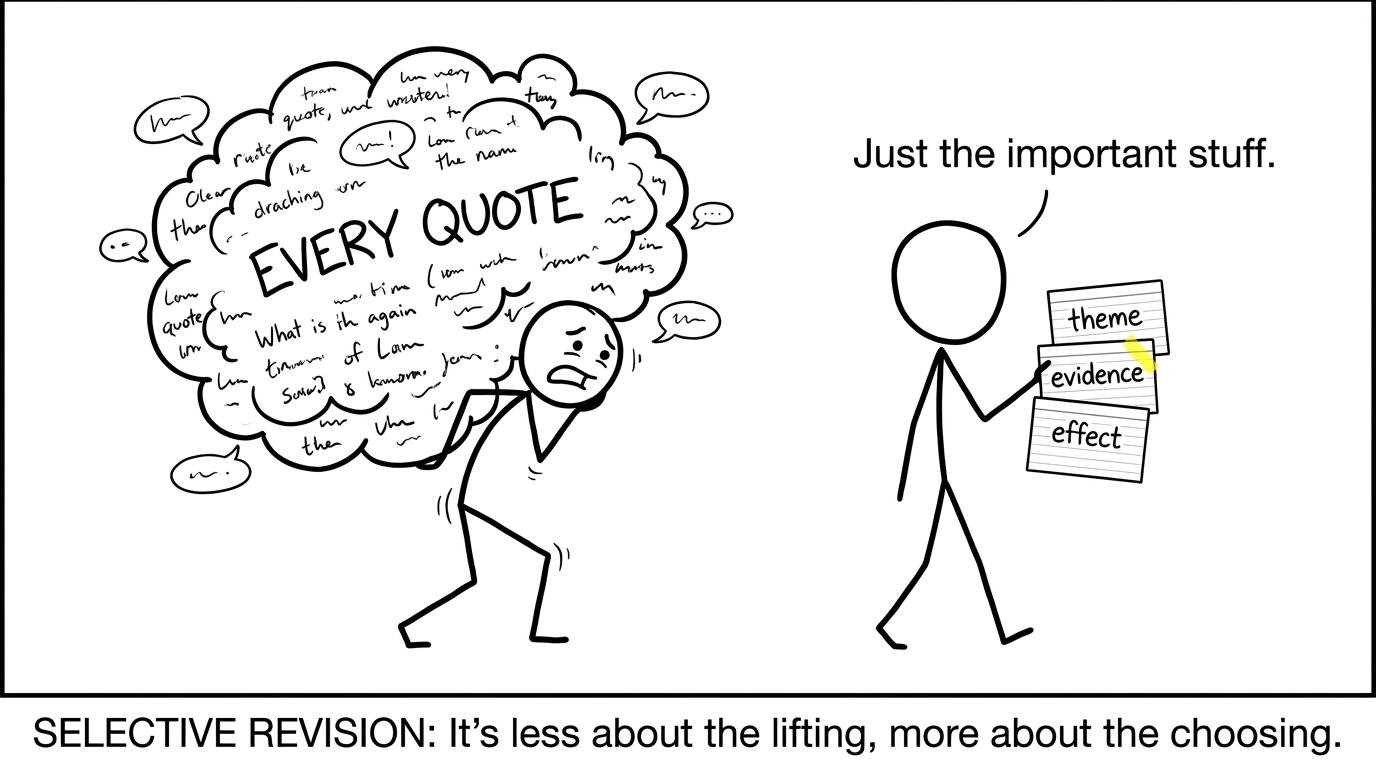 A student choosing a few useful quotation cards instead of carrying every quotation
A realistic twelve-week self-study plan
This plan assumes three English sessions each week: two sessions of around 454545 to 606060 minutes and one longer writing session. Adjust the workload to your exam date and existing knowledge, but preserve the order.
| Week | Main focus | Evidence of progress |
|---|---|---|
| One | Confirm the board, specification, texts, entry arrangements and paper format. Complete a diagnostic response without extensive revision. | A course checklist and a short list of weaknesses. |
| Two | Read or revisit the first set text. Track plot, characters, themes and turning points. | A concise whole-text map created from memory. |
| Three | Study the first text more closely. Select flexible quotations and analyse important writer choices. | Theme sheets and one completed essay. |
| Four | Read or revisit the second set text using the same process. | A plot and character map plus retrieval questions. |
| Five | Develop interpretations of the second text and practise linking extracts to the whole work where your paper requires it. | One timed response, marked against the criteria. |
| Six | Study the modern prose or drama text specified by your board. Focus on argument rather than plot summary. | Theme connections and one essay plan. |
| Seven | Complete a timed modern-text essay. Review paragraph focus, evidence and analysis. | A rewritten introduction and improved paragraph. |
| Eight | Organise the prescribed poetry anthology by themes and useful comparisons. | A comparison grid built from memory. |
| Nine | Write poetry comparisons and practise selecting the most relevant second poem. | One planned and one timed comparison. |
| Ten | Practise unseen poetry or other unseen material required by your specification. | Two independent responses with reflection notes. |
| Eleven | Complete timed sections from an official paper. Identify problems with knowledge, writing or timing. | An error log containing specific next actions. |
| Twelve | Sit a complete paper under the correct conditions, mark carefully and repair the weakest areas. | A final priority list rather than a new pile of notes. |
During the final weeks, do not abandon maths to rescue English. Alternate subjects deliberately. The same principle used in the best order for learning GCSE maths topics applies here: build core knowledge before expecting full-paper performance.
How to practise essays without a classroom
Use a repeatable cycle:
- answer the question before writing anything else;
- plan a defensible argument;
- select evidence because it supports that argument;
- explain how the writer's choices shape meaning;
- connect context only where it adds insight;
- compare your response with the mark scheme and exemplars;
- rewrite the weakest section;
- return to a similar task several days later.
Do not give yourself a grade after every essay. Early self-marking is more reliable when it asks narrower questions: Did every paragraph answer the question? Did I analyse rather than label methods? Did I support each claim? Did I spend too long on the opening?
This resembles effective maths paper practice. MathsGenie's guide to using past papers properly centres on attempting, marking, diagnosing and retesting. The subject changes, but the learning cycle survives.
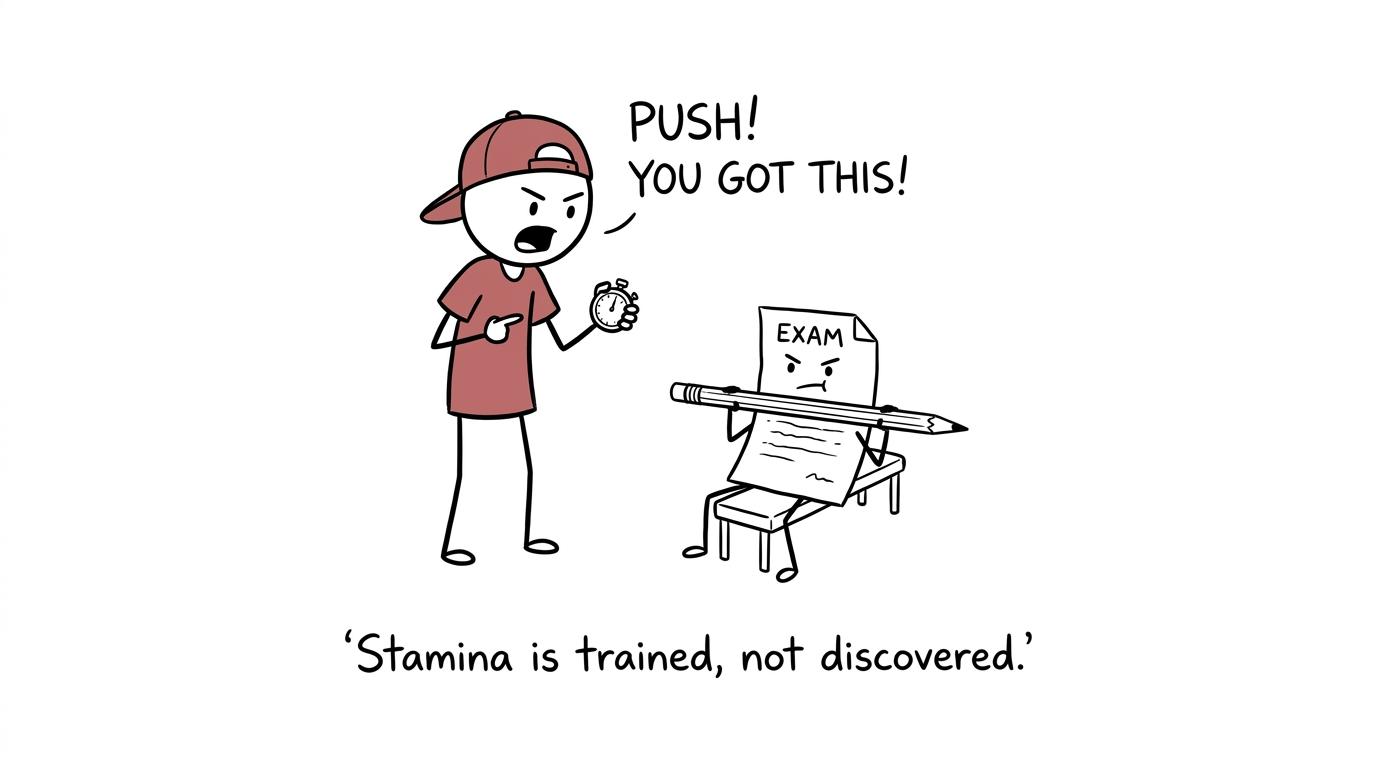 An exam paper training in a tiny gym to build writing stamina
Balance English Literature with GCSE maths
English essays can expand to fill every available evening. Give each session a defined output: one theme map, one essay plan or one timed response. Stop when the output is complete.
Keep maths active through short, regular practice. Choose the page matching your board, such as AQA GCSE Maths revision, OCR GCSE Maths revision or Eduqas GCSE Maths revision. Use revision lessons for weak topics, then move directly to questions and mark schemes.
Near the exams, combine official maths papers with fresh practice such as Edexcel GCSE Maths predicted papers. Predicted papers should sharpen preparation, not replace official past papers. The same caution applies to predicted English questions: revise complete texts and transferable arguments rather than betting everything on one theme.
Common mistakes when studying alone
Choosing texts before checking the specification
A famous GCSE novel is not automatically one of your permitted texts. Confirm the board, qualification code and current prescribed list first.
Reading instead of retrieving
Rereading feels productive because the page becomes familiar. Close the book and reconstruct themes, events and quotations from memory. Familiarity is not recall.
Memorising quotations without ideas
A quotation is useful only when you can connect it to characters, themes and writer choices. A smaller bank of flexible evidence is more manageable than hundreds of isolated lines.
Writing essays without reviewing them
Volume alone does not create improvement. Mark each response against the assessment criteria, identify one weakness and rewrite something.
Depending on predicted questions
No prediction removes the need to know the whole text. Prepare adaptable arguments and practise responding to unfamiliar wording.
Leaving timed papers until the end
Essay stamina must be trained. Begin with paragraphs and individual questions, then progress to sections and complete papers. Maths students can use a similar progression through MathsGenie's one-week revision plan when organising their final maths preparation.
Start with structure, not confidence
You do not need to feel ready before beginning. You need the correct specification, the correct texts and a weekly process that produces visible work.
Read closely. Retrieve without notes. Write regularly. Use official assessment material. Seek occasional feedback. Then repeat.
While English Literature needs its own texts and exam-board resources, MathsGenie can keep the mathematical half of your timetable clear and manageable. Use the free GCSE Maths revision hub for revision lessons, practice questions, mini tests and video support, then build exam confidence with past papers, mark schemes and predicted papers. A good independent plan does not ask one subject to disappear. It gives each subject a reliable next step.