

Rounding to Significant Figures: GCSE Maths
Rounding to significant figures GCSE maths explained with a simple method, worked examples, common mistakes and exam-style practice questions.
A student can understand every word in a rounding question and still lose the mark. That was the pattern for Sam, a hypothetical GCSE student who kept counting from the decimal point, crossing out the wrong digits and hoping the calculator would decide what mattered.
The idea that finally made rounding to significant figures GCSE maths feel manageable was simple: significant figures begin at the first non-zero digit. Find that digit, count to the required place, then use the next digit to decide whether to round up.
This method works for whole numbers, decimals and very small values. It is also useful when estimating calculations and giving answers to an appropriate degree of accuracy.
The significant figures checklist
Use this process every time:
- Find the first digit that is not zero.
- Count from that digit to the required significant figure.
- Underline the final digit you are keeping.
- Look at the digit immediately to its right.
- If that digit is 555 or more, round up.
- If it is 444 or less, leave the kept digit unchanged.
- Replace removed place-value digits in whole numbers with zeros.
The first non-zero digit is the anchor. Once Sam stopped looking automatically for a decimal point and started looking for that anchor, the questions became much less mysterious.
For a complete lesson with practice, use the Maths Genie rounding lesson alongside this guide.
What counts as a significant figure?
A significant figure is a digit that contributes to the stated accuracy of a number. Counting normally begins with the first non-zero digit.
Consider 0.004720.004720.00472. The zeros before 444 only locate the decimal value, so they are not counted as significant figures. The significant digits are 444, 777 and 222.
In 50 60050\,60050600, the first significant figure is 555. If the number is being treated as an exact written value, the internal zero helps preserve place value, while the zeros at the end may create ambiguity about the intended accuracy. GCSE questions avoid that uncertainty by asking you to round a given number to a stated number of significant figures.
Do not confuse significant figures with decimal places:
- Decimal places are counted from the decimal point.
- Significant figures are counted from the first non-zero digit.
For example, 0.037460.037460.03746 to 222 decimal places is 0.040.040.04, but to 222 significant figures it is 0.0370.0370.037.
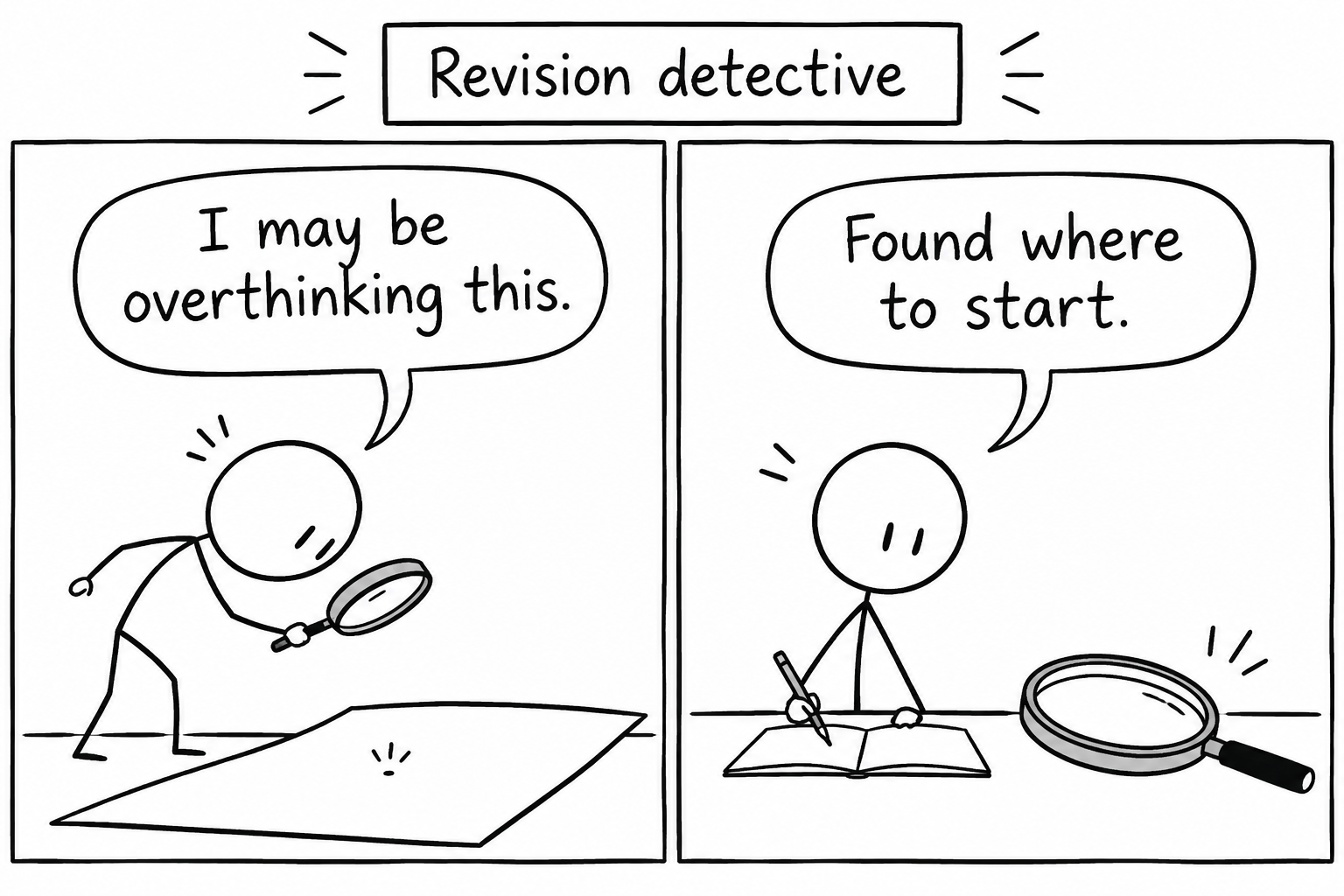 A student sets aside an enormous magnifying glass after finding where to begin
Rounding to significant figures worked examples
These examples use the same reliable method. The important step is not the final answer. It is identifying the last digit to keep before doing any rounding.
Rounding a whole number
Round 73 64873\,64873648 to 222 significant figures.
The first significant digit is 777, so the second is 333. The next digit is 666:
73 648≈74 00073\,648 \approx 74\,00073648≈74000Because 666 is at least 555, the 333 rounds up to 444. The remaining whole-number places become zeros.
This is where Sam used to write 747474. That has the right first two digits but the wrong place value. The original number is about seventy-four thousand, not seventy-four.
Rounding a decimal less than one
Round 0.0063840.0063840.006384 to 333 significant figures.
Ignore the zeros before the first non-zero digit. Count 666, 333, 888. The next digit is 444, so the 888 stays unchanged:
0.006384≈0.006380.006384 \approx 0.006380.006384≈0.00638The leading zeros remain because they locate the decimal point, but they are not part of the significant-figure count.
Rounding when the next digit is five
Round 12.65112.65112.651 to 333 significant figures.
Keep 111, 222 and 666. The next digit is 555, so round the 666 up:
12.651≈12.712.651 \approx 12.712.651≈12.7For GCSE rounding, a next digit of 555, 666, 777, 888 or 999 means round up.
Rounding creates a zero
Round 9.969.969.96 to 222 significant figures.
Keep 999 and 999. The next digit is 666, so the second 999 rounds up. This causes a carry:
9.96≈109.96 \approx 109.96≈10The result 101010 represents the rounded value to 222 significant figures in this context. If accuracy must be made completely explicit, standard form can show it as 1.0×1011.0 \times 10^11.0×101.
You now have the full method; use the Maths Genie GCSE lessons and Question Bank to practise applying it without rebuilding your own set of questions.
Why significant figures matter in GCSE Maths
Rounding is not confined to a single early-number question. It can appear when you estimate, interpret calculator answers or give a result to a requested degree of accuracy. A question may explicitly say “Give your answer to 333 significant figures”, so the final rounding instruction is part of the task.
It is usually safest to keep the full calculator value during a multi-step calculation and round only at the end, unless the question tells you to use rounded values. Rounding too early can make the final answer inaccurate.
Practising with GCSE past papers helps you recognise these instructions in context. After attempting a paper, compare your work with its mark scheme rather than checking only the final value. That reveals whether the lost mark came from the calculation or the rounding.
Common mistakes with significant figures
Counting zeros before the first non-zero digit
In 0.0005260.0005260.000526, the first significant digit is 555, not one of the zeros. To 222 significant figures:
0.000526≈0.000530.000526 \approx 0.000530.000526≈0.00053Counting from the decimal point
This confuses significant figures with decimal places. In 14.78314.78314.783, counting significant figures begins at 111. Counting decimal places begins at 777.
Looking at every discarded digit
Only the first digit after the final kept digit decides the rounding. To round 4.32684.32684.3268 to 333 significant figures, keep 4.324.324.32 and inspect the next digit, 666:
4.3268≈4.334.3268 \approx 4.334.3268≈4.33You do not make a chain of separate rounding decisions.
Removing place-value zeros
Rounding 681 249681\,249681249 to 222 significant figures gives:
681 249≈680 000681\,249 \approx 680\,000681249≈680000Writing 686868 changes the size of the number. The zeros are needed as place holders.
Rounding during the calculation
Suppose an answer requires several calculator operations. Storing or writing the full value until the final line reduces the risk of a rounding error affecting later work.
Rounding to significant figures questions
Try these without looking back at the examples. State each answer to the requested accuracy.
- Round 4 7824\,7824782 to 222 significant figures.
- Round 0.083640.083640.08364 to 333 significant figures.
- Round 956 201956\,201956201 to 111 significant figure.
- Round 7.8957.8957.895 to 333 significant figures.
- Round 0.00049170.00049170.0004917 to 222 significant figures.
- A calculator gives 18.37642918.37642918.376429. Give the answer to 333 significant figures.
Answers:
- 4 8004\,8004800
- 0.08360.08360.0836
- 1 000 0001\,000\,0001000000
- 7.907.907.90
- 0.000490.000490.00049
- 18.418.418.4
Question 444 is especially useful. The final zero in 7.907.907.90 shows the requested precision, while 7.97.97.9 would communicate only 222 significant figures. For more mixed exam practice, work through the Maths Genie predicted papers and check each final answer against the stated degree of accuracy.
Make the method automatic
Sam did not need a clever shortcut. The change came from using the same sequence every time: find, count, underline, inspect and round. That routine left less room for guesswork.
Knowing the method is the first step; applying it accurately under exam pressure takes short, repeated practice. Your turn: start the matching lesson and complete rounding to significant figures questions in the Maths Genie Lessons and Question Bank.















