

Rounding to Significant Figures Exam Questions
Rounding to significant figures exam questions explained through three GCSE examples, with clear working, mark guidance and practice to build your confidence.
A rounding question can feel straightforward until the number begins with several zeros or the answer suddenly needs an extra digit. For rounding to significant figures exam questions, the reliable method is to start counting at the first non-zero digit, identify the last digit you need, then check the digit immediately after it.
Imagine a student working through three GCSE questions. They know the rounding rule, but their real challenge is deciding where to apply it. We will follow their working from a whole number to a small decimal, then an estimation calculation where showing the method matters.
These are original exam-style examples, rather than questions taken from a particular past paper. Any suggested marks below are illustrative; actual marks depend on the question’s mark scheme.
Your quick checklist
- Find the first non-zero digit.
- Count to the required significant figure.
- Inspect the next digit: 555 or more means round up; below 555 means leave the retained digit unchanged.
- Preserve place value with zeros where necessary.
- Check that you used significant figures, rather than decimal places.
Understand what significant figures count
Significant figures count from the first non-zero digit, wherever it appears. Decimal places count positions after the decimal point. That difference explains many lost marks.
Zeros before the first non-zero digit simply locate the number on the place-value scale. Zeros between significant digits count. A trailing zero after a decimal point can also communicate the requested accuracy.
Before doing any rounding, underline the final digit you intend to keep. This small habit makes the decision visible and reduces the temptation to count from the decimal point.
If that distinction still feels uncertain, the rounding revision guide provides another explanation to use alongside these examples.
Three rounding to significant figures exam questions
Whole numbers: preserve their size
Question: Write 58 36258\,36258362 correct to 222 significant figures.
Our imagined student starts at 555. The second significant figure is 888, so the next digit, 333, decides whether it changes.
Since 3<53<53<5, the 888 stays unchanged. The remaining places become zeros:
58 362≈58 00058\,362 \approx 58\,00058362≈58000The answer is 58 00058\,00058000, not 585858. Rounding changes the precision of the number while keeping its approximate size.
Where the mark comes from: A standalone question like this is often worth one mark for the correct answer. Underlining the retained digit helps you think, but it does not automatically earn a separate method mark.
Small decimals: ignore leading zeros, then handle the carry
Question: Write 0.0099740.0099740.009974 correct to 222 significant figures.
The student initially hesitates over the zeros. They return to the rule: counting starts at the first non-zero digit.
The first two significant digits are both 999. The next digit is 777, so the second 999 must round up. Carrying through the retained digits gives:
0.009974≈0.0100.009974 \approx 0.0100.009974≈0.010That final zero matters. In 0.0100.0100.010, the 111 is the first significant figure and the final 000 is the second. Writing 0.010.010.01 gives the same numerical value, but does not communicate the requested two-significant-figure precision as clearly.
Where the mark comes from: For an illustrative one-mark question, the target answer is 0.0100.0100.010. When accuracy is explicitly requested, write the answer in a form that displays it.
The student’s improvement here is small but useful: they now mark both the first significant digit and the final retained position before rounding.
Use MathsGenie’s Rounding Lessons and Rounding Question Bank to practise that same identify, inspect and round routine.
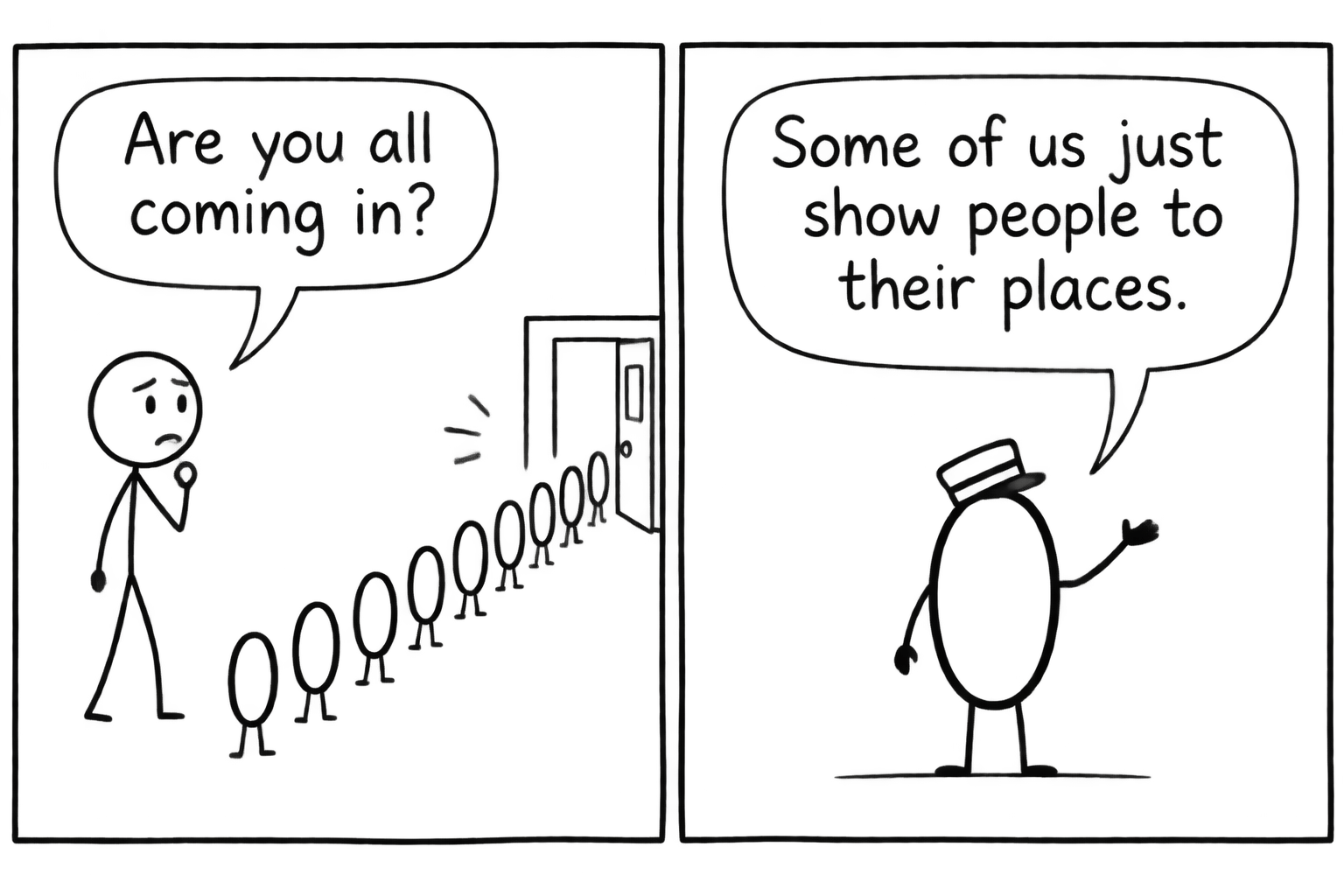 Stick-figure comic about zeros acting as place-value ushers
Estimation: make the rounding method visible
Question: Estimate
39.7×0.0610.198\frac{39.7\times 0.061}{0.198}0.19839.7×0.061by rounding each number to 111 significant figure.
This time, the student has several decisions to make. They write each rounded value first:
39.7≈40,0.061≈0.06,0.198≈0.239.7\approx40,\qquad 0.061\approx0.06,\qquad 0.198\approx0.239.7≈40,0.061≈0.06,0.198≈0.2Then they substitute these values into the original calculation:
40×0.060.2=2.40.2=12\frac{40\times0.06}{0.2} =\frac{2.4}{0.2} =120.240×0.06=0.22.4=12The estimate is 121212.
Where method marks can come from: In an illustrative three-mark scheme, credit could be split between suitable rounding, a correct calculation using the rounded values, and the final answer. Some official schemes label intermediate credit as process marks; others use method marks. The exact allocation varies.
The useful habit is consistent: show the rounded calculation. It gives the examiner evidence of your approach if later arithmetic goes wrong. A calculator answer to the original expression, followed by rounding, would not demonstrate the requested estimation method.
For more on choosing convenient values, see the estimating lesson.
Common mistakes in GCSE rounding questions
Counting every zero. Leading zeros do not count as significant figures. Begin at the first non-zero digit, then count every digit after it, including zeros.
Looking too far ahead. Only the digit immediately after your retained position decides whether to round up. Later digits do not change that decision.
Losing place value. Whole-number answers may need placeholder zeros. Check that your rounded answer remains close to the original number.
Rounding twice. Round directly from the original value to the requested accuracy. An intermediate rounded value can push the final answer in the wrong direction.
Rounding too early in an ordinary calculation. Estimation questions ask you to simplify values first. In a calculation requiring an accurate final answer, keep the available precision until the end unless instructed otherwise.
Exam-style practice
Try these without looking at the answers. For each one, identify the retained digit and the deciding digit before writing your answer.
- Write 72 64872\,64872648 correct to 222 significant figures.
- Write 0.0040860.0040860.004086 correct to 333 significant figures.
- Write 9.9639.9639.963 correct to 222 significant figures.
- Estimate 61.2×0.390.081\frac{61.2\times0.39}{0.081}0.08161.2×0.39 by rounding each number to 111 significant figure.
Answers: 73 00073\,00073000; 0.004090.004090.00409; 101010; and
60×0.40.08=300.\frac{60\times0.4}{0.08}=300.0.0860×0.4=300.For the third answer, 1.0×1011.0\times10^11.0×101 makes the two-significant-figure precision explicit if you are comfortable with standard form.
When using rounding to significant figures past paper questions, check the stated accuracy and the mark scheme. Record whether each error came from counting, rounding or arithmetic, so your next practice addresses the actual difficulty.
Turn the method into a habit
Our imagined student now has a repeatable approach, including a way to show working when rounding becomes part of a longer calculation. Your next step is to make that approach reliable when the numbers look unfamiliar. Start with MathsGenie’s Rounding Lessons and Question Bank to practise identifying significant figures, handling zeros and checking your working.















