

Rounding to Decimal Places Exam Questions
Rounding to decimal places exam questions explained with three GCSE worked examples, marking guidance, common mistakes and focused practice for revision.

A rounding question can look almost too easy. Then exam pressure changes it. You count the wrong digits, inspect the wrong number or round halfway through a calculation. A mark that felt secure quietly disappears.
The reliable way to answer rounding to decimal places exam questions is to mark the required decimal place, inspect only the digit immediately after it, then round once. If the question involves a calculation, keep the full calculator value until the final line.
The decimal places checklist
Use this routine whenever a question specifies decimal places:
- Count digits from the decimal point.
- Identify the final digit you need to keep.
- Look at the digit immediately to its right.
- If that next digit is 000, 111, 222, 333 or 444, keep the final digit unchanged.
- If it is 555, 666, 777, 888 or 999, increase the final digit by 111.
- Remove the remaining digits.
- Include any necessary placeholder zero and units.
This is the method covered in MathsGenie's rounding lesson. Rounding numbers and measures to specified decimal places is part of GCSE number content.
Draw a short line after the last decimal place required. The digit immediately to its right makes the decision.
Before calculating, underline the requested accuracy. A correct calculation can still produce an incorrect final answer if you overlook that instruction.
Question one: direct rounding
Exam-style question
Write 12.6055912.6055912.60559 correct to 333 decimal places.
Step-by-step answer
Count three digits after the decimal point:
12.605∣5912.605\mid5912.605∣59The third decimal digit is 555. The next digit is also 555, so increase the kept digit:
12.60559≈12.606 to 3 decimal places12.60559 \approx 12.606 \text{ to } 3 \text{ decimal places}12.60559≈12.606 to 3 decimal placesWhere the mark comes from
A direct rounding question like this is commonly worth one accuracy mark. There may be no separate method mark, so write 12.60612.60612.606 clearly.
The zero matters. Decimal places are positions, including zeros, whereas significant figures start at the first non-zero digit.
Compare your method with MathsGenie's three-decimal-place question and worked solution.
Question two: rounding after a calculation
Exam-style question
A ribbon measuring 23.723.723.7 metres is cut into 888 equal pieces. Calculate each piece's length, correct to 222 decimal places.
Step-by-step answer
First complete the division:
23.7÷8=2.962523.7 \div 8 = 2.962523.7÷8=2.9625Keep two digits after the decimal point:
2.96∣252.96\mid252.96∣25The next digit is 222, so the second decimal digit stays unchanged. Include the unit:
2.96 m\boxed{2.96\text{ m}}2.96 mWhere the method marks come from
An indicative two-mark allocation could be:
- one method mark for calculating 23.7÷823.7 \div 823.7÷8;
- one accuracy mark for 2.96 m2.96\text{ m}2.96 m.
Exact allocations depend on the exam board and mark scheme. Showing the calculation makes your method visible and may earn a method mark even if the final rounding is wrong.
Use the rounding lessons and question bank to practise this routine.
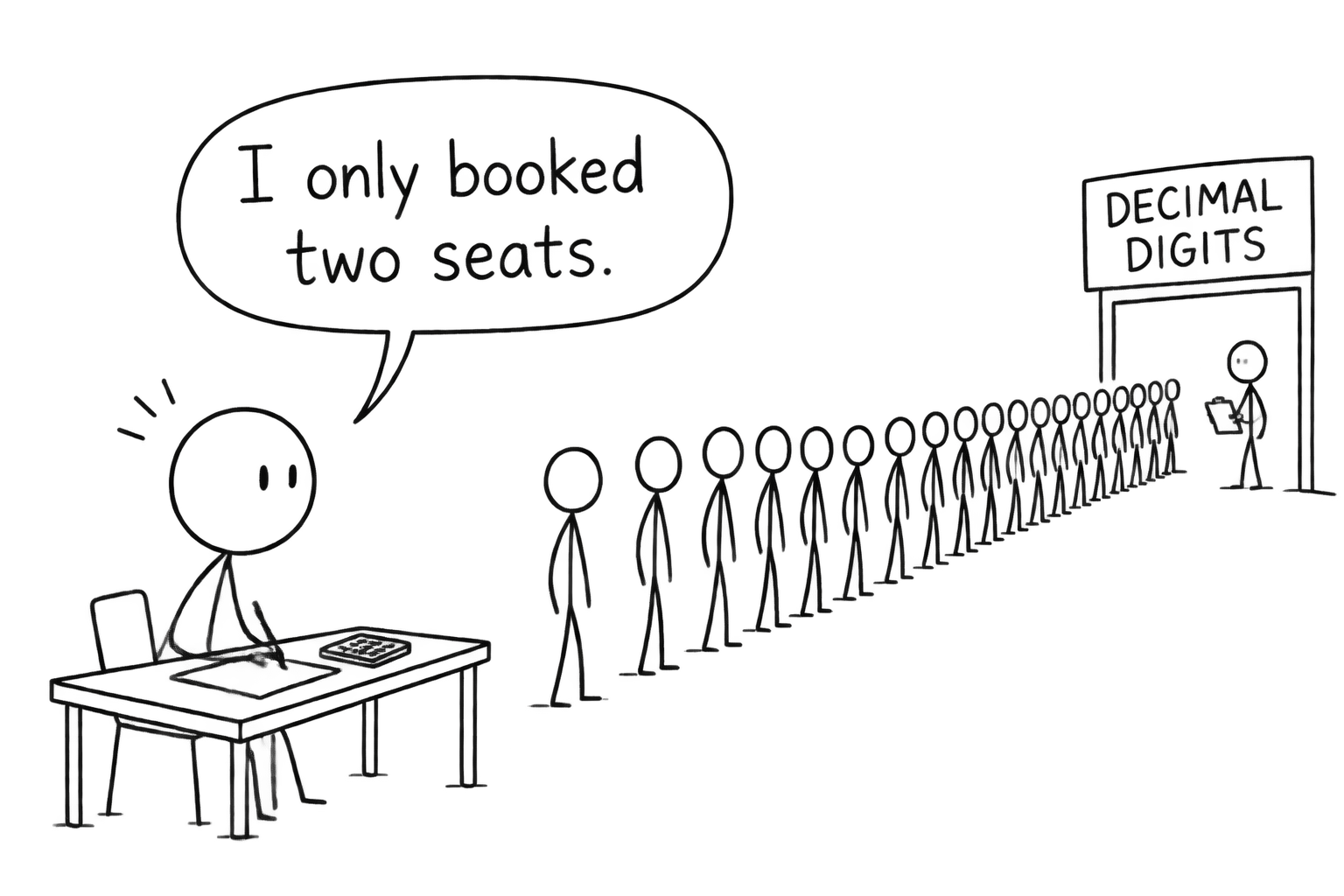 A student managing a queue of unnecessary decimal digits
Question three: rounding in a multi-step problem
Rounding is often the final instruction in a longer problem. Here, the challenge is keeping the earlier calculations accurate.
Exam-style question
A right-angled triangle has shorter sides of length 7.37.37.3 cm and 4.84.84.8 cm. Calculate the hypotenuse, correct to 222 decimal places.
Step-by-step answer
Using Pythagoras' theorem:
x2=7.32+4.82x^2 = 7.3^2 + 4.8^2x2=7.32+4.82Evaluate the squares and add:
x2=53.29+23.04=76.33x^2 = 53.29 + 23.04 = 76.33x2=53.29+23.04=76.33Take the square root:
x=76.33=8.736704184…x = \sqrt{76.33} = 8.736704184\ldotsx=76.33=8.736704184…The second decimal digit is 333, and the next digit is 666. Therefore, increase the 333 to 444:
x≈8.74 cm\boxed{x \approx 8.74\text{ cm}}x≈8.74 cmWhere the method marks come from
A possible three-mark structure is:
- one method mark for forming 7.32+4.827.3^2 + 4.8^27.32+4.82;
- one method mark for taking the square root;
- one accuracy mark for 8.74 cm8.74\text{ cm}8.74 cm.
These allocations are illustrative. The published mark scheme determines how an actual exam question is marked.
How to handle rounding in the exam
For a simple one-mark question, a correct final answer may be enough. For a calculation or problem-solving question, show your calculation before the rounded result.
Keep intermediate values in your calculator using its answer or memory function. Round once, at the end, unless the question specifically instructs otherwise.
MathsGenie's rounding revision guide revisits decimal places and significant figures. You can also use the AQA rounding revision page or Eduqas rounding exam questions.
Common mistakes in rounding questions
Counting from the first non-zero digit
That identifies significant figures. For decimal places, begin immediately after the decimal point.
Looking at every remaining digit
Only the next digit decides. In 4.372914.372914.37291 to 222 decimal places, inspect the 222. The later digits do not affect the decision: the result is 4.374.374.37.
Rounding up whenever digits remain
Extra digits do not automatically increase the answer. The next digit must be at least 555.
Forgetting to carry
If the last retained digit is 999 and must increase, carry into the place to its left. This can affect several digits, including the whole-number part. Afterwards, count the decimal places again. Carrying changes the digits, but the answer must still display the accuracy requested in the question.
Removing a placeholder zero
Write 6.56.56.5 as 6.506.506.50 when asked for 222 decimal places. The zero communicates the requested accuracy.
Rounding during intermediate steps
Early rounding changes values used later. Keep the full calculator value until the final answer.
Forgetting units
Carry the appropriate unit into answers involving length, area, mass or time.
Exam-style practice
Try these before checking the answers:
- Write 2.792.792.79 correct to 111 decimal place.
- Write 18.169318.169318.1693 correct to 222 decimal places.
- Calculate 41.6÷741.6 \div 741.6÷7, correct to 333 decimal places.
- Calculate the area of a rectangle measuring 8.468.468.46 cm by 3.273.273.27 cm, correct to 111 decimal place.
The answers, in order, are 2.82.82.8, 18.1718.1718.17, 5.9435.9435.943 and 27.7 cm227.7\text{ cm}^227.7 cm2.
Next, attempt MathsGenie's one-decimal-place question and mixed decimal-place question. Check the worked solutions after committing to an answer.
When checking, identify the first place your method went wrong. Was it counting decimal positions, choosing the deciding digit, carrying or entering the calculation? Write a brief correction beside your answer, then retry the question without looking. This makes your next practice session more useful than simply copying the solution.
Turn the method into reliable marks
Identify, inspect, decide and round once. Use MathsGenie's linked revision lessons and practice questions to make that sequence familiar. Check each mistake, then attempt another question independently: reliable marks come from applying a clear method consistently.















