Roots of Quadratic Graphs GCSE Maths Guide
Roots of quadratic graphs GCSE maths explained with clear steps, worked examples, common mistakes and exam-style questions for confident revision.
A student can draw a beautiful parabola, label every axis and still lose the mark for its roots. That is what kept happening to Sam. Whenever a question asked for the roots of a quadratic graph, Sam looked at the turning point, then the vertical axis, then guessed.
The idea finally clicked when it was reduced to one sentence: the roots are the xxx-coordinates where the quadratic graph crosses or touches the xxx-axis. At these points, y=0y=0y=0.
That is the essential answer for roots of quadratic graphs GCSE maths questions. The rest is careful graph reading.
The roots checklist
When you are given a quadratic graph:
- find the xxx-axis, the horizontal axis where y=0y=0y=0;
- identify where the curve crosses or touches it;
- read the xxx-coordinate of each point;
- write the roots as values of xxx, not as yyy-coordinates;
- check the scale before giving your answer.
Most quadratic graphs have two roots, one repeated root or no real roots. The shape of the parabola tells you which situation you have.
| What the graph does | Number of real roots |
|---|---|
| Crosses the xxx-axis twice | Two |
| Touches the xxx-axis once | One repeated root |
| Does not meet the xxx-axis | No real roots |
What is a root of a quadratic graph?
Suppose a graph represents
y=x2−5x+6.y=x^2-5x+6.y=x2−5x+6.A root is an xxx-value that makes y=0y=0y=0. Graphically, that means looking for the points where the curve meets the xxx-axis. Algebraically, it means solving
x2−5x+6=0.x^2-5x+6=0.x2−5x+6=0.The words root, solution and xxx-intercept are closely connected here:
- a root is a value of xxx for which the quadratic equals zero;
- a solution is an xxx-value satisfying the corresponding equation;
- an xxx-intercept is the point where the graph meets the xxx-axis.
There is one useful distinction. A root is a number such as x=2x=2x=2, while an intercept is a coordinate such as (2,0)(2,0)(2,0). Read exactly what the question requests.
The Maths Genie drawing quadratic graphs lesson explains how a value table becomes a smooth parabola and how its key features can be interpreted.
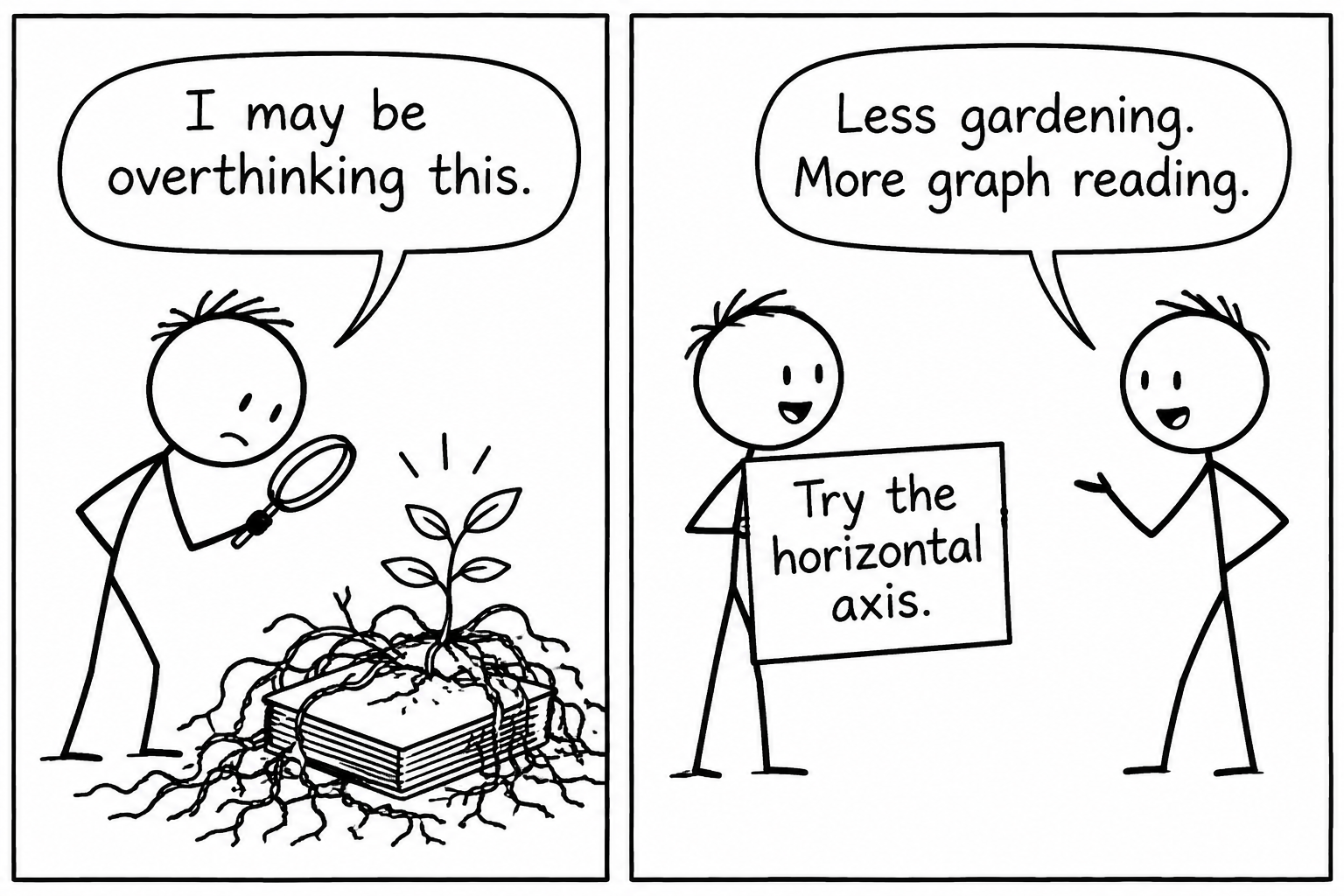 A student detective looks for roots in the wrong place before being pointed towards the horizontal axis
Roots of quadratic graphs worked examples
Reading two roots from a graph
Imagine that the graph of
y=x2−x−6y=x^2-x-6y=x2−x−6crosses the xxx-axis at (−2,0)(-2,0)(−2,0) and (3,0)(3,0)(3,0).
Step 1: Find the xxx-axis. This is the line y=0y=0y=0.
Step 2: Locate both places where the parabola crosses that axis.
Step 3: Read their xxx-coordinates.
The roots are therefore
x=−2andx=3.x=-2 \quad \text{and} \quad x=3.x=−2andx=3.You can check this by factorising:
x2−x−6=(x+2)(x−3).x^2-x-6=(x+2)(x-3).x2−x−6=(x+2)(x−3).Setting each bracket equal to zero gives
x+2=0orx−3=0,x+2=0 \quad \text{or} \quad x-3=0,x+2=0orx−3=0,so
x=−2orx=3.x=-2 \quad \text{or} \quad x=3.x=−2orx=3.The algebra and graph describe the same result in different ways.
Recognising a repeated root
Now suppose the graph of
y=x2−4x+4y=x^2-4x+4y=x2−4x+4touches the xxx-axis at (2,0)(2,0)(2,0) and turns upwards without crossing it.
There is one visible meeting point, so the root is
x=2.x=2.x=2.Factorising explains why it is called a repeated root:
x2−4x+4=(x−2)2.x^2-4x+4=(x-2)^2.x2−4x+4=(x−2)2.Both identical factors give x=2x=2x=2. You might describe this as one repeated root rather than two different roots.
Estimating roots from a graph
Some roots do not fall exactly on grid lines. Suppose a graph crosses the xxx-axis between 111 and 222, then again between 444 and 555.
Read the scale first. If each small square represents 0.20.20.2, the crossings might give estimates such as
x≈1.4andx≈4.6.x\approx1.4 \quad \text{and} \quad x\approx4.6.x≈1.4andx≈4.6.Use the accuracy supported by the graph. Do not claim several decimal places when the grid only permits a rough estimate. Graphical solutions are often approximate, which is why the symbol ≈\approx≈ may be more appropriate than ===.
You now have the method in hand; use the Maths Genie quadratic graphs questions to practise reading roots instead of relying on a guess in the exam.
Why setting y=0y=0y=0 works
This was the moment the idea became reliable for Sam. Every point on the xxx-axis has a yyy-coordinate of zero. Therefore, wherever a quadratic graph meets that axis, the equation's output is zero.
For a general quadratic
y=ax2+bx+c,y=ax^2+bx+c,y=ax2+bx+c,the roots satisfy
ax2+bx+c=0.ax^2+bx+c=0.ax2+bx+c=0.This connection lets an exam question move between a graph and an equation. You might be asked to use a graph to solve a quadratic equation, identify the roots from intercepts or check algebraic answers against a plotted curve.
If the equation is instead written as
x2−5x+6=4,x^2-5x+6=4,x2−5x+6=4,you should not simply read where the original graph crosses the xxx-axis. If the graph shown is y=x2−5x+6y=x^2-5x+6y=x2−5x+6, find where the curve meets the horizontal line y=4y=4y=4. Those intersection points solve the equation.
Common mistakes with quadratic roots
Giving the yyy-intercept
The yyy-intercept lies on the vertical axis, where x=0x=0x=0. Roots lie on the horizontal axis, where y=0y=0y=0. These are different features.
Using the turning point
A turning point is the maximum or minimum of the parabola. It is only a root when it lies exactly on the xxx-axis. Otherwise, it does not answer a question asking for roots.
Ignoring a negative root
A crossing to the left of the yyy-axis has a negative xxx-coordinate. Include it and preserve its minus sign.
Reading the scale incorrectly
Axes do not always increase in ones. Check the labels and count the intervals before deciding on a value.
Writing coordinates when values are requested
If asked for the roots, write something like
x=−1andx=4.x=-1 \quad \text{and} \quad x=4.x=−1andx=4.If asked for the xxx-intercepts, give
(−1,0)and(4,0).(-1,0) \quad \text{and} \quad (4,0).(−1,0)and(4,0).Forcing two answers
A parabola can touch the axis once or miss it completely. Do not invent a second root because quadratic equations often have two solutions.
Exam-style practice
Try these without looking back at the worked examples.
Question A
A quadratic graph crosses the xxx-axis at (−3,0)(-3,0)(−3,0) and (5,0)(5,0)(5,0). State its roots.
Answer:
x=−3andx=5.x=-3 \quad \text{and} \quad x=5.x=−3andx=5.Question B
The graph of y=x2+6x+9y=x^2+6x+9y=x2+6x+9 touches the xxx-axis at (−3,0)(-3,0)(−3,0). State the root and describe it.
Answer:
x=−3.x=-3.x=−3.It is a repeated root because the graph touches the axis rather than crossing it.
Question C
A graph crosses the xxx-axis at approximately x=−1.7x=-1.7x=−1.7 and x=2.4x=2.4x=2.4. Use the graph to solve f(x)=0f(x)=0f(x)=0.
Answer:
x≈−1.7andx≈2.4.x\approx-1.7 \quad \text{and} \quad x\approx2.4.x≈−1.7andx≈2.4.For further exam-style practice with worked solutions and mark schemes, work through the Maths Genie quadratic graphs exam booklet. Students following other specifications can also use the OCR quadratic graphs revision page or the Eduqas quadratic graphs lesson.
Turn the idea into exam marks
Sam's progress did not come from memorising another long rule. It came from pausing at every roots question and asking, “Where is y=0y=0y=0?” Knowing that method is the first step; applying it accurately across unfamiliar scales and equations is what secures the marks.
Use Maths Genie's Lessons and Question Bank to move from understanding roots of quadratic graphs to answering them confidently under exam conditions. Start the quadratic graphs lesson, then complete the quadratic graphs Question Bank.