Roots of Quadratic Graphs Exam Questions | GCSE
Roots of quadratic graphs exam questions explained with three worked GCSE examples, graphical methods, common mistakes and free targeted revision practice.
A quadratic graph can look finished before the real question has begun. The curve is drawn, the axes are labelled, and the instruction says, “Write down the roots.” What should you read?
For roots of quadratic graphs exam questions, find where the curve meets the xxx-axis. Here, y=0y=0y=0, so the corresponding xxx-coordinates solve the quadratic equation.
The three worked examples below move from reading roots to drawing an additional line. Mark allocations are illustrative: always follow the actual question and its mark scheme.
The method to remember
Use this checklist:
- Identify where y=0y=0y=0.
- Read the xxx-coordinates, not the yyy-coordinates.
- Check both branches of the curve.
- If drawing a graph, plot accurately and use a smooth curve.
- Give estimates appropriate to the scale.
A quadratic can have two distinct real roots, one repeated real root or no real roots. Its curve crosses the xxx-axis twice, touches it once or misses it completely.
The word “root” describes a solution, not a special plotting technique. Setting the expression equal to zero connects the equation to the graph. Once you recognise that connection, the instruction becomes much less mysterious.
Need a refresher? Start with the Drawing Quadratic Graphs lesson.
Question one: reading roots from a graph
The graph of
y=x2+x−6y=x^2+x-6y=x2+x−6crosses the xxx-axis at (−3,0)(-3,0)(−3,0) and (2,0)(2,0)(2,0).
Question: Write down the roots of x2+x−6=0x^2+x-6=0x2+x−6=0. Give both answers. This illustrative question is worth 222 marks.
Read the crossing points
Follow the xxx-axis rather than looking for the curve's lowest point. The crossings have xxx-coordinates −3-3−3 and 222, so write:
x=−3orx=2x=-3 \quad \text{or} \quad x=2x=−3orx=2An illustrative allocation is one accuracy mark for each root. No algebra is needed when the instruction asks you to read the graph. Writing the values of xxx answers the equation more directly than giving coordinate pairs.
Before reading either value, check the horizontal scale. A small square does not always represent one unit. Use labelled positions to establish the spacing, then count carefully from the origin, especially towards negative values.
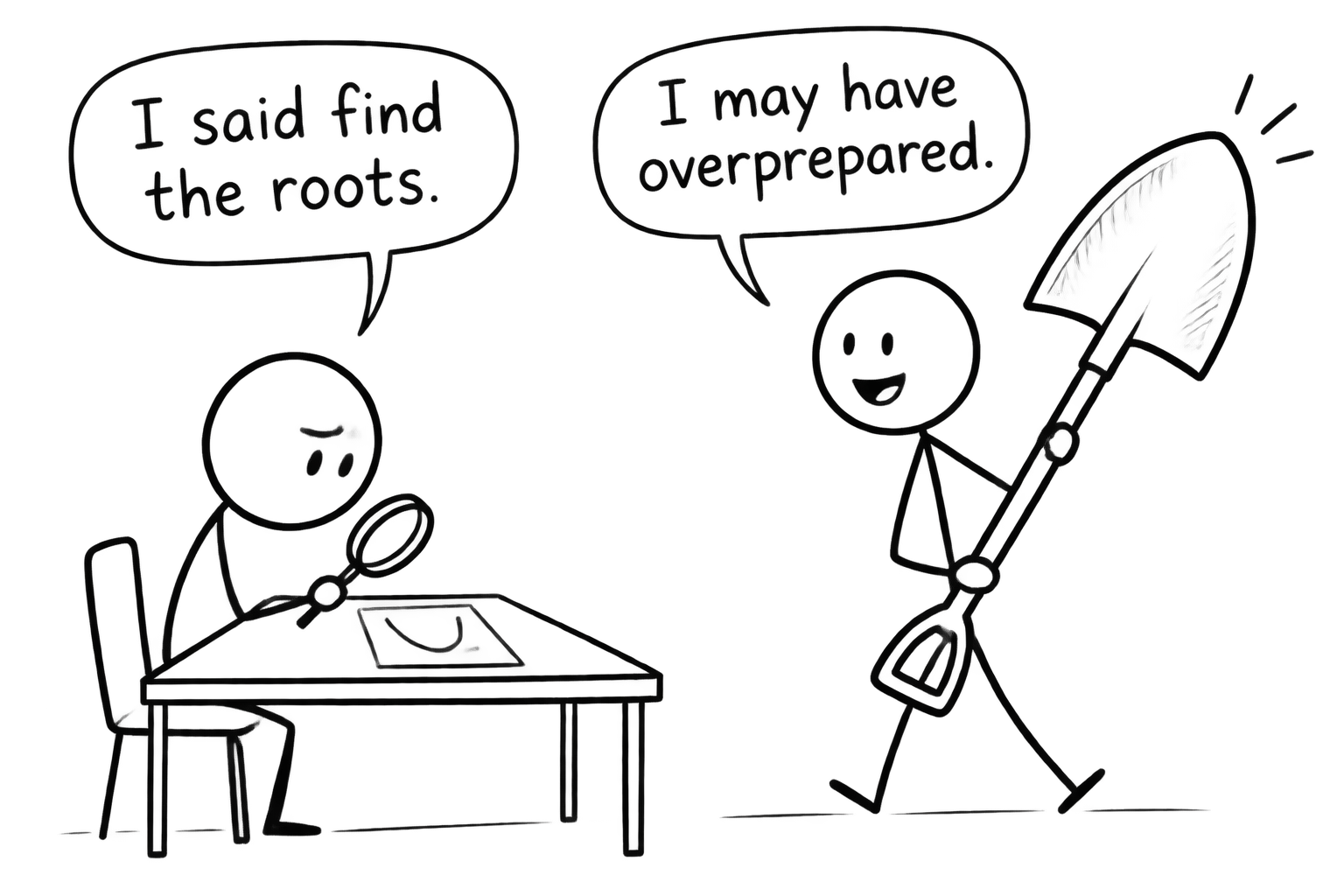 A student searches for mathematical roots while a friend arrives with a garden spade
Question two: drawing the graph first
Question: Complete the table for y=x2−x−6y=x^2-x-6y=x2−x−6, draw the graph for −3≤x≤4-3\leq x\leq4−3≤x≤4, and use it to solve x2−x−6=0x^2-x-6=0x2−x−6=0. This illustrative question is worth 555 marks.
Calculate the values
Substitute each value of xxx. When x=−1x=-1x=−1:
y=(−1)2−(−1)−6=1+1−6=−4y=(-1)^2-(-1)-6=1+1-6=-4y=(−1)2−(−1)−6=1+1−6=−4The completed table is:
| xxx | −3-3−3 | −2-2−2 | −1-1−1 | 000 | 111 | 222 | 333 | 444 |
|---|---|---|---|---|---|---|---|---|
| yyy | 666 | 000 | −4-4−4 | −6-6−6 | −6-6−6 | −4-4−4 | 000 | 666 |
Keep brackets around negative inputs. They distinguish squaring a negative number from placing a negative sign before a square.
Plot, draw and read
Plot each coordinate and draw a smooth U-shaped curve through the points, rather than joining them with straight segments.
The curve crosses the xxx-axis at:
x=−2orx=3x=-2 \quad \text{or} \quad x=3x=−2orx=3Marks may reward correct table values, accurate plotting, a suitable curve and the roots. Exact allocations depend on the question, so show the requested stages rather than only the final answer.
If one plotted point sits noticeably away from the emerging curve, check its substitution and position before drawing. Do not force a strange bend through a likely error. A quadratic curve should be smooth, with a single turning point.
Review the quadratic graphs revision guide, then practise using the quadratic graphs exam booklet.
Question three: drawing an additional line
You are given the graph of
y=x2+xy=x^2+xy=x2+xQuestion: Use the graph to solve x2+x−4=0x^2+x-4=0x2+x−4=0. This illustrative question is worth 333 marks.
Match the equation to the supplied curve
Rearrange the equation:
x2+x=4x^2+x=4x2+x=4The supplied curve represents y=x2+xy=x^2+xy=x2+x, so find where its height is 444. Draw the horizontal line:
y=4y=4y=4Extend it far enough to meet both branches. The intersections give the solutions because both the curve and the line have the same yyy-value there.
Read both intersections
The approximate solutions are:
x≈−2.6orx≈1.6x\approx-2.6 \quad \text{or} \quad x\approx1.6x≈−2.6orx≈1.6A mark scheme may reward the correct line and each acceptable root. Use the graph's precision; extra decimal places do not make a graphical estimate more accurate.
Notice the distinction: these answers are roots of x2+x−4=0x^2+x-4=0x2+x−4=0, not the xxx-intercepts of the supplied curve. Rearranging tells you which intersections matter.
Keep the additional line visible in your final working. It explains how you obtained the estimates and allows the examiner to distinguish a graphical solution from unsupported answers. Read vertically down from each intersection to the horizontal axis.
Explore further questions in the Drawing Quadratic Graphs Question Bank.
Common mistakes that lose marks
Reading the turning point
The turning point is the curve's maximum or minimum. It is only a root when it lies on the xxx-axis.
Answering with y=0y=0y=0
This identifies the height of the roots, not their values. Report the relevant xxx-coordinates.
Missing signs or solutions
A crossing left of the yyy-axis has a negative xxx-coordinate. Scan both branches before finishing, but do not assume every quadratic has two distinct real roots.
Ignoring the requested method
If asked to use a graph, show the necessary curve or additional line. Algebra can check your answer, but may not demonstrate the graphical method required.
Exam-style practice
Try these before checking the answers:
- A curve crosses at (−4,0)(-4,0)(−4,0) and (1,0)(1,0)(1,0). State its roots.
- Draw y=x2−2x−3y=x^2-2x-3y=x2−2x−3 and read its roots.
- Given y=x2−2xy=x^2-2xy=x2−2x, which line solves x2−2x−3=0x^2-2x-3=0x2−2x−3=0?
The answers are x=−4x=-4x=−4 and x=1x=1x=1; x=−1x=-1x=−1 and x=3x=3x=3; and y=3y=3y=3, respectively. For more written practice, use the Edexcel GCSE exam booklets.
When checking, separate calculation errors from graph-reading errors. Recalculating every table entry will not fix a misunderstood axis scale. Identify the stage that failed, practise that skill, then attempt the complete question again without looking at the solution.
Turn understanding into confidence
The reliable sequence is short: identify the equation, draw anything needed, then read every relevant xxx-coordinate. Accuracy comes from practising that sequence, not rushing it.
Start with MathsGenie's GCSE revision lessons, then attempt questions independently. Check your working, identify the first mistake and retry it. That makes your next revision session purposeful.