

Revision Plan for a Grade 4 in GCSE Maths
Revision plan for a grade 4 in GCSE Maths with priority topics, a weekly timetable and practical advice for balancing weak and secure areas.
Aiming for a grade 444 can make GCSE Maths revision feel strangely vague. You know the destination, but not which topics deserve tomorrow evening or how long to spend on something you already understand.
A successful revision plan for a grade 4 in GCSE Maths is not about covering every page equally. It is about securing accessible marks, repairing important weaknesses and practising under exam conditions. Start with core number, ratio, algebra, geometry, probability and statistics, then use past-paper results to decide what comes next.
Your grade 4 revision checklist
Use this as the framework for your plan:
- Diagnose your strengths and weaknesses with mixed questions.
- Spend roughly 60%60\%60% of topic-practice time on weak areas and 40%40\%40% on secure areas.
- Prioritise foundational topics that connect to several parts of the course.
- Practise without notes, then mark every answer.
- Record mistakes by topic and reason.
- Complete timed exam questions every week.
- Revisit difficult topics after a few days rather than once.
Grade boundaries change between exam boards and exam series, so there is no permanent number of marks that guarantees a grade 444. Check the official boundary for your board when reviewing an older paper, but build a margin of safety rather than aiming for the minimum.
Which topics matter for GCSE Maths grade 4?
No topic can guarantee particular marks on the day. Edexcel, AQA, OCR and Eduqas papers sample content from across their specifications, and the exact mixture varies.
The sensible strategy is to begin with skills that appear throughout foundation and higher-tier work. Number and proportional reasoning are particularly valuable because they also support algebra, geometry and statistics.
Number and calculation
Make these skills reliable:
- Negative numbers and the order of operations
- Fractions, decimals and percentages
- Percentage change and reverse percentages
- Factors, multiples and prime factors
- Rounding, estimation and bounds
- Standard form
A student who can calculate a percentage but forgets to interpret the answer is not yet secure. Your practice should include written problems, not just isolated calculations. MathsGenie's GCSE Maths revision resources organise lessons and questions by topic and grade, which makes them a practical starting point.
Ratio and proportion
Prioritise simplifying ratios, sharing in a ratio, direct proportion, recipes, scale drawings, best buys, speed, density and unit conversions.
These topics often combine several small decisions. You may need to identify the total number of parts, find the value of one part and then answer in the correct unit. Write down each stage instead of attempting the whole calculation mentally.
Algebra
For a grade 444 target, concentrate on:
- Simplifying expressions
- Substitution
- Expanding and factorising single brackets
- Solving linear equations and inequalities
- Sequences
- Coordinates and straight-line graphs
- Forming simple expressions and equations
Algebra becomes easier when symbols stop feeling special. Substitution is still arithmetic; solving an equation is still a sequence of inverse operations. Return to algebra several times each week because fluency develops through spaced practice.
Geometry and measures
Secure angle facts, perimeter, area, volume, transformations, constructions, Pythagoras' theorem and basic trigonometry where these are included in the material you are revising for your tier.
Learn formulae only where your specification requires them. More importantly, practise selecting the right method from a diagram. Label known lengths and angles before calculating anything.
Probability and statistics
Revise averages, range, frequency tables, charts, scatter graphs, probability scales, sample spaces and relative frequency. These questions test interpretation as much as calculation, so complete sentences and accurate comparisons matter.
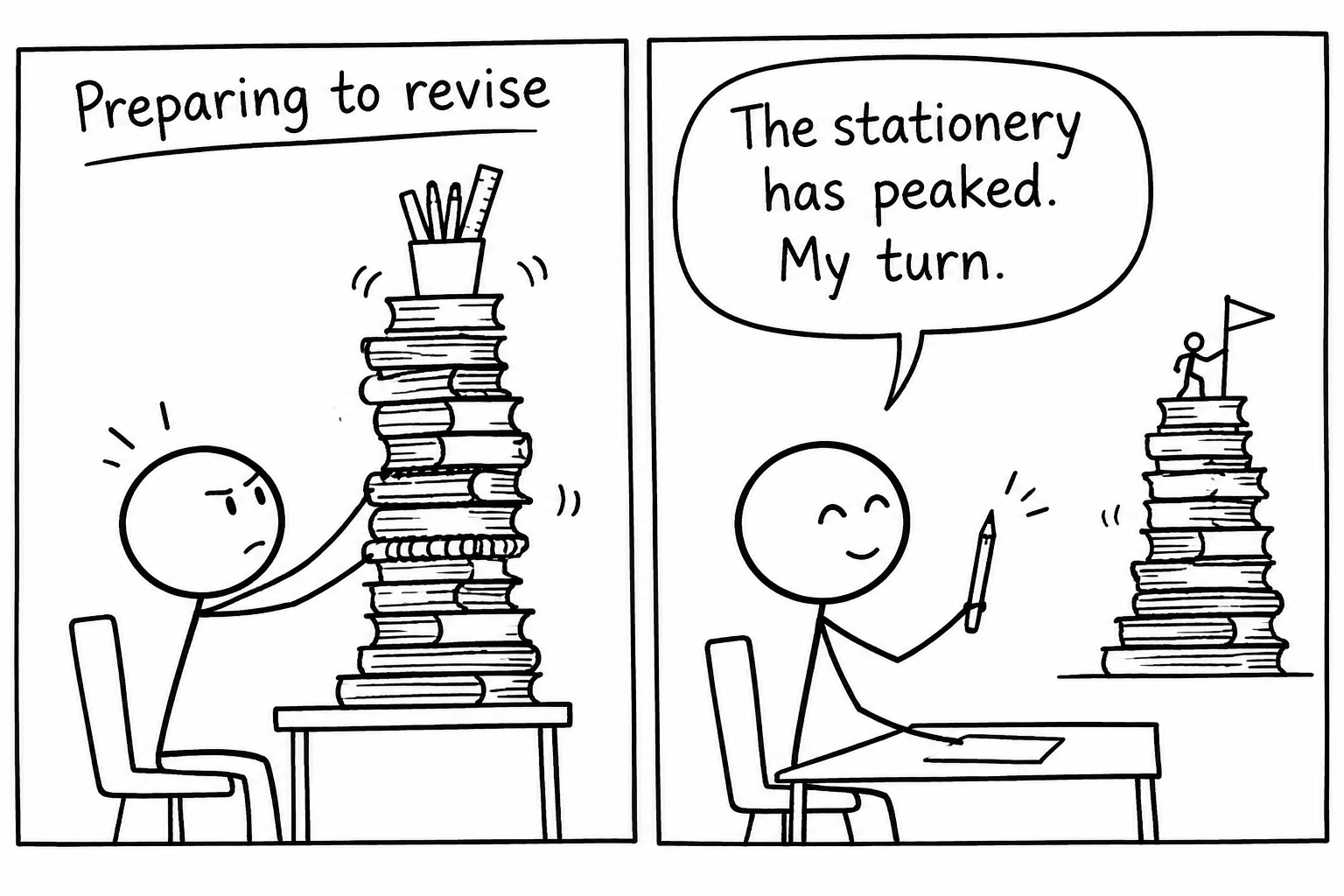 A student discovers that collecting revision stationery is not the same as revising
How to divide your revision time
Imagine that you have five sessions each week, each lasting 454545 minutes. That gives you:
5×45=225 minutes. 5 \times 45 = 225\text{ minutes}. 5×45=225 minutes.A useful starting split is:
0.6×225=135 minutes on weaker areas, 0.6 \times 225 = 135\text{ minutes on weaker areas}, 0.6×225=135 minutes on weaker areas, 0.4×225=90 minutes on secure areas and mixed practice. 0.4 \times 225 = 90\text{ minutes on secure areas and mixed practice}. 0.4×225=90 minutes on secure areas and mixed practice.This is not an unbreakable rule. If basic fractions are preventing progress in ratio and probability, temporarily give them more time. If percentages are already accurate under timed conditions, maintain them with short mixed sets rather than another full lesson.
Classify topics using evidence:
- Red: you cannot begin without help or repeatedly use the wrong method.
- Amber: you know the method but make errors or struggle with unfamiliar wording.
- Green: you can answer accurately without notes and explain your reasoning.
A green topic still needs retrieval practice. Confidence can be misleading, especially when you have just watched a video and the method remains in short-term memory.
Once you have colour-coded your topics, you can build your schedule in the MathsGenie Revision Planner instead of arranging every session by hand.
A weekly GCSE Maths revision template
The following template can be repeated each week. Change the named topics according to your latest mistakes.
| Session | Focus | Suggested structure |
|---|---|---|
| Monday | Weak topic 111 | Review the method, answer questions without notes, then mark them |
| Tuesday | Weak topic 222 | Practise the skill and finish with two mixed problems |
| Wednesday | Secure skills | Complete short retrieval questions from several green topics |
| Thursday | Weak topic 111 revisited | Retry previous errors, then answer fresh questions |
| Saturday | Exam practice | Complete a timed paper section, mark it and update your topic list |
Inside a 454545-minute topic session, try:
- 555 minutes recalling facts or methods from memory
- 101010 minutes reviewing one revision lesson
- 202020 minutes answering questions without support
- 101010 minutes marking, correcting and recording errors
The correction stage is part of revision, not administration. Write the reason beside each error: misunderstood question, forgotten fact, wrong method, calculation slip or incomplete working. That diagnosis tells you what the next session should fix.
How to use papers without wasting them
A full paper can show how your skills behave under pressure, but doing paper after paper without analysis simply repeats the same weaknesses.
Begin with topic questions while repairing gaps. Add timed sections once a week, then move towards complete papers as the examination approaches. Use MathsGenie's GCSE Maths past papers for realistic practice and consult the accompanying mark schemes after making a genuine attempt.
When marking, use three totals:
- Marks earned securely
- Marks lost through missing knowledge
- Marks lost through slips, interpretation or weak working
The second total identifies topics to learn. The third identifies exam habits to change. Both matter for a GCSE Maths grade 444.
Nearer the examination, GCSE Maths predicted papers can provide additional practice. Treat them as practice papers, not a forecast of the exact questions that will appear.
Common mistakes when planning for grade 4
Revising only favourite topics
Repeating comfortable work creates activity without much improvement. Keep 40%40\%40% of topic time for secure areas, but direct the larger share towards weaknesses that are within reach.
Starting with the hardest question
A grade 444 plan should first protect accessible marks. Build reliable foundations before spending an entire evening on one demanding problem.
Watching instead of answering
A video can explain a method, but recognition is not recall. Close the example and complete questions independently. Use MathsGenie's revision lessons and video solutions to learn and review, then test yourself with practice questions and mini tests.
Ignoring the mark scheme
Mark schemes reveal required working, accepted answers and where method marks may be available. Compare your solution carefully rather than checking only the final answer.
Treating every week identically
Your plan should respond to evidence. If Saturday's paper shows that ratio has improved but equations remain weak, next week's timetable must change.
Build the plan you will actually follow
Knowing what to revise is only half the task. The other half is turning red and amber topics into specific sessions before fixed exam dates arrive.
You have seen how to balance weak skills, secure topics and weekly exam practice. Now enter your priorities and build your grade 444 schedule in the MathsGenie Revision Planner.















