

Revision Plan for a B in A-Level Maths
Revision plan for a B in A-Level Maths with topic priorities, a weekly timetable, past-paper strategy and a sensible split between weak and secure areas.

Aiming for a B can create an oddly difficult revision problem. You are not trying to relearn every page of the course, but you cannot afford to revise only the topics you enjoy. The gap between a C and a B is often filled by ordinary marks: accurate algebra, complete methods and questions you should have secured but rushed.
A useful revision plan for a B in A-Level Maths should therefore do three things. It should protect your reliable marks, repair weaknesses with the greatest impact, and give you regular practice under exam conditions. It should not depend on guessing a fixed percentage, because grade boundaries vary between exam boards and exam series.
This plan uses a six-week structure, but you can compress or extend it around your exam date.
Your grade B revision checklist
Before planning individual sessions, make sure your week contains:
- two sessions on weaker high-value topics;
- two sessions maintaining secure topics;
- one mixed pure session;
- one statistics or mechanics session;
- one timed paper section or full paper;
- time to mark your work and correct every avoidable error;
- one lighter or rest day.
Use your own specification to check the exact content required by Edexcel, AQA, OCR or Eduqas. The MathsGenie A-Level hub is a useful starting point, while students following Pearson can go directly to the Edexcel A-Level Maths revision page for relevant papers, mark schemes and revision materials.
Which topics carry the marks at grade B level?
There is no official set of “grade B topics”. An A-Level Maths grade comes from your total mark across the papers, and questions can combine several areas of the specification. A calculus problem, for example, may also require confident algebra, trigonometry and interpretation.
That makes connected, reusable skills particularly important.
Algebra and functions
Algebra sits underneath much of A-Level Maths. Prioritise indices, surds, quadratics, inequalities, functions, transformations, partial fractions and algebraic manipulation.
You should be comfortable rearranging expressions such as
y=3x−2x+4y=\frac{3x-2}{x+4}y=x+43x−2and recognising when factorising or substitution will simplify a later method. Weak algebra quietly removes marks from calculus, trigonometry and coordinate geometry, so improving it has benefits across several topics.
Calculus
Differentiation and integration are major parts of A-Level pure mathematics. Revise standard derivatives and integrals, applications to gradients and areas, stationary points, differential equations, numerical methods and the more advanced techniques on your specification.
Do not measure confidence by whether a method looks familiar. Test whether you can choose and execute it without a prompt. In an exam, the difficult step is often recognising what the question requires.
Trigonometry and exponentials
Secure exact values, identities, equations, graphs, radians, logarithms and exponential models. These topics often reward a sequence of correct decisions rather than one inspired leap.
For example, solving a trigonometric equation means more than finding one value of θ\thetaθ. You must respect the stated interval and include every valid solution.
Statistics and mechanics
Applied mathematics can become a source of dependable marks when you understand the model rather than memorising isolated instructions. In statistics, focus on probability, distributions, hypothesis testing and interpretation. In mechanics, prioritise kinematics, forces, Newton’s laws, moments and connected-particle models where they appear in your specification.
Always write down what a variable represents, choose a positive direction in mechanics, and answer statistical questions in context.
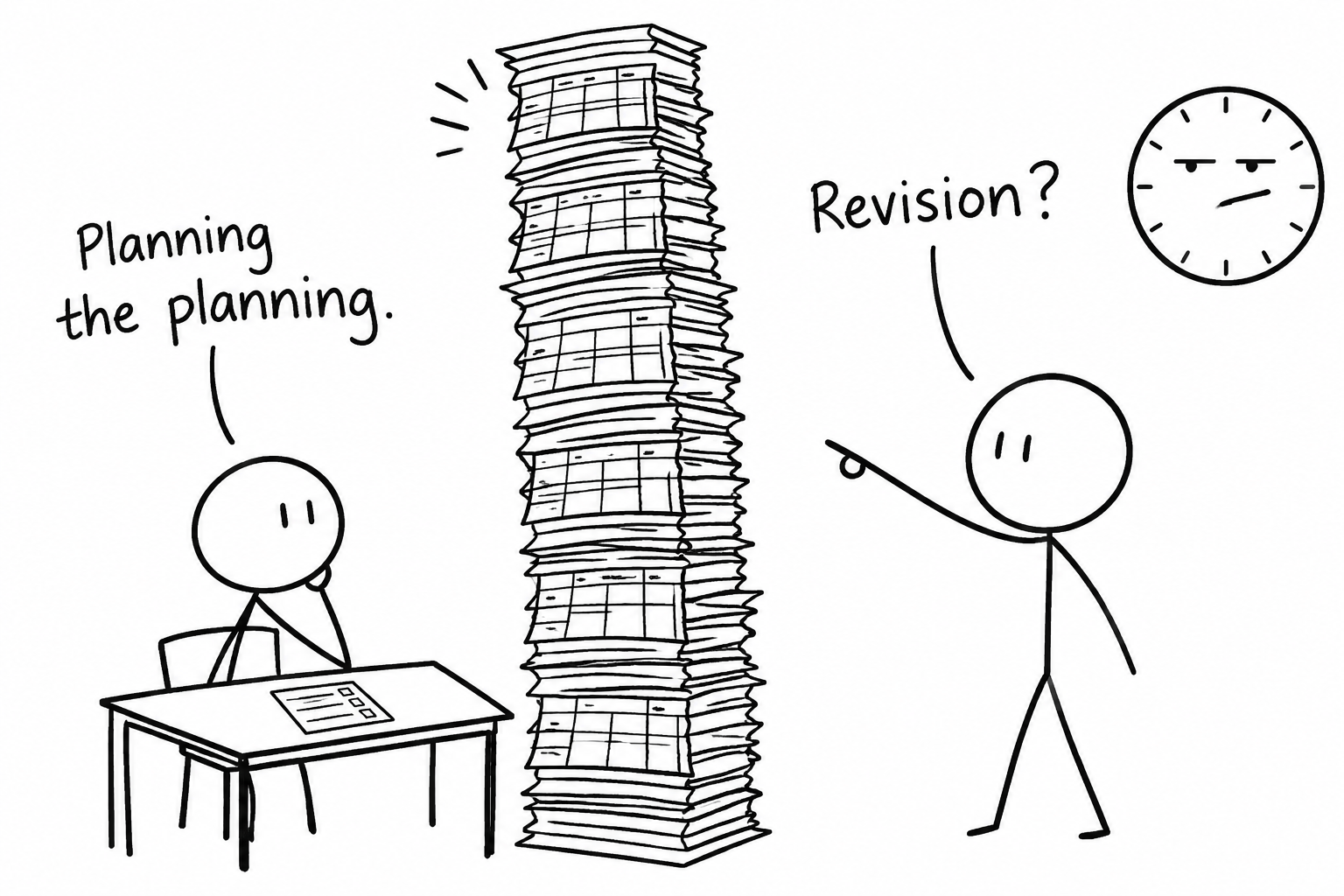 A student realises that planning the planning has become larger than revision itself
Split revision time between secure and weak areas
A student aiming for a B should not spend the entire week confronting their worst topics. That feels responsible, but it allows reliable skills to decay. Equally, revising only comfortable chapters creates confidence without enough improvement.
A sensible starting split is:
| Type of work | Share of revision time | Purpose |
|---|---|---|
| Weak, high-impact topics | 50%50\%50% | Repair methods that affect several parts of the course |
| Secure topics | 30%30\%30% | Preserve accuracy and speed on attainable marks |
| Mixed timed practice | 20%20\%20% | Practise choosing methods under exam conditions |
Treat this as a diagnostic ratio, not a rule. If timed papers reveal that mechanics causes most of your lost marks, give it more time. If your knowledge is sound but you work too slowly, move time towards mixed timed practice.
Classify each topic using evidence:
- Secure: you can answer unfamiliar questions and explain your method.
- Developing: you know the method but need prompts or make recurring errors.
- Weak: you cannot reliably identify how to begin.
Your developing list often offers the quickest progress. Moving a topic from nearly correct to dependable usually requires less time than rebuilding one from the beginning.
A weekly A-Level Maths revision template
Here is a repeatable week based on six sessions of about 606060-909090 minutes. Shorten the sessions if necessary, but preserve the balance between learning, retrieval and timed work.
| Day | Main task | Session structure |
|---|---|---|
| Monday | Weak pure topic | Recall key facts, practise one method, then answer mixed questions |
| Tuesday | Secure pure topics | Short sets from two or three areas, with an accuracy target |
| Wednesday | Weak statistics or mechanics topic | Relearn the model, practise questions and write corrections |
| Thursday | Mixed pure practice | Complete questions without topic labels or prompts |
| Friday | Rest or light retrieval | Review formulae, error cards or corrected questions |
| Saturday | Timed exam practice | Complete a paper section or full paper under realistic conditions |
| Sunday | Mark and repair | Use the mark scheme, classify errors and redo missed questions |
Each ordinary session can follow a simple pattern:
- 101010 minutes of retrieval without notes;
- 151515-202020 minutes reviewing a method;
- 303030-454545 minutes answering questions;
- 101010 minutes marking and recording corrections.
Once this weekly structure feels like a lot to organise, build it in the MathsGenie Revision Planner rather than repeatedly redrawing it on paper.
Turn six weeks into a focused plan
Weeks one and two: diagnose and repair
Complete a timed paper or substantial mixed section, then sort every lost mark into four categories: knowledge, method choice, algebra or arithmetic, and exam technique. Use the results to choose two weak topics with broad consequences.
Do not merely read their notes. After reviewing a method, close the explanation and reproduce it from memory. Then answer questions whose topic is not announced in advance.
Weeks three and four: mix and strengthen
Continue repairing weaknesses, but increase mixed practice. Topic-by-topic exercises teach execution; mixed questions teach selection. You need both.
Start revisiting repaired topics after gaps of several days. This spaced practice reveals whether a method has entered long-term memory or was only familiar immediately after revision.
Weeks five and six: perform and refine
Complete regular timed papers using the correct duration and equipment for your exam board. Mark them carefully, using the mark scheme to understand where method marks are awarded.
Your score matters, but your error pattern matters more. A missing idea needs revision. A correct method ruined by algebra needs slower working and deliberate checking. A blank final question may be less urgent than six avoidable errors scattered across accessible questions.
Use past papers without wasting them
Past papers are not only tests. They are diagnostic tools.
After each paper, record:
- the topic of every lost mark;
- whether the error was conceptual or avoidable;
- the exact correction required;
- when you will attempt the question again.
Redo incorrect questions after 484848 hours, then revisit them the following week. Keep your first solution hidden. If you can only complete the question while remembering the mark scheme, the skill is not yet secure.
MathsGenie brings together A-Level past papers and revision resources, helping you move from practice to marking without turning the search for materials into another revision task.
Common mistakes when targeting a B
Treating a grade boundary as a target score
Boundaries change between exam series. Build a safety margin by pursuing every accessible mark rather than stopping when a practice-paper score resembles a previous boundary.
Spending too long making notes
Neat notes can support revision, but they do not demonstrate that you can solve a problem. Most session time should involve retrieval, calculation and written solutions.
Ignoring secure topics
Reliable marks need maintenance. Include short mixed sets so that familiar algebra, differentiation and applied methods remain quick and accurate.
Marking generously
Use the published mark scheme and require complete notation, valid reasoning and contextual conclusions. If you cannot explain why a mark was awarded, investigate before counting it.
Recording errors without correcting them
An error log only works when it changes future behaviour. Write a specific response such as “check the interval after solving” or “define the positive direction before resolving forces”, then practise that response.
Build your grade B schedule
A grade B plan succeeds when weekly intentions become completed sessions. Exams have fixed dates, and every week spent repeatedly reorganising revision is a week with fewer questions answered. You have seen how to balance weak topics, secure marks and timed practice across six weeks; now turn that structure into your own timetable. Build your schedule in the MathsGenie Revision Planner.















