Does GCSE Geography Revision Order Matter?
Revision order GCSE geography advice: learn what to tackle first, when order matters, and how to balance geography with GCSE maths revision.
Revision timetables often look wonderfully organised before revision begins. Geography sits in one coloured box, maths in another, and every evening appears to have a clear purpose. Then the first difficult topic arrives and the plan starts to wobble.
So, does revision order GCSE geography planning actually matter? Yes, but not because there is one perfect sequence of subjects. Order matters when it helps you revisit material over time, prioritise genuine weaknesses and prepare for the next exam. It matters far less whether geography comes before or after maths on an ordinary evening.
The best order is personal and flexible: diagnose your gaps, tackle demanding work while alert, revisit it later, and adjust the timetable using evidence from questions rather than instinct.
The short answer: what should you revise first?
Use this checklist when choosing what comes next:
- Confirm your geography exam board and specification: AQA, Edexcel, OCR or Eduqas.
- List the topics and skills that will actually be assessed.
- Test yourself before deciding that a topic is secure.
- Prioritise weak, important or soon-to-be-examined material.
- Put demanding tasks in the part of the day when you concentrate best.
- Revisit topics after a gap instead of completing each one in a single block.
- Mix knowledge recall with maps, data, fieldwork and extended responses.
- Keep maths in the timetable, especially if numerical and graphical skills are unreliable.
A timetable should make good decisions easier. It should not become a rulebook that forces you to revise rivers simply because Tuesday has always been labelled “rivers”.
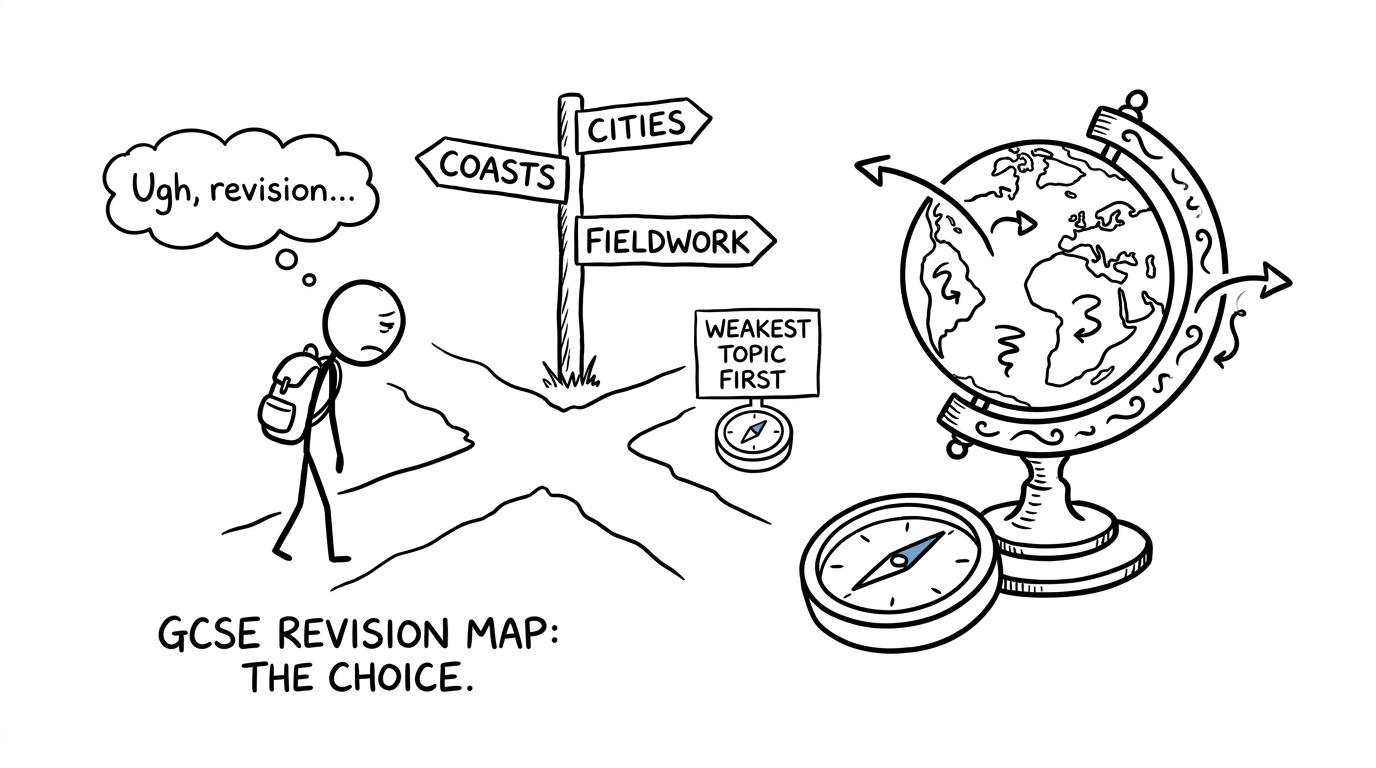 A student choosing between geography topics while a decorative globe points nowhere
Why revision order can matter for GCSE Geography
Geography combines several kinds of learning. You need knowledge of places, processes, examples and case studies, but you may also need to interpret maps, analyse unfamiliar resources, apply geographical ideas, evaluate evidence and construct justified conclusions.
These demands are connected. Revising them in a sensible sequence can therefore reduce confusion.
Foundations should come before detailed examples
Begin by checking that you understand the central process or concept. A collection of case-study facts is less useful if you cannot explain the geography connecting them.
For a physical topic, that might mean securing the process before learning detailed impacts and management responses. For a human topic, it might mean understanding causes and relationships before memorising place-specific evidence.
This is not a reason to spend weeks making basic notes. It is a reason to repair the foundations quickly, then apply them through questions.
Skills should run through the whole plan
Do not leave geographical skills until every content topic is “finished”. Official specifications assess skills alongside subject knowledge. For example, AQA states that cartographic, graphical, numerical and statistical skills can be assessed across its written papers. Its course also includes physical geography, human geography, geographical applications, fieldwork and issue evaluation.
Other boards organise their components differently, so use the specification supplied by your school rather than borrowing another student’s topic order. GCSE Geography is not normally arranged into the foundation and higher tiers used in GCSE maths.
Skills such as map interpretation, percentage change, graphs, averages and data evaluation are better treated as a thread running through revision. If those calculations feel fragile, use MathsGenie’s free GCSE Maths revision hub and GCSE Statistics revision resources to strengthen them separately.
Revisiting is more important than the first sequence
Educational research supports active retrieval and spacing learning across different days. In practical terms, trying to recall coastal processes without notes is usually more informative than reading the same page again. Returning to that topic later gives you another chance to retrieve it.
This means the first topic in your plan should not be completed and abandoned. A useful rhythm is:
- learn or repair the topic;
- retrieve the key ideas without notes;
- answer an exam-style question;
- check the response against guidance or a mark scheme;
- return after a short gap;
- test the topic again in mixed practice.
The exact interval is less important than ensuring there is an interval. The MathsGenie revision planner can help you protect those return visits while balancing geography with maths and other GCSE subjects.
A practical revision order for Geography topics
There is no universal list that every student should follow. AQA, Edexcel, OCR and Eduqas use different structures, options and terminology. Your school may also have selected particular landscapes, resources or case studies.
Instead, build your order using three layers.
Start with diagnosis
Take a short set of mixed questions from material approved for your geography course. Work without notes, then classify each weakness:
- knowledge gap: a process, term, location or example was missing;
- application gap: you knew the content but could not use it with an unfamiliar resource;
- skills gap: the map, graph, scale or calculation caused the problem;
- response gap: the answer lacked evidence, explanation or a supported judgement;
- timing gap: you knew what to write but could not complete it efficiently.
Use the result to create a red, amber and green topic list. Red topics come first, amber topics return regularly, and green topics receive brief checks so they do not fade.
Build from concepts to application
Within each topic, a productive order is:
- core vocabulary and processes;
- causes, effects and relationships;
- named examples or case-study evidence required by your course;
- maps, graphs, photographs and numerical data;
- short-answer questions;
- extended responses and evaluation;
- delayed mixed retrieval.
This sequence moves from understanding towards examination performance. It also stops revision becoming a contest to see how many facts can fit on one flashcard.
Bring fieldwork back regularly
Fieldwork is easy to postpone because it can feel separate from physical and human content. It is not. You may need to understand enquiry questions, sampling, data collection, presentation, analysis, conclusions, limitations and improvements.
Schedule short fieldwork sessions throughout the plan. Reconstruct your enquiry from memory, explain why a method was chosen, interpret results and evaluate reliability. Your own fieldwork details should come from your class materials rather than a generic online example.
Should Geography come before or after maths?
Usually, either order can work. The more useful question is: which task needs your best concentration today?
If geography extended writing is your weakest task and you think clearly straight after school, put it first. If you lose accuracy in algebra when tired, begin with maths. On another day, reverse the order. A fixed subject hierarchy is less useful than matching the task to your energy and the urgency of the exam.
A balanced evening might contain one demanding block, one shorter block and a brief retrieval check. Avoid always giving your favourite subject the freshest part of the evening while leaving the weakest one until you are exhausted.
There is also genuine overlap between the subjects. Geography may require you to work with scale, proportions, percentages, averages and graphs. MathsGenie’s scale drawings revision, ratio lesson and percentages revision can help you isolate those mathematical skills without pretending that maths practice replaces geography revision.
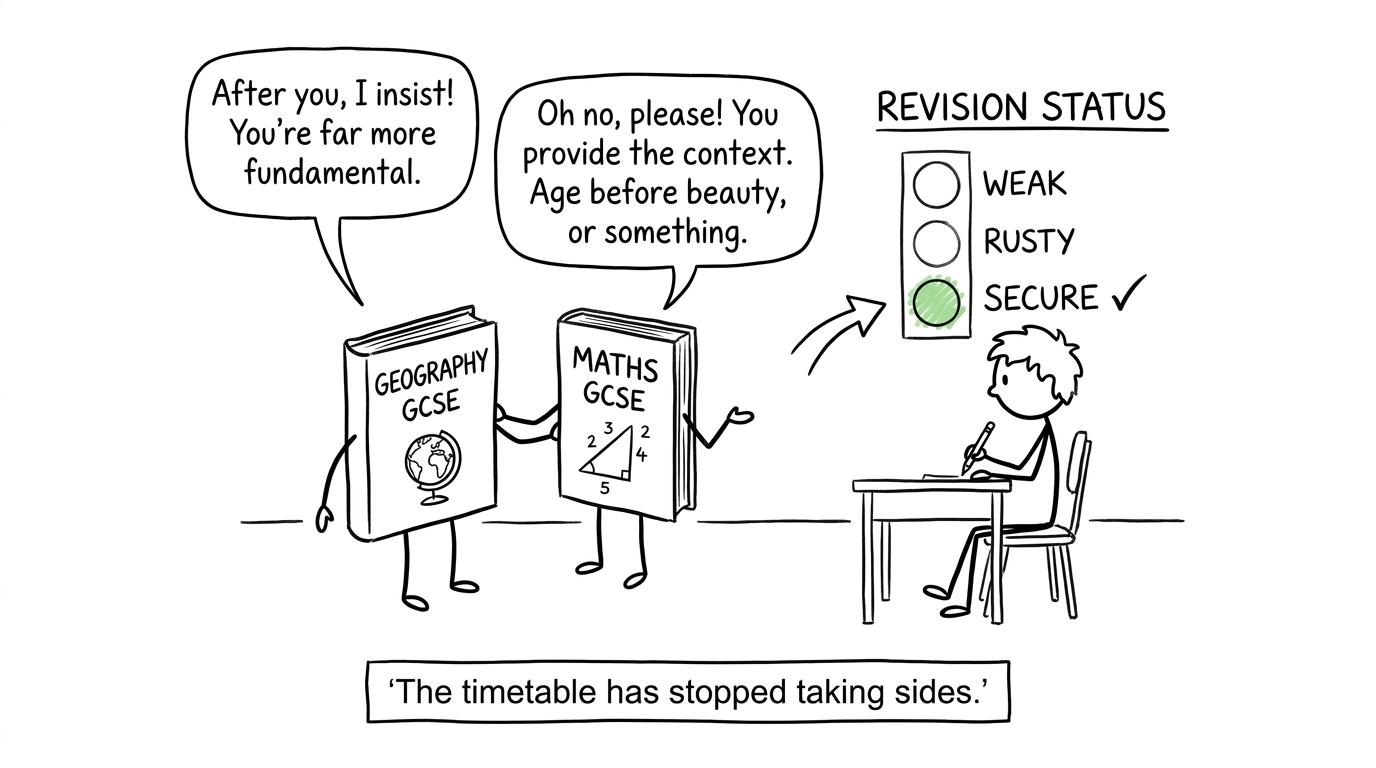 Geography and maths books negotiating their places in a revision timetable
How the order should change as exams approach
Early in revision, prioritise coverage and diagnosis. Repair major gaps while there is still time to return to them.
In the middle phase, mix topics more often. Alternate physical and human geography, combine recall with resource interpretation, and introduce timed sections. This helps you recognise what a question requires instead of relying on the comfort of knowing which chapter you opened.
Near the exam, let the paper order influence your priorities. Check the official timetable and your board’s component structure, then give the next paper slightly more attention without abandoning later papers. If your course includes advance or pre-release material, follow your teacher’s instructions and the current rules for your examination series.
Use fresh exam-style questions carefully. Predicted content should never persuade you to ignore parts of the specification. The same principle applies in maths: MathsGenie’s guide to starting past papers recommends using papers diagnostically and repairing the weaknesses they reveal.
For maths preparation alongside geography, complete papers from the correct board and tier. The MathsGenie past-paper library brings together papers and mark schemes, with worked or video solutions available for selected material.
Common revision-order mistakes
Finishing one topic and never returning
A neat tick can create false confidence. Build return visits into the timetable so earlier topics must be retrieved after a delay.
Revising in textbook order automatically
Textbook order supports teaching, but it may not reflect your weaknesses, paper dates or chosen specification options. Diagnose before deciding.
Starting every session with the easiest subject
Easy work creates momentum, but it can also consume the only period when you are fully alert. Put at least some difficult tasks first.
Leaving skills and fieldwork until the end
Maps, data, numerical techniques and fieldwork evaluation need repeated application. Treat them as recurring strands, not final chapters.
Measuring time instead of learning
Two hours at a desk is not proof of progress. A better measure is whether you can recall, apply and explain the material without support.
Refusing to alter the timetable
A plan written before testing cannot know where your gaps are. Review it weekly. Move secure topics down and repeated mark losses up.
Make your order evidence-led, not perfect
The order you revise GCSE Geography in matters, but only in a practical sense. Start with what is weak, important and approaching soon. Build understanding before detail, weave geographical skills and fieldwork throughout, and revisit learning after a gap. Whether geography appears before maths on a particular evening is secondary to the quality of the work you do.
Then give maths the same evidence-led treatment. Open the MathsGenie GCSE Maths revision hub, choose your board and tier, and use free revision lessons and practice questions to repair specific gaps. Follow with mini tests, past papers, predicted papers, mark schemes and video solutions.
A good timetable does not predict every difficulty. It simply makes sure that, when a weakness appears, you know what to do next.