

Revising Maths Over Christmas After Mocks
Revising maths over Christmas after mocks? Turn feedback into a manageable GCSE revision plan, protect time off and build a targeted maths practice paper.
November can make maths feel unusually public. There is the mock paper on your desk, the questions you recognise but cannot finish, and then the wait for a result. By December, it is tempting to let that grade describe your ability.
Revising maths over Christmas after mocks works best when you use your marked paper to choose a few priorities, practise them in short sessions, and test them again. Leave room for a proper holiday. Your mocks provide evidence about what needs attention; they are a diagnostic, not a verdict.
Here is how to turn that evidence into a manageable plan for January.
Start with the paper behind the grade
Imagine a Year 11 student receiving their November mock in December. Their first instinct might be to compare grades with friends. A more useful next step is to look at where the marks went.
A blank answer can mean several things: an unfamiliar topic, uncertainty about starting, or simply running out of time. Each needs a different response.
Read your paper alongside the mark scheme and any teacher feedback. Sort lost marks into four groups:
- Knowledge: you did not know the fact or method.
- Application: you knew the topic but could not interpret the question.
- Accuracy: arithmetic, signs, units or copying caused the error.
- Timing: you did not reach the question or spent too long elsewhere.
For Year 10 students, check which topics your class has covered before adding unfamiliar material to your holiday list. For Year 11, ask your teacher which gaps deserve attention first.
Your Christmas revision checklist
Before the holiday begins, gather:
- Your marked mock papers and teacher feedback.
- Your exam board and foundation or higher tier.
- Three priority skills, chosen from your mistakes.
- A few realistic revision slots, with days off included.
- Fresh questions for checking progress afterwards.
Start from MathsGenie’s GCSE maths revision resources and select your board, whether that is Edexcel, AQA, OCR or Eduqas. This keeps your practice connected to the right course.
Three priorities is a suggested starting point, not a rule. Choose an amount you can revisit properly.
Revising maths over Christmas after mocks: a practical plan
Choose skills you can name precisely
“Get better at algebra” gives you nowhere clear to begin. “Solve equations with brackets” tells you what to practise and what success should look like.
Pick topics that appeared in your mock, that you have already been taught, and that support other work. Fractions, percentages and rearranging formulae often repay attention because they appear within longer questions.
Include a topic where you nearly succeeded. Recovering an incomplete method can be a useful early win, alongside tackling a more substantial gap.
Give each session a clear job
A suggested session of around 25-35 minutes could include:
- Five minutes recalling the method without notes.
- Ten minutes using a revision lesson and attempting practice questions.
- Ten minutes answering fresh questions independently.
- Five minutes marking and recording the next step.
Adjust this to your concentration and other commitments. The useful measure is whether you can do something more independently afterwards.
Write a specific note when you finish: “I need to check negative signs when expanding brackets” is more actionable than “algebra went badly”.
Put rest in the timetable first
Christmas includes family plans, disrupted routines and tiredness after term. Put those commitments into your plan before allocating revision.
You might choose four short sessions in the first week, followed by a few review sessions in the second. That is a planning suggestion, not a required quota.
The MathsGenie revision planner can help organise topics around your available time. Leave spare space so one missed session does not collapse the whole plan.
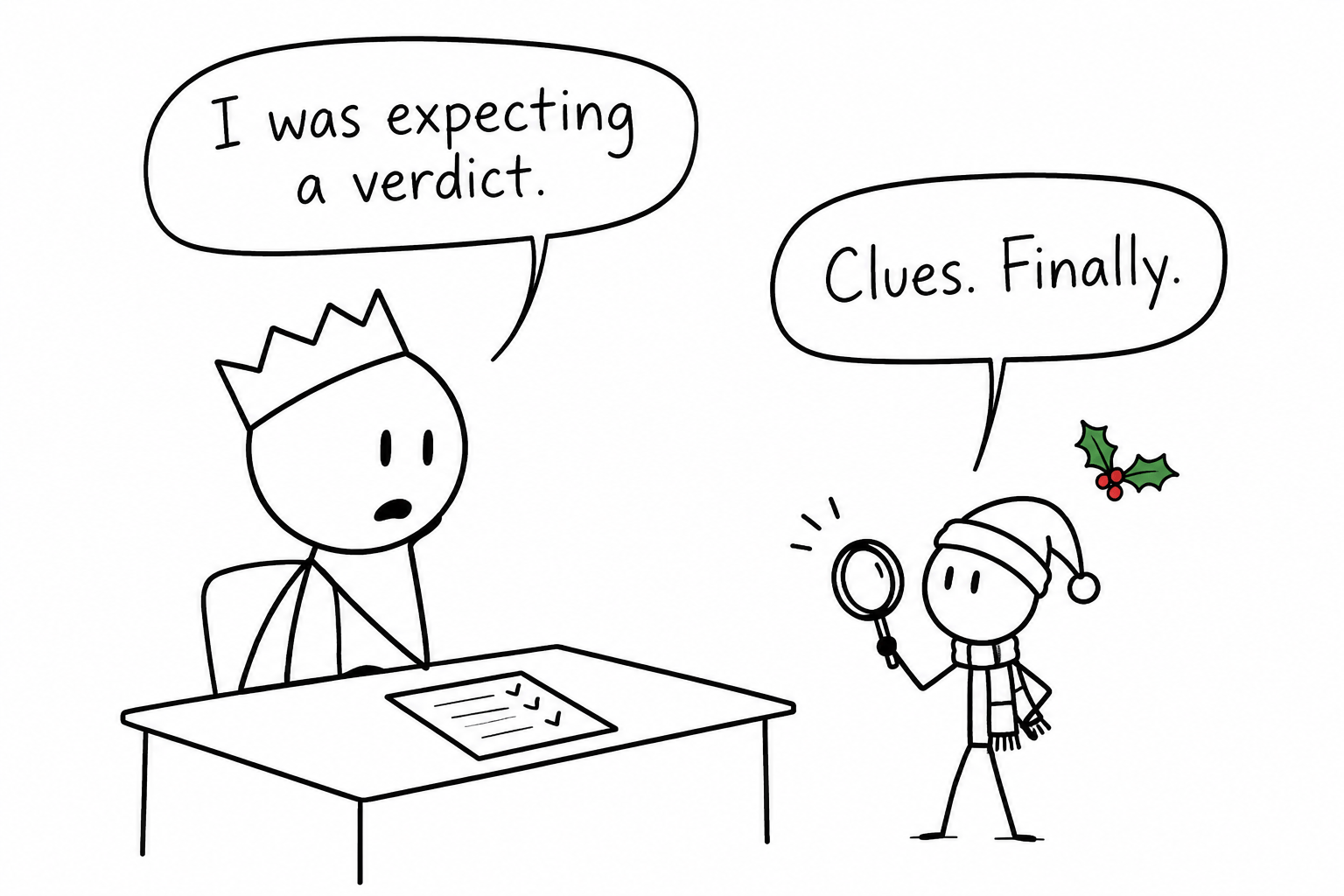 A Christmas mock exam detective helps a student see their marked paper as clues rather than a verdict
Turn GCSE maths mocks into better practice
Watching a solution can make a method feel familiar before you can reproduce it. After using a lesson or video solution, close it and attempt a fresh question.
If you get stuck, identify the first step you could not explain. Review that step, then try again without copying. Mark schemes help you see which parts of the method earned credit and where your working became unclear.
Revisit the skill a few days later. Immediate success is encouraging; a successful attempt after a gap gives you better evidence that the method is becoming secure.
Edexcel students can use topic-focused maths mini tests for short checks. Once individual skills improve, mix them together. Recognising which method a question needs is part of exam preparation too.
Common mistakes after December mocks
Repeating whole papers without repairing gaps
Past papers organised by exam board are useful for practising question selection, timing and sustained concentration. However, another full paper may reveal the same difficulties if you have not worked on them between attempts.
Alternate focused practice with broader checks. Use predicted papers as additional practice when appropriate, remembering that they cannot guarantee what will appear in an exam.
Calling every error careless
Repeated slips deserve investigation. Did you skip a written step, misread the instruction or rush a calculation? Choose a checking habit that addresses the actual cause.
Treating the mock grade as a forecast
A mock records performance on a particular assessment. Its coverage, difficulty and school grading arrangements affect how you should interpret it. Ask your teacher what the result shows about your next steps rather than assuming it fixes your final grade.
How parents can help without adding pressure
Ask, “Which question makes more sense now?” This directs attention towards learning and gives your child something concrete to explain.
Help protect an agreed revision slot, provide a quiet space where possible, and respect planned time off. If the feedback is unclear, help your child prepare a specific question for their teacher. Parents can support the routine without becoming the maths teacher.
Finish Christmas with evidence of progress
By January, aim to identify a few things you can now do independently and a clear next priority. That is more useful than counting hours spent beside an open workbook.
Choose the topics your mocks exposed and build a targeted practice paper in Mock Exam Builder. Attempt it independently, review the mistakes, and use MathsGenie’s free revision resources to guide your next session. Let the next paper show what your practice has changed.















