Revise Weakest Topic First in GCSE English?
Revise weakest topic first GCSE English Language and Literature? Learn when to start there, when to delay and how to plan an effective revision session.
A revision session often begins with a quiet negotiation. You know comparative poetry or language evaluation needs attention, but quotation recall feels safer. Or perhaps you should do maths first because its answers feel more definite.
If you are wondering whether to revise weakest topic first GCSE English Language and Literature, the practical answer is: usually, yes. Begin with a short, clearly defined task on your weakest area while your attention is fresh. However, do not spend the entire session trapped there. Follow it with something more secure, then return to the weakness briefly at the end or on another day.
Starting first creates time for feedback and future practice. Finishing with the topic can still be useful for retrieval, but repeatedly postponing it usually protects the weakness rather than repairing it.
The quick decision checklist
Use this before each English revision session:
- Identify a specific weakness, not a whole subject.
- Begin with it if you can attempt the task independently.
- Use a short warm-up first if anxiety is stopping you from starting.
- Produce an answer, plan or quotation test rather than rereading notes.
- Check your work against teacher feedback or your exam board's materials.
- Record one precise improvement.
- Revisit the same skill on another day.
- Keep enough time for maths and your other GCSE subjects.
The important choice is not simply first or last. It is whether the weak area receives focused practice, useful feedback and a planned return.
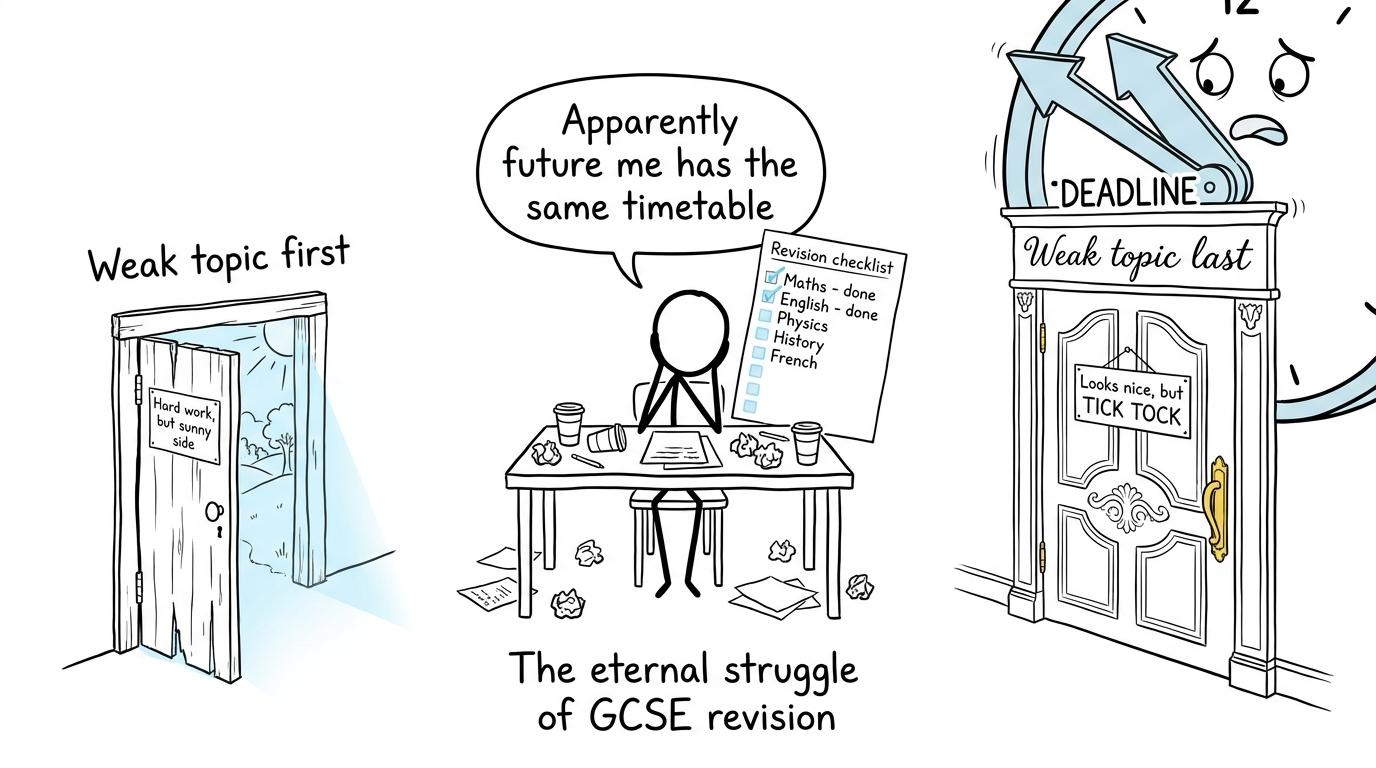 A student choosing between revising a weak topic first and leaving it for later
Why revising your weakest topic first usually works
A weak topic needs more than exposure. It needs diagnosis, an active attempt, feedback and another attempt. Starting early in the session gives you room for that process.
It also removes an easy form of procrastination. Secure topics provide the pleasant feeling of fluency: quotations come to mind, familiar questions look manageable and pages fill quickly. That feeling is encouraging, but it is not always evidence that your revision priorities are right.
There is another advantage. Retrieval practice means trying to recall or apply learning with limited prompting. Evidence reviewed by the Education Endowment Foundation describes low-stakes quizzing and retrieval as generally promising when it is appropriately challenging and followed by feedback. A weak-topic task at the start therefore becomes both revision and diagnosis.
This is the same principle used in effective maths revision. A GCSE maths mini test can expose the method you cannot yet retrieve; an English paragraph or quotation check can expose the interpretation you cannot yet support. The subject changes, but the feedback loop remains:
attempt, check, correct, revisit.
When starting with the weakest area can go wrong
“Weakest topic first” is not a command to begin every evening with the most overwhelming task available.
If your chosen target is “all of poetry” or “English Language Paper 2”, the task is too broad. Faced with something shapeless, students often spend their freshest minutes arranging notes rather than practising. Narrow the target to a skill such as comparing viewpoints, analysing structure, selecting evidence or planning a response to one theme.
Starting there can also fail when you lack the basic knowledge needed to attempt the task. If you cannot remember the text, question format or relevant assessment objective, begin with a brief review. Then close the notes and produce something from memory. Support should lead into independence, not replace it.
Finally, a difficult opening can drain motivation if it lasts too long. Set a boundary. A focused opening block should create evidence about your learning, not consume the whole evening.
MathsGenie's guide to finding your weakest GCSE topics uses the same useful distinction: weakness should be identified from performance, not from a vague feeling that a subject is difficult.
When revising the weakest topic last makes sense
Putting a weak area last can work in three situations.
You need a short starting win
A brief, secure warm-up can lower the resistance to beginning. Recall a few quotations, check terminology or complete a familiar maths question. Then move to the weak topic while most of the session remains.
The danger is letting the warm-up become the session. Decide in advance when you will switch.
You are using the end as a retrieval check
A return at the end can reveal whether the earlier work stayed in memory. Close the notes and write a paragraph plan, reconstruct an argument or list the evidence you would use. This is much more useful than finishing by reading the same page again.
The task requires support that is not available yet
You may need feedback from your teacher, a copy of the set text or confirmation of the question format. In that case, schedule the task for a specific later point. “After I collect the marked essay” is a plan. “When I feel ready” usually is not.
So, does tackling your weakest area at the start or end actually make a difference? Yes, because placement affects attention, avoidance and the opportunity to correct mistakes. But the quality of the task and whether you revisit it matter more than order alone.
Use the weak-topic sandwich
For most students, the strongest approach is neither an exhausting weak-only session nor a comfortable strong-only session. Use three stages:
- Open with the weakness: attempt one tightly defined task.
- Move to mixed or secure practice: maintain broader knowledge and confidence.
- Close with retrieval: recall the correction or outline the improved response without notes.
This structure protects attention without allowing one difficult area to dominate your timetable. It also creates spacing when you schedule another retrieval attempt later. Research on learning generally supports distributing practice across days rather than relying on one massed session, although the best interval depends on the material and the learner.
A similar rhythm appears in MathsGenie's GCSE maths revision timetable: diagnose weaknesses, practise actively, review errors and return to them. If you are balancing English with foundation or higher tier maths, the timetable should allocate both subjects real tasks rather than labels such as “revise English”.
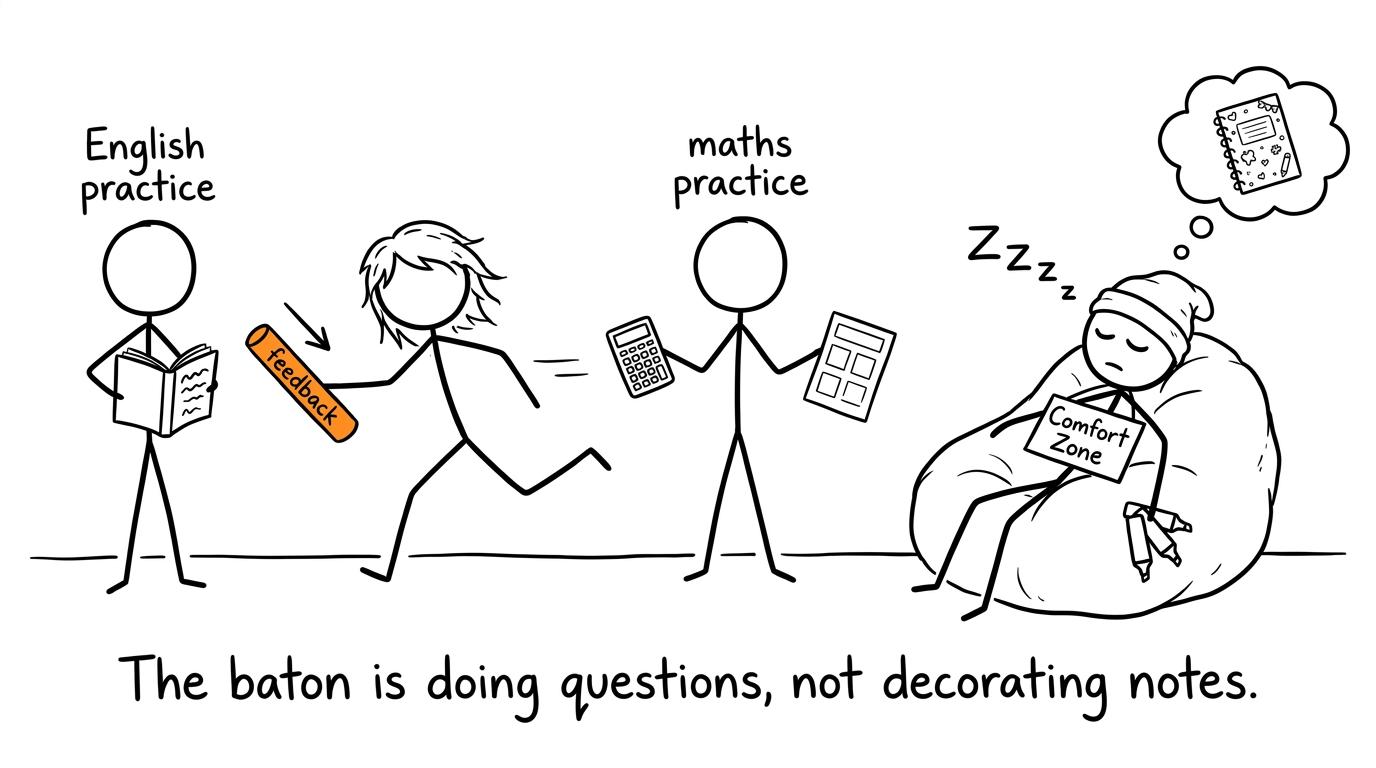 English and maths revision passing the feedback baton
Define weakness differently in Language and Literature
English Language and English Literature do not create identical revision problems.
English Language weaknesses are often transferable skills
Official English Language assessment objectives in England divide the qualification between reading and writing. They cover skills including identifying and interpreting information, analysing language and structure, comparison, evaluation, adapting writing to audience and purpose, and technical accuracy.
Your weakness might therefore be:
- selecting evidence rather than copying large sections;
- explaining effects instead of identifying techniques;
- comparing perspectives across texts;
- evaluating with precise textual support;
- controlling structure, register, punctuation or spelling in writing.
These skills improve through fresh texts and timed responses, not by memorising one perfect answer.
English Literature weaknesses can involve knowledge and argument
Literature requires knowledge of whole texts alongside critical interpretation. The national subject content includes Shakespeare, a nineteenth-century novel, poetry and modern literature, although exact texts and paper structures depend on your specification.
A Literature weakness may involve insecure quotations, thin knowledge of a theme, limited analysis of form and structure, unsupported context or an argument that does not answer the question.
Do not assume that memorising more context fixes an analytical weakness. Likewise, sophisticated analysis cannot rescue an answer with no secure textual knowledge. Diagnose the layer that is failing.
Always check your own Edexcel, AQA, OCR or Eduqas specification and teacher guidance because paper formats, set texts and mark allocations differ. The assessment objectives provide direction, but your board's materials show how they are assessed.
Balance English weaknesses with GCSE maths revision
Students preparing for maths exams cannot allow one English weakness to absorb every available session. Revision is a portfolio: each subject needs enough attention to prevent important skills from fading.
Use evidence to choose your next task. For English, that evidence might come from a marked essay, timed paragraph or quotation test. For maths, use the GCSE maths revision hub, where resources are organised by board and include revision guides, questions and papers.
A simple cross-subject pattern is:
- one focused English weakness task;
- one maths topic identified through questions;
- feedback on both;
- a scheduled reattempt.
If maths is currently the weaker subject, reverse the order on some days. The principle is not “English always comes first”. It is “important weaknesses receive fresh attention before comfort consumes the timetable”.
MathsGenie's free revision resources include self-assessments and testing materials that can help you make that decision from evidence. Nearer the exams, GCSE predicted papers and past papers can reveal whether repaired topics remain secure under mixed, timed conditions.
Common mistakes when prioritising weak topics
Calling an entire paper a weakness
“Paper 1” is not a workable target. Name the question type, assessment objective or stage of the response that causes difficulty.
Rereading instead of attempting
Recognition feels easier than retrieval. Close the guide and produce a plan, paragraph, comparison or quotation list before checking.
Spending every session on the same weakness
A difficult skill needs repeated contact, but other knowledge also needs maintenance. Space the practice and mix it with secure areas.
Marking without taking action
A score is only a description. Turn feedback into a correction such as “link the quotation to the writer's purpose” or “compare methods as well as ideas”. Then apply that correction.
Ignoring the exam board
Do not practise a question format simply because it appeared in a generic video or worksheet. Confirm your specification, texts and assessment structure with your school.
Leaving all timed practice until the end
Topic work builds skill; timed papers test whether that skill survives pressure. Maths students can read when to start GCSE past papers and apply the central lesson across subjects: start with manageable sections, review them properly and build towards full papers.
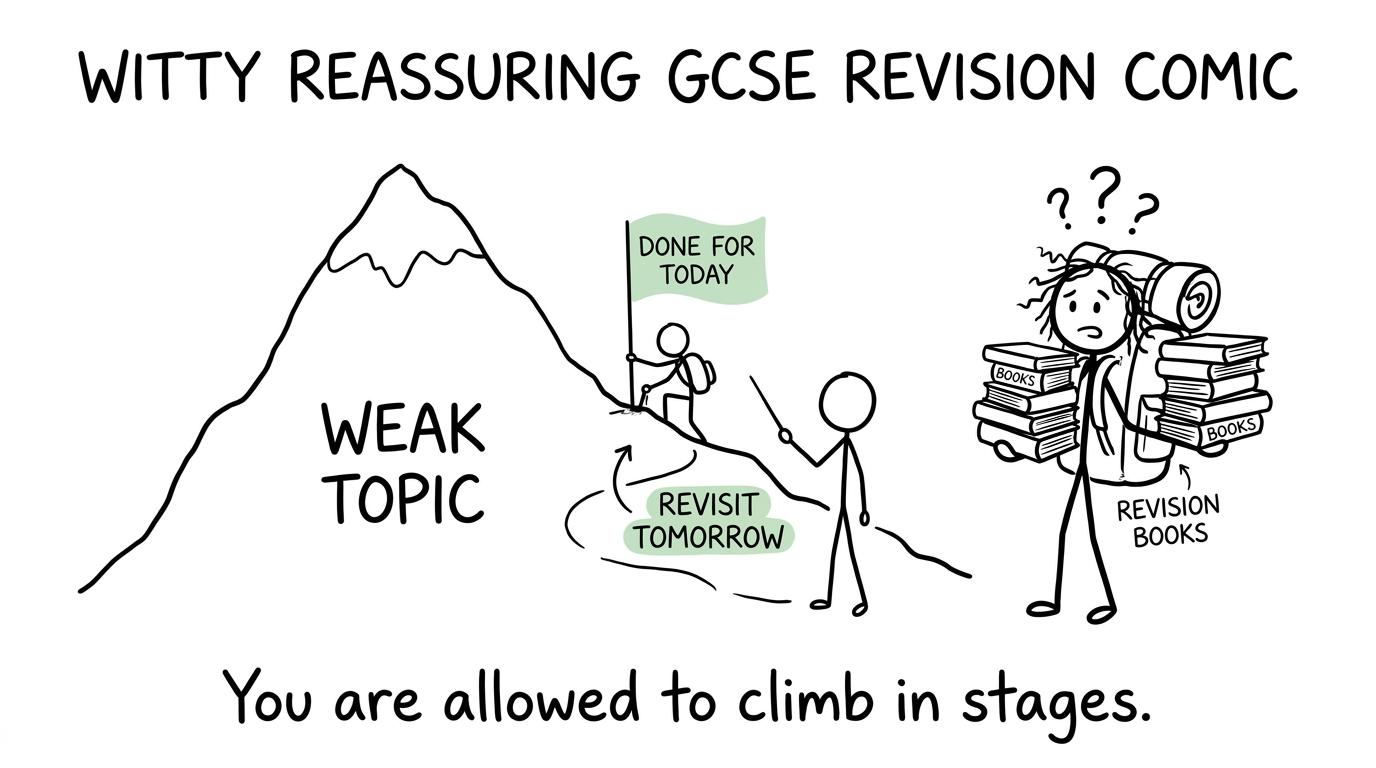 A student climbing the weak-topic mountain in manageable stages
Start early, but return later
The best default is simple: tackle a small part of your weakest English Language or Literature area near the start, while your attention and options are greatest. Use a brief warm-up when necessary, then finish with retrieval or schedule a later reattempt.
Weakness is not a permanent label. It is information about what should happen next.
Use that same idea across your maths preparation. Begin at MathsGenie's GCSE revision home, identify a genuine gap and work through a revision lesson followed by practice questions. Then test the improvement with mini tests, past papers or predicted papers, checking mark schemes and video solutions where available.
Do not wait for the weak topic to feel inviting. Make it small enough to start, useful enough to mark and important enough to revisit.