How to Revise GCSE French With a Sibling
Revise GCSE French with a sibling effectively: learn what their exam experience can teach you, what may now be outdated, and how to plan useful sessions.
The tempting idea is that an older sibling has already discovered every shortcut. They know the speaking exam, remember the awkward listening questions and may still have a folder of carefully highlighted notes. But if you want to revise GCSE French with a sibling, their greatest value is not necessarily what they remember. It is what they can help you practise.
Yes, revising with a sibling can help. They can test vocabulary, listen to spoken answers, run role-play practice and make revision more accountable. However, their old topic lists, exam timings and speaking advice may be outdated, particularly if they sat GCSE French before the reformed specifications were first assessed in summer 2026. Your current specification, teacher guidance and official assessment materials must take priority.
The quick sibling revision checklist
Before opening an old exercise book, agree on five things:
- Confirm your exam board, specification and tier.
- Check when your sibling sat the qualification.
- Use them as a questioner, listener and practice partner rather than as the final authority.
- Base sessions on your current vocabulary, grammar and assessment materials.
- Protect time for your other GCSEs, especially maths.
That last point matters. Shared French revision should save time, not absorb the whole evening. A structured timetable such as the GCSE maths revision timetable can help you keep both subjects moving.
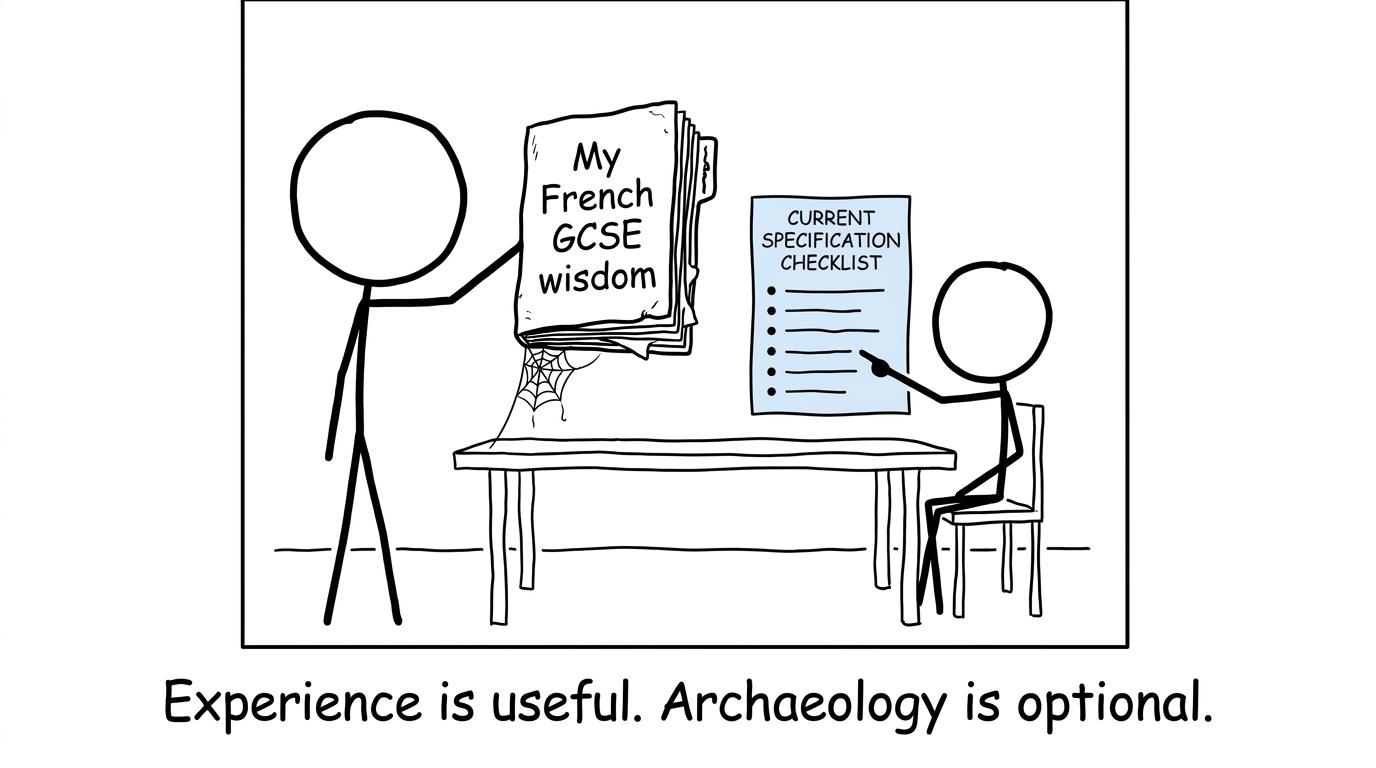 Two siblings compare old French GCSE wisdom with a current specification
What an older sibling can genuinely help with
The strongest benefits survive specification changes. Conversation is still conversation. Retrieval is still retrieval. Calm familiarity with an exam is still valuable.
They can make vocabulary practice active
Looking at a vocabulary list can feel productive without proving that you can recall anything. A sibling can cover the answers, change the order and return to words you missed later.
Ask them to test in both directions. Recognising French and producing French are different demands. They can also place vocabulary inside short questions so that you must understand meaning rather than recite a memorised list.
Your sibling does not need perfect French pronunciation to run a useful recall session. They need the current list and enough discipline not to reveal answers too quickly. If pronunciation is being assessed, however, compare uncertain words with resources approved by your teacher rather than treating family memory as definitive.
They can provide a real audience for speaking
Speaking alone is comfortable because nobody notices a long pause. Speaking to another person reveals whether you can respond, recover and keep going.
A sibling can:
- ask current role-play or conversation prompts;
- time complete responses;
- notice answers that are too short;
- ask an unexpected follow-up question;
- record a session for you to review;
- note repeated hesitation, unclear pronunciation or missing detail.
Their job is not to rewrite every sentence into advanced French. It is to help you communicate clearly under mild pressure. Your teacher and the current mark criteria remain the best authorities on how marks are awarded.
They can support dictation and reading aloud
The reformed GCSE French qualifications introduced for first assessment in summer 2026 place explicit attention on sound-symbol correspondences. Current assessments include dictation and reading-aloud demands, although the precise structure depends on the exam board.
This creates two useful sibling activities. First, give them an approved sentence to read while you transcribe what you hear. Second, read a current passage aloud and ask them to circle places where you hesitate or change your pronunciation between attempts.
They do not need to diagnose every sound. Their useful observation may simply be: “You slowed down at the same ending both times.” That tells you what to take back to your teacher or practise with a reliable audio model.
They can make you start on time
Sometimes the best revision technique is another person waiting at the table. Agreeing to begin at a fixed time removes the small daily negotiation that often delays independent work.
Keep the arrangement modest. A focused session followed by independent correction is usually more useful than an open-ended evening of chatting, testing and searching through old notes. Maths students can use the same dependable rhythm in the twenty-minute maths revision routine.
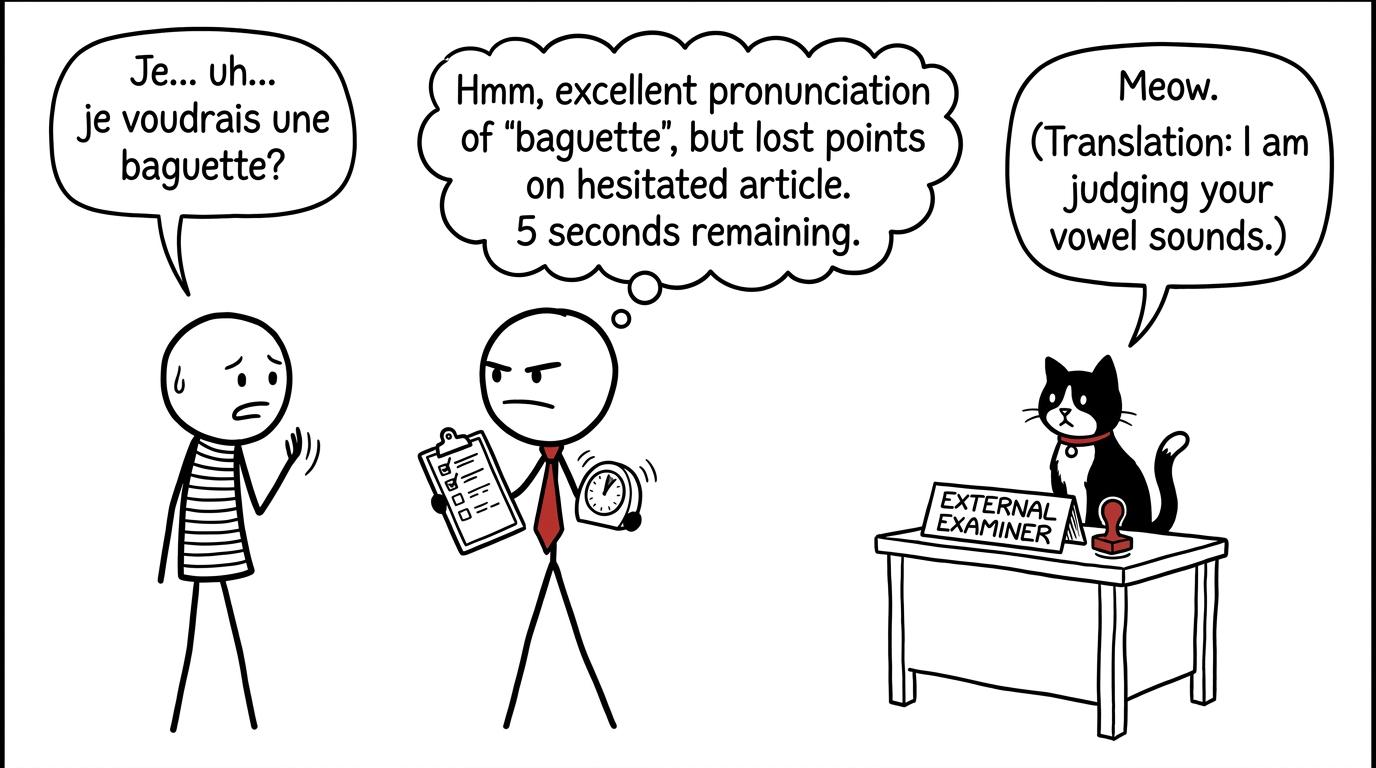 A sibling runs a very serious kitchen-table French speaking test
What may be outdated in your sibling's GCSE French advice
An old resource is not automatically wrong. A French verb does not expire because an exam specification changes. The danger is assuming that accurate language content must also be accurate exam guidance.
Old speaking formats
If your sibling sat GCSE French in 2025 or earlier, they prepared for the previous qualification. Reformed GCSEs were taught from September 2024 and first assessed in summer 2026. Current specifications include newer features such as reading aloud and an associated short interaction, while exact task order, timings and marks vary between boards.
Advice about a former photo card, general conversation structure or preparation period may therefore be misleading. Check the specification code rather than relying only on the board name: an exam board can have an old and a new specification under different codes.
Old vocabulary and topic lists
A sibling's vocabulary cards may contain useful French, but they may not match your prescribed vocabulary and grammar. The reformed qualifications use defined vocabulary requirements, with additional demand at higher tier. Themes and contexts can also be organised differently.
Use current school lists as the source. Old cards can become optional extension material, but they should not displace words you are expected to understand and use.
Old sample answers and memorised scripts
A polished answer can teach sentence structure, but memorising somebody else's response carries two risks. It may answer an old task, and it may collapse when the question changes.
Ask your sibling to interrupt the script with a different question. If you can adapt the language, you understand it. If you can only restart from the beginning, you have memorised a sequence rather than developed a usable response.
Old assumptions about tiers and papers
Do not assume your sibling's tier, paper order or timings apply to you. Current AQA and Pearson Edexcel French qualifications require students to take a consistent tier across the components, but details must be checked against your own board. Schools using other awarding organisations may follow different documentation.
The principle is simple: experience explains what exam pressure feels like; the current specification explains what your exam contains.
How to structure a useful sibling session
A sibling session works best when each person has a clear role. Try this structure:
Set one narrow goal
Choose one outcome, such as recalling travel vocabulary, completing a role-play or improving reading aloud. “Revise French” is too broad to guide either person.
Attempt before receiving help
Answer from memory first. Your sibling should wait through a reasonable pause rather than supplying the opening word. The attempt shows what you can currently retrieve.
Record only useful feedback
Limit feedback to a few categories:
- vocabulary you could not recall;
- grammar patterns that repeatedly broke down;
- pronunciation requiring verification;
- questions you misunderstood;
- answers that needed more relevant detail.
Do not turn the session into continuous correction. Too many interruptions can prevent you from completing a thought.
Finish with an independent retest
Repeat missed material later without your sibling beside you. Help has worked only when you can perform independently.
This is also how effective maths revision operates: attempt, mark, repair and retest. The guide to using GCSE past papers properly explains that feedback loop in detail, while MathsGenie's GCSE maths revision hub provides board-specific lessons and question practice.
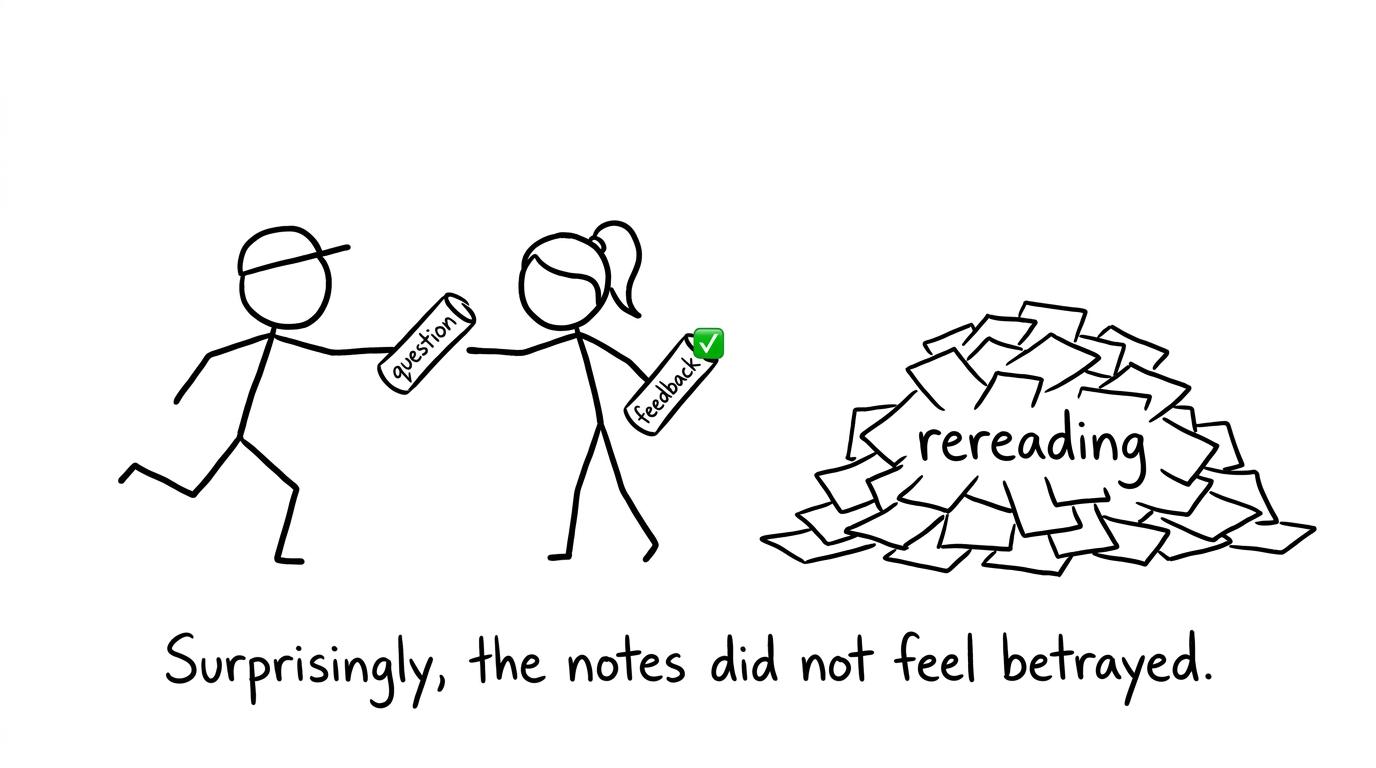 Siblings pass questions and feedback while rereading waits on the sidelines
When sibling revision is not helping
Shared revision is a poor fit if your sibling guesses corrections, mocks mistakes or repeatedly turns the session into an argument. Familiarity is only helpful when it creates a safe but focused practice environment.
It may also be unnecessary for quiet reading or written correction. Use your sibling where another person adds something: live questioning, listening, timing and accountability. Work independently when you need concentration.
If the arrangement becomes distracting, shorten it or ask a teacher, classmate or another adult to run the prompts instead. The aim is better performance, not loyalty to one revision method.
Common mistakes when revising French with a sibling
Treating old notes as the specification
Keep useful language, but verify all task formats, timings, vocabulary requirements and mark guidance against current materials.
Letting the stronger person do the thinking
If your sibling translates, plans and corrects every answer immediately, the session measures their French. You need to attempt each task before receiving support.
Practising only speaking
A sibling is convenient for conversation, but GCSE French also assesses listening, reading and writing. Keep all assessed skills in your plan.
Accepting confident but uncertain corrections
Confidence is not evidence. Mark doubtful language for checking with your teacher or an approved current resource.
Allowing French to crowd out maths
Revision has an opportunity cost. Build boundaries around shared sessions, then return to your wider plan. MathsGenie's free resources hub offers mini tests, predicted papers and shorter practice formats when time is tight. You can then progress to Edexcel GCSE maths past papers, AQA GCSE maths revision or OCR GCSE maths past papers, depending on your board.
Use experience, but verify the map
An older sibling can be an excellent revision partner because they offer something a textbook cannot: a responsive human being. They can ask again, notice hesitation and make a practice task feel real.
But having sat GCSE French does not make every old handout current. Use your sibling for interaction and accountability; use your present specification, teacher and current assessment materials for accuracy.
Then give maths the same disciplined attention. Start at MathsGenie for free revision lessons and practice questions, diagnose weaknesses with mini tests, and build towards past papers and predicted papers. Mark with the supplied mark schemes, use video solutions when a method is unclear and let each mistake decide what you practise next.