Revise GCSE Food and Nutrition Alone or With Others?
Revise GCSE Food and Nutrition alone or with others. Compare both methods, match them to each topic and build a focused plan that supports maths too.
Revision can look productive without producing much learning. A quiet hour may become careful highlighting. A group session may become an hour of conversation with five minutes of quizzing attached.
So, is it better to revise GCSE Food and Nutrition alone or with others? The short answer is: use both. Revise alone when you need concentration, honest self-testing and independent exam practice. Revise with others when explanation, questioning and comparison will expose gaps in your understanding. The best choice depends less on personality than on the task in front of you.
This matters for maths students too. Food Preparation and Nutrition involves percentages, ratios, quantities, timings, data and graphs. If those skills feel uncertain, strengthening them through GCSE Maths revision can protect marks across more than one subject.
The quick revision checklist
Use this simple division of labour:
- Revise alone: nutrient recall, food-safety facts, timed exam questions, calculations, personal error correction and planning.
- Revise with others: verbal quizzes, food-science explanations, comparing evaluations, discussing food choices and checking misconceptions.
- Use both: learn independently, explain to somebody else, then return to an individual question without notes.
- Keep NEA work independent: discussion may help you understand course content, but assessed work must follow your teacher's and exam board's authentication rules.
- Measure learning by retrieval: ask what you can recall, apply and explain without looking at your notes.
There is no need to declare yourself a permanent solo reviser or group reviser. A whisk and an oven do different jobs. Revision methods do too.
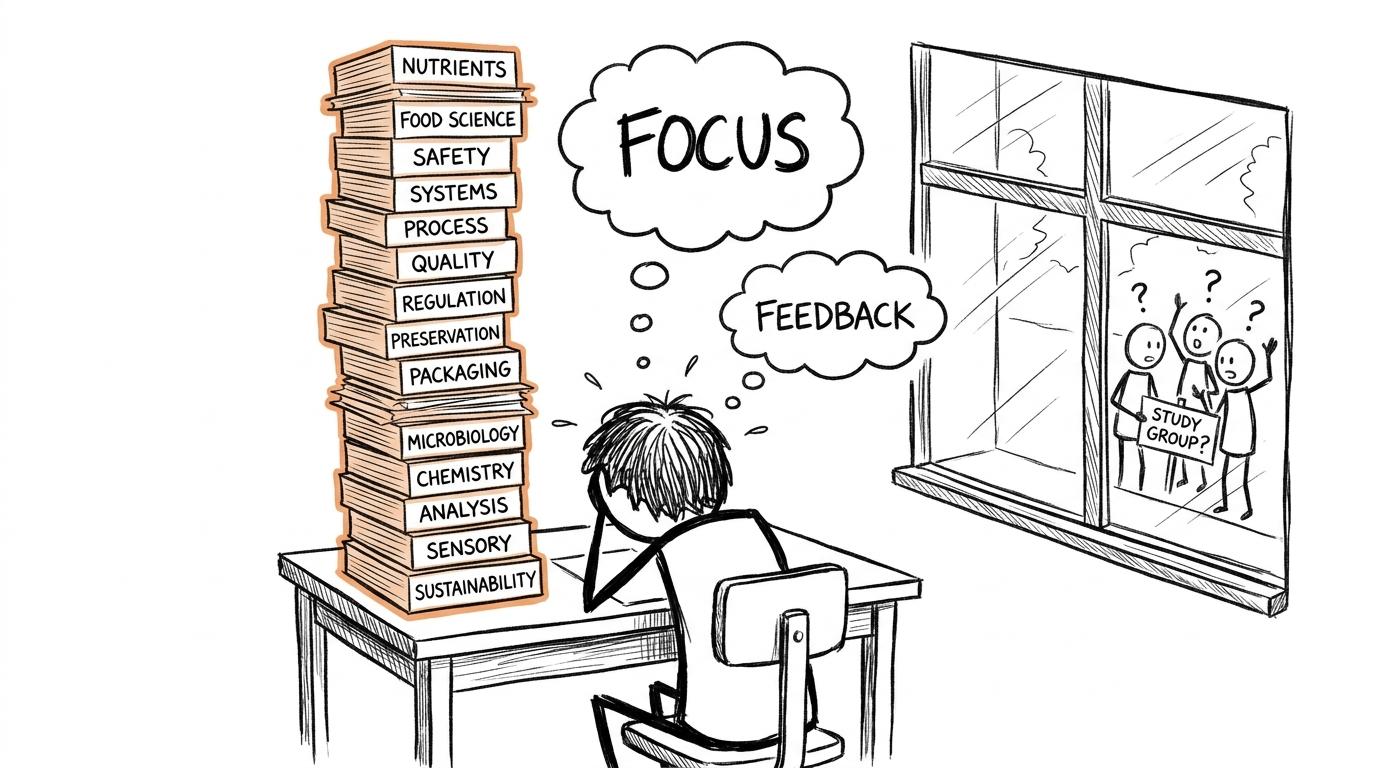 A student deciding between focused solo revision and useful feedback from friends
Why solo revision works
Solo revision gives you control. You choose the topic, pace, level of difficulty and length of the session. More importantly, there is nowhere to hide. In a group, recognition can feel like knowledge: another student says the answer and it suddenly seems familiar. Alone, a blank page reveals whether you could actually retrieve it.
Retrieval practice is the deliberate attempt to recall previously learnt material. Educational evidence supports its value, particularly when questions are appropriately challenging, feedback follows and the material is revisited after a delay. That makes self-quizzing more useful than repeatedly reading a polished set of notes.
Topics that suit solo revision
Independent work is especially effective for:
- recalling the functions and sources of nutrients
- learning food-poisoning risks and safety procedures
- distinguishing food provenance terms
- memorising key temperatures or processes required by your specification
- completing timed short-answer and extended-response questions
- practising recipe calculations, ratios and percentages
- correcting personal misconceptions
Solo work also makes it easier to match revision to your own exam board. AQA, OCR and Eduqas organise and assess the course in slightly different ways, although each combines theoretical knowledge with non-exam assessment. Check your specification and use the precise language expected in its mark schemes.
The limitation of revising alone
Independence can preserve an error as easily as it preserves a correct idea. If you repeatedly explain gelatinisation incorrectly, repetition only makes the incorrect version more fluent. Feedback matters.
Build a checking stage into every session. Compare answers with an authorised mark scheme, class materials or teacher feedback. For the numerical skills beneath food questions, MathsGenie's ratio revision guide helps you review the structure of proportional reasoning before you practise independently.
Why revising with others works
A productive group forces ideas into words. It is one thing to recognise that proteins denature; it is another to explain what changes, why the change happens and how it affects a food product. Explaining a concept can reveal the missing link between a remembered keyword and genuine understanding.
Collaborative learning can support attainment, but it does not work automatically. The task needs a shared purpose, every student needs to participate and the group must check its conclusions. For informal revision, a pair or small group is usually easier to manage than a crowded room.
Topics that benefit from discussion
Group revision is particularly useful for:
- explaining food-science processes in a logical sequence
- comparing reasons for different food choices
- discussing environmental, ethical, cultural and economic influences
- evaluating sensory properties and practical outcomes
- generating questions from the specification
- practising extended responses verbally before writing alone
- spotting vague language such as “healthier” without an explanation
A useful group question does not merely ask, “What is the answer?” It asks, “Why?”, “Under what conditions?” and “What evidence would support that judgement?” This moves revision from factual recall towards application, analysis and evaluation.
The limitation of group revision
Groups create an illusion of coverage. One confident person answers everything, another checks their phone and everyone leaves feeling that the chapter was revised. In reality, only one person did the retrieval.
Give each session a visible structure. Everyone should first answer independently. Only then should the group compare responses and resolve disagreements using reliable materials. The individual attempt is crucial because it makes each person test their own memory.
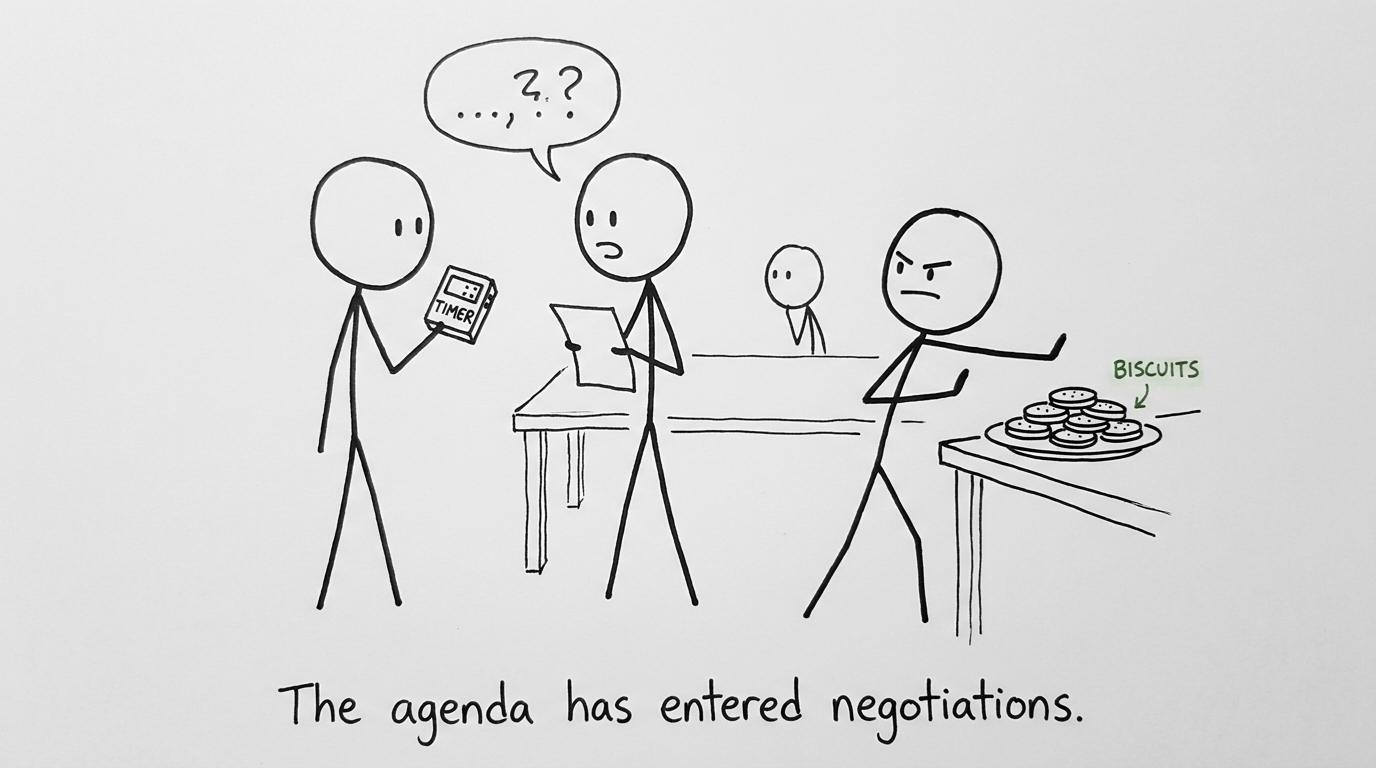 A revision group negotiating whether the agenda or biscuits are in charge
Which method suits each Food and Nutrition topic?
| Topic or task | Best starting method | Why it fits |
|---|---|---|
| Nutrient functions and sources | Alone | Retrieval cards and closed-book lists reveal personal knowledge gaps. |
| Food science | With others, then alone | Verbal explanation tests understanding; individual writing proves you can reproduce it. |
| Food safety | Alone, then paired quiz | Facts need accurate recall, while questioning helps expose dangerous misconceptions. |
| Food choice and provenance | With others | Discussion helps you compare several justified perspectives. |
| Recipe ratios and quantities | Alone | You need to carry out each calculation independently and check units. |
| Sensory evaluation | With others | Comparing interpretations can improve analytical language, provided evidence supports each claim. |
| Timed written paper | Alone | Exam conditions require independent recall, pacing and decision-making. |
| Reviewing a completed paper | With others or a teacher | Alternative reasoning and feedback can uncover why marks were lost. |
The pattern is simple: facts and calculations usually begin alone; explanation and evaluation often improve through discussion; final exam performance must be tested independently.
The maths inside GCSE Food and Nutrition
Food questions can test mathematical thinking even when the page does not look like a maths paper. Recipes involve proportion. Nutritional information may involve percentages. Investigations can produce tables and graphs. Practical planning depends on time and quantities.
Useful relationships include:
percentage=partwhole×100\text{percentage} = \frac{\text{part}}{\text{whole}} \times 100percentage=wholepart×100and a recipe scale factor:
scale factor=required number of portionsoriginal number of portions\text{scale factor} = \frac{\text{required number of portions}}{\text{original number of portions}}scale factor=original number of portionsrequired number of portionsThese are best practised alone because another student's calculation cannot demonstrate your fluency. Start with the appropriate Edexcel GCSE Maths revision hub, AQA GCSE Maths revision hub or OCR GCSE Maths revision hub, depending on your maths exam board.
Do not assume your Food Preparation and Nutrition board must match your maths board. Check each subject separately. Foundation and higher tier apply to GCSE Maths, not as interchangeable labels for the Food Preparation and Nutrition qualification.
A hybrid revision routine that uses both methods
A reliable routine alternates private effort with useful feedback.
Begin with independent retrieval
Choose one narrow topic and write what you remember without notes. Follow this with a few questions. Mark your response and record one precise gap, such as “cannot explain the role of gluten during bread making”, rather than “food science is bad”.
If organising several subjects feels difficult, adapt the structure in MathsGenie's GCSE revision timetable guide. Short, repeatable sessions are easier to maintain than occasional revision marathons.
Use a focused group check
Bring the questions you could not resolve to a partner or small group. Set a specific outcome: by the end, everyone should be able to explain one process, answer one application question and identify one misconception.
Rotate roles:
- one person asks the question
- one answers without notes
- one challenges vague reasoning
- one checks the agreed answer against reliable course material
Roles should rotate so that confidence does not become control.
Finish alone
After the discussion, close every resource and write the answer independently. This final step matters. A conversation can make an idea feel clear while it is present, but the exam asks you to reconstruct that idea later.
Use the same cycle for maths: lesson, practice, marking, correction and retest. MathsGenie's one-month GCSE revision plan shows how retrieval, focused practice and timed work can fit into a manageable schedule.
Protecting the independence of NEA work
Food Preparation and Nutrition includes written examination content and non-exam assessment. Across the main specifications, the written examination contributes 50%50\%50% of the qualification and NEA contributes 50%50\%50%, although component details and timings vary by board.
Revision collaboration is not permission to collaborate on authenticated assessment work. Your submitted work must be your own and completed under the conditions set by your exam board, school and teacher. Do not share written sections for copying, exchange results as if they were your own or allow somebody else to rewrite your evaluation.
If you are uncertain about what discussion is permitted, ask your teacher before sharing anything. Protecting authenticity is more important than making a paragraph sound polished.
Common mistakes when choosing how to revise
Revising everything in the same way
Flashcards may suit nutrient facts but are weak preparation for an extended evaluation. Match the method to the thinking required: recall, calculation, explanation, application or judgement.
Turning a group into an audience
Listening to the strongest student is not active revision. Every person needs thinking time, an individual response and a chance to explain.
Confusing rereading with retrieval
Notes can support learning, but they should not remain open throughout every task. Close them, attempt the answer and then check.
Avoiding timed independent work
Even excellent group discussion cannot replace writing under exam conditions. Regular independent questions reveal whether knowledge survives time pressure.
Ignoring numerical weaknesses
A small uncertainty with ratio, percentage change or graph interpretation can affect several subjects. Use OCR GCSE Maths topic worksheets or the resources for your own board to practise the skill rather than merely rereading the method.
Treating predicted papers as predictions of certainty
Predicted papers provide fresh, exam-style practice; they cannot tell you exactly what will appear. Use them after topic revision and alongside official past papers, not instead of full specification coverage.
Choose the method that makes thinking visible
The better revision method is the one that makes you do the intellectual work. Alone, that means recalling, calculating and writing without support. With others, it means explaining, questioning and correcting rather than simply sharing a room.
Begin with a solo knowledge check. Take genuine uncertainties to a focused partner or small group. Then finish with an independent exam question. That sequence gives you concentration, feedback and proof.
MathsGenie can support the numerical foundation beneath your Food and Nutrition work while keeping your maths preparation moving. Choose your board in the GCSE Maths revision area, learn through free revision lessons, practise with topic questions and mini tests, and build exam confidence using past papers, predicted papers, mark schemes and video solutions. Pick one weak skill today, test it honestly and let the result decide what you revise next.