Review Mock Mistakes GCSE Astronomy: Now or Later?
Review mock mistakes GCSE Astronomy straight away, then retest later. Use a two-stage method that turns feedback into stronger maths exam marks reliably.
A marked mock can create two opposite urges. One is to inspect every lost mark immediately. The other is to put the paper away until the disappointment has faded. If you are asking when to review mock mistakes GCSE Astronomy, the most useful answer is: diagnose the mistakes as soon as practical, then retest them after a short delay.
Do not wait several days before finding out what went wrong. By then, the reasoning behind your answer may be harder to reconstruct. But do not assume that correcting a question once means you have learnt it either. Return to the skill, without notes, roughly 242424 to 727272 hours later. Immediate review gives you clarity; delayed retrieval shows whether the correction has lasted.
That two-stage approach matters particularly in GCSE Astronomy because mathematical skills account for at least 20%20\%20% of the qualification marks, while observational knowledge and skills account for at least 15%15\%15%. A mistake involving standard form, graphs, ratios or angular measures may therefore reveal a maths weakness that could affect more than one subject.
The short answer: review now, retest later
Use this checklist after a mock:
- Take a short break if you are tired or upset.
- Mark or review the paper on the same day where possible.
- Identify why each mark was lost, not merely which answer was wrong.
- Correct the method while the original thinking is still familiar.
- Practise a small number of closely related questions.
- Retest the same skill without notes after 242424 to 727272 hours.
- Revisit persistent errors about a week later.
This is not a choice between immediate and delayed review. The strongest practical routine uses both for different purposes.
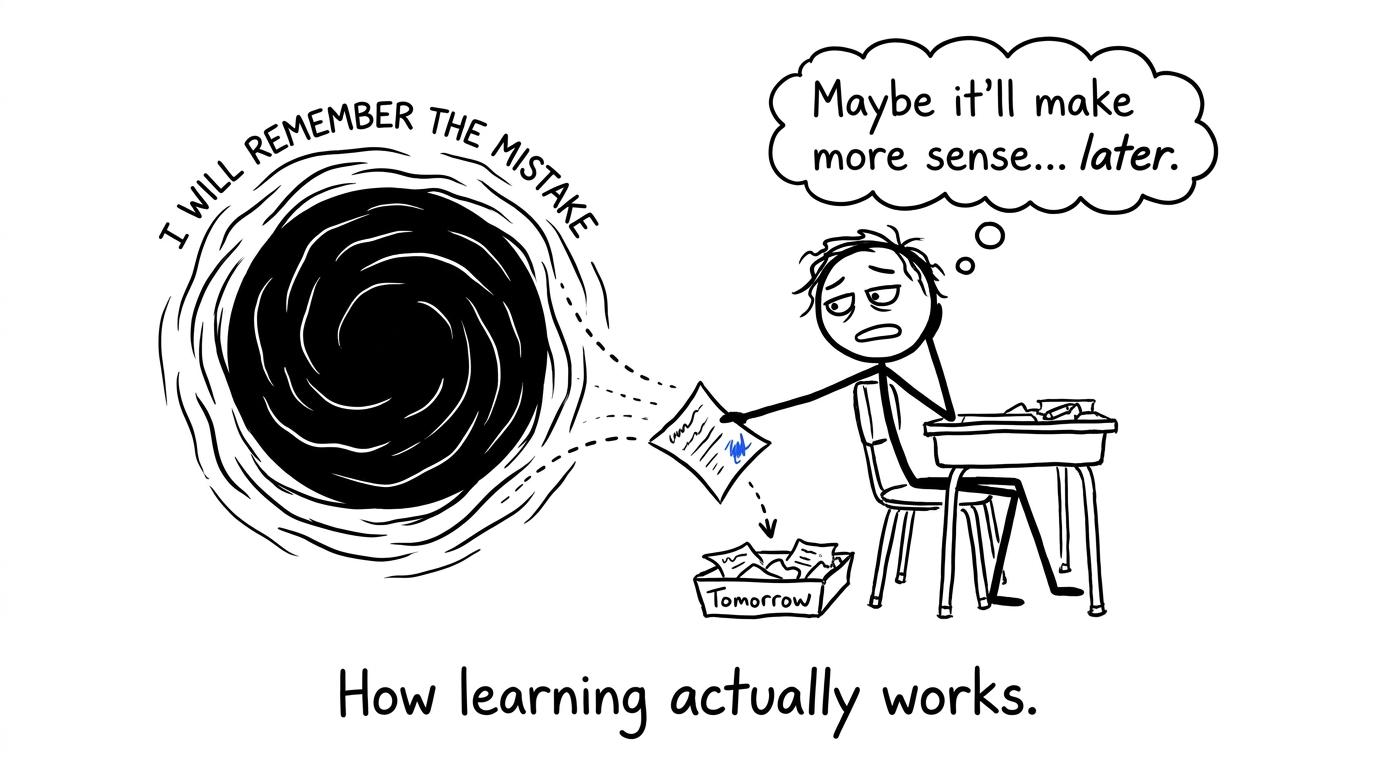 A mock paper narrowly escaping the black hole of procrastination
Why immediate mock review is useful
A mock paper is most valuable while you can still remember what happened on the page. Perhaps you misunderstood the wording. Perhaps you knew the formula but entered it incorrectly. Perhaps the method was sound until you rounded too early.
Those errors can look identical in the total mark, yet they require different repairs.
Your reasoning is still recoverable
Soon after the mock, you can often remember why you chose a particular route. That makes it easier to distinguish between:
- a genuine knowledge gap;
- an incorrect mathematical method;
- an arithmetic or calculator slip;
- a failure to use units or suitable significant figures;
- a misread instruction;
- an exam-timing problem.
Wait too long and the paper becomes archaeological evidence. You can see what you wrote, but not always what you were thinking.
Incorrect methods can be interrupted quickly
Feedback research does not establish one perfect delay for every learner and task. Some studies favour immediate feedback, some find little difference, and some circumstances can favour a delay. The consistent practical message is simpler: feedback needs to arrive in time to move learning forward, and the student must act on it.
For a GCSE mock, prompt review prevents an incorrect method from being rehearsed again. If an astronomy calculation exposes weak standard form, for instance, use a relevant standard form revision topic rather than repeatedly rereading the corrected answer.
Astronomy reveals transferable maths weaknesses
The current GCSE Astronomy requirements include arithmetic, standard form, ratios, percentages, inverse-square relationships, significant figures, means, probability, algebra, graphs, gradients and angular measures. These are not isolated astronomy tricks. They overlap substantially with GCSE Maths.
A weak graph interpretation method could lose marks in astronomy and in a maths paper. Difficulty with angular reasoning may also point towards geometry or GCSE trigonometry revision. Reviewing promptly lets one mock improve preparation across subjects.
Why you should still return a few days later
Immediate correction can create a convincing illusion: the solution looks obvious because it is sitting beside you. Recognition is not the same as independent recall.
The delayed attempt asks a harder and more useful question: can you now choose and carry out the method without being shown it?
Retesting provides evidence of learning
During the delayed session, close the mark scheme and remove the corrected solution. Use a fresh question testing the same underlying skill. If you can complete it independently, the repair is becoming reliable. If you cannot, you have discovered that the original review produced familiarity rather than mastery.
Research across classroom settings supports retrieval practice as a useful learning strategy. The important feature is the attempt to retrieve and apply knowledge, followed by feedback. That is why a GCSE mini test or paper resource is more revealing than reading your correction for a third time.
Spacing makes the method work harder
A gap introduces a little forgetting. That may feel inconvenient, but it forces you to reconstruct the method rather than copy it from short-term memory. The effort is diagnostic.
A sensible rhythm is:
- First review: the same day, after a short break.
- First retest: around 242424 to 727272 hours later.
- Second retest: roughly one week later if the error was important or repeated.
- Mixed check: include the skill in a later timed paper.
These are practical intervals, not universal scientific laws. Adjust them around lessons, other exams and your teacher's feedback. The essential point is to schedule a fresh attempt rather than hoping you will remember to return.
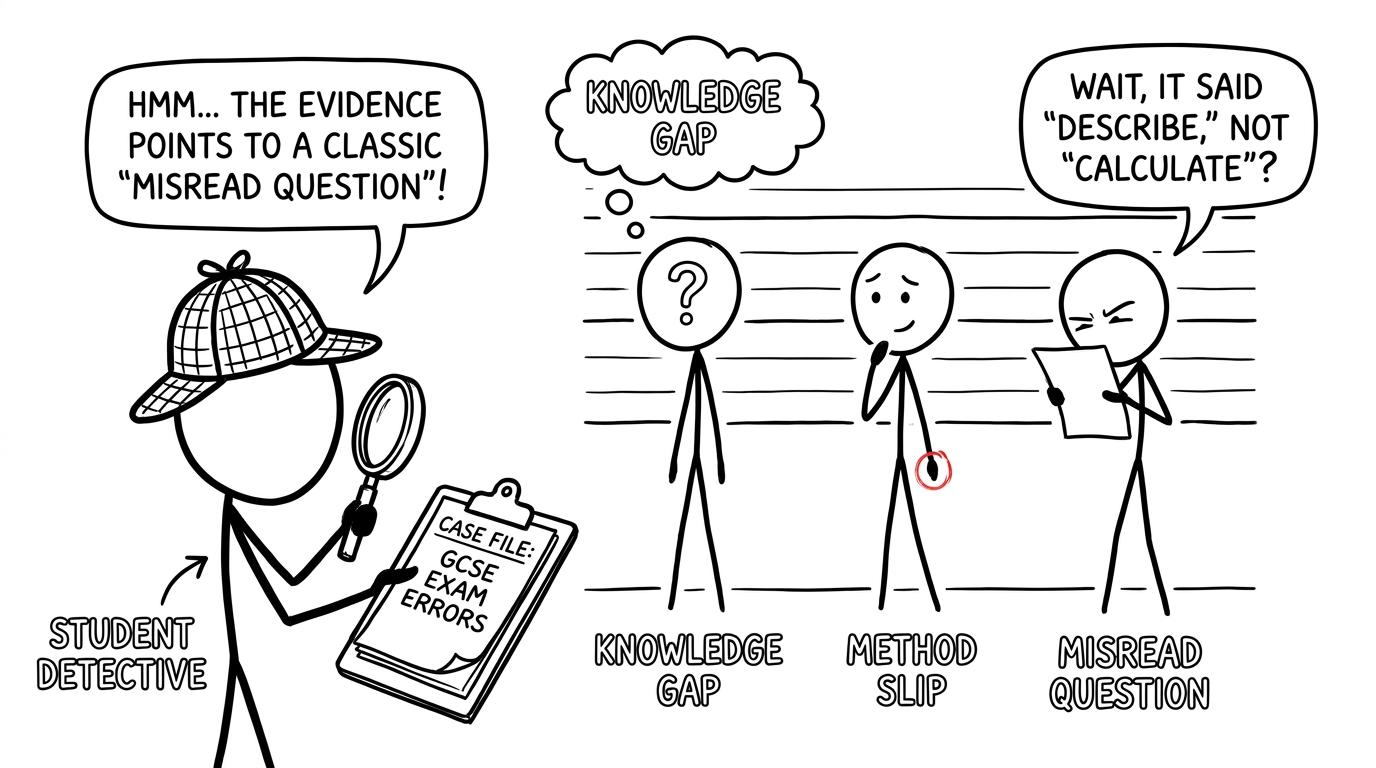 A student detective identifies three different kinds of mock mistake
What waiting actually costs you
Waiting a few days does not erase all learning. Delayed feedback can still help, and research findings on exact timing vary by task and context. The real cost is practical rather than dramatic.
You lose detail about the original mistake
After several days, “I got it wrong” may be all you remember. You may no longer know whether the problem was recall, interpretation, calculation or time pressure. That weakens the diagnosis and makes your follow-up revision less precise.
Your next revision sessions use outdated information
A mock is a map of where marks are leaking. If you postpone reviewing it, you may spend the next few evenings revising comfortable topics while the important weaknesses remain untouched.
The MathsGenie revision planner can turn those newly identified gaps into scheduled tasks. A paper only changes your future performance when its evidence changes what you do next.
Errors can accumulate across connected topics
Suppose several astronomy questions expose uncertainty with units, rearranging formulae and reading graphs. Those are connected foundations. Leaving them unresolved can make later questions feel harder, even when the astronomy itself is understood.
Use the GCSE Maths revision hub to choose your exam board and locate the exact topic. Students taking Edexcel, AQA, OCR or Eduqas GCSE Maths should practise with resources matched to their own board and foundation or higher tier, even though the weakness was first noticed in an astronomy mock.
Delay can become avoidance
A planned delay supports retrieval. An unplanned delay often becomes a week, then a fortnight, then a paper that is never opened again. The difference is whether the next action has a date.
A two-stage mock correction routine
Stage one: diagnose while the paper is fresh
Give yourself enough time to settle after the mock. Then use the mark scheme and, where available, a video solution to inspect each lost mark.
For every error, record four things:
- the topic;
- the marks lost;
- the reason;
- the action needed.
Keep the reason specific. “Careless” is rarely useful. “Rounded before the final calculation”, “used the wrong graph scale” or “did not convert the unit” gives you something you can change.
You can prioritise topics with a simple measure:
priority score=marks lost+number of repeated errors\text{priority score}=\text{marks lost}+\text{number of repeated errors}priority score=marks lost+number of repeated errorsThis is a revision tool, not an exam-board calculation. Its purpose is to stop one difficult-looking question distracting you from a smaller mistake that appears repeatedly.
The guide to finding your weakest GCSE topics offers a broader way to turn paper evidence into focused practice.
Stage two: retrieve without support
After a short delay, answer a fresh question on each priority skill. Do not begin by rereading the solution. Attempt first, check second.
If the answer is correct and the method is secure, place the topic into later mixed practice. If it is wrong, return to the relevant revision lesson, complete targeted practice questions and schedule another retest.
For realistic exam practice, the Edexcel GCSE Maths past papers include papers and mark schemes organised by series. If you take another maths board, use the corresponding area from the main GCSE hub.
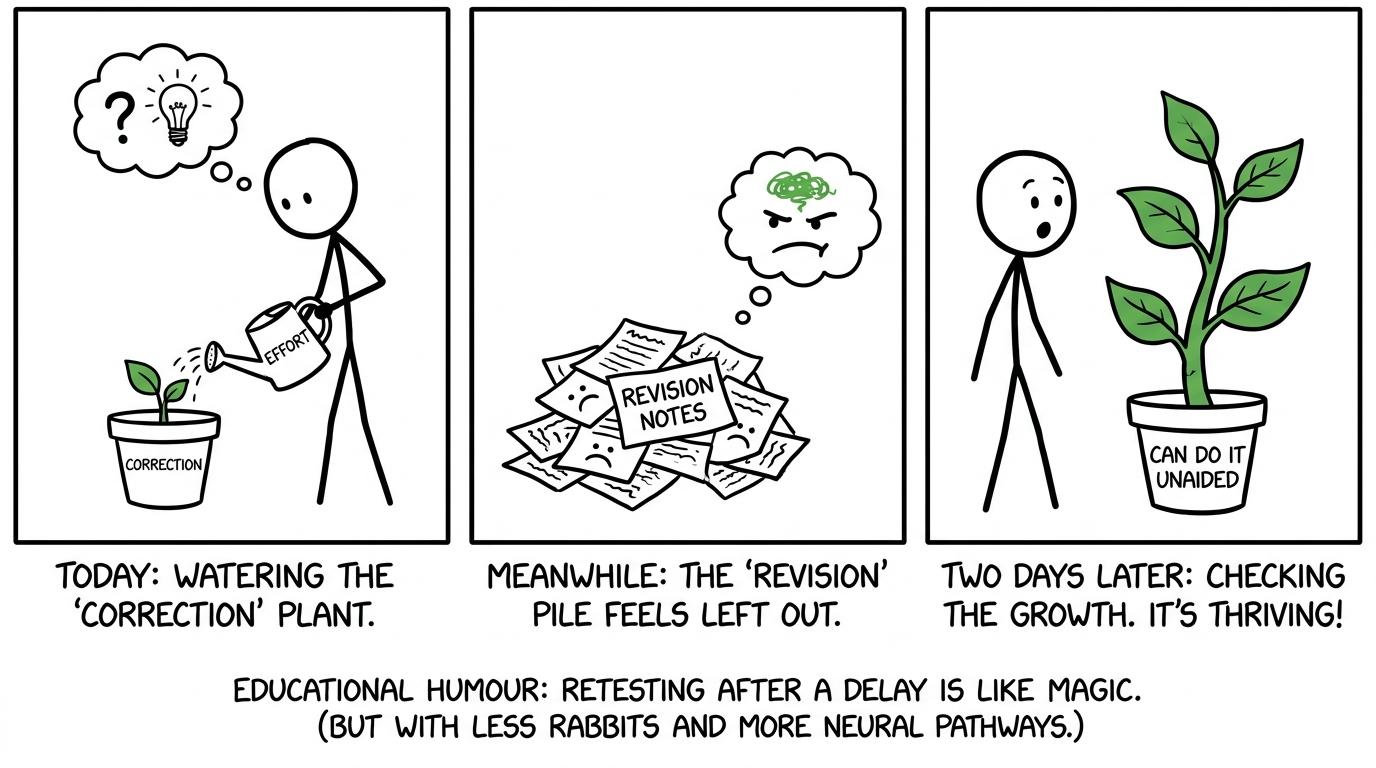 A correction grows stronger when it is checked again later
How long should the immediate review take?
You do not need to relive the entire mock in one exhausting session. Start with 202020 to 303030 focused minutes:
- identify the largest knowledge gaps;
- classify repeated mistakes;
- correct one or two high-value methods;
- schedule the remaining work.
For a long paper, split the review across sessions. Immediate review means beginning the diagnosis promptly, not forcing yourself to complete every correction when you are too tired to think clearly.
If mocks are still some distance away, read when to start GCSE past papers and build review time into every planned paper. Sitting papers without analysing them mostly measures your current level; reviewing them is what creates the next improvement.
Common mistakes when reviewing GCSE Astronomy mocks
Copying the mark scheme
A copied solution proves that you can copy. Rewrite the key method in your own concise words, then close the solution and attempt a fresh question.
Correcting only the final answer
Examiners may award method marks even when a final answer is wrong. Trace the solution from the first incorrect step. The repair should target the point where the reasoning changed course.
Treating every error as an astronomy problem
Some errors arise from subject knowledge; others come from algebra, ratio, graphs, significant figures or calculator use. Send each mistake to the correct revision resource. The probability revision guide, for example, is more useful for a probability weakness than rereading an astronomy chapter.
Retesting with the identical question
Remembering an answer is not necessarily understanding the method. Use a different question with the same skill and unfamiliar values or wording.
Reviewing immediately but never revisiting
This is the most common flaw in an otherwise sensible process. A correction made with the mark scheme open feels secure. Only delayed, unsupported practice tells you whether it is available under exam conditions.
Turn the mock into your next revision plan
A mock mark is a snapshot, not a verdict. Its real value lies in the information underneath the total: the methods you could not recall, the instructions you misread and the mathematical foundations that need attention.
So review promptly, while your reasoning can still be reconstructed. Correct the smallest underlying weakness. Then wait briefly and test it again without help. Immediate feedback and delayed retrieval are not rivals; they are two halves of the same revision loop.
Start with the free MathsGenie GCSE Maths revision area, choose your board and tier, and connect each mock mistake to a revision lesson or practice question. Then use past papers, predicted papers, mini tests, mark schemes and video solutions to check whether the repair survives exam conditions. Put the retest into the revision planner now. That small scheduled return is often where a correction becomes a mark you can keep.