

Reverse Percentages Exam Questions for GCSE
Reverse percentages exam questions explained through three GCSE examples, with clear multiplier methods, working, method marks and practice tips.
A percentage question can feel perfectly familiar until it asks you to travel backwards.
You are given the price after a sale, the population after an increase or the value after depreciation. The original amount has disappeared. That is the defining feature of reverse percentages exam questions: you know the result of a percentage change and must recover the starting value.
The reliable method is simple. Express the final amount as a percentage or multiplier of the original, then divide. To see how this works under exam pressure, we will follow a GCSE student through three exam-style questions of rising difficulty and identify the working likely to earn method marks.
The reverse percentage checklist
Before calculating, ask:
- Am I given the amount after a percentage change?
- What percentage of the original remains?
- What is the corresponding decimal multiplier?
- Have I divided by that multiplier rather than multiplied?
- Does my answer make sense compared with the final amount?
For an increase of r%r\%r%, the multiplier is:
1+r100 1+\frac{r}{100} 1+100rFor a decrease of r%r\%r%, the multiplier is:
1−r100 1-\frac{r}{100} 1−100rIf the final amount is FFF and the original amount is OOO, then:
F=O×multiplier F=O\times\text{multiplier} F=O×multiplierTherefore:
O=Fmultiplier O=\frac{F}{\text{multiplier}} O=multiplierFThat final rearrangement is the whole topic in one line.
Why dividing finds the original amount
A common percentage calculation moves forwards. If a coat originally costs £80£80£80 and is reduced by 25%25\%25%, you multiply by 0.750.750.75.
A reverse question gives you the reduced price instead. Multiplication created the final price, so division undoes it:
original price=sale price0.75 \text{original price}=\frac{\text{sale price}}{0.75} original price=0.75sale priceThe word “reverse” does not mean finding the opposite percentage. It means reversing the calculation.
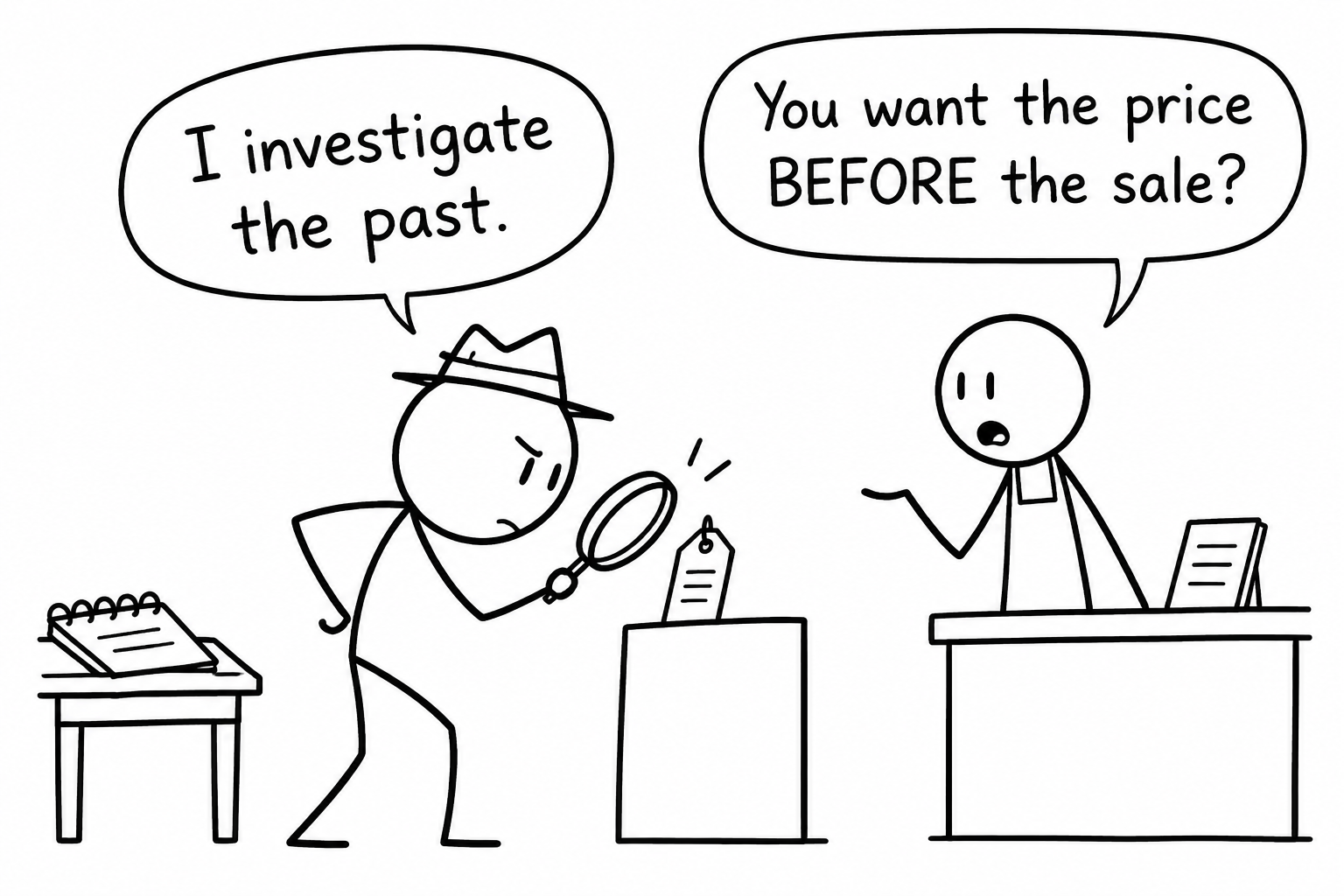 A student detective investigates the mysterious price before a sale
Question one: reversing a simple reduction
Aisha begins with a familiar sale question.
A jacket is reduced by 20%20\%20%. Its sale price is £56£56£56. Find its original price.
Step one: find the percentage remaining
A reduction of 20%20\%20% leaves:
100%−20%=80% 100\%-20\%=80\% 100%−20%=80%So £56£56£56 represents 80%80\%80% of the original price.
Step two: write the multiplier
80%=0.8 80\%=0.8 80%=0.8The forward calculation would be:
original price×0.8=56 \text{original price}\times0.8=56 original price×0.8=56Step three: reverse the calculation
original price=56÷0.8 \text{original price}=56\div0.8 original price=56÷0.8 original price=70 \text{original price}=70 original price=70The jacket originally cost £70£70£70.
Where the method marks come from
On a typical multi-mark GCSE question, useful working would include 80%80\%80%, the multiplier 0.80.80.8, or a correct calculation such as 56÷0.856\div0.856÷0.8. Exact marking varies between papers and exam boards, so the paper’s mark scheme is always decisive. However, writing the multiplier and division gives an examiner clear evidence of your method.
Aisha also checks the direction. A reduced price of £56£56£56 must be lower than the original, and £70£70£70 is higher. The answer is plausible.
Question two: reversing an increase
The next question changes one word, but that word matters.
After increasing by 15%15\%15%, the number of members in a club is 529529529. How many members were there originally?
Step one: find the new percentage
An increase of 15%15\%15% means the final membership is:
100%+15%=115% 100\%+15\%=115\% 100%+15%=115%Step two: convert to a multiplier
115%=1.15 115\%=1.15 115%=1.15So:
original membership×1.15=529 \text{original membership}\times1.15=529 original membership×1.15=529Step three: divide by the multiplier
original membership=529÷1.15 \text{original membership}=529\div1.15 original membership=529÷1.15 original membership=460 \text{original membership}=460 original membership=460There were 460460460 members originally.
Check the result
Find 15%15\%15% of 460460460:
0.15×460=69 0.15\times460=69 0.15×460=69Then:
460+69=529 460+69=529 460+69=529The answer returns exactly to the value in the question.
The important change in Aisha’s thinking is that she no longer starts by pressing calculator buttons. She first decides what the final number represents. Here, 529529529 is not 15%15\%15% of the original. It is 115%115\%115% of the original.
Once this divide-by-the-multiplier method feels clear, use the Maths Genie Lessons and Question Bank to repeat it across reductions and increases rather than rebuilding a practice set yourself.
Question three: reverse percentage followed by profit
The final problem contains an extra stage.
A bicycle increases in value by 12%12\%12%. Its new value is £672£672£672. It is then sold for £735£735£735. Find the profit as a percentage of the bicycle’s original value.
Aisha notices that the question asks for a percentage of the original value. She must recover that value before calculating the profit.
Step one: reverse the increase
After a 12%12\%12% increase, the bicycle is worth:
100%+12%=112% 100\%+12\%=112\% 100%+12%=112%The multiplier is:
1.12 1.12 1.12Therefore:
original value=672÷1.12 \text{original value}=672\div1.12 original value=672÷1.12 original value=600 \text{original value}=600 original value=600Step two: calculate the profit
profit=735−600 \text{profit}=735-600 profit=735−600 profit=135 \text{profit}=135 profit=135Step three: express the profit as a percentage of the original
profit percentage=135600×100 \text{profit percentage}=\frac{135}{600}\times100 profit percentage=600135×100 profit percentage=22.5% \text{profit percentage}=22.5\% profit percentage=22.5%The profit is 22.5%22.5\%22.5% of the original value.
Where the method marks come from
This question has several mark-worthy stages:
- identifying the multiplier 1.121.121.12
- calculating 672÷1.12672\div1.12672÷1.12
- finding the profit using 735−600735-600735−600
- using the original value as the denominator in 135600×100\frac{135}{600}\times100600135×100
Even if an arithmetic slip appears late in the solution, clearly structured working may allow earlier method marks to be awarded, depending on the mark scheme. A calculator-only answer hides those decisions. Written working preserves them.
Two valid methods for reverse percentages
The multiplier method is usually the fastest, especially when the percentage is awkward. A unitary method is also valid.
In question one, £56£56£56 represents 80%80\%80%. Therefore:
1%=56÷80=0.7 1\%=56\div80=0.7 1%=56÷80=0.7Then:
100%=0.7×100=70 100\%=0.7\times100=70 100%=0.7×100=70Both approaches produce £70£70£70. The unitary method can make the meaning clearer, while the multiplier method is more compact:
56÷0.8=70 56\div0.8=70 56÷0.8=70Choose one method and show it coherently. Switching methods halfway through creates more opportunities for error.
Common mistakes in reverse percentages GCSE exams
Subtracting the percentage from the final amount
A student might find 20%20\%20% of £56£56£56 and add it back. This does not work because the 20%20\%20% reduction was calculated from the unknown original price, not from £56£56£56.
Multiplying instead of dividing
For the jacket, 56×0.856\times0.856×0.8 moves further forwards and makes the amount smaller. To undo multiplication by 0.80.80.8, divide by 0.80.80.8.
Using the change as the multiplier
After a 15%15\%15% increase, the final amount is 115%115\%115%, not 15%15\%15%, of the original. The correct multiplier is 1.151.151.15, not 0.150.150.15.
Reversing an increase with an equal decrease
An increase of 20%20\%20% is not undone by decreasing the new value by 20%20\%20%. For example:
100×1.2=120 100\times1.2=120 100×1.2=120but:
120×0.8=96 120\times0.8=96 120×0.8=96Division by the original multiplier gives the true reversal:
120÷1.2=100 120\div1.2=100 120÷1.2=100Rounding too early
Keep the full calculator value during intermediate stages. Round only at the end and use the degree of accuracy requested in the question.
Exam-style practice
Try these without looking back at the examples:
- A laptop is reduced by 35%35\%35% and now costs £520£520£520. Find its original price.
- A town’s population increases by 8%8\%8% to 23,76023{,}76023,760. Find its original population.
- After losing 16%16\%16% of its value, a machine is worth £18,480£18{,}480£18,480. It is later sold for £20,000£20{,}000£20,000. Find the sale price as a percentage of the machine’s original value.
Answers:
- £800£800£800
- 22,00022{,}00022,000
- The original value is £22,000£22{,}000£22,000, so the sale price is 20,00022,000×100≈90.9%\frac{20{,}000}{22{,}000}\times100\approx90.9\%22,00020,000×100≈90.9% of the original value.
Turn the method into exam confidence
Aisha’s progress came from separating every problem into three decisions: identify the final percentage, convert it to a multiplier, then divide. Knowing those steps is useful; following them consistently across unfamiliar reverse percentages past paper questions is what makes the method dependable.
Your turn: start the matching Maths Genie Lessons and Question Bank practice, show every multiplier, and check each answer against the direction of the change.















