

Resitting GCSE Maths While Working Full Time
Resitting GCSE maths while working full time? Build a realistic revision plan, understand November resit rules and practise efficiently with MathsGenie.
Finishing work tired and then opening a GCSE maths paper can feel like starting a second shift. The problem is rarely a lack of ambition. It is finding enough time and concentration after work, travel and everyday responsibilities.
Resitting GCSE maths while working full time is manageable, but the plan must fit an adult working week. You do not need to recreate a Year 11 timetable. You need short, targeted sessions, regular exam practice and a clear understanding of which topics are costing you marks.
Imagine Sam, a post-16 resit student working Monday to Friday. Sam cannot revise for three hours every evening. A more realistic plan uses several focused sessions during the week and one longer block at the weekend. The aim is not to do everything. It is to keep returning to the questions that matter.
Your practical resit checklist
Before building a revision routine, confirm the essentials:
- Find out whether you are entering through a college, training provider or approved exam centre.
- Confirm your exam board and tier.
- Check the entry deadline, examination dates and fees directly with your centre.
- Choose between the November resit and the summer series.
- Complete a diagnostic paper to identify weak topics.
- Protect several realistic revision slots each week.
- Use mark schemes and video solutions to correct mistakes.
- Move towards timed papers as the examination approaches.
The GCSE Maths revision hub lets you select your exam board and access relevant revision materials, worksheets and past papers.
Understand the GCSE maths resit rules
GCSE mathematics is available in the usual summer examination series. It is also available in November for candidates who are aged 16 or over on 31 August of that year. This age condition is set nationally, but practical arrangements still depend on your centre and exam board.
If you are no longer enrolled at a school or college, you may need to enter as a private candidate. Private candidates sit examinations at an approved school, college or other examination centre. Contact centres early because availability, entry deadlines and charges can vary.
Do not assume that a previous school will automatically enter you. Ask for written confirmation of:
- the examination series;
- the exam board and specification;
- your foundation or higher tier entry;
- the total fee and payment deadline;
- the dates and location of every paper;
- any approved access arrangements.
Exact dates change each year, so check your statement of entry and the current timetable supplied by your centre. If you require access arrangements, discuss them early rather than waiting until the examination is close.
Is the November resit right for you?
A November resit can work well when your previous result was close to your target and you can begin focused practice soon after receiving it. The shorter preparation period may help you retain earlier knowledge.
It is not automatically the best option. If work is especially demanding in autumn, or if your diagnostic paper reveals substantial gaps across number, algebra, ratio, geometry and statistics, the summer series may provide the time needed to rebuild securely.
Sam might choose November after discovering that most lost marks came from fractions, percentages and rearranging formulae. Someone else may choose summer because the foundations need broader attention. The sensible question is not, “Which sitting is quickest?” It is, “Which sitting gives me a realistic chance of reaching the required grade?”
Your centre should also help you decide the appropriate tier. Foundation and higher papers cover overlapping skills but have different grade ranges and demands. Base the decision on evidence from marked work, not pride or assumptions about what an adult learner should take.
Build revision around a full-time job
A working student needs a minimum viable routine, one that still happens on an ordinary week rather than only on an unusually quiet one.
Sam's week could look like this:
- Monday: a 25-minute revision lesson and a small set of practice questions.
- Wednesday: a 30-minute mixed mini test.
- Friday: rest, especially after a tiring working week.
- Saturday: a 60-minute timed section or targeted practice paper.
- Sunday: mark the work, correct errors and choose the next topics.
This is more sustainable than promising to revise every evening. A plan should include recovery because exhausted practice often becomes passive watching rather than active problem-solving.
Use the MathsGenie Revision Planner to organise work towards the examination date. If shifts change, treat revision as a weekly target rather than insisting on identical times every day. The guidance on creating a realistic GCSE maths revision timetable can help you adapt the structure.
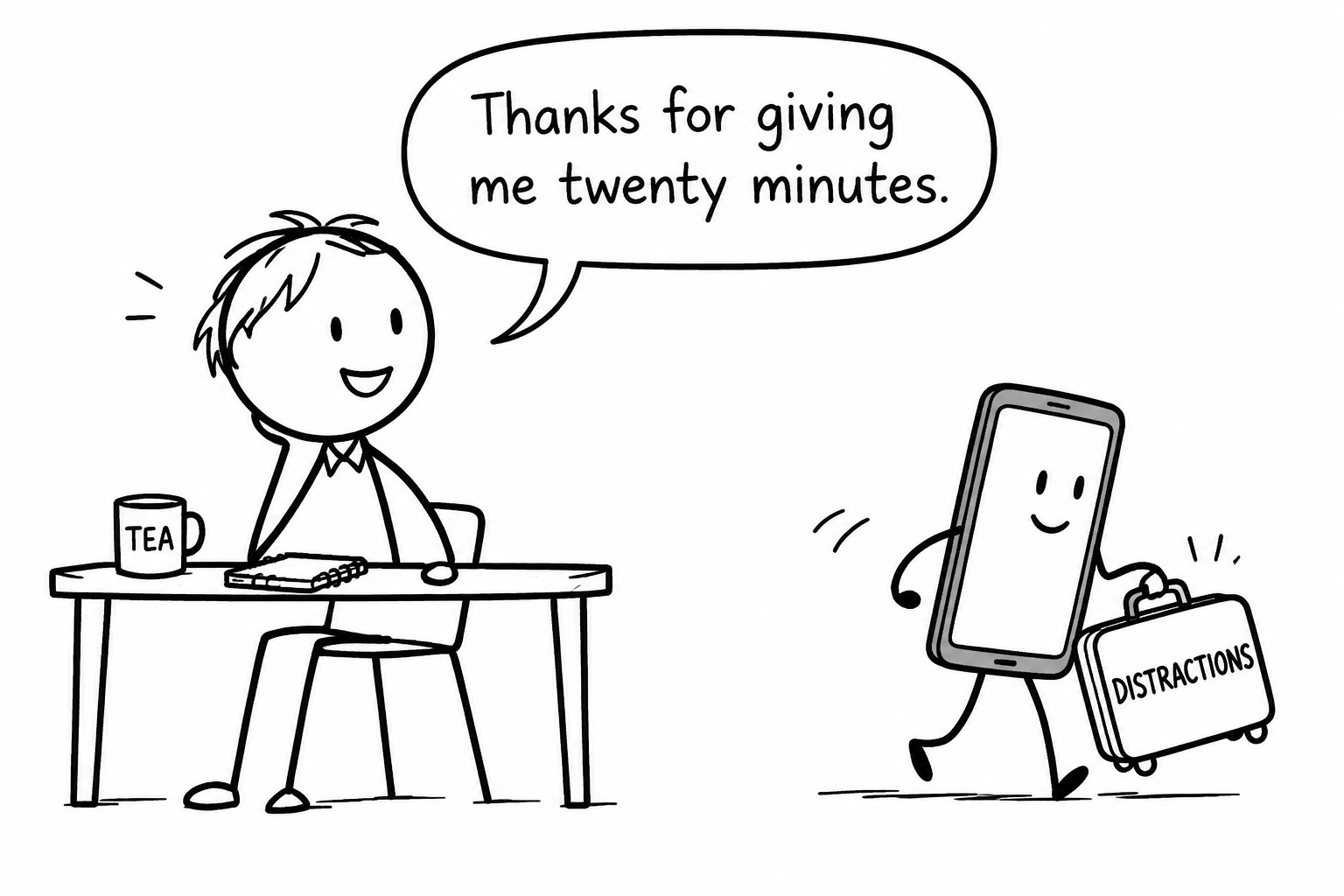 A working student thanks a phone for taking distractions away during a short revision session
Make every session targeted
The scarce resource is not just time. It is alert attention. That makes the order of a session important.
Start with a diagnostic paper
Complete part of a paper without notes and mark it honestly. Separate each lost mark into one of three categories:
- a topic you did not understand;
- a method you knew but could not recall;
- an examination mistake, such as misreading the question or failing to show working.
This turns “I am bad at maths” into a useful list of specific tasks. Browse the appropriate resources through the GCSE maths exam board selector, then use revision lessons and practice questions for those topics.
Use a learn, practise, mark, repeat cycle
Watch a short lesson or video solution, answer questions without copying the method, and check the mark scheme. Then return to the topic several days later. Recognition is not the same as recall. A method can look obvious on screen and still disappear when you meet it alone in an examination.
Keep an error log with four brief notes: topic, mistake, correct method and retest date. The log should become shorter and more precise over time.
Add timed papers gradually
Past papers reveal whether separate skills can be selected under pressure. Start with individual sections if a complete paper is difficult to fit around work. Later, protect enough uninterrupted time to experience a full paper under examination conditions.
MathsGenie's Edexcel GCSE Maths past papers, for example, include papers by examination series with mark schemes and worked solutions where available. Students taking another board can select AQA, OCR, Eduqas or the relevant specification from the main GCSE maths page.
The guide to using GCSE past papers at the right time explains how to move from topic practice into full-paper revision without wasting limited papers too early.
Common mistakes working resit students make
Waiting for a free evening
Free evenings rarely arrive reliably. Schedule a short session before the week becomes crowded. Twenty focused minutes can be more useful than an imaginary two-hour block.
Revising only comfortable topics
Repeating familiar arithmetic feels productive, but it may not address the marks you regularly lose. Let marked papers choose the next topic.
Watching without answering questions
Videos explain methods. Improvement comes from attempting questions independently, checking the mark scheme and correcting the work.
Saving exam practice until the final week
Timed work exposes slow methods, calculator errors and gaps in recall. Introduce it gradually rather than making the first full paper your real examination.
Ignoring the administrative details
Revision cannot compensate for a missed entry deadline or an incorrect tier. Confirm arrangements with the centre and keep the documents somewhere accessible.
Turn limited time into useful evidence
Resitting while employed can feel lonely because there may be no classroom timetable carrying you forward. Yet work has probably already taught you something valuable: dependable systems outperform occasional bursts of effort.
Begin with one marked paper. Identify the weakest areas, practise them and retest them. Use the one-month GCSE maths revision plan if you need a shorter structure, or spread the same cycle across a longer preparation period.
When you know exactly which topics need attention, build a targeted practice paper in the MathsGenie Mock Exam Builder. It is a practical next step: choose the material you need, complete it under realistic conditions, mark it carefully and let the result decide what you practise next.















