

Redo GCSE Engineering Mock Timed: Is It Worth It?
Redo GCSE engineering mock timed or review it first? Learn when a full resit builds exam stamina and when targeted correction is the smarter choice.
A completed mock can create an awkward choice. You could sit the entire paper again, hoping that repetition produces a better score. Or you could slow down, inspect the first attempt and repair the weaknesses it exposed.
If you are wondering whether to redo GCSE Engineering mock timed, the short answer is: review and correct the first attempt before resitting the whole paper. A full timed redo becomes worthwhile later, when you need to test pacing, concentration and whether your corrections still work under pressure.
The order matters. Resitting too soon may measure your memory of the questions rather than genuine improvement. Reviewing without ever returning to timed conditions, however, leaves exam technique untested.
The quick decision checklist
Redo the complete mock under timed conditions if most of these statements are true:
- You have marked and analysed the first attempt.
- You have revised the topics responsible for lost marks.
- Several days have passed since you last saw the questions.
- Timing, stamina or question selection caused genuine problems.
- You can recreate realistic exam conditions.
- You have enough revision time left to review the second attempt properly.
Choose targeted review instead if:
- You have not yet used the mark scheme carefully.
- Most lost marks came from a few identifiable knowledge gaps.
- You remember the answers or wording clearly.
- Your next exam is close and a full resit would replace higher-priority revision.
- You are repeating the paper mainly to obtain a more reassuring score.
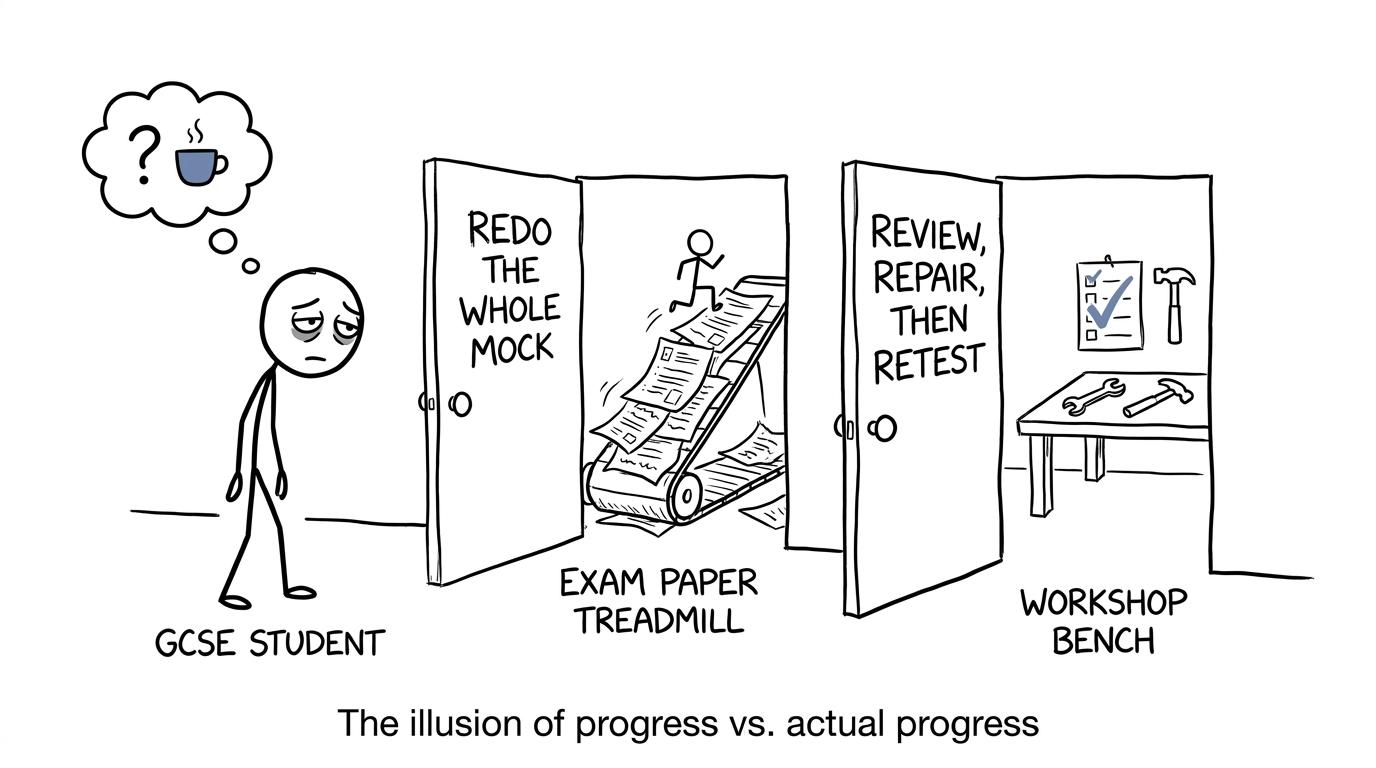 A student chooses between an exam-paper treadmill and a repair workshop
What a full GCSE Engineering mock actually tests
A timed mock tests more than engineering knowledge. It also tests whether you can retrieve that knowledge, interpret unfamiliar contexts, complete calculations, communicate extended answers and make sensible decisions while the clock continues moving.
For AQA GCSE Engineering, the written paper is currently a 222-hour examination worth 120120120 raw marks and 60%60\%60% of the qualification. The non-exam assessment accounts for the remaining 40%40\%40%. The written paper can include multiple-choice questions, short answers, calculations, practical contexts and extended responses.
That creates a simple overall pacing reference:
120 minutes120 marks=1 minute per mark\frac{120\text{ minutes}}{120\text{ marks}}=1\text{ minute per mark}120 marks120 minutes=1 minute per markThis is an average, not a command to spend exactly one minute on every mark. Reading, checking and longer analytical responses change the rhythm. It does show why losing twenty minutes to one stubborn section can affect the rest of the paper.
GCSE Engineering is not divided into foundation and higher tiers. Your separate GCSE Maths entry may be foundation or higher, depending on your school and exam board. Check the paper instructions and your teacher's guidance rather than transferring assumptions from Edexcel, AQA, OCR or Eduqas Maths to Engineering.
The Engineering assessment objectives also explain why memorising the first mock's answers is not enough. Across the qualification, they reward knowledge and understanding, application in different contexts, and analysis and evaluation. A better second score only matters if those abilities have improved.
Review the first attempt before you resit it
A mock is valuable because it gives you information. Once you have a score, the most useful question is not simply, "How many marks did I get?" It is, "Why did each mark disappear?"
Review every lost mark and assign it to one of these categories:
- Knowledge: you did not know the engineering principle, material, process or system.
- Application: you knew the idea but did not recognise how it fitted the context.
- Calculation: the formula, substitution, rearrangement, units or rounding went wrong.
- Communication: the answer lacked the explanation, evidence or comparison required.
- Reading: you overlooked a command word, diagram detail or condition.
- Timing: you rushed, became stuck or left reachable questions unanswered.
This turns one disappointing total into a practical revision plan. Five calculation errors need a different response from five unanswered marks at the end.
For mathematical weaknesses, use the GCSE Maths revision hub to find lessons and exam-style questions. Choose the board you actually take, such as the AQA GCSE Maths revision area or the OCR GCSE Maths revision area. The engineering context may change, but reliable skills with ratio, percentages, graphs, standard form, formulae and units still matter.
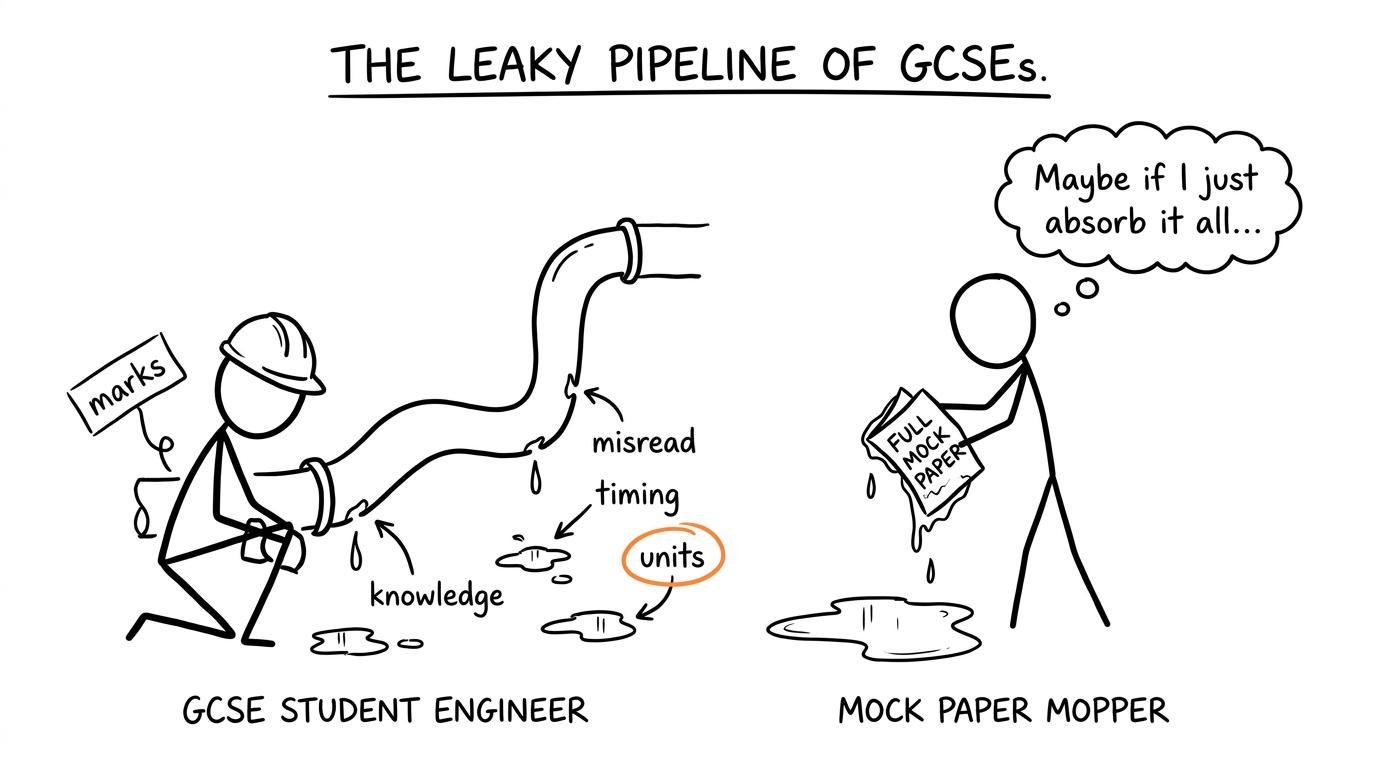 An engineering student repairs the different places where marks leak away
Why targeted correction is usually the better first step
A complete resit consumes more than the paper's official duration. You need time to prepare, sit it, mark it and act on the result. If you merely repeat the paper and check the new total, much of that investment is lost.
Targeted correction is usually more efficient because it directs revision towards the precise causes of lost marks. It also uses retrieval practice: you attempt to recall and apply knowledge rather than simply rereading notes. Feedback then tells you what to repair.
A productive correction cycle looks like this:
- Mark the original response honestly.
- Write one sentence explaining why marks were lost.
- Revisit the relevant lesson, notes or specification point.
- Complete fresh questions testing the same skill.
- Reattempt the original question without copying the mark scheme.
- Test the skill again after a gap.
For calculations, avoid practising only one familiar engineering question. Use mixed GCSE Maths questions so you must decide which method is needed. MathsGenie's Edexcel GCSE Maths mini tests are useful for shorter timed bursts, while the Edexcel GCSE Maths past papers provide longer practice with mark schemes and worked solutions where available.
The purpose is not to turn Engineering revision into a second Maths course. It is to remove mathematical friction so that your engineering understanding can earn the marks it deserves.
When redoing the entire mock becomes worthwhile
A full timed resit is valuable when it answers a question that targeted practice cannot answer: can you now perform across the whole paper under sustained pressure?
When timing caused the problem
If you left substantial sections unanswered, rushed the final questions or spent too long perfecting low-mark responses, another full sitting can test a new pacing strategy.
Before beginning, decide how you will behave when stuck. You might mark the question, move forward and return later. The resit then tests a deliberate system rather than repeating the same habits with a timer nearby.
When concentration faded
Short practice cannot reproduce the mental demands of a 222-hour paper. If accuracy declined sharply later in the first mock, a complete resit can build awareness of stamina, checking and attention.
When you have repaired broad weaknesses
Suppose the first attempt exposed problems across calculations, materials, manufacturing processes and extended evaluation. After focused revision, a full paper provides a useful mixed test. It asks you to recognise what each question needs without being told the topic in advance.
When enough time has passed
An immediate redo is often misleading. Familiar diagrams, remembered answers and recognition of the question order can inflate the score. Leave a meaningful gap, revise in between and, where possible, use a different secure paper for a cleaner measurement.
Fresh papers are generally better for diagnosis. A repeated paper is better for checking whether specific corrections and exam routines have survived.
How to resit the mock properly
If a full redo is justified, make it a realistic rehearsal:
- Use the correct paper time.
- Work in silence without notes or a phone.
- Use only the equipment permitted for that assessment.
- Do not pause the timer when a question becomes uncomfortable.
- Show calculations, units and reasoning clearly.
- Leave time to return to skipped questions.
- Mark only after the sitting has finished.
Record more than the second total. Compare:
- marks gained through stronger knowledge;
- marks gained through improved application;
- questions completed this time;
- avoidable calculation or reading errors;
- performance near the end of the paper;
- answers remembered from the first attempt.
If the second score rises mainly because you remembered exact responses, treat it cautiously. If unfamiliar application, calculations and time management all improve, the resit has given stronger evidence.
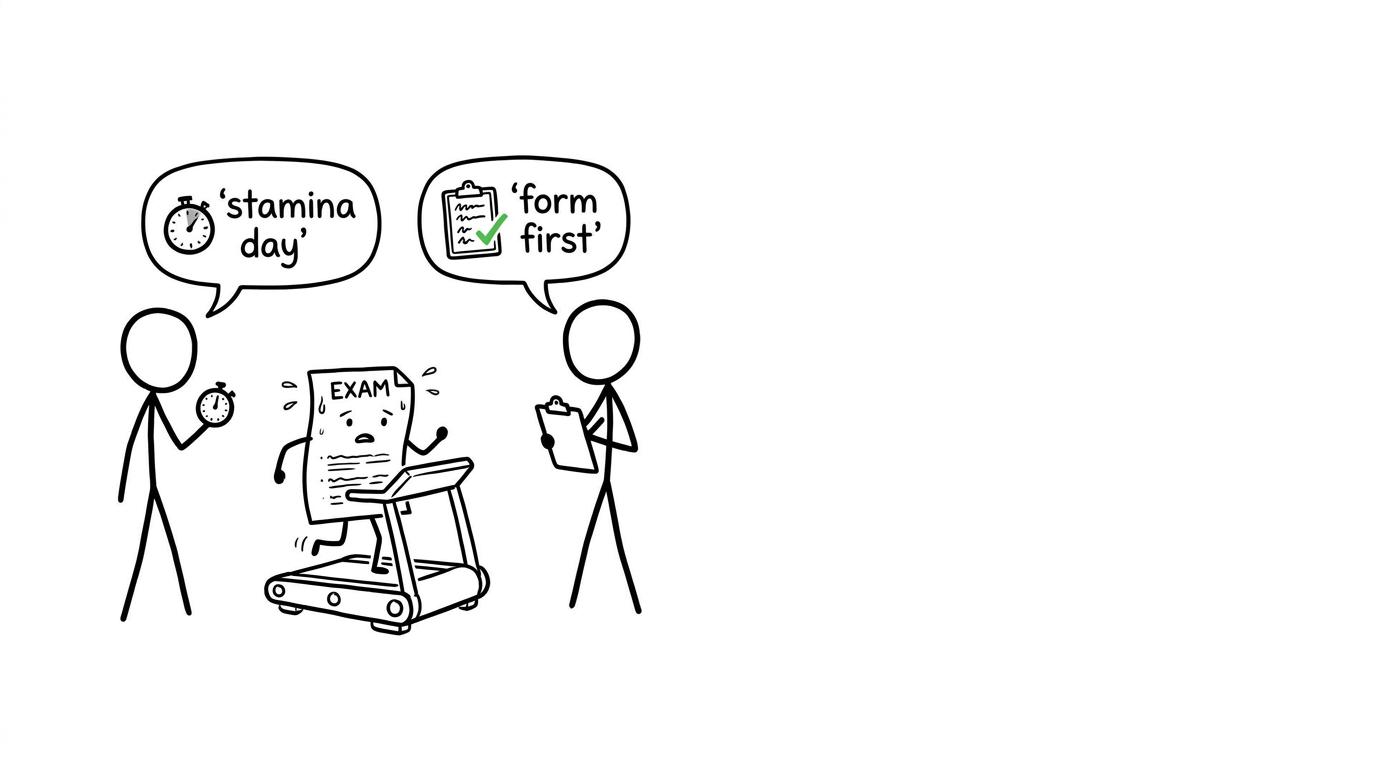 An exam paper trains for stamina while a mark scheme coach checks its form
A balanced revision sequence
The best choice is rarely "review or resit" forever. It is usually a sequence:
First, diagnose. Mark the original mock and create a short error log.
Then, repair. Use lessons, notes and focused questions to address the largest mark losses.
Next, retest selectively. Reattempt missed questions and complete fresh questions on the same skills.
Finally, pressure-test. Sit a complete mock or another full paper under timed conditions.
This sequence separates learning from performance testing. Both matter, but they serve different purposes.
If your engineering calculations remain unreliable, use the MathsGenie guide to using past papers properly to strengthen your attempt-mark-fix-retest routine. You can also follow the wider guidance on when to begin GCSE past papers when planning the transition from short tasks to complete timed papers.
Near the exam, GCSE predicted papers can provide fresh Maths practice alongside official past papers. They should sharpen preparation rather than encourage guesses about exactly what will appear.
Common mistakes when redoing a mock
Chasing a higher score instead of better understanding
A familiar paper often feels easier. That confidence is pleasant, but it is not automatically transferable. Track why marks improved, not only how many.
Resitting before correcting anything
Repeating the same thinking tends to reproduce the same errors. Repair knowledge, calculation and communication gaps before applying full time pressure again.
Reading the mark scheme passively
A mark scheme is feedback, not revision by itself. Close it and reconstruct the answer independently. For extended responses, identify which evidence and reasoning made the answer creditworthy.
Treating every wrong answer as a timing problem
A timer cannot repair missing knowledge. If you could not answer a question with unlimited time, learn the content first. If you could answer it calmly but not quickly, timed practice is appropriate.
Ignoring units and intermediate working
Engineering calculations depend on clear quantities and consistent units. Write the formula, substitute carefully, preserve sufficient accuracy and include the required unit. A correct idea hidden inside unclear working may not earn every available mark.
Using only the repeated score as evidence
Compare performance on fresh questions too. Genuine improvement should travel to a different context, diagram or set of values.
Make the next attempt count
Redoing an entire GCSE Engineering mock under timed conditions can be worthwhile, but it should usually come after reviewing the first attempt. The mock identifies the leaks; focused revision repairs them; the timed resit checks whether the repair holds under pressure.
Start by categorising every lost mark. Use MathsGenie's free revision lessons and practice questions to strengthen the calculations behind your engineering answers, then test those skills through mini tests, past papers and mark schemes. When the foundations are steadier, return to a full timed paper and treat it as an experiment rather than a verdict.
Open the MathsGenie GCSE Maths revision hub, choose your exam board and build a clear cycle of lesson, practice, marking, correction and retesting. Add past papers, predicted papers and video solutions when you are ready to test performance. The goal is not simply to complete more papers. It is to make each paper change what happens in the next one.










