

Recurring Decimals to Fractions GCSE Maths
Recurring decimals to fractions GCSE maths, explained with a clear algebra method, worked examples, common mistakes and exam-style revision questions.
A student can understand fractions, solve equations and still feel defeated by a row of decimal digits that refuses to end. Imagine one who sees 0.272727…0.272727\ldots0.272727…, remembers something about multiplying by 100100100, then subtracts the wrong lines and arrives at a fraction larger than 111.
The reassuring truth is that recurring decimals to fractions GCSE maths questions use one dependable idea. Give the decimal a letter, multiply it until the recurring digits line up, then subtract. The infinite part disappears, leaving an ordinary equation.
That is the whole method. The skill lies in choosing the correct power of 101010 and keeping the subtraction organised.
The method at a glance
Use this checklist whenever you convert a recurring decimal into a fraction:
- Let xxx equal the recurring decimal.
- Count the digits in the repeating block.
- Multiply by 101010, 100100100, 100010001000 or another power of 101010 so identical recurring parts line up.
- Subtract the original equation, or another suitable multiple of it.
- Solve the resulting linear equation.
- Simplify the fraction fully.
- Check that the size of your answer is sensible.
The matching recurring decimals to fractions lesson builds this process gradually, while the complete topic revision page brings the supporting resources together.
Why subtraction makes the recurring digits disappear
A recurring decimal contains a block of digits that repeats for ever. For example,
0.272727…0.272727\ldots0.272727…has a repeating block of two digits. Multiplying by 100100100 shifts the decimal point by two places:
27.272727…27.272727\ldots27.272727…The decimal parts are now identical. When one expression is subtracted from the other, every recurring digit after the decimal point cancels.
This is not a trick that happens to work. It works because multiplication by the correct power of 101010 produces two numbers with precisely the same infinite tail.
Notation varies between questions. You might see dots above the first and last recurring digits, or a line above the repeating block. Writing the decimal with an ellipsis during your working can make the pattern easier to see.
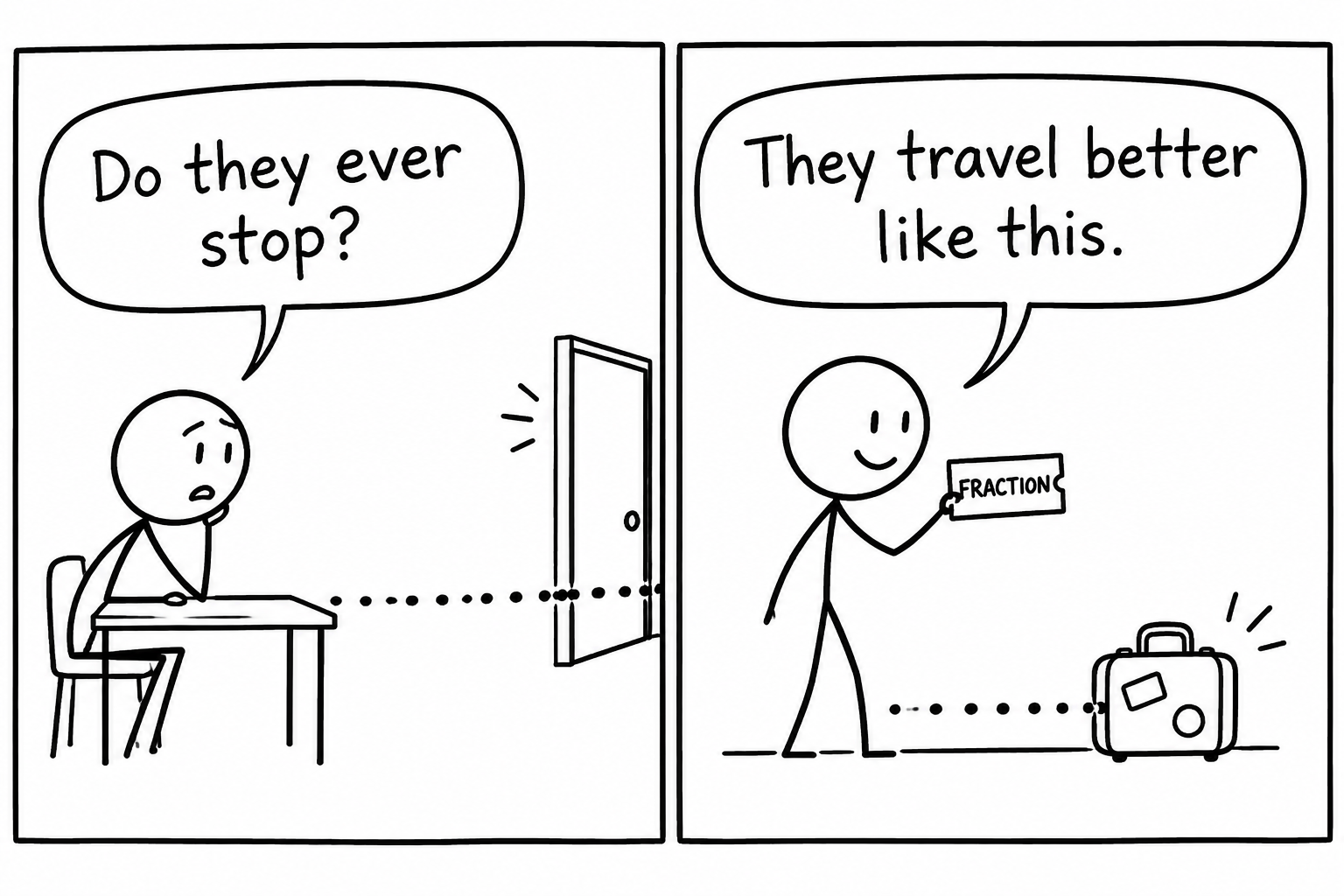 Stick figures turn an endless decimal train into a compact fraction suitcase
Recurring decimals to fractions worked examples
The student in our opening problem was trying to remember isolated rules. The turning point comes when the student stops asking, “What number do I multiply by?” and starts asking, “How many places must I move so the repeating blocks line up?”
One recurring digit
Convert 0.7777…0.7777\ldots0.7777… into a fraction.
Let
x=0.7777…x=0.7777\ldotsx=0.7777…There is one digit in the repeating block, so multiply by 101010:
10x=7.7777…10x=7.7777\ldots10x=7.7777…Subtract the first equation from the second:
10x−x=7.7777…−0.7777…10x-x=7.7777\ldots-0.7777\ldots10x−x=7.7777…−0.7777…Therefore,
9x=79x=79x=7and
x=79.x=\frac{7}{9}.x=97.The answer is already in its simplest form.
Two recurring digits
Convert 0.272727…0.272727\ldots0.272727… into a fraction.
Let
x=0.272727…x=0.272727\ldotsx=0.272727…The repeating block contains two digits, so multiply by 100100100:
100x=27.272727…100x=27.272727\ldots100x=27.272727…Now subtract:
100x−x=27.272727…−0.272727…100x-x=27.272727\ldots-0.272727\ldots100x−x=27.272727…−0.272727…This gives
99x=27.99x=27.99x=27.Therefore,
x=2799=311.x=\frac{27}{99}=\frac{3}{11}.x=9927=113.Notice the final simplification. Stopping at 2799\frac{27}{99}9927 could lose a mark if the question asks for the fraction in its simplest form.
You now have the complete core method; use the Maths Genie step-by-step lessons to practise setting out the equations until choosing the multiplier feels automatic.
A non-recurring digit before the recurring block
Some questions include digits that do not recur. Convert 0.16666…0.16666\ldots0.16666… into a fraction.
Let
x=0.16666…x=0.16666\ldotsx=0.16666…Multiplying by 101010 moves beyond the non-recurring digit:
10x=1.6666…10x=1.6666\ldots10x=1.6666…Multiplying by 100100100 creates another expression with the same recurring decimal part:
100x=16.6666…100x=16.6666\ldots100x=16.6666…Subtract the first of these new equations from the second:
100x−10x=16.6666…−1.6666…100x-10x=16.6666\ldots-1.6666\ldots100x−10x=16.6666…−1.6666…So
90x=15.90x=15.90x=15.Therefore,
x=1590=16.x=\frac{15}{90}=\frac{1}{6}.x=9015=61.This is where the method often clicks. You do not always subtract xxx itself. You subtract two expressions whose recurring tails line up.
A recurring decimal greater than one
Convert 1.272727…1.272727\ldots1.272727… into a fraction.
Let
x=1.272727…x=1.272727\ldotsx=1.272727…Multiply by 100100100:
100x=127.272727…100x=127.272727\ldots100x=127.272727…Subtract:
99x=126.99x=126.99x=126.Therefore,
x=12699=1411.x=\frac{126}{99}=\frac{14}{11}.x=99126=1114.A decimal greater than 111 must produce a fraction greater than 111. That quick size check would expose an answer such as 311\frac{3}{11}113 immediately.
If fractions themselves need refreshing, revisit fractions, decimals and percentages revision before returning to these algebraic conversions.
How to choose the multiplier
The repeating block determines the basic power of 101010:
| Length of recurring block | Useful multiplier |
|---|---|
| One digit | 101010 |
| Two digits | 100100100 |
| Three digits | 100010001000 |
For a purely recurring decimal, this usually means subtracting xxx from 10x10x10x, 100x100x100x or 1000x1000x1000x.
When non-recurring digits come first, create two shifted versions instead. For 0.1252525…0.1252525\ldots0.1252525…, multiplying by 101010 places the decimal at the beginning of the recurring block, while multiplying by 100010001000 moves one complete two-digit block further. The decimal tails then match.
A useful written habit is to place the equations directly above one another. Aligned working makes subtraction errors much less likely and gives the examiner a clear mathematical argument to follow.
Common mistakes
Multiplying by the wrong power of ten
For 0.363636…0.363636\ldots0.363636…, multiplying by 101010 gives 3.63636…3.63636\ldots3.63636…. This does not line up with the original decimal. The repeating block has two digits, so multiplying by 100100100 is the direct choice.
Subtracting inconsistently
If you write 100x−x100x-x100x−x on the left, you must subtract the matching numbers in the same order on the right. Reversing only one side creates a sign error.
Treating recurring and terminating decimals alike
A terminating decimal such as 0.3750.3750.375 ends. A recurring decimal such as 0.3333…0.3333\ldots0.3333… continues indefinitely. The algebraic subtraction method is designed for the infinite repeating pattern.
Forgetting to simplify
After solving for xxx, look for a common factor in the numerator and denominator. The conversion is not quite finished until the fraction is fully simplified.
Dropping the whole-number part
When the original number is greater than 111, the final fraction must also be greater than 111. Estimate before accepting your answer.
Recurring decimals to fractions questions
Try these without looking at the answers first. Show the equations you use, not just the final fraction.
- Convert 0.4444…0.4444\ldots0.4444… into a fraction.
- Convert 0.363636…0.363636\ldots0.363636… into a fraction.
- Convert 0.23333…0.23333\ldots0.23333… into a fraction.
- Convert 1.272727…1.272727\ldots1.272727… into a fraction.
- Convert 0.1252525…0.1252525\ldots0.1252525… into a fraction.
Answers
- 49\frac{4}{9}94
- 411\frac{4}{11}114
- 730\frac{7}{30}307
- 1411\frac{14}{11}1114
- 62495\frac{62}{495}49562
If an answer is wrong, do not simply copy the fraction. Find the first line where the recurring tails stopped matching. That line reveals whether the problem was the multiplier, subtraction or simplification. You can then apply the method to more targeted problems in the Edexcel GCSE Maths Question Bank.
Turn the method into a reliable exam skill
Our hypothetical student did not need another shortcut. The improvement came from writing aligned equations, checking the size of each answer and practising enough questions for the structure to become familiar. Knowing the process once is different from producing it accurately under exam conditions.
Start the recurring decimals lesson, then use the Question Bank to turn the same align, subtract, solve and simplify method into a dependable GCSE exam skill.















