Recover From a Bad GCSE Food and Nutrition Mock
Recover from a bad GCSE Food and Nutrition mock with a practical plan to diagnose lost marks, improve exam technique and revise the right content.
A disappointing mock result can make months of effort feel invisible. You see the mark, compare it with the grade you hoped for, and begin treating one paper as a prediction of the summer.
It is not. To recover from a bad GCSE Food and Nutrition mock, turn the paper into a diagnosis: check where marks were lost, group those losses by cause, revise the three most important gaps, and then answer similar questions again under timed conditions. The emotional recovery matters, but the practical recovery begins when every lost mark is given a next action.
This is particularly useful if you are balancing Food Preparation and Nutrition with GCSE maths. Both subjects reward accurate reading, application, calculations, data interpretation and disciplined use of mark schemes. The habits can reinforce each other.
Your recovery checklist
Start with this sequence:
- Wait until the first wave of disappointment has passed.
- Confirm your exam board and specification.
- Review the paper with the mark scheme and your teacher's feedback.
- Label each lost mark as a knowledge, application, command-word, calculation or timing problem.
- Select three priority areas rather than trying to repair everything at once.
- Use short retrieval sessions followed by exam questions.
- Reattempt weak questions without notes.
- Keep your GCSE maths revision moving alongside the subject recovery.
A mock becomes valuable only when it changes what you do next.
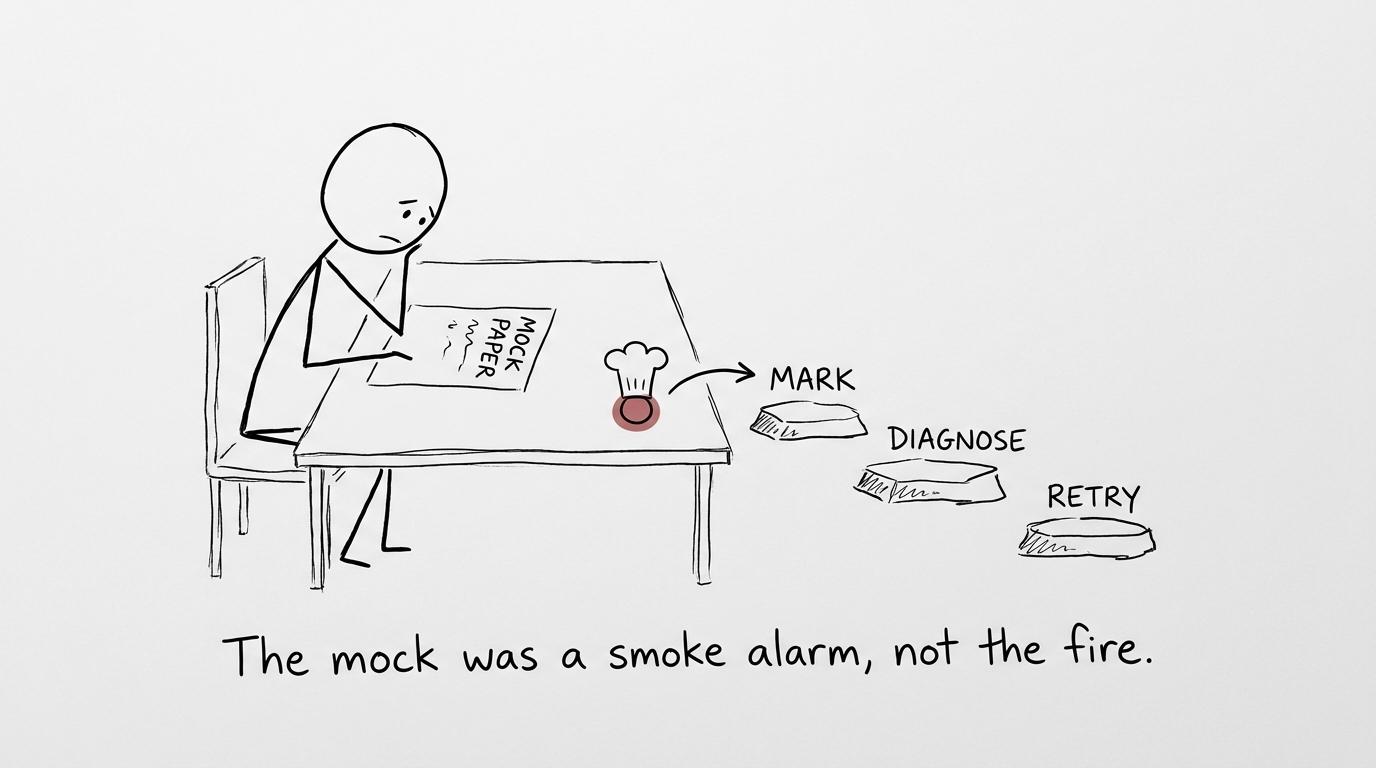 A mock paper acting as a warning rather than a verdict
Understand what the mock actually measured
GCSE Food Preparation and Nutrition is assessed through a written examination and non-exam assessment, usually called NEA. Ofqual's subject requirements allocate 50%50\%50% of the qualification to examination and 50%50\%50% to NEA.
The exact format depends on the board. For example, the current AQA course has a one-hour-and-45-minute written paper worth 100100100 marks, while OCR uses a one-hour-and-30-minute written examination. Eduqas uses a one-hour-and-45-minute written component. AQA, OCR and Eduqas all divide the remaining assessment between a food investigation and a food preparation task, although their component structures and mark totals differ.
That distinction matters. A low written mock mark does not automatically describe the quality of your practical work or determine your final GCSE result. Equally, strong practical work should not be used as a reason to ignore gaps in theory.
Ask your teacher:
- Which exam board and paper did the mock follow?
- Was it a complete paper or a shortened school assessment?
- Which topics had been taught before the mock?
- How was the mock grade boundary chosen?
- Were marks awarded using the official mark scheme?
School mock grades may use boundaries selected by the school, so concentrate first on the raw marks and the questions. Those are more useful for planning than an isolated grade.
Turn the paper into a marks-leak audit
Do not begin by copying the whole specification into a new revision timetable. Begin with the evidence already sitting on your desk.
Read each question you dropped marks on and place it in one of these categories:
| Type of mark loss | What it usually means | Your next action |
|---|---|---|
| Knowledge | A fact, process or technical term was missing | Retrieve it from memory, check it, then test it again |
| Application | You knew the content but did not connect it to the food, person or situation | Practise questions containing unfamiliar contexts |
| Command word | Your response did not analyse, explain, justify or evaluate as required | Build a response checklist for each command word |
| Calculation or data | A percentage, proportion, unit, table or graph caused difficulty | Repair the relevant maths skill and repeat the calculation |
| Exam technique | The answer was vague, repetitive or poorly structured | Compare it with the mark scheme and improve the response |
| Timing | Questions were rushed or left unfinished | Practise short timed sections and set checkpoints |
This separates two problems that often feel identical. Not knowing why enzymic browning occurs is a content gap. Knowing the idea but failing to apply it to the named ingredient is an application gap. They need different revision.
The official assessment objectives support this distinction. Across regulated GCSE Food Preparation and Nutrition qualifications, AO1 covers knowledge and understanding, AO2 covers application, AO3 covers planning and practical performance, and AO4 covers analysis and evaluation. Their overall weightings are 20%20\%20%, 30%30\%30%, 30%30\%30% and 20%20\%20% respectively.
A paper filled only with memorised definitions therefore cannot prepare you for every demand. You must also apply, analyse and evaluate.
Build a recovery plan around three priorities
A poor mock can create an urge to revise everything. That usually produces an impressive timetable and very little depth.
Choose three priorities using these questions:
- Which topic cost the most marks?
- Which error appeared more than once?
- Which gap can be improved through deliberate practice?
- Which weakness is also affecting another subject, especially maths or science?
Your priorities might include food science explanations, nutritional needs, food safety, provenance, sensory data, extended responses or calculations. Match them to your own board's specification rather than relying on a generic online checklist.
Use a simple weekly rhythm:
Learn and retrieve
Review one small area, close your notes and write down what you can remember. Then check for omissions. Retrieval should involve a genuine attempt to recall information, not copying from an open textbook.
Education Endowment Foundation guidance emphasises that retrieval is most useful when it is repeated after a delay and followed by feedback. That means correcting a misconception is part of the revision, not an optional final step.
Apply the knowledge
Answer short questions that require the same knowledge in different contexts. If you revised protein, for instance, your practice should move beyond listing facts and towards explaining or justifying choices for a stated person, dish or dietary requirement.
Reattempt and review
Return to the weak question later without the mark scheme. Keep it on your priority list until you can produce a precise answer independently. Familiarity with the correction is not the same as being able to retrieve it.
The same loop works in maths: learn, practise, mark, diagnose and retry. MathsGenie's GCSE maths revision hub brings together lessons, questions, papers and solutions so that this process remains manageable beside your Food and Nutrition revision.
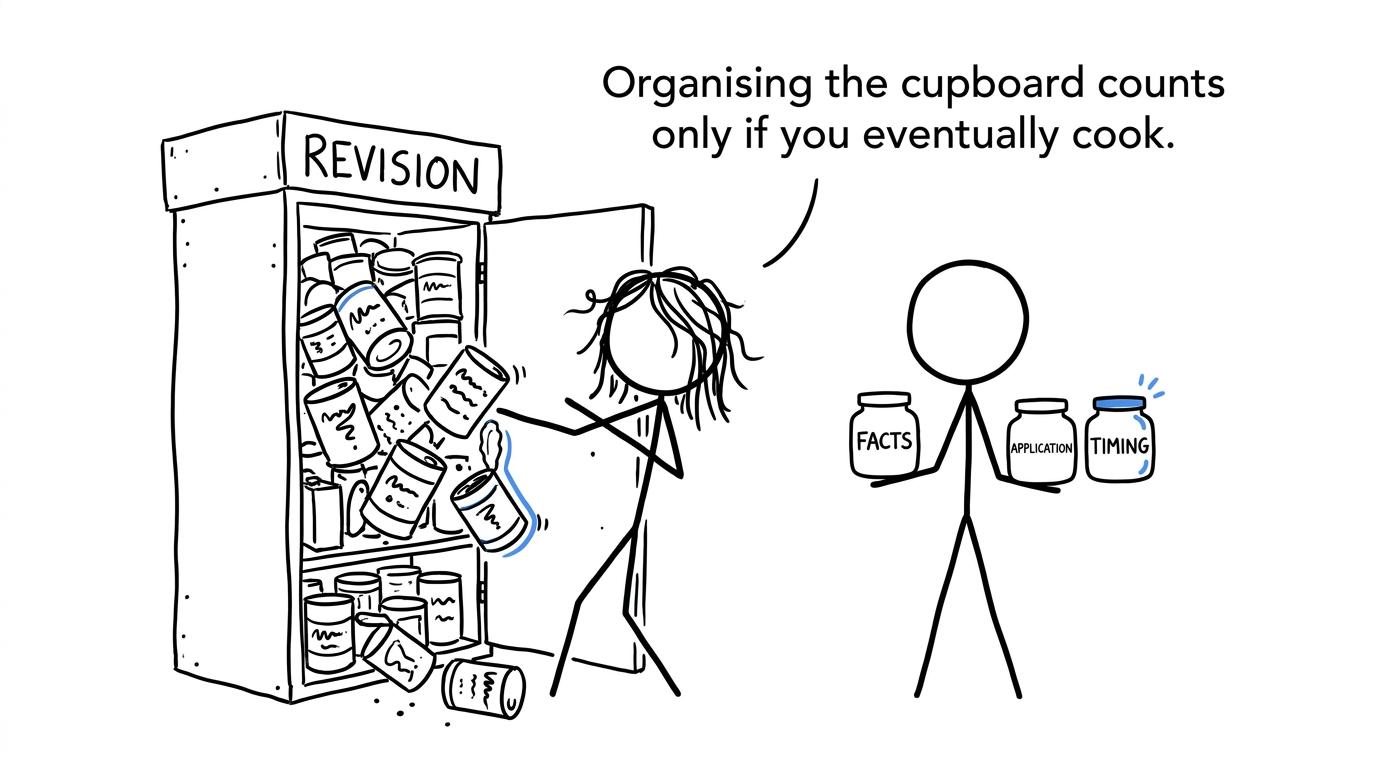 A chaotic revision cupboard beside three useful priorities
Repair the maths behind Food and Nutrition
Food Preparation and Nutrition is not a maths qualification, but numeracy can still protect marks. The Department for Education's subject content includes calculating energy and nutritional values, planning recipes and managing quantities, time and cost.
Percentages and proportions
You may need to interpret nutritional information, calculate a percentage or compare values. The core relationship is:
percentage=partwhole×100\text{percentage}=\frac{\text{part}}{\text{whole}}\times 100percentage=wholepart×100If this caused difficulty, use MathsGenie's GCSE percentages revision to rebuild the skill through lessons, worksheets and questions.
Scaling ingredients depends on proportion:
new amount=original amount×new number of portionsoriginal number of portions\text{new amount}=\text{original amount}\times\frac{\text{new number of portions}}{\text{original number of portions}}new amount=original amount×original number of portionsnew number of portionsThe GCSE proportion revision page is directly relevant to recipe quantities, while the ratio revision guide can strengthen comparisons and sharing methods.
Averages, tables and graphs
Food investigations and sensory testing can involve results presented in tables or charts. You should be able to identify patterns, compare results and distinguish a conclusion supported by data from one that merely sounds plausible.
For numerical results, the mean is:
mean=total of the valuesnumber of values\text{mean}=\frac{\text{total of the values}}{\text{number of values}}mean=number of valuestotal of the valuesUse the GCSE averages resources if data handling weakened your mock response. When reading or producing a graph, check the labels, units, scale and whether the conclusion matches the plotted information. MathsGenie's drawing and reading linear graphs revision can improve the underlying plotting and interpretation skills.
Improve extended responses without writing everything you know
Longer answers are not memory dumps. They are decisions made in response to a particular question.
Before writing, underline the command word, subject and context. If the question asks you to evaluate, include relevant strengths and limitations before reaching a supported judgement. If it asks you to justify, connect each choice to a reason. If it asks you to explain, make the causal link clear rather than presenting two disconnected facts.
A useful planning frame is:
- Make a precise point.
- Use subject knowledge to develop it.
- Apply it to the stated context.
- Explain the resulting effect or consequence.
- Add a justified judgement when the command requires one.
Use the number of marks and available space as guidance, but do not assume that one sentence automatically earns one mark. Mark schemes reward relevant content, not sentence counting.
Keep the recovery compatible with maths revision
One weak mock should not consume every revision evening. Build a timetable that keeps all your subjects alive.
You could use three short Food and Nutrition sessions each week: one for retrieval, one for application and one for a timed question. Place these alongside targeted maths sessions and one mixed paper activity. MathsGenie's guide to creating a GCSE maths revision timetable can help you build a realistic weekly structure.
As maths exams approach, use GCSE past papers and practice resources at the correct board and tier. Foundation and higher tier apply to GCSE maths; do not assume the same tier language applies to Food Preparation and Nutrition.
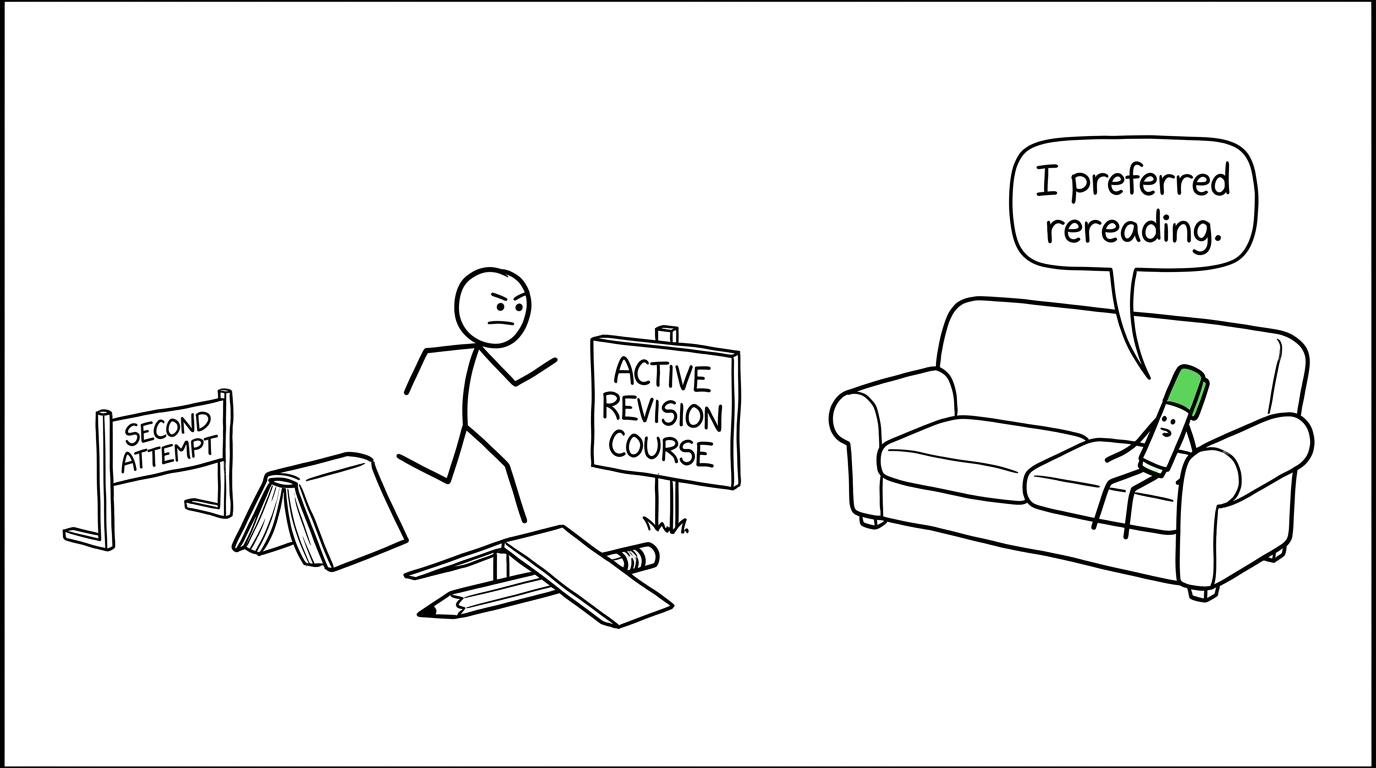 Active revision overtaking passive rereading
Common mistakes after a bad mock
Revising only the topics you enjoy
Comfortable revision feels productive because answers come quickly. Your audit should decide what receives time, not your mood.
Rereading instead of retrieving
Reading can restore understanding, but it does not prove that you can recall and apply the knowledge independently. Close the resource and test yourself.
Treating every lost mark as a knowledge gap
Some marks disappear through weak application, ignored command words, missing units or poor timing. More notes will not automatically repair those errors.
Memorising whole model answers
A memorised response may not fit a new ingredient, dietary need or scenario. Learn accurate knowledge and flexible answer structures instead.
Ignoring the mark scheme
The mark scheme reveals the precision expected, but use it after making an honest attempt. Copying it creates recognition, not recall.
Abandoning other subjects
Recovery is not a punishment timetable. Protect your maths routine with focused topic practice, mini tests, past papers and video solutions rather than allowing one mock to take over every evening.
A bad mock can still become useful
The mark itself is fixed. Its meaning is not.
Once you identify the exact leaks, choose three priorities and reattempt questions after feedback, the mock stops being a verdict and becomes a map. Keep the plan narrow enough to follow and specific enough to measure. Ask your teacher when a mark scheme point or NEA requirement is unclear, because the correct details depend on your exam board and task.
At the same time, keep building the numeracy that supports recipe scaling, percentages and data interpretation. Start with MathsGenie's free GCSE maths revision resources, then use revision lessons, practice questions, mini tests, mark schemes and video solutions to repair individual weaknesses. Add past papers and predicted papers when you are ready to test those skills under pressure.
Do not try to feel confident before you begin. Begin with one diagnosed mistake, correct it properly, and let the evidence of improvement build the confidence for you.