

How to Rebuild a Revision Plan After Mock Results
How to rebuild a revision plan after mock results by turning feedback into clear priorities, stronger study techniques and a realistic exam schedule.
Mock results can make a revision plan feel obsolete overnight. If you are wondering how to rebuild a revision plan after mock results, begin with the papers: identify why marks were lost, rank the gaps and turn those priorities into specific revision tasks. Keep routines that worked, then adjust what you practise and how you check progress.
A disappointing grade can feel like a judgement on weeks of effort. Yet the grade alone cannot tell you what to do tomorrow. Your marked answers can.
Your post-mock revision checklist
A useful rebuild has six stages:
- Collect papers, mark schemes and teacher feedback.
- Separate knowledge gaps from exam-technique problems.
- Rank topics by importance.
- Choose an active revision technique for each weakness.
- Schedule returns to difficult material.
- Review progress weekly.
This approach works for GCSE and A Level students. The content differs, but both need a plan based on evidence rather than the emotion of results day.
Begin with the paper, not the grade
Two students can receive the same grade for different reasons. One may lack knowledge; another may understand the methods but misread questions or run out of time.
Go through each mock with the relevant mark scheme and classify your mistakes:
| Reason marks were lost | What it suggests |
|---|---|
| You could not remember the content | A knowledge or recall gap |
| You knew the method but could not finish | An application gap |
| You misread the question | An interpretation problem |
| You made arithmetic or notation errors | An accuracy problem |
| You left questions unfinished | A possible timing or confidence problem |
Ask your teacher about working you cannot diagnose yourself. A mark scheme shows what earned marks; your written method helps reveal where understanding broke down.
Avoid labelling every small error “careless”. Repeated sign errors or missed instructions are patterns that deserve a specific correction task.
Turn feedback into priorities
Revising the mock from beginning to end gives every mistake equal attention. Instead, sort topics into three groups:
- High priority: weak knowledge, repeated errors or skills that support other topics.
- Medium priority: partly understood material needing focused practice.
- Maintenance: secure content needing occasional retrieval.
At GCSE, check that tasks match your foundation or higher tier. At A Level, look for weaknesses affecting several areas. Insecure algebra can obstruct otherwise sound work in functions, calculus and mechanics.
Give high-priority gaps the largest share of your available sessions while retaining maintenance and timed practice. Avoid fixing percentages before you know what your week can accommodate.
The GCSE revision timetable guide provides a broader weekly structure. If exams are approaching, the one-month maths revision plan offers a shorter planning framework.
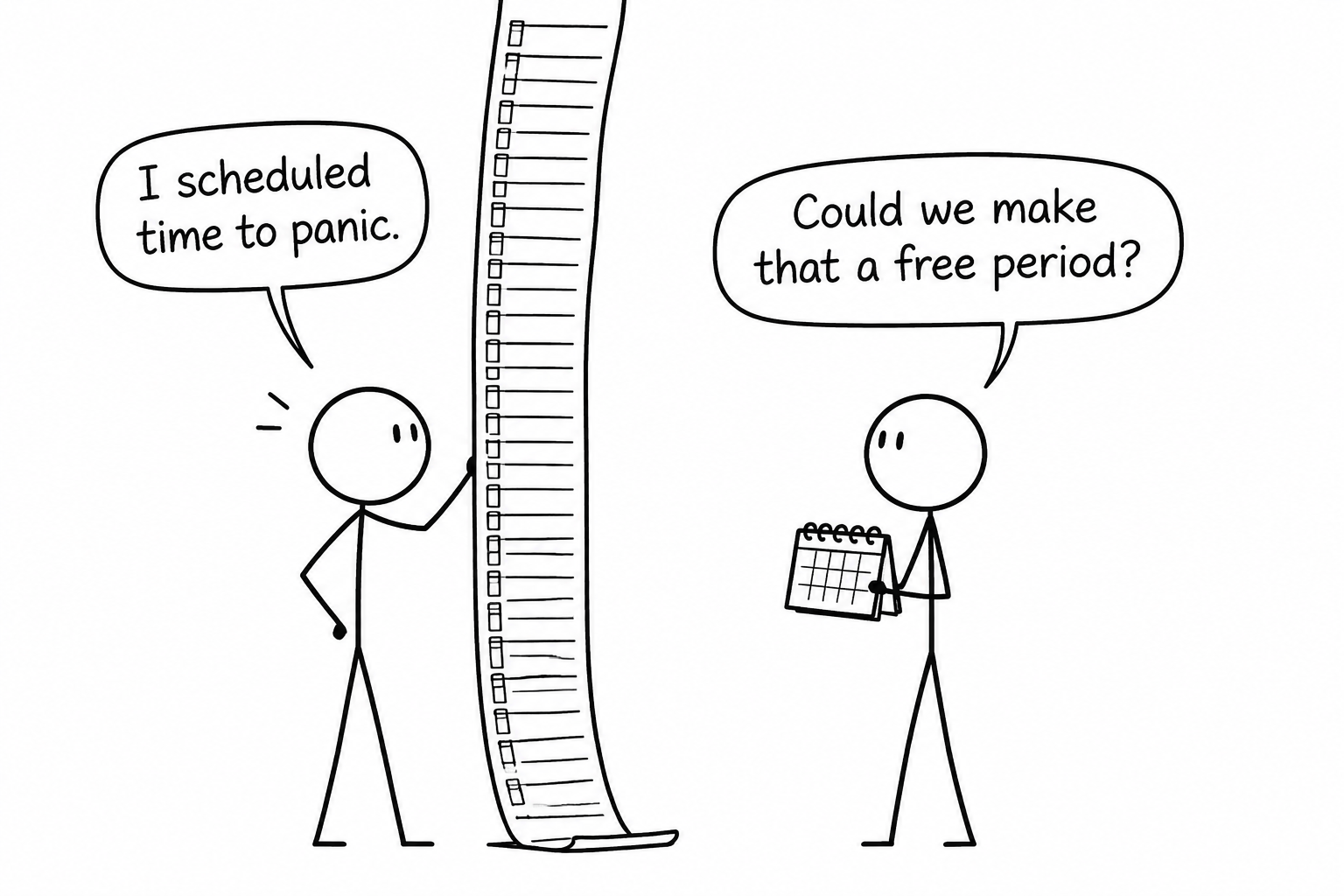 XKCD-style comic showing a student who scheduled time to panic beside an enormous revision timetable
Match the technique to the problem
“Revise maths” leaves too many decisions until later. A useful task names the topic, the activity and how you will check it.
For missing knowledge
Watch a short revision lesson, then close your notes and retrieve the main ideas. Explain the method aloud or answer questions without prompts. Check what you missed before practising again.
Copying a clear explanation can feel reassuring, but independent recall gives you better evidence of what you remember.
For weak application
Move from a guided method to focused questions completed independently. Compare your working with mark schemes or video solutions, then correct the precise step that failed.
Return on another day. Completing a large block once does not establish that you can still use the method later, especially when it appears among unfamiliar questions.
For timing and exam technique
Begin with short timed sections. Afterwards, identify whether delays came from slow methods, uncertainty or spending too long on one question. Turn each finding into a practice task before attempting another paper.
MathsGenie's free revision lessons, practice questions, mark schemes, video solutions, mini tests, past papers and predicted papers support these different stages. The guide to a revision timetable you will actually stick to helps organise them realistically.
Build a week you can complete
Include sessions for learning weak content, practising independently, retrieving earlier material and completing timed questions. Each session should finish with a brief judgement: secure, improving or still weak.
Plan around lessons, homework, sleep and other commitments. Leave spare capacity for unfinished work. If every evening is full, one difficult day can disrupt the entire timetable.
The MathsGenie revision-planning guide explains how to give your priorities a clear home. Use the Revision Planner to organise tasks and revisits without repeatedly rebuilding a paper timetable.
Review progress every week
Check whether you can now answer questions without notes, whether familiar errors remain and whether the workload was realistic. Use marked practice and mini tests as evidence.
Move topics towards maintenance when you can retrieve and apply methods independently on separate occasions. If something remains weak, change the approach or ask for help. Repeating the same unsuccessful activity is unlikely to resolve the underlying confusion.
Common revision-planning mistakes after mocks
Revising everything equally: protect secure knowledge, but direct more attention towards recurring weaknesses.
Building a punishment timetable: disappointment can encourage unrealistic hours. Choose a workload you can sustain alongside school and rest.
Choosing only comfortable topics: begin selected sessions with a difficult priority before returning to familiar material.
Counting time instead of outcomes: record questions attempted, errors corrected and methods retrieved. Time spent is useful context, but it does not show understanding by itself.
Turn the mock into your next move
Your result is fixed; your response is still open. Begin with one paper, identify one recurring weakness and schedule a task that addresses it. Then check whether that task helped.
Use MathsGenie's revision resources to repair the gaps and build your next week in the Revision Planner. A workable plan gives each session a purpose and each mistake a useful next step.















