

Ready for GCSE Biblical Hebrew Early Sitting?
Ready for GCSE Biblical Hebrew early sitting? Use this evidence-based checklist to assess language, literature, timing and your wider GCSE workload.
There is a difference between wanting to finish a GCSE early and being ready to do it. Enthusiasm often arrives first. Evidence takes longer.
If you are asking whether you are ready for GCSE Biblical Hebrew early sitting, the short answer is this: you should be able to complete both current Pearson Edexcel papers under timed conditions, handle unseen language independently, analyse both prescribed texts and protect your progress in maths and your other GCSE subjects. One strong mock or excellent knowledge of a familiar passage is not enough.
Early entry can be sensible for a student whose performance is already secure and repeatable. It is less sensible when the date itself has become more important than the grade, or when preparation depends heavily on prompts from a teacher.
The early-sitting readiness checklist
Before agreeing to an early entry, you should be able to answer yes to most of these questions:
- Have you covered the complete specification rather than selected favourite areas?
- Can you translate genuinely unseen Biblical Hebrew without teacher prompts?
- Can you identify and explain grammar accurately in context?
- Do you know both set texts prescribed for your examination series?
- Can you analyse language rather than merely retell events?
- Can you compare themes across the two texts in a structured response?
- Have you completed both full papers in strict timed conditions?
- Are your results stable across several assessments?
- Does your teacher support the entry based on marked evidence?
- Can you prepare without weakening maths, English and your other GCSE subjects?
- Has your school or examination centre confirmed the entry arrangements?
The final decision should be made with your teacher, school and parent or carer. Readiness is not simply a feeling. It is a pattern visible in your work.
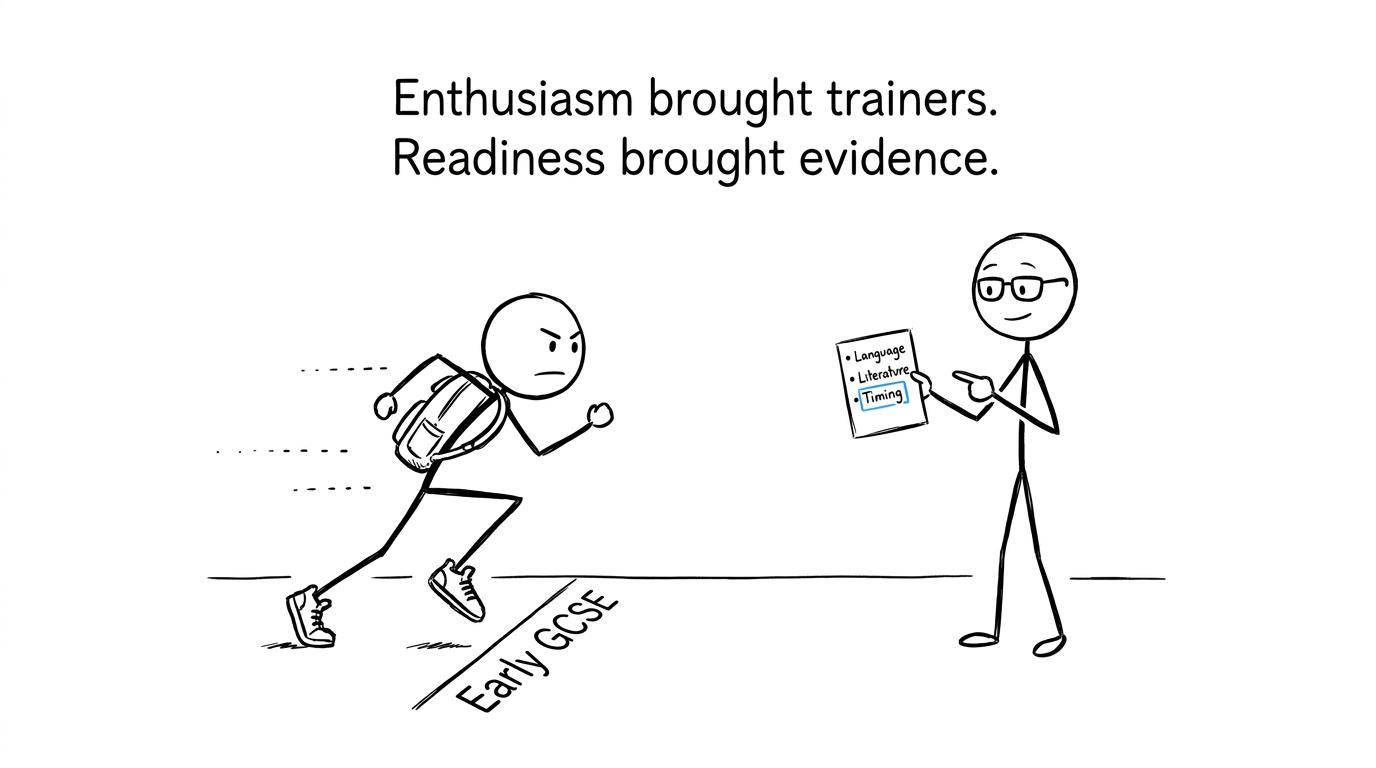 A student comparing enthusiasm with an evidence-based early GCSE checklist
Know the examination you are volunteering to sit
For the current Pearson Edexcel GCSE in Biblical Hebrew, specification code 1BH01\mathrm{BH}01BH0, assessment is linear. This means that both externally examined components must be taken in the same May or June series.
Component 1 is Language. It lasts 222 hours, carries 100100100 marks and contributes 50%50\%50% of the qualification. It tests knowledge and understanding of Biblical Hebrew through unseen material, including comprehension, translation and grammatical knowledge. The specification also includes a choice involving grammar questions or translation into Biblical Hebrew.
Component 2 is Literature. It also lasts 222 hours, carries 100100100 marks and contributes the remaining 50%50\%50%. It assesses knowledge of the prescribed literature, translation and grammar within the texts, analysis of language, and comparison of themes.
For examinations from summer 2026 to summer 2028, Pearson prescribes two areas of literature:
- Genesis, covering Joseph’s rise to power in chapters 414141, 424242 and 434343
- Kings, covering the miracles of Elisha in chapters 444, 555, 666 and 777
Always confirm your examination series and prescribed texts with your teacher. Older papers remain useful for learning question styles, but their literature content may come from an earlier set-text cycle.
This structure matters because there is no safe half-entry. Being excellent at literature cannot remove the need to cope with unseen language, and strong translation cannot compensate for an undeveloped comparative essay.
Genuine readiness appears in unseen language
Familiar material can create a comforting illusion. After revising a passage several times, you begin to recognise its shape before you have truly processed its grammar. Recognition feels fast, so it feels like mastery.
An unseen passage removes that support. You must identify forms, use vocabulary intelligently, follow syntax and produce clear English without knowing the story by memory. That is why unseen work is one of the strongest tests of whether early entry is appropriate.
A genuinely ready student can usually:
- distinguish secure knowledge from a sensible contextual inference
- recognise regular and irregular forms required by the specification
- preserve tense, person and relationships between clauses
- translate the whole sentence rather than replacing difficult details with a guess
- continue calmly when one word is unfamiliar
- review an answer without rewriting correct material unnecessarily
Your evidence should come from several unseen passages completed without notes. If performance falls sharply whenever teacher scaffolding disappears, you may be progressing well, but you are not yet independently exam-ready.
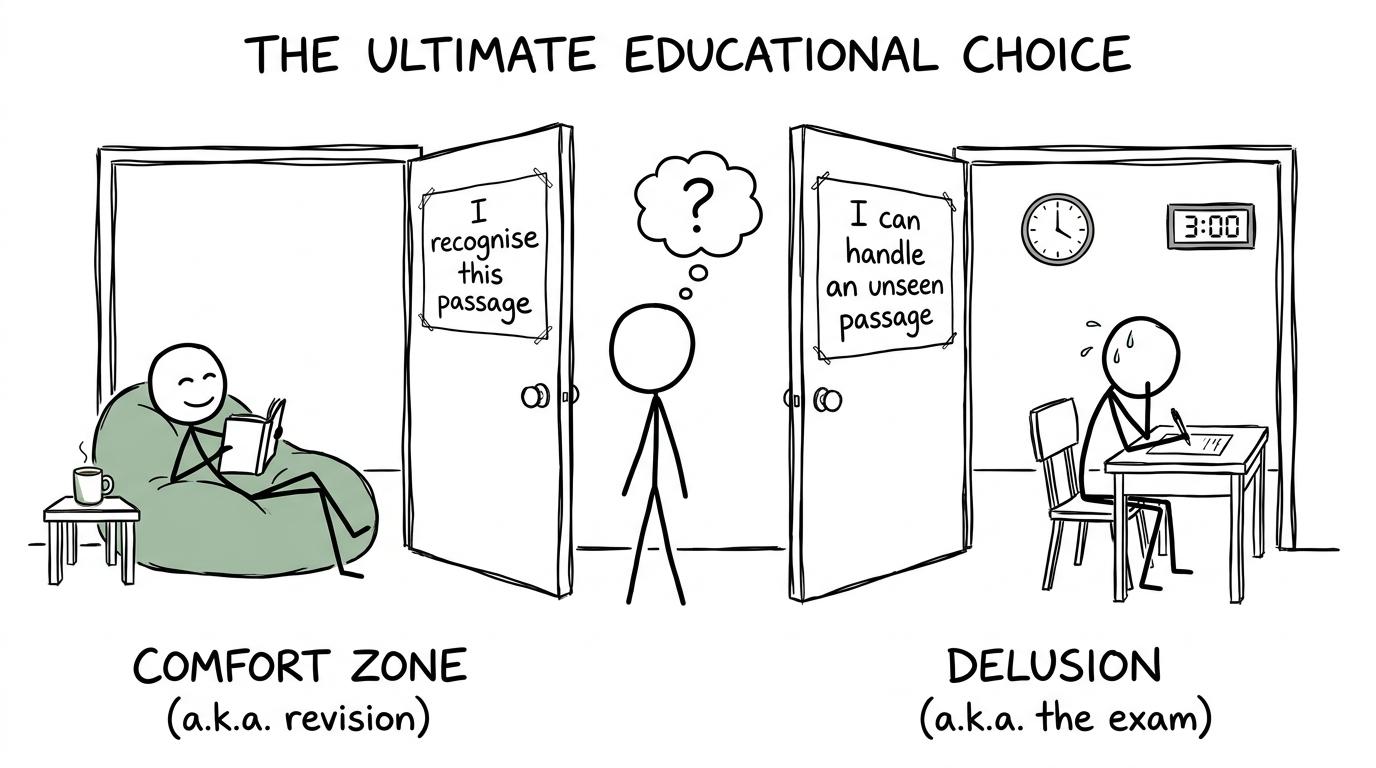 A student choosing between recognising a familiar passage and tackling an unseen one
Literature knowledge must go beyond remembering the story
Knowing what happens is necessary, but the literature paper asks for more than narrative recall. You need accurate textual knowledge and the ability to explain how language creates meaning or emphasis.
You should be able to move between three levels of thought:
What does the passage say?
This includes comprehension, translation, relevant context within the prescribed books and accurate identification of people or events.
How does the language work?
Here you consider significant vocabulary, repetition, contrast, syntax, imagery or other literary features. Naming a feature is only the beginning. You must connect it to its effect in the passage.
How does it contribute to the wider text?
Longer responses require you to select relevant evidence, develop an interpretation and compare how a theme is presented across both prescribed texts. A memorised paragraph is fragile because it may not answer the precise question set.
A student ready to sit early can produce this reasoning independently. They do not need a teacher to supply the analytical point before they can explain it.
Your marks should be stable, not spectacular once
One high score can be encouraging, but it may reflect a familiar paper, generous marking or questions that happened to suit you. Readiness is better shown by a run of assessments covering different demands.
Use current mark schemes wherever possible and ask a qualified teacher to moderate extended responses. Grade boundaries change between examination series, so do not build the decision around an assumed fixed percentage. Look instead for a secure margin above the level you hope to achieve and for consistency across both components.
Your assessment record should include:
- separate timed sections completed without help
- full Language and Literature papers
- unseen passages not previously discussed
- essays marked for relevance, evidence, comparison and analysis
- an error log showing whether old weaknesses actually disappear
The principle is familiar from maths revision: a paper is most useful when it reveals what to repair. MathsGenie’s guide to using GCSE past papers properly explains the paper, mark, fix and retest cycle. Although MathsGenie does not provide Biblical Hebrew papers, that disciplined assessment method transfers directly.
Check whether early entry fits your whole GCSE programme
A grade is never earned in isolation. An extra evening spent memorising a set text is an evening not spent repairing algebra, writing an English essay or sleeping.
This does not mean you should avoid ambitious plans. It means the plan must fit. Build a weekly timetable containing your real commitments and use conservative estimates. Include schoolwork, travel, rest and preparation for both Biblical Hebrew papers.
Then ask:
- Are maths topics being postponed repeatedly?
- Are you completing homework hurriedly to protect Hebrew revision time?
- Does your plan rely on giving up sleep near the examination?
- Would waiting allow you to reach a stronger grade with less pressure?
- Is there a meaningful academic reason to sit early?
You can organise the maths side of this decision through the free GCSE Maths revision hub, choosing your exam board and tier before identifying weak areas. If time is tight, the 20-minute GCSE maths revision routine can keep core skills active without pretending that every session needs to be enormous.
For a broader plan, use the GCSE maths revision timetable guide. A timetable is not proof that you have enough time; it is a test of whether enough time genuinely exists.
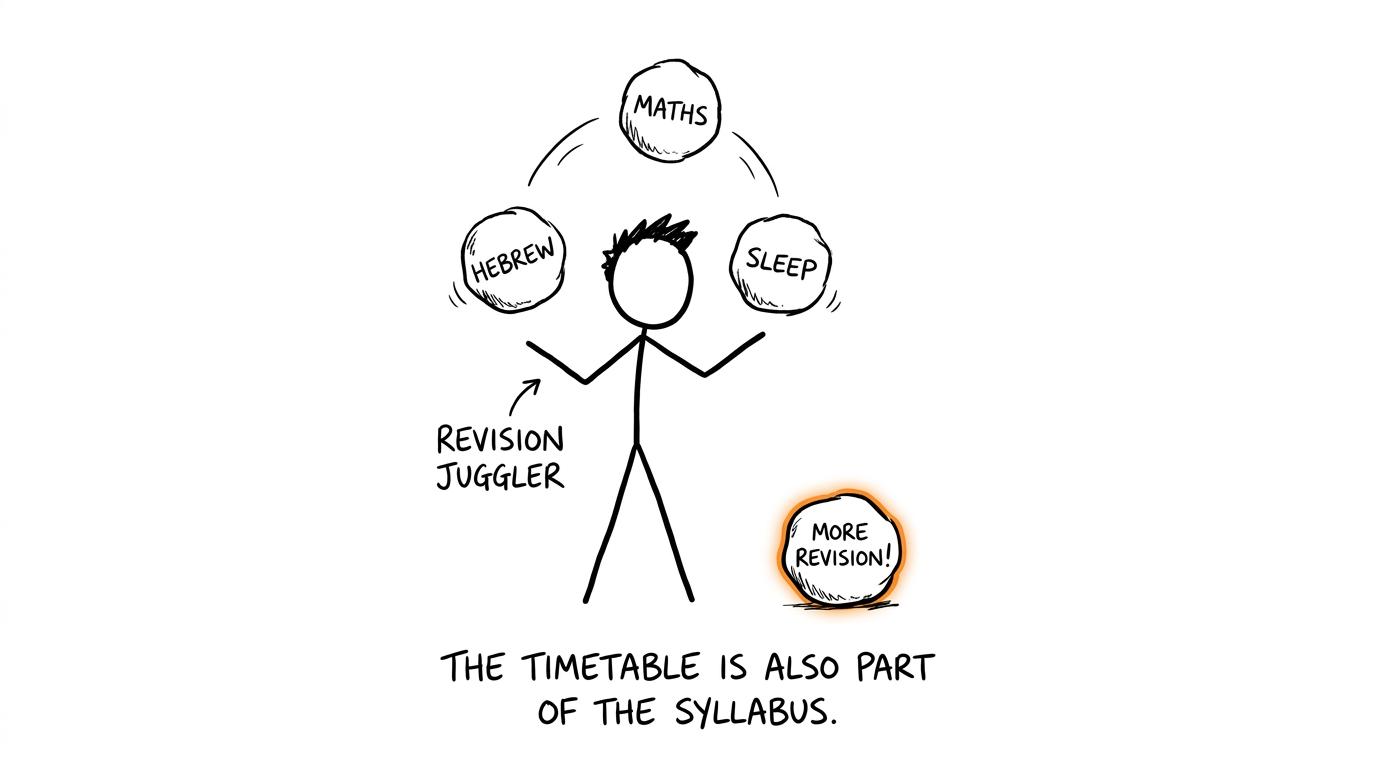 A student balancing Biblical Hebrew, maths and sleep in a revision timetable
Keen versus ready: the distinction that matters
A keen student enjoys lessons, volunteers answers and wants the challenge. These are valuable qualities, but they describe motivation.
A ready student can perform when the passage is unfamiliar, the clock is running and no reassurance is available. They finish both papers, make reasoned decisions under pressure and recover from difficult questions. Their teacher can point to evidence across the whole specification.
The clearest warning sign is conditional confidence: “I can do it if this topic appears”, “I am fine when I recognise the passage”, or “I will learn the missing chapters just before the exam”. Early entry should rest on present capability, not an optimistic forecast.
You should also consider the emotional response to a disappointing result. Ask your school what resitting would involve, how an early result would be reported and whether there are any consequences specific to its entry policy. If entering privately, arrangements must be made through an approved examination centre, and availability and deadlines need checking well in advance.
Common mistakes when deciding to enter early
Treating speed as the same as understanding
Fast recall of familiar vocabulary is useful, but the examination rewards accurate comprehension, translation and analysis. Slow, controlled reasoning often earns more marks than a quick assumption.
Revising only comfortable material
Students naturally return to the passages and grammar they already know. A readiness audit should focus on what you avoid, especially unseen language and extended analysis.
Using old set texts without checking the series
Past papers can teach format, but the prescribed literature changes. Confirm that your preparation covers the texts for your actual examination year.
Judging readiness from untimed work
Open-book essays and guided translations help you learn. They do not show whether you can perform independently for 222 hours. You need both learning tasks and closed-book timed assessment.
Ignoring the rest of the timetable
An early GCSE is not a success if it quietly damages several other subjects. Use short GCSE maths mini tests and revision resources to monitor whether essential skills remain secure, then return to full paper practice when appropriate.
Mistaking predicted papers for predictions of your result
A predicted paper is practice based on likely styles and content, not a promise about the live examination. Maths students can use MathsGenie’s GCSE predicted papers to sharpen exam technique, but readiness should always be judged across multiple forms of evidence.
Make the decision from evidence, not impatience
Sitting GCSE Biblical Hebrew early can be a thoughtful choice when the course is complete, performance is stable and the wider revision plan remains healthy. The strongest sign is not that you feel ahead. It is that unfamiliar material no longer changes the quality of your thinking.
Ask your teacher for an honest review of both components. Complete timed papers, analyse every lost mark and check the practical entry arrangements with your school or approved centre. If the evidence says wait, waiting is not failure. More preparation may turn a possible grade into a secure one.
Meanwhile, keep your maths moving. Start at the MathsGenie GCSE Maths revision area, use revision lessons and practice questions to close gaps, and test yourself with mini tests, past papers, predicted papers, mark schemes and video solutions. A good early-entry decision protects your whole education, not merely the next date on the calendar.











