

Should You Read the GCSE D&T Specification?
Read GCSE Design and Technology specification wisely: discover what the official document reveals, what guides miss and how to build a sharper revision plan.
A revision guide feels reassuring. It explains ideas, provides examples and turns a large course into manageable pages. The official specification can feel like the opposite: formal, dense and written for teachers.
Yet if you read GCSE Design and Technology specification material strategically, you gain something a guide cannot always provide: a precise map of what your exam board may assess. The short answer is yes, it is worth reading, but you do not need to study every administrative paragraph. Use the specification to check coverage, understand assessment and identify the maths skills that belong inside D&T. Then use lessons, questions and past papers to learn them.
That distinction matters. A specification tells you the destination. It does not do the travelling for you.
The short checklist
Use your official specification to find:
- the exact qualification and exam-board code;
- the subject-content headings you must know;
- the division between core and specialist or in-depth content;
- the written examination structure;
- the non-exam assessment requirements;
- the assessment objectives and their weightings;
- the mathematical skills assessed in context;
- any appendix defining technical language, formulae or permitted equipment.
Do not try to memorise the whole PDF. Read the contents page, assessment overview, content statements, maths appendix and assessment objectives. Leave sections aimed at centres, moderation administration and post-results procedures unless they directly affect your work.
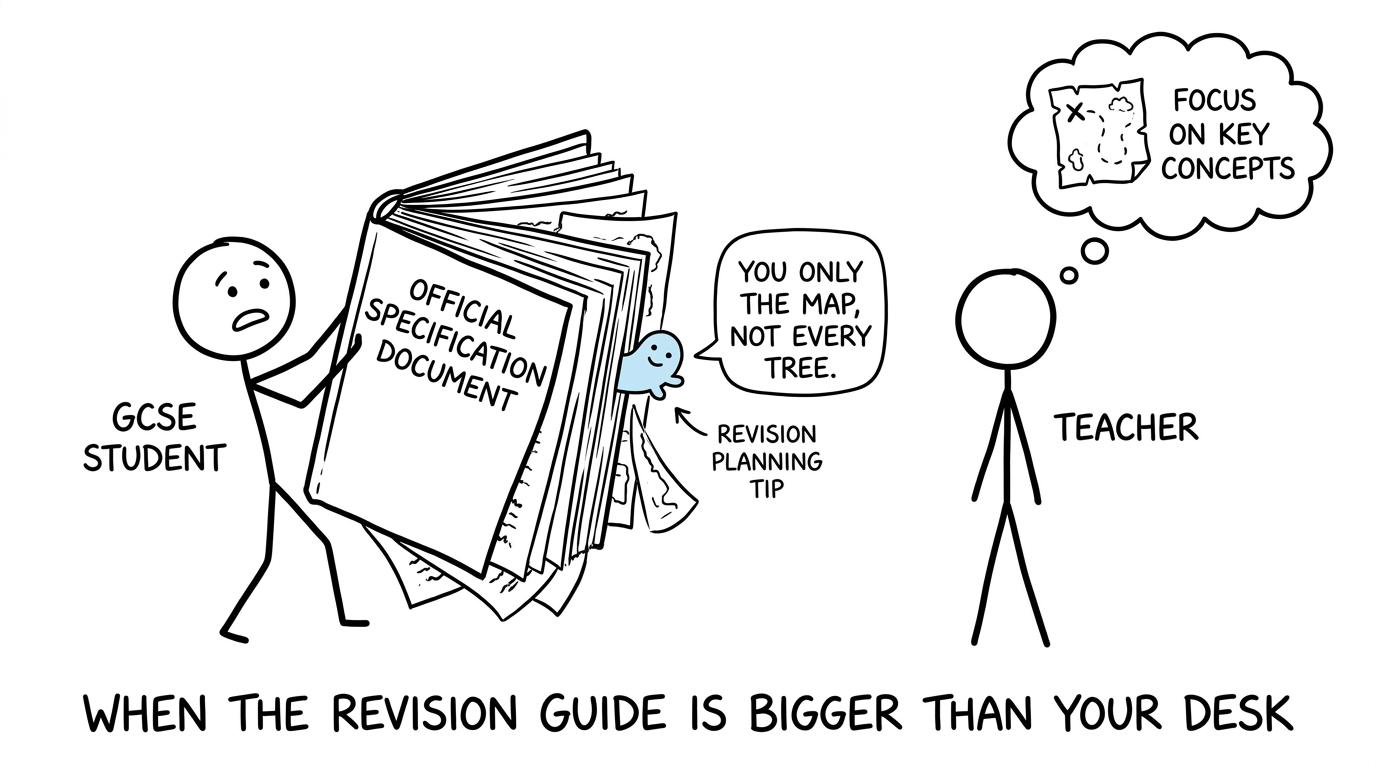 A student discovers that the specification is a map rather than another textbook
What the official specification gives you that a guide may not
A good revision guide interprets the course. The specification defines it. That difference produces several practical benefits.
An authoritative boundary around the course
Revision becomes uncomfortable when you cannot tell whether a detail is essential, useful background or simply interesting. The specification provides the boundary.
Its content statements show what students are expected to know, understand and apply. Depending on your board, these may be organised as core technical principles, specialist knowledge, designing and making principles, material categories or broader topic areas.
The names and structure vary between AQA, Pearson Edexcel, OCR and Eduqas. That is why using the correct document matters. An AQA checklist cannot safely replace an OCR specification, even where much of the underlying national subject content overlaps.
A guide may simplify or combine several statements into one chapter. That often makes learning easier, but it can hide a small assessable point. Reading the official list lets you compare your guide against the source rather than assuming the guide contains everything.
A clearer picture of how marks are distributed
The specification does more than list topics. It explains how knowledge and design work contribute to the qualification.
Across the major GCSE D&T specifications, assessment combines a written examination with non-exam assessment. Current official documents for AQA, Pearson Edexcel, OCR and Eduqas describe an exam worth 50%50\%50% and an NEA component worth 50%50\%50%, although the organisation, terminology and recommended working time can differ.
The assessment objectives also reveal what kind of performance earns marks. They distinguish between activities such as:
- identifying and investigating design possibilities;
- designing and making prototypes;
- analysing and evaluating decisions, outcomes and wider issues;
- demonstrating and applying technical knowledge.
This changes revision decisions. If you only memorise material properties, you are preparing for one kind of demand. You must also be able to apply knowledge to a product, justify choices and evaluate design consequences.
The difference between broad and specialist knowledge
Students sometimes revise only the material area used for their NEA. The specification shows why that can be risky.
Your board may require broad core knowledge alongside deeper knowledge of a chosen material category or in-depth area. The wording differs, so check exactly what applies to your qualification. Mark each statement as one of the following:
- secure;
- partly secure;
- not yet learned;
- unclear whether it has been taught.
That final category is valuable. It gives you a specific question to take to your teacher instead of the unhelpfully broad feeling that you may have missed something.
What you learn about maths in GCSE D&T
The maths appendix is one of the strongest reasons for a maths student to open the specification.
Official subject requirements state that at least 15%15\%15% of the marks in the written D&T examination must reward mathematical skills. Those skills must be assessed within a design and technology context rather than as isolated calculations, and the minimum demand is not below Key Stage 333 mathematics.
The national subject content identifies areas including:
- decimal and standard form;
- ratios, fractions and percentages;
- quantities, costs and sizes;
- scale drawings;
- surface area and volume;
- tables, charts and data presentation;
- plotting and interpreting graphs;
- translating between graphical and numerical information;
- angles and representations of 222D and 333D forms;
- metric and SI units.
The gain from reading this list is not merely knowing that “maths comes up”. You learn which maths deserves targeted practice and the contexts in which it may appear.
If units are a weak point, use MathsGenie's Conversions and Units revision resources. For drawings and models, revisit the Scale Drawings revision guide. Questions about material capacity and quantities connect naturally to Volume of a Prism revision.
This is where the specification becomes useful beyond D&T. Ratio, percentage change, graphs, standard form, area and volume also matter in GCSE maths. Repairing one weak skill can therefore protect marks in two subjects.
How to read the specification without wasting an evening
The wrong approach is to begin on the first page and highlight almost everything. Highlighting feels active, but a page covered in colour no longer shows priorities.
Use three passes instead.
First pass: establish the structure
Confirm your exam board, specification code and current document version. Ask your teacher if you are uncertain. Then locate the contents page and assessment overview.
Write down only:
- exam length and marks;
- component weightings;
- main paper sections;
- content groupings;
- NEA structure;
- location of the maths requirements.
This pass should produce a small map, not a second specification.
Second pass: turn content statements into a checklist
Read the assessable content and convert each statement into a question you can answer honestly. “Properties of materials” is vague. “Can I select a suitable material and justify the choice using relevant properties?” is testable.
Keep the wording close enough to the specification that important command verbs remain visible. Words such as understand, apply, analyse, evaluate and calculate signal different kinds of preparation.
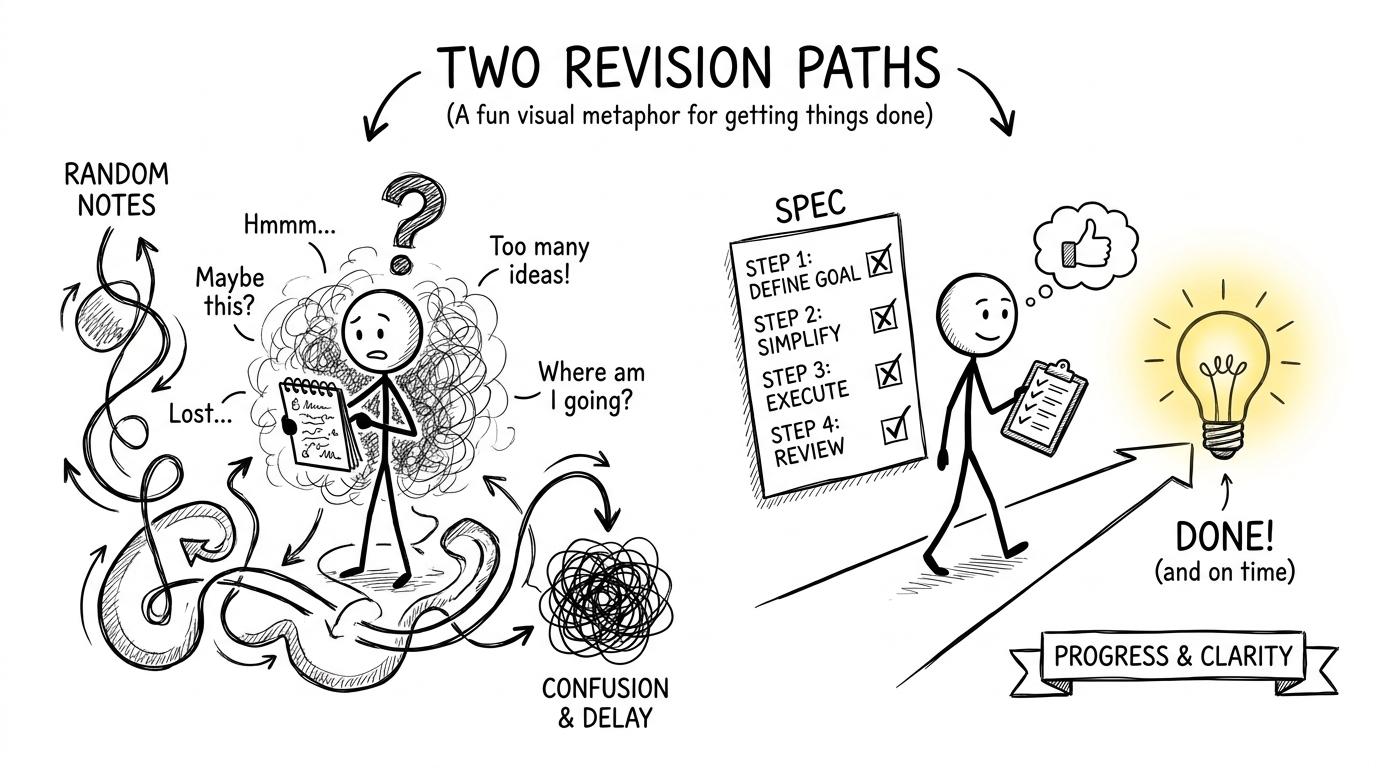 One student follows the specification while another wanders through random notes
Third pass: connect the checklist to evidence
A tick should mean more than “I remember seeing this”. Give yourself evidence:
- Can you explain it without notes?
- Can you apply it to an unfamiliar product?
- Can you answer an exam question on it?
- Can you interpret the relevant data or calculate accurately?
- Can you compare your response with a mark scheme?
For cross-subject maths gaps, begin at the GCSE Maths revision hub, where topics are organised with lessons, questions and revision tools. The GCSE maths topics by exam board and tier guide can help you locate the corresponding skill in your own maths course.
Why the specification cannot replace a revision guide
The official document is accurate, but accuracy is not the same as teachability.
A line in a specification may represent several lessons of knowledge and application. It usually will not explain the idea at a student-friendly pace, diagnose misconceptions or provide enough practice to make the skill reliable.
Think of your resources as having different jobs:
| Resource | Best use |
|---|---|
| Official specification | Defining content and assessment |
| Revision guide or lesson | Learning and organising knowledge |
| Practice questions | Applying knowledge and calculations |
| Mark scheme | Understanding what earns marks |
| Past paper | Testing coverage, timing and interpretation |
| Predicted paper | Additional exam-style rehearsal near the exam |
The strongest approach is specification-led, not specification-only. Use the document to decide what must be revised, then use teaching resources to do the revision.
Turn the document into a practical revision plan
After checking the specification, choose a small number of actions. A useful weekly cycle is:
- select one D&T content cluster;
- revise the knowledge using your class materials or guide;
- answer relevant questions without notes;
- mark the work and record the precise gap;
- practise one linked maths skill;
- return to the specification checklist and update it only when evidence supports the change.
If you are unsure how to sequence the mathematical part, MathsGenie's guide to the best order for learning GCSE maths topics offers a sensible progression from number fluency through ratio, graphs, geometry and measures.
Nearer the examination, mixed practice becomes more important. GCSE predicted papers can reveal whether a maths method remains secure when it is no longer labelled for you. Remember that predicted papers are practice resources, not promises about exact exam content.
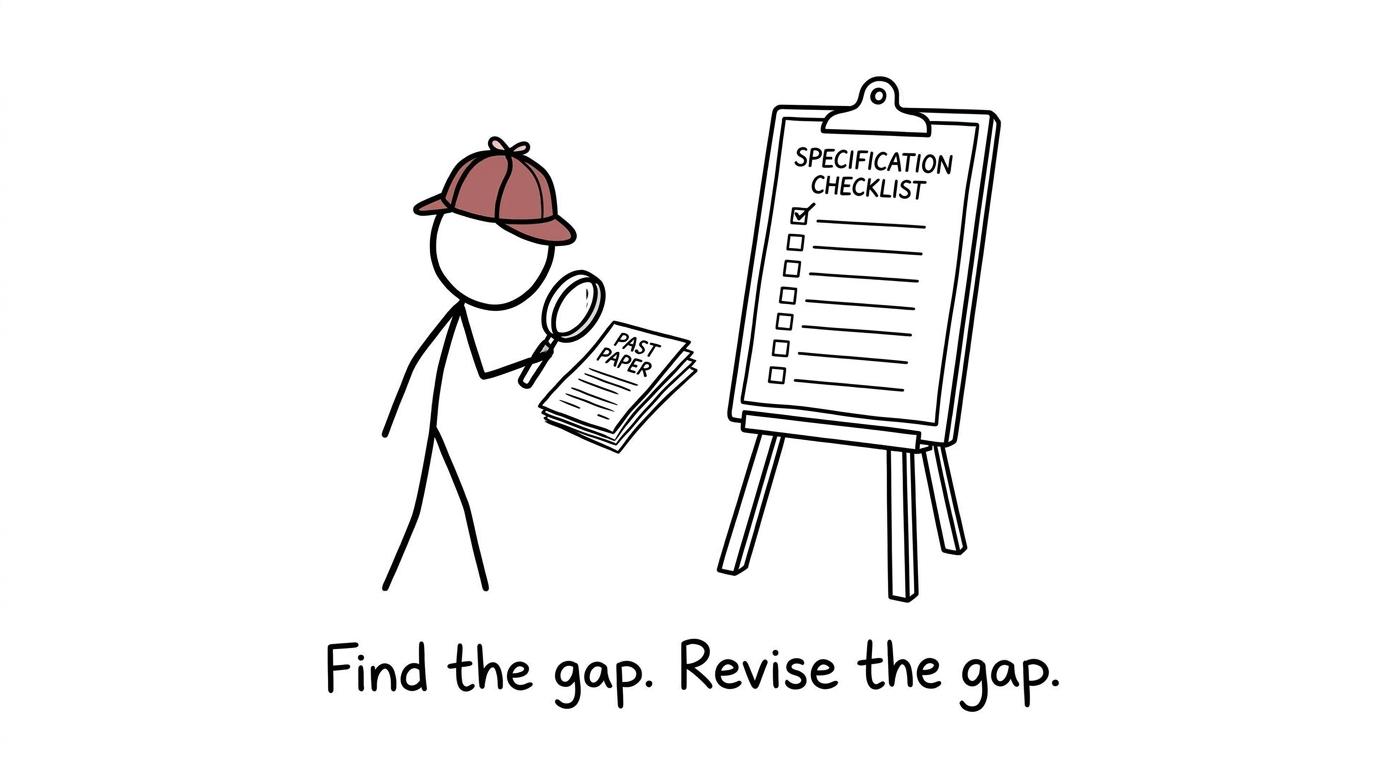 A revision detective compares a paper with the specification case file
Common mistakes when using a D&T specification
Reading the wrong board's document
AQA, Pearson Edexcel, OCR and Eduqas do not organise every detail identically. Confirm the board and qualification code before building a checklist.
Treating every page as revision content
Specifications contain material for teachers and examination centres. Prioritise subject content, assessment, mathematical requirements and assessment objectives.
Assuming a checklist tick means mastery
Recognition is weaker than recall and application. Require evidence from questions, explanations or marked work before declaring a topic secure.
Ignoring maths because it feels like a separate subject
At least 15%15\%15% of written-exam marks assess mathematical skills in D&T contexts. Practise calculations with units, diagrams, costs, data and material quantities rather than revising methods only in isolation.
Using the specification instead of questions
Reading can expose gaps, but only retrieval and application can test them. A specification is a diagnostic map, not an exam rehearsal.
Read it once, then make it work
So, is it worth reading the full GCSE Design and Technology specification yourself? It is worth inspecting the whole document and reading the student-relevant sections carefully. It is rarely worth treating every page as something to memorise.
What you gain is control: an authoritative content boundary, a clear view of assessment, visibility of overlooked details and a precise list of the maths skills D&T can test. What you still need is practice.
Open your correct specification, build a short checklist and identify one maths weakness today. Then use MathsGenie's free GCSE revision resources to learn the method, complete practice questions and check solutions. As examinations approach, add mini tests, past papers, mark schemes, video solutions and predicted papers. The specification shows where you are going. MathsGenie helps you become ready for the journey.











