

Read Answers Aloud GCSE English Language: Does It Help?
Read answers aloud GCSE English Language: spot weak structure, unclear sentences and punctuation errors with a focused revision routine for better writing.
A sentence can look perfectly sensible when you have just written it. You know what you intended, so your mind quietly supplies missing words, smooths awkward transitions and forgives punctuation that is not really doing its job.
That is why the read answers aloud GCSE English Language technique can help. Hearing your answer forces you to encounter what is actually on the page, not merely the meaning you remember. It can reveal sentences that run for too long, paragraphs that change direction without warning and ideas that do not connect clearly.
It is not a complete editing system, and you cannot read aloud in the exam hall. But during revision, it is a simple and effective way to test the structure, clarity and rhythm of your writing.
The quick answer and checklist
Yes, reading your own GCSE English Language answers aloud can improve them, particularly when you use the technique on a completed practice response and then make specific changes.
Listen for:
- places where you stumble or need to start again;
- sentences that leave you short of breath;
- several short sentences producing an accidental stop-start rhythm;
- repeated words, openings or ideas;
- punctuation that does not match your natural pauses;
- paragraphs whose purpose is difficult to summarise;
- transitions that feel abrupt or confusing;
- a tone that does not suit the form, audience or purpose.
The important part comes afterwards. Mark the problem, name it and revise it. Simply performing an answer aloud is not the same as improving it.
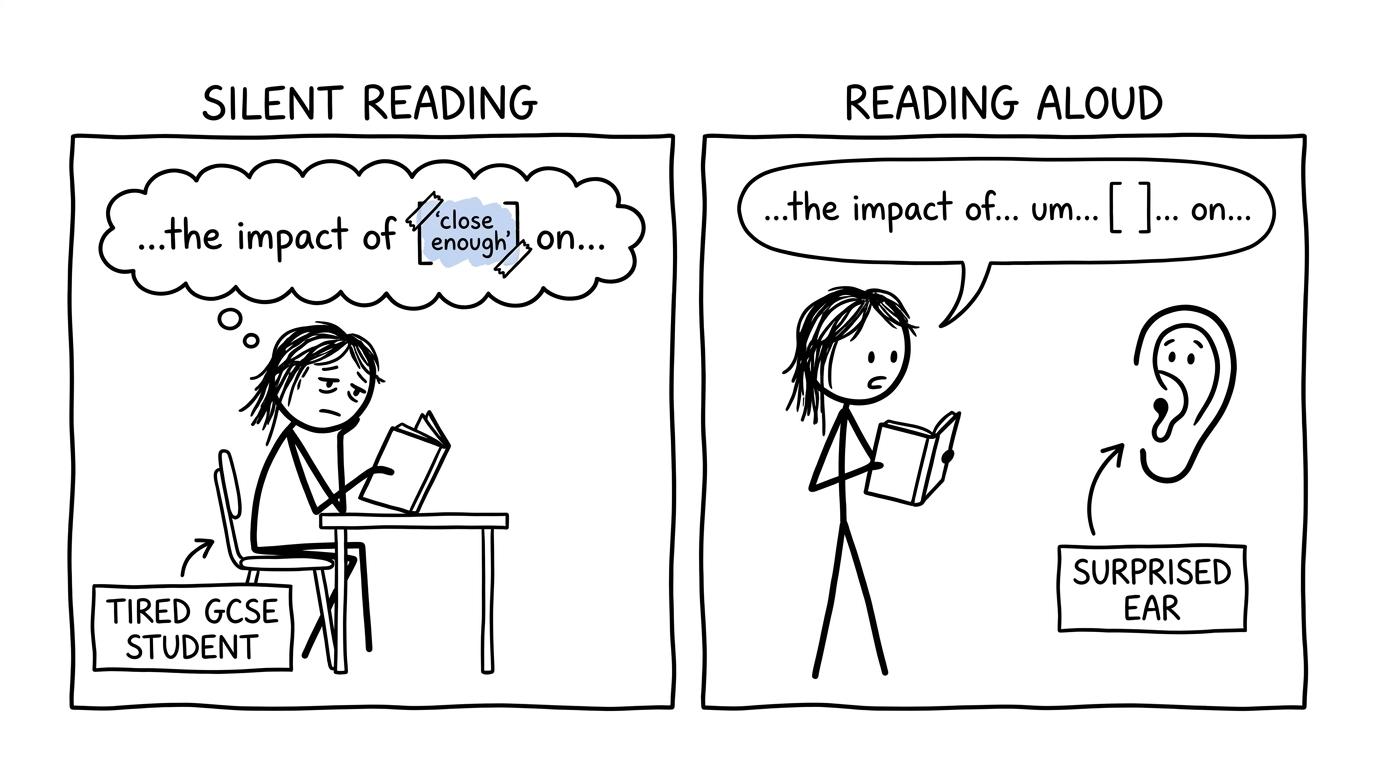 A student's brain quietly repairs a missing word until an ear notices it
Why silent reading can hide structure problems
When you reread your own work silently, you bring useful but dangerous knowledge to the page: you already know what you meant.
This familiarity encourages the mind to skim. It may glide over a missing word because the intended sentence is still fresh in your memory. It may accept a weak link between paragraphs because you understand the connection, even though a first-time reader may not.
Reading aloud slows the process down. Every written word has to become a spoken word, making omissions and awkward constructions harder to ignore. Guidance from several university writing centres recommends the method for noticing unclear sentences, repetition, run-ons, inaccurate punctuation and problems with flow. This should not be treated as a guarantee that every error will be found, but it explains why changing the mode of review can be useful.
There is a helpful distinction here:
- Silent reading often checks meaning: you ask whether you understand the answer.
- Reading aloud tests delivery: you hear how the answer guides somebody else through that meaning.
GCSE English Language rewards both. Across specifications, AO5 concerns clear, effective communication and the coherent organisation of ideas. AO6 concerns vocabulary, sentence structures, spelling and punctuation. The precise paper format differs between AQA, Edexcel, OCR and Eduqas, so use your board's current specification and mark schemes, but those assessment objectives are common across GCSE English Language qualifications in England.
How reading aloud exposes weak organisation
Structure is bigger than punctuation. It is the order in which a reader receives information and the path connecting one idea to the next.
You hear when a paragraph has no clear job
After reading a paragraph, pause and state its purpose in a few words. Perhaps it introduces a setting, develops an argument, changes the mood or presents a counterpoint.
If you cannot say what the paragraph contributes, it may contain several competing ideas. Reading aloud makes this easier to notice because you experience the paragraph as a sequence rather than seeing it as one block of text.
You notice missing links
Two ideas can both be relevant without being properly connected. On the page, the paragraph break may create the illusion of organisation. Aloud, the shift can sound sudden.
Ask:
- Does the next paragraph follow logically?
- Is a transition needed?
- Have I changed time, place, focus or viewpoint clearly?
- In transactional writing, does each paragraph advance the central argument?
Do not add connectives mechanically. The goal is not to begin every paragraph with a stock phrase. The relationship between the ideas needs to be clear.
You hear pacing rather than counting techniques
A long sentence is not automatically sophisticated, and a short sentence is not automatically effective. Sentence length matters because of what it does.
If every sentence is long, the answer may become difficult to follow. If every sentence is brief, the writing may sound fragmented. Reading aloud exposes this pattern more naturally than highlighting isolated techniques.
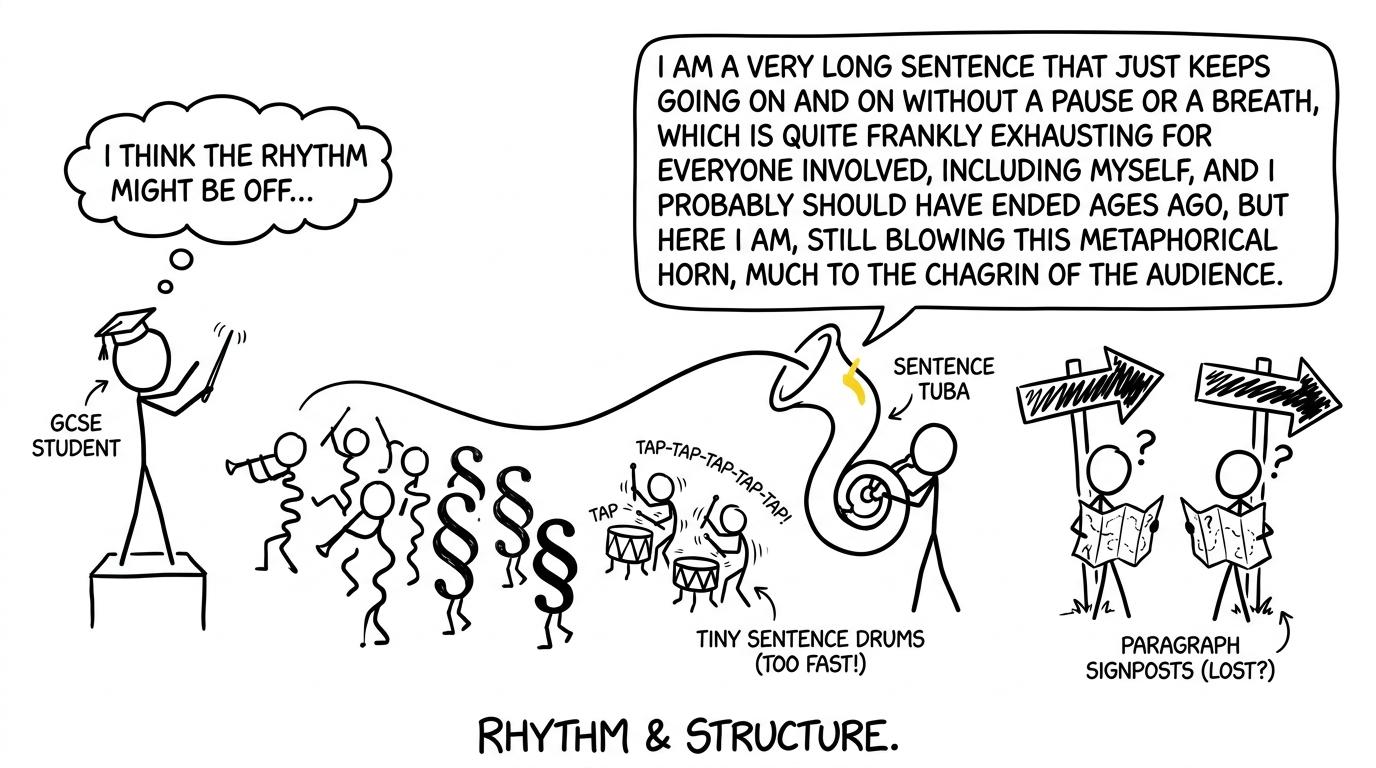 A student conducts an orchestra of overlong and unusually short sentences
What to listen for at sentence level
A useful read-through has one purpose at a time. Trying to assess structure, vocabulary, spelling and punctuation simultaneously often becomes vague.
Breath and punctuation
Do not insert pauses simply because you know where the sentence is going. Try to respect the punctuation on the page.
If you repeatedly need a major pause where there is no suitable punctuation, inspect the sentence. It may need to be divided or punctuated differently. If a full stop interrupts an idea that has not been completed, you may have created a fragment.
Breath is a warning signal, not a grammar rule. Some grammatically controlled sentences are deliberately long, while some short sentences are inaccurate. Use the sound to locate the problem, then apply the relevant punctuation rule.
Repetition
Repeated words are easy to miss visually because attention tends to move towards meaning. The ear often notices them quickly.
Some repetition is deliberate and effective, particularly in persuasive or creative writing. Ask whether it creates emphasis or merely shows that a word has been reused accidentally. The same applies to repeated sentence openings and repeated paragraph structures.
Tone and register
An article, speech, letter, description and narrative make different demands. Reading aloud helps you hear whether the voice suits the audience and purpose.
A formal argument may sound too conversational. A speech may be accurate but lifeless because it never acknowledges listeners. A narrative may have vivid vocabulary yet sound emotionally flat because every sentence follows the same pattern.
A practical revision routine
Use this method on practice answers rather than waiting until the final week before the exam.
Create distance first
If possible, leave a short gap between writing and reviewing. Familiarity makes it easier to read the intended version rather than the real one. Even moving to another revision task before returning can help.
Read slowly and exactly
Follow each word with a pen or finger. Do not silently repair missing words or improve the sentence while speaking. When something sounds wrong, make a small mark and continue to the end of the paragraph.
Stopping to rewrite every sentence immediately can make it difficult to judge the overall flow.
Review in three passes
Use three focused passes:
- Structure pass: paragraph purpose, sequence, transitions and ending.
- Sentence pass: clarity, length, fragments, repetition and rhythm.
- Accuracy pass: spelling, punctuation, grammar and missing words.
Then compare the revised response with the relevant exam-board mark scheme. Reading aloud identifies possible weaknesses; the assessment criteria tell you which qualities examiners reward.
Keep a small error log
Record recurring patterns such as "paragraph changes focus", "sentence runs too long" or "same opening repeated". Your next practice answer should target one or two of these patterns.
This is the same feedback principle that makes effective maths revision work: attempt, check, diagnose, repair and retest. MathsGenie's guide to finding your weakest GCSE topics explains how to turn errors into focused next steps, while the 20-minute GCSE maths revision routine shows how short feedback cycles can fit into a busy week.
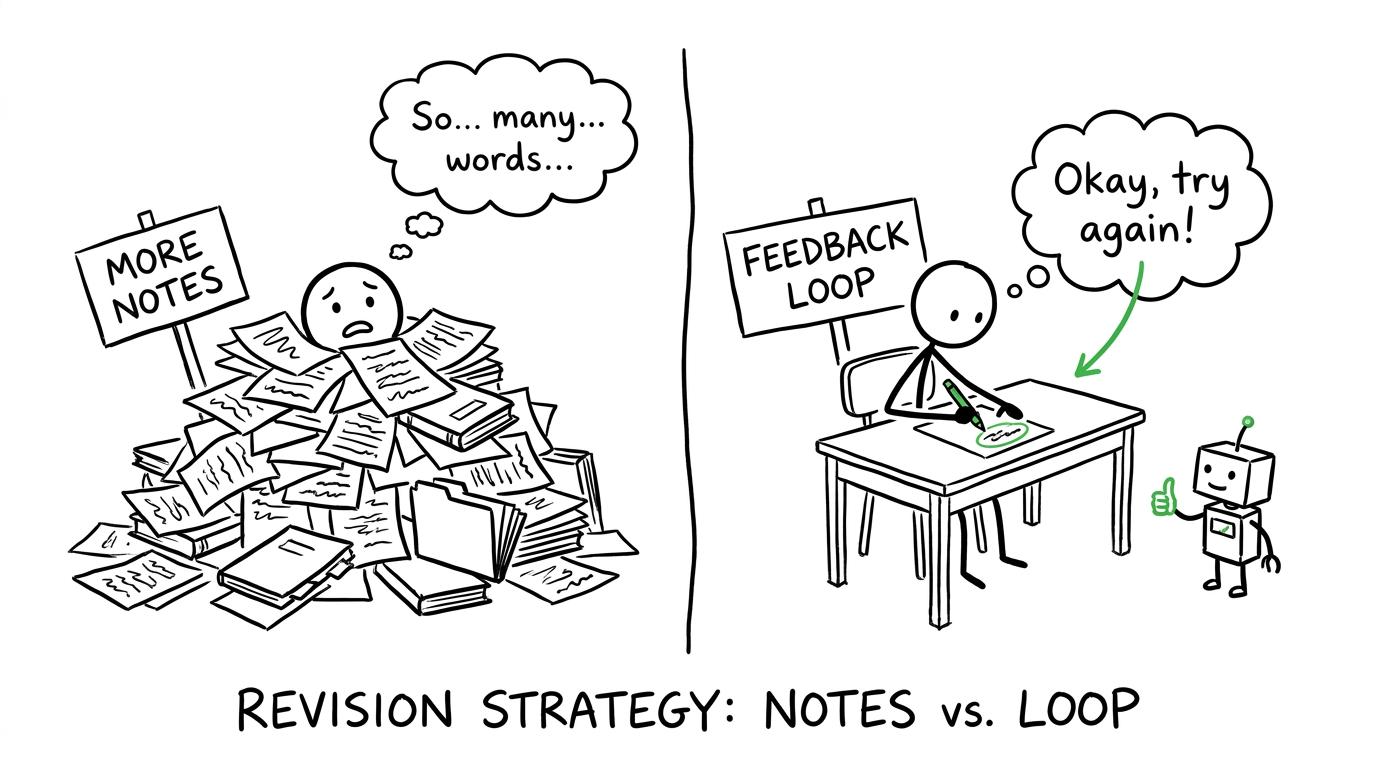 One revision desk collects notes while another uses a calm feedback loop
Why this matters to students revising maths
English and maths can feel like opposite subjects, but both ask you to communicate a line of thought under time pressure.
In English Language, the reader needs to follow the development of an argument, description or narrative. In maths, the examiner needs to follow your method. Reading a mathematical explanation aloud during home revision can reveal skipped reasoning, unclear references such as "it" or "this", and steps that appear without justification.
It does not replace written working. Instead, it tests whether the working forms a coherent route from the information given to the conclusion. This is particularly useful for explanations, proofs and questions asking you to show, justify or interpret.
You can apply the same habit after completing a set from the GCSE maths revision hub. Explain your method aloud, compare it with the mark scheme or video solution, and identify the first place where your reasoning diverged.
For shorter feedback sessions, use the Edexcel GCSE maths mini tests. When building exam stamina, choose papers for your board, such as Edexcel GCSE maths past papers, AQA GCSE maths past papers or the OCR GCSE maths revision area.
Common mistakes when reading answers aloud
Treating every stumble as an error
You may stumble because you are nervous, tired or unfamiliar with a word. Mark the location, then inspect the grammar and meaning before changing anything.
Using breath as the only punctuation rule
Natural speech varies between speakers. A pause can alert you to a possible issue, but punctuation must still reflect grammatical structure and intended effect.
Editing only individual words
Replacing ordinary vocabulary with elaborate alternatives will not repair a confused paragraph. Review the order and purpose of ideas before polishing word choices.
Reading too quickly
Fast reading recreates the problem of silent skimming. Use a moderate pace, follow every word and avoid correcting the answer from memory.
Assuming the technique works in the examination
You must not disturb other candidates by reading aloud in an exam hall. Practise the method beforehand so that you become better at recognising structural warning signs during a final silent check.
Forgetting to make a second attempt
Improvement requires evidence. After editing, rewrite the affected section or complete another response with the same target. In maths, the equivalent is returning to a different question after studying the correction. MathsGenie's GCSE predicted papers can provide further exam-style practice after topic repairs.
Turn hearing into better revision
Reading aloud helps because it creates distance between intention and execution. It lets you hear where a reader may lose the thread, where punctuation fights the sentence and where a paragraph has not earned its place.
The method is strongest when it belongs to a feedback loop: write, read, mark, revise and try again. Use it for GCSE English Language practice, then carry the same discipline into maths by explaining methods, checking written reasoning and repairing specific weaknesses.
Make MathsGenie your free maths revision base. Begin with revision lessons and practice questions, use mini tests for quick checks, and progress to past papers and predicted papers. Mark with the supplied mark schemes and use video solutions when a method is unclear. Good revision is rarely about doing more without reflection. It is about noticing what your first attempt was trying to tell you.










