Read Answers Aloud GCSE Bengali: Does It Help?
Read answers aloud GCSE Bengali advice: discover how hearing your writing can expose weak structure, missing detail and errors before the exam.
A Bengali answer can look complete when you read it silently. You know what you intended to say, so your mind quietly supplies missing links, smooths over awkward sentences and treats repeated ideas as if they were new. The page feels convincing because the argument is already clear in your head.
That is why the read answers aloud GCSE Bengali technique can help. Hearing your response forces you to meet the words in a different way. It can reveal abrupt changes of subject, unfinished explanations, repetition and sentences carrying too many ideas. Research on proofreading has found that reading aloud can improve the detection of spelling, grammar and word-choice errors compared with silent reading. It is not a complete editing system, but it is a useful final layer.
For students preparing primarily for GCSE maths, the wider lesson matters too: an answer is not finished merely because you understand it. The examiner must be able to follow it.
The short answer
Reading your own GCSE Bengali answers aloud is worth trying because it may help you:
- hear where the response loses direction;
- notice sentences that are too long or overloaded;
- find repeated words and ideas;
- detect omitted words and awkward grammar;
- check whether each paragraph has a distinct purpose;
- test whether your tone suits the audience and task;
- identify places that need teacher feedback.
Use it after checking that you have addressed the prompt and before completing your final spelling and grammar check. Reading aloud should supplement the specification, mark scheme, model responses and teacher feedback rather than replace them.
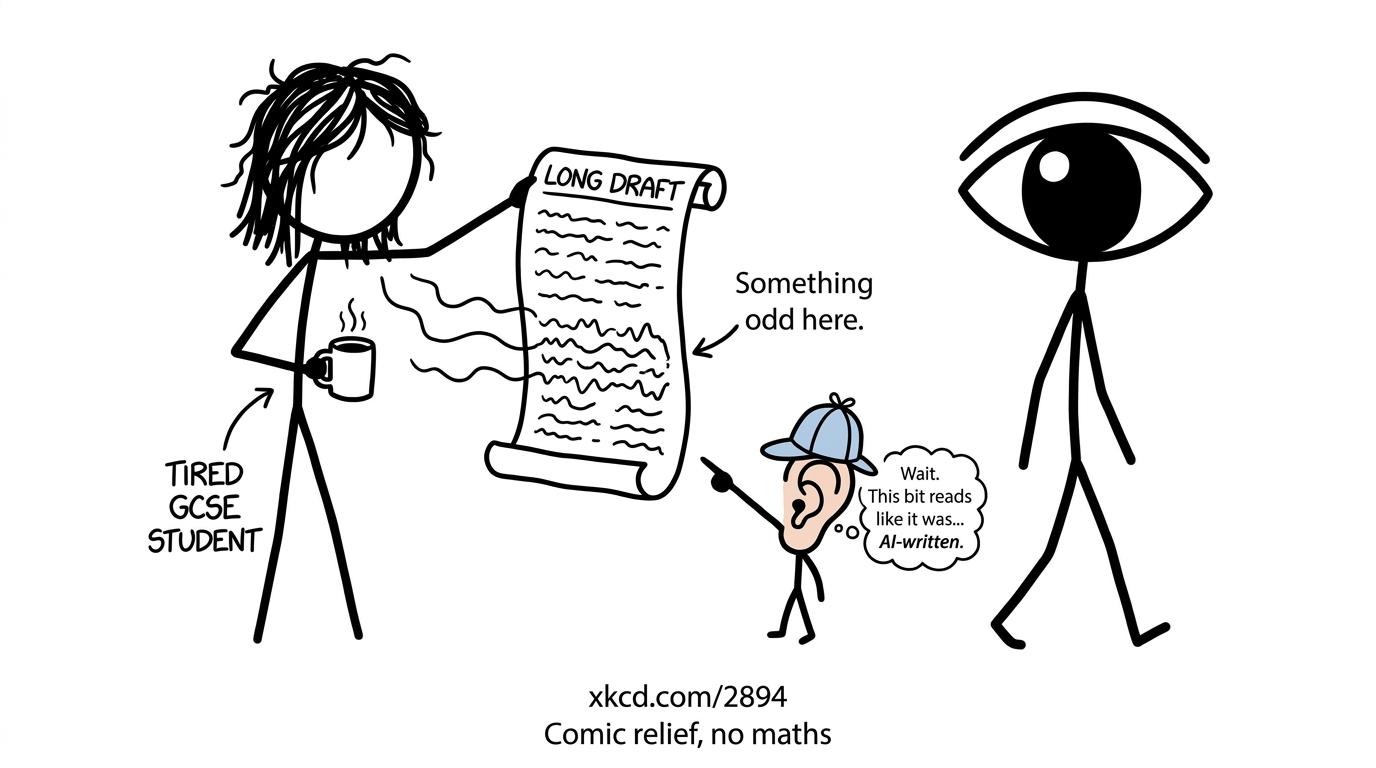 A cartoon ear detects a suspicious paragraph that silent reading missed
Why silent reading can miss structure problems
When you reread your own work, you bring hidden knowledge to the page. You remember the plan. You know why the second paragraph follows the first, even if you never wrote that connection down. You may also recognise the intended word rather than attending closely to the word that is actually there.
Silent reading is efficient, which is normally helpful. During proofreading, however, speed can allow the mind to glide across a weak transition or missing detail. Reading aloud slows the process and adds an auditory version of the text. A sentence that looked acceptable may suddenly sound crowded. A paragraph ending may feel abrupt. Two consecutive sections may sound as though they make the same point.
Experimental research published in the Journal of Applied Research in Memory and Cognition found that proofreading aloud improved participants' detection of both non-contextual errors, such as typographical mistakes, and contextual errors involving grammar or word choice. This evidence was not specific to Bengali or GCSE candidates, so it should not be presented as proof that the method will raise every student's mark. It does, however, support using oral proofreading as one practical editing technique.
What to listen for in a GCSE Bengali response
The aim is not to perform the answer dramatically. You are listening for signs that its written structure is making the reader work too hard.
Changes of direction
Pause whenever the answer moves to a new idea. Ask whether the change is signposted and whether the new point belongs in the same paragraph. If you find yourself adding an explanation aloud that is absent from the page, write that missing connection down.
Paragraph purpose
After reading a paragraph, summarise its job in a few words. It might introduce the subject, describe an event, explain an opinion, justify a view or conclude the response. If two paragraphs have the same job, one may be repetitive. If a paragraph has several unrelated jobs, it may need reorganising.
This matters because communication is not simply a collection of accurate sentences. Depending on the qualification, task and mark scheme, examiners may also consider relevance, clarity, development, vocabulary, grammatical structures and accuracy. Always use the specification and assessment materials for the exact qualification you are taking. GCSE Bengali and International GCSE Bangla are not interchangeable labels, and their paper structures can differ.
Sentence load
A natural stumble is useful evidence, though not an automatic verdict. You might stumble because a sentence is long, punctuation is unclear or the order of ideas is unnatural. Mark the place and inspect it after finishing the paragraph.
Do not shorten every sentence merely because it is challenging to read. A controlled range of structures can strengthen writing. The real question is whether the sentence communicates its meaning clearly and accurately.
Repetition and vague language
Repeated vocabulary becomes easier to hear than to see. Listen for the same adjective, connective or opinion appearing several times close together. Also notice vague references: if you hear a word meaning “this”, “that” or “they”, is the reference unmistakable?
Tone and audience
A response intended for a friend should not sound exactly like a formal report. Reading aloud can make an unsuitable register more noticeable. Check the task again: who is writing, who will read it, and what is the purpose?
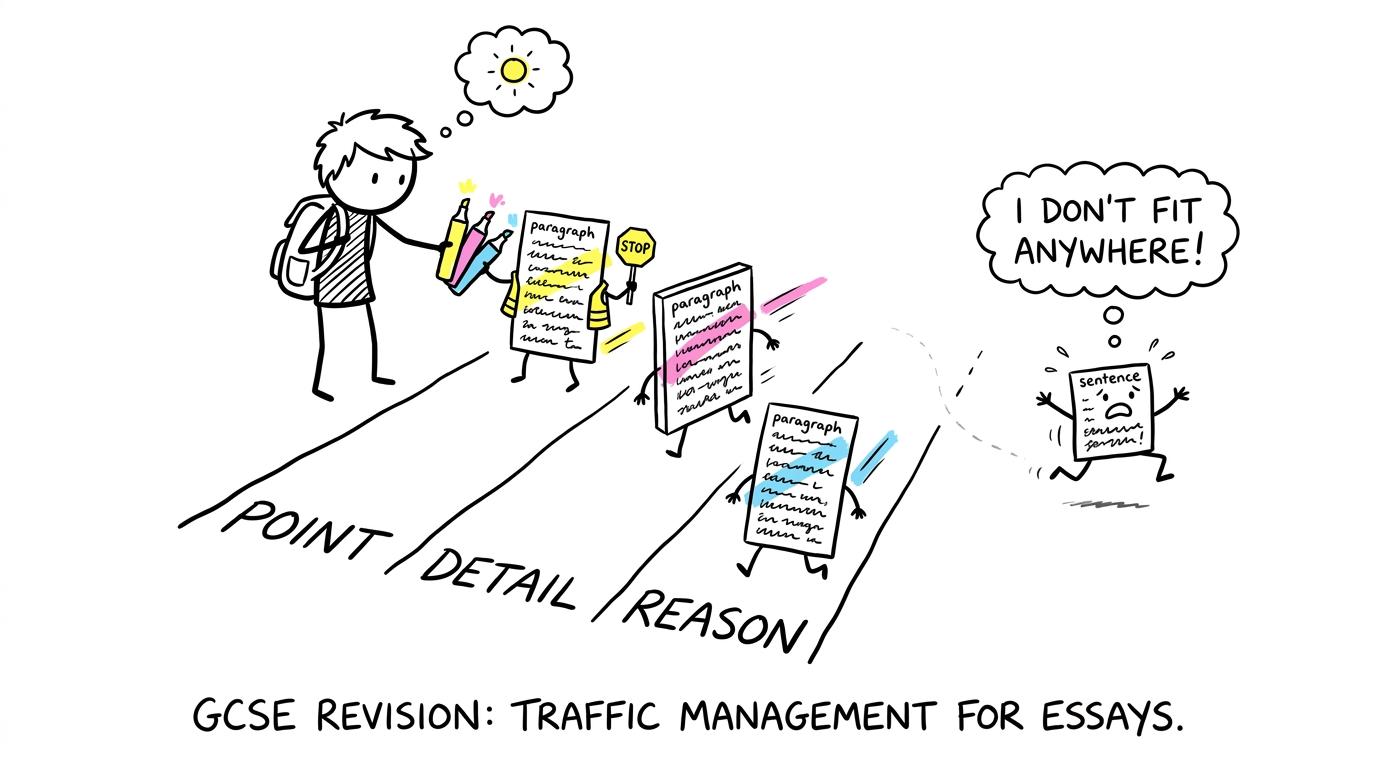 Paragraph traffic wardens organise points, details and reasons
A practical read-aloud revision routine
Use the method on practice responses at home, where speaking is appropriate. Do not assume that reading aloud will be allowed in the real examination room; it would normally disturb other candidates. In an exam, you will need to reproduce the same careful attention silently.
Check the task before the sound
First, reread the question and identify every required element. Reading aloud cannot reveal an omitted bullet point if you have forgotten what the bullet points were. Confirm the required purpose, audience, format and approximate length stated in your paper.
Read exactly what is written
Follow the script with a finger or pen and resist correcting it while speaking. If a word is missing, do not insert it automatically. Mark the gap. If you repeatedly say a better expression than the one on the page, compare the two deliberately afterwards.
Mark, but do not constantly stop
Use a simple code in the margin:
Sfor structure;Rfor repetition;Gfor grammar;Vfor vocabulary;?where meaning is unclear.
These labels are editing notes rather than part of the Bengali response. Finish a sentence or short paragraph before revising it so that you can hear the overall movement.
Revise the largest problem first
Correcting one spelling mistake is satisfying, but it will not repair a response that misses part of the task. Work in this order:
- task coverage and relevance;
- overall order and paragraphing;
- clarity of individual sentences;
- grammar, vocabulary and spelling;
- presentation and final checks.
Read the revised section once more
The second reading has a narrow purpose: confirm that the change actually improved the passage and did not create a new error. Then stop. Endless polishing can consume time without producing meaningful improvement.
What reading aloud cannot do
Reading aloud is a detector, not an examiner. It can tell you that a sentence sounds wrong without telling you which grammatical form is required. It can expose a thin paragraph without supplying relevant knowledge or precise vocabulary. It may also miss an expression that sounds familiar in everyday speech but is unsuitable in formal writing.
A study of second-language writing found that reading aloud helped with some surface-level corrections but did not outperform expert feedback. The sensible conclusion is modest: use your ear to locate possible weaknesses, then use reliable feedback to understand and correct them.
For Bengali revision, that means comparing work with the official mark scheme and examiner materials for your qualification, then asking your teacher about errors you cannot diagnose. Keep a short error log containing the original issue, the correction and the rule or reminder you need next time.
How this helps with GCSE maths answers
The subject changes, but the communication problem remains. In maths, you may understand a method while leaving out the line that makes it visible to the examiner. Saying the reasoning quietly during revision can expose leaps such as moving from the information in the question to a final answer without showing substitution or intermediate working.
You should not turn the maths exam into a spoken performance. Instead, use verbal explanation during practice. After answering a question, explain what each line achieves. If you cannot describe why a step follows, the written solution may contain a gap.
Begin with the GCSE maths revision hub, choosing the correct board and foundation or higher tier resources. Short sessions from the twenty-minute GCSE maths revision routine can help you combine explanation with active question practice.
The strongest revision loop is attempt, inspect and repair. Use Edexcel GCSE maths mini tests for focused checks, or identify recurring gaps with the guide to finding your weakest GCSE topics. Then explain the corrected method aloud before attempting a fresh question without support.
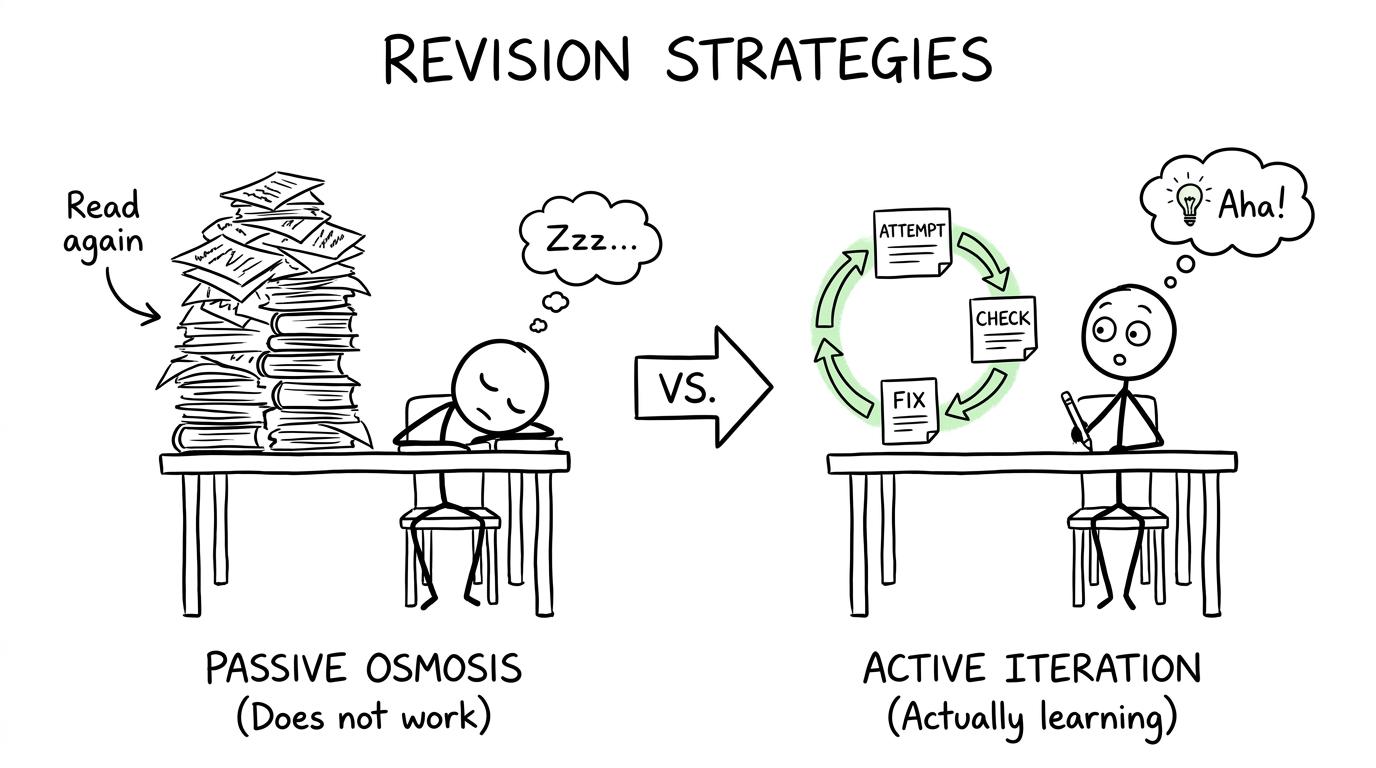 One student rereads passively while another follows an attempt, check and fix loop
Common mistakes when reading answers aloud
Treating every stumble as a writing error
You may hesitate because a Bengali word is unfamiliar to pronounce, not because the written sentence is structurally weak. Mark the spot, inspect the sentence and decide using grammar and meaning rather than sound alone.
Listening only for spelling
Oral proofreading is especially valuable when you listen above sentence level. Ask whether ideas develop logically and whether every paragraph earns its place. A perfectly pronounced response can still be repetitive or incomplete.
Quietly improving the text while reading
Your brain may add a missing word or connective. This hides the exact problem you are trying to find. Point to each written word and read only what appears.
Using the technique instead of feedback
If you know that something sounds wrong but cannot explain why, do not guess repeatedly. Ask your teacher and record the correction. Reading aloud starts the diagnosis; informed feedback completes it.
Applying it only on the night before an exam
The technique is more useful as a habit. Schedule it with the free MathsGenie revision planner, alongside your other subjects, so that you can review several responses over time rather than rushing through one draft.
Confusing familiarity with mastery
A response can sound smoother simply because you have read it several times. Test improvement on a new task. This is the same reason maths students should move from notes to questions, as explained in the guide to turning GCSE notes into active recall.
Build a revision habit that survives the exam
Reading a GCSE Bengali response aloud can reveal what silent reading conceals: missing links, repeated ideas, overloaded sentences and changes of direction that exist in your head but not on the page. Its value is not that speaking magically repairs writing. Its value is that hearing creates distance from a familiar draft.
Use the process deliberately: check the task, read exactly what is written, mark structural signals, revise the largest problem and confirm the change. Then seek feedback for anything your ear can detect but your current knowledge cannot solve.
Carry the same discipline into maths. Use Edexcel GCSE maths past papers to test complete solutions under time, then inspect each lost mark with the mark scheme and available video solutions. Nearer the examination, add Edexcel GCSE maths predicted papers as fresh practice rather than a substitute for official past papers.
MathsGenie gives you the free revision lessons, practice questions, mini tests, mark schemes, video solutions, past papers, predicted papers and revision planning tools to make that cycle repeatable. Start with one answer today. Attempt it, listen to it, find the gap and fix it.