

Ratio GCSE Maths Explained With Worked Examples
Ratio GCSE maths made clear with simple methods, worked examples, common mistakes and exam-style ratio questions for confident revision.
A ratio question can look harmless. Two numbers, a colon and perhaps a bag of sweets. Yet it is easy to use the right arithmetic in the wrong order.
Imagine a student called Sam. Each time Sam sees a ratio, he adds the numbers, divides something, then hopes. Sometimes it works. Often it does not. The turning point comes when he stops treating every question as the same task.
That is the key to ratio GCSE maths: first decide what the ratio describes, then choose the method. Ratios compare quantities in parts. Once you can move between parts and actual amounts, the topic becomes much more predictable.
Your ratio checklist
Before calculating, ask:
- What quantities are being compared?
- Are they written in the correct order?
- Do the quantities have the same units?
- Am I simplifying, sharing or finding a missing amount?
- Does the question give one part or the total?
- Have I answered in the units requested?
This checklist is short, but it prevents most ratio errors.
What does a ratio mean?
The ratio 2:32:32:3 means that for every 222 equal parts of the first quantity, there are 333 equal parts of the second. It does not necessarily mean that the actual quantities are 222 and 333.
For example, red and blue counters could be in the ratio 2:32:32:3. Possible amounts include:
2:3,4:6,10:15.2:3,\qquad 4:6,\qquad 10:15.2:3,4:6,10:15.These are equivalent ratios because both parts have been multiplied by the same value.
Order matters. If red to blue is 2:32:32:3, then blue to red is 3:23:23:2. A correct calculation attached to the wrong quantity still produces the wrong answer.
Simplifying a ratio
Simplifying a ratio is similar to simplifying a fraction. Divide every part by the same highest common factor.
Worked example: simplify a two-part ratio
Simplify 18:3018:3018:30.
The highest common factor of 181818 and 303030 is 666. Divide both parts by 666:
18:30=3:5.18:30=3:5.18:30=3:5.The ratio is fully simplified because 333 and 555 have no common factor greater than 111.
Worked example: convert the units first
Simplify 50 cm:2 m50\text{ cm}:2\text{ m}50 cm:2 m.
Sam's old mistake would be to write 25:125:125:1. That compares 505050 with 222 before making the units equal.
Convert 2 m2\text{ m}2 m to centimetres:
2 m=200 cm.2\text{ m}=200\text{ cm}.2 m=200 cm.Now simplify:
50:200=1:4.50:200=1:4.50:200=1:4.The quiet rule beneath the calculation is important: a ratio only compares like units fairly.
Sharing an amount in a ratio
This is where ratio begins to click for Sam. He realises that the numbers in the ratio represent a number of equal parts, not the amounts being shared.
Use this method:
- add the ratio parts;
- divide the total amount by the number of parts;
- multiply the value of one part by each ratio number;
- check that the shares add to the original total.
Worked example: share an amount
Share £84£84£84 in the ratio 2:52:52:5.
First find the total number of parts:
2+5=7.2+5=7.2+5=7.Find the value of one part:
£84÷7=£12.£84\div 7=£12.£84÷7=£12.Calculate each share:
2×£12=£24,2\times £12=£24,2×£12=£24, 5×£12=£60.5\times £12=£60.5×£12=£60.Therefore, the shares are £24£24£24 and £60£60£60.
Check:
£24+£60=£84.£24+£60=£84.£24+£60=£84.When a question gives the total, add the ratio parts before dividing. That single sentence is worth remembering.
You now have the core method; use the Maths Genie ratio lesson and its questions to practise applying it without having to assemble examples yourself.
Finding an amount from one known share
Some ratio questions do not give the total. Instead, they tell you the value represented by one side of the ratio.
Worked example: use a known amount
The ratio of adults to children at an event is 3:73:73:7. There are 212121 adults. How many children are there?
The 333 adult parts represent 212121 adults. Find one part:
21÷3=7.21\div 3=7.21÷3=7.Children occupy 777 parts, so:
7×7=49.7\times 7=49.7×7=49.There are 494949 children.
Notice that we did not add 3+73+73+7. The total number of people was not given. We matched the known quantity, 212121, to its ratio value, 333.
That difference separates two common question types:
| Information given | First calculation |
|---|---|
| The total amount | Add all ratio parts |
| One quantity in the ratio | Divide that quantity by its matching ratio part |
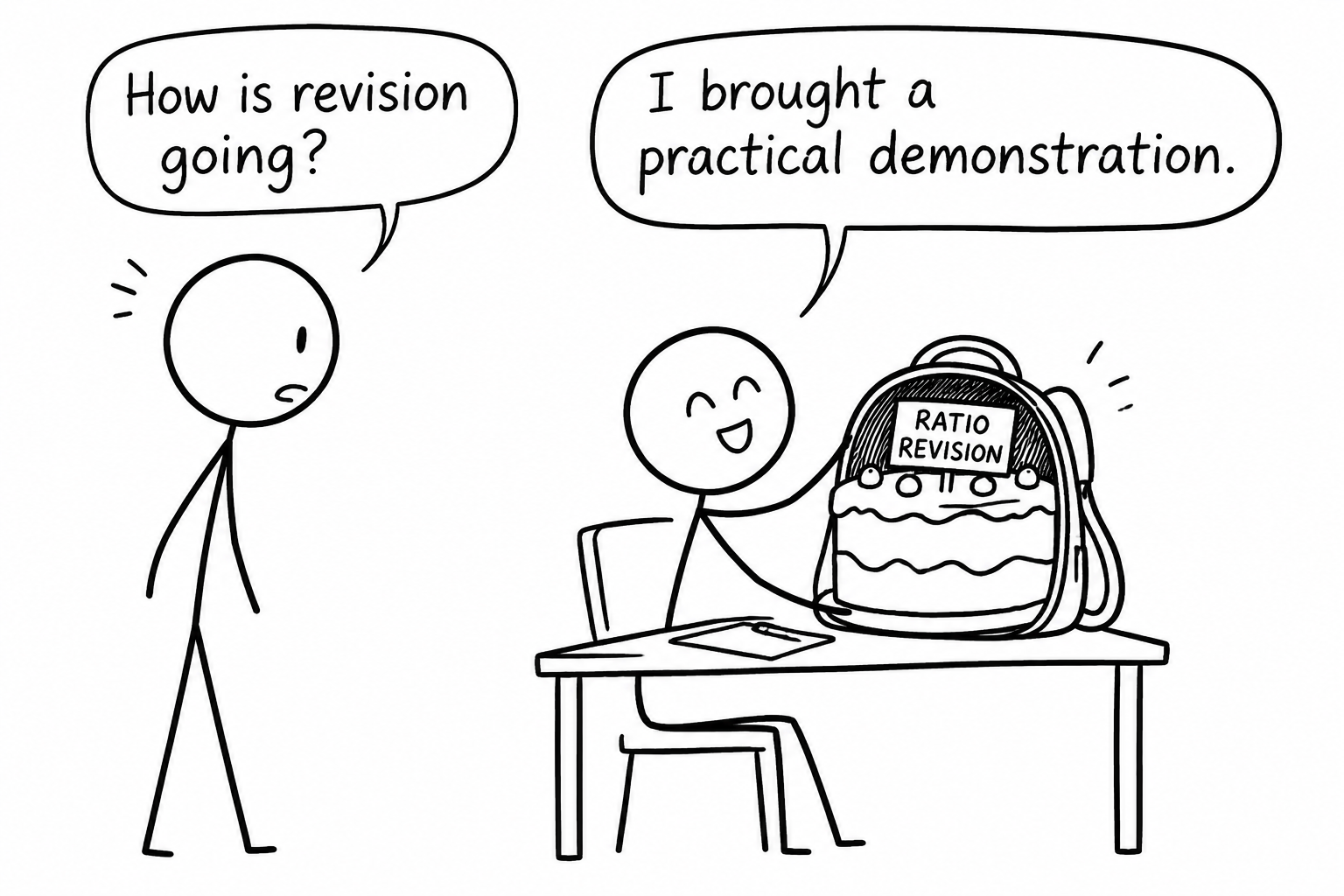 A stick-figure student brings a giant ratio revision cake to a desk
Solving a ratio problem using scale factors
Equivalent ratios are useful when one amount scales neatly to another.
Worked example: find a missing value
Orange paint and white paint are mixed in the ratio 3:43:43:4. A decorator uses 202020 litres of white paint. How much orange paint is needed?
White paint has increased from 444 parts to 202020 litres. The scale factor is:
20÷4=5.20\div 4=5.20÷4=5.Apply the same scale factor to the orange paint:
3×5=15.3\times 5=15.3×5=15.The decorator needs 151515 litres of orange paint.
A ratio stays equivalent only when every part is multiplied or divided by the same number.
Exam-style ratio questions to try
Try these without looking back at the examples. Show each stage because clear working can help you earn method marks even if a later arithmetic error occurs.
- Simplify 24:3624:3624:36.
- Share £132£132£132 in the ratio 4:74:74:7.
- The ratio of fiction to non-fiction books is 5:25:25:2. There are 353535 fiction books. Find the number of non-fiction books.
- Simplify 750 g:3 kg750\text{ g}:3\text{ kg}750 g:3 kg.
- Flour and sugar are mixed in the ratio 7:37:37:3. A recipe uses 240 g240\text{ g}240 g of sugar. Find the mass of flour.
Answers:
- 2:32:32:3
- £48£48£48 and £84£84£84
- 141414
- 1:41:41:4
- 560 g560\text{ g}560 g
For fuller exam preparation, combine topic practice with GCSE revision resources, GCSE exam papers and GCSE predicted papers. Ratio may also appear inside longer problems, so recognising the structure matters as much as recognising the word.
Common ratio mistakes
Adding the parts at the wrong time
Add the parts when you know the total. If you know one quantity, divide it by the ratio part representing that quantity.
Forgetting to match the order
In the ratio of cats to dogs, the first number represents cats. Write labels above or below the ratio if the wording is complicated.
Mixing units
Convert measurements to the same unit before simplifying. For example, do not simplify metres against centimetres until one has been converted.
Changing only one side
If 2:52:52:5 is multiplied by 333, the equivalent ratio is 6:156:156:15, not 6:56:56:5.
Stopping after finding one part
The value of one part is usually an intermediate result. Return to the question and multiply it by the required number of parts.
Missing a sensible check
Shared amounts should total the original amount. Equivalent ratios should simplify to the same ratio. A larger ratio part should correspond to a larger quantity.
Make ratio stay understood
Sam's progress is not that he finds a clever shortcut. He learns to pause. Total given? Add the parts. One share given? Match it to its part. Different units? Convert first.
Knowing those rules is one step; following them accurately across unfamiliar ratio questions is the next. Use the lesson to review the method, then complete Question Bank practice until choosing the first step feels automatic.
Start with the Maths Genie ratio lesson and Question Bank practice.















