

Ratio and Fractions Exam Questions: GCSE Guide
Ratio and fractions exam questions explained through three GCSE examples, with clear methods, common mistakes and advice on securing method marks.

A ratio question can look harmless until a fraction appears halfway through it. Suddenly, the total is unclear, the wording feels dense and it is difficult to know whether to multiply, divide or add.
The reliable way to answer ratio and fractions exam questions is to slow the problem down. Identify what the ratio represents, convert the fraction into compatible parts, and keep each stage visible. That final point matters because a correct method can earn marks even when an arithmetic slip changes the answer.
We will follow a hypothetical student, Sam, through three exam-style questions of rising difficulty. Each one develops the same habit: find one useful part before trying to find everything.
A quick ratio and fractions checklist
Before calculating, ask:
- Does the ratio compare two groups or a group with the whole?
- Does the fraction describe one group, the amount remaining or the whole?
- Can the fraction be rewritten as a ratio?
- Do I need to add the ratio parts?
- Have I shown enough working for a marker to follow my method?
- Does my answer represent the quantity requested?
A fraction such as 37\frac{3}{7}73 naturally gives the part-to-whole ratio 3:73:73:7. If 37\frac{3}{7}73 of a group has one property, then the remaining fraction is
1−37=47,1-\frac{3}{7}=\frac{4}{7},1−73=74,so the ratio of the first group to the remaining group is 3:43:43:4, not 3:73:73:7.
That distinction sits behind many ratio and fractions GCSE exam problems.
Question one: finding a fraction from a ratio
Sam begins with a question that tests the connection between a two-part ratio and a fraction of the whole.
Red and blue counters are in the ratio 3:53:53:5. What fraction of the counters are red?
Step one: identify the relevant part
The red counters account for 333 parts. The blue counters account for 555 parts.
Step two: find the total number of parts
3+5=83+5=83+5=8Step three: write the requested fraction
The fraction that is red is therefore
38.\frac{3}{8}.83.The answer is already in its simplest form.
Where the method marks come from
For a short question, the mark scheme may award a mark simply for the correct fraction. In a longer version, showing 3+5=83+5=83+5=8 makes the part-to-whole reasoning explicit. Exact mark allocations vary by paper and exam board, so students should treat visible working as protection rather than trying to predict a particular mark scheme.
Sam’s key decision was not the addition. It was recognising that the denominator had to represent all the counters.
Question two: sharing an amount using a fractional condition
The next question reverses the idea. Instead of finding a fraction from a ratio, Sam must convert a fraction into a ratio before sharing an amount.
A class contains 303030 students. Two-fifths of the students travel by bus. The remaining students walk. Find the ratio of students who travel by bus to students who walk.
Step one: calculate the number travelling by bus
25×30=12\frac{2}{5}\times 30=1252×30=12Step two: calculate the number who walk
30−12=1830-12=1830−12=18Step three: form and simplify the ratio
12:18=2:312:18=2:312:18=2:3Therefore, the ratio of students travelling by bus to students walking is
2:3.2:3.2:3.There is also a faster route. If 25\frac{2}{5}52 travel by bus, then 35\frac{3}{5}53 walk. The ratio is immediately
25:35=2:3.\frac{2}{5}:\frac{3}{5}=2:3.52:53=2:3.Both methods are valid. The first may feel safer because each quantity is visible; the second reveals the underlying structure more efficiently.
Where the method marks come from
Useful working includes finding 25\frac{2}{5}52 of 303030, subtracting from the total and simplifying the resulting ratio. If Sam made a small arithmetic error but continued consistently, some method credit could still be available, depending on the published mark scheme.
This is the repeatable process: turn the fraction into two comparable groups, then simplify. To practise that process beyond one example, use the Maths Genie GCSE revision lessons and the Maths Genie question bank to work through matching ratio questions while the method is fresh.
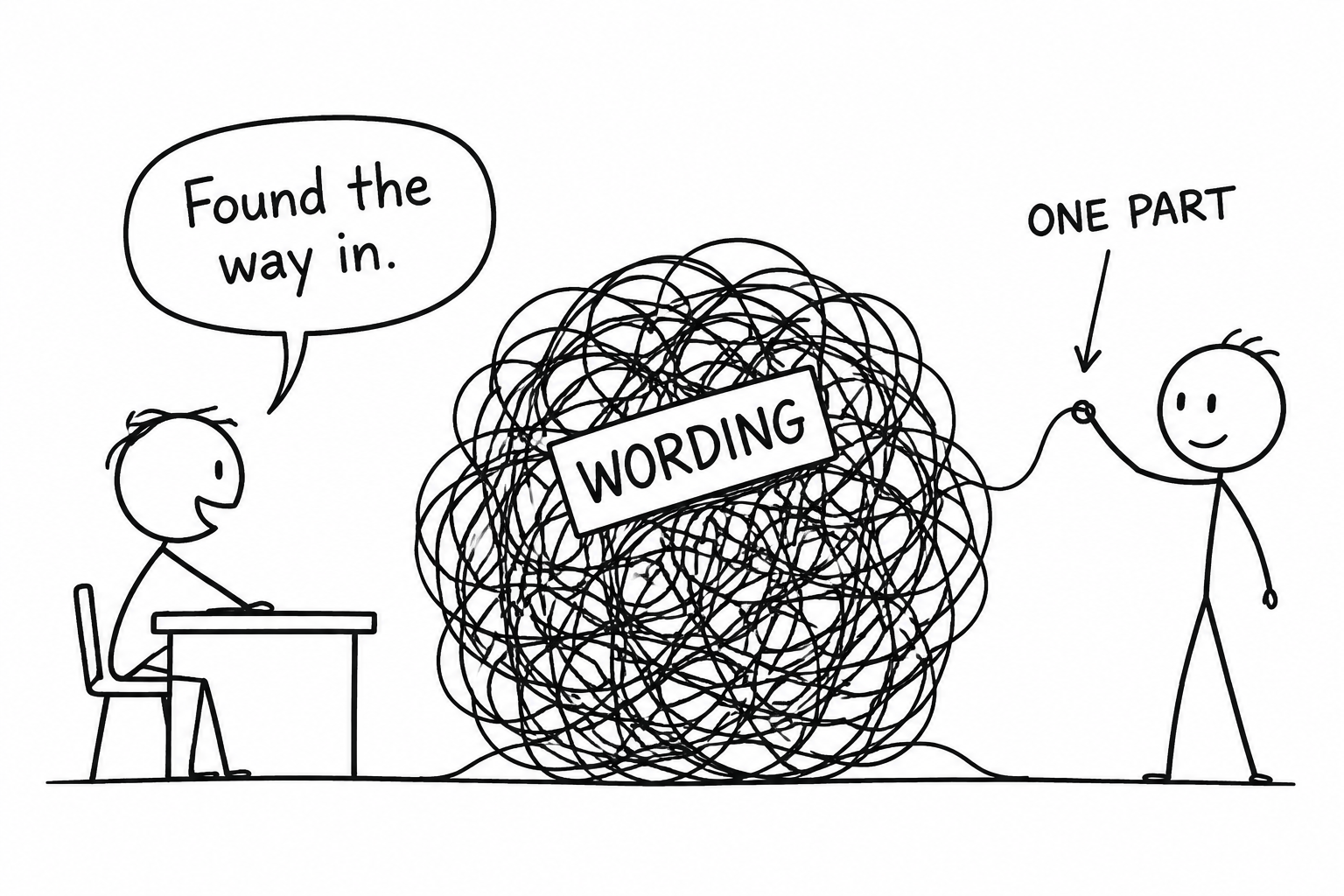 A stick-figure student finding one useful ratio part inside tangled exam wording
Question three: combining a ratio with a fraction of one share
The final question requires several linked stages. This is where organised working becomes especially valuable.
A prize fund is shared between Aisha and Ben in the ratio 3:53:53:5. Ben gives 14\frac{1}{4}41 of his share to charity. Aisha keeps all her share. After the donation, Ben has £45 more than Aisha. Find the original prize fund.
Sam first identifies what changes and what remains fixed. Aisha keeps all 333 of her ratio parts. Ben begins with 555 parts but keeps only 34\frac{3}{4}43 of his share.
Step one: express Ben’s remaining share in ratio parts
34×5=154\frac{3}{4}\times 5=\frac{15}{4}43×5=415Ben therefore keeps 154\frac{15}{4}415 parts, while Aisha keeps 333 parts.
Step two: find the difference in parts
Write 333 with denominator 444:
3=1243=\frac{12}{4}3=412The difference is
154−124=34\frac{15}{4}-\frac{12}{4}=\frac{3}{4}415−412=43of one original ratio part.
Step three: use the monetary difference
The question says this difference equals £45, so
34 of one part=45.\frac{3}{4}\text{ of one part}=45.43 of one part=45.One original part is
45÷34=45×43=60.45\div\frac{3}{4}=45\times\frac{4}{3}=60.45÷43=45×34=60.Step four: find the original total
The original ratio had
3+5=83+5=83+5=8parts. Therefore, the prize fund was
8×60=480.8\times 60=480.8×60=480.The original prize fund was £480.
Check the answer
Aisha originally receives
3×60=180.3\times 60=180.3×60=180.Ben originally receives
5×60=300.5\times 60=300.5×60=300.After donating 14\frac{1}{4}41, Ben keeps
34×300=225.\frac{3}{4}\times 300=225.43×300=225.The difference is
225−180=45,225-180=45,225−180=45,which matches the question.
Where the method marks come from
Sam has created a clear chain of evidence:
- Ben keeps 34\frac{3}{4}43 of his original share.
- Ben’s remaining share is 154\frac{15}{4}415 ratio parts.
- The difference is 34\frac{3}{4}43 of one part.
- One part is worth £60.
- Eight original parts are worth £480.
Even if the final multiplication went wrong, those earlier stages could demonstrate substantial progress. Mark schemes differ, but linked working is always easier to credit than an unexplained answer.
How to approach ratio and fractions past paper questions
Knowing the method is different from recognising it under exam pressure. Build that recognition deliberately:
- Read the final sentence first so you know what must be found.
- Underline the total, ratio, fraction and any amount that changes.
- Label the ratio parts rather than relying on memory.
- Convert fractional conditions before combining quantities.
- Keep exact fractions during the calculation instead of rounding decimals.
- Check that your result satisfies every statement in the question.
When working through GCSE past papers, do not only record whether an answer was right. Compare your route with the mark scheme and note the first line at which your reasoning changed. The GCSE predicted papers can then help you practise choosing methods across a mixed paper rather than within a single topic.
Common mistakes to avoid
Using one ratio number as the denominator
If the ratio is 3:53:53:5, the whole contains 888 parts. The fraction represented by the first group is 38\frac{3}{8}83, not 35\frac{3}{5}53.
Confusing a part-to-whole ratio with a part-to-part ratio
If 27\frac{2}{7}72 of a group is absent, the present fraction is 57\frac{5}{7}75. The absent-to-present ratio is therefore 2:52:52:5, while the absent-to-total ratio is 2:72:72:7.
Applying the fraction to the wrong amount
In the prize question, Ben donates 14\frac{1}{4}41 of his own share, not 14\frac{1}{4}41 of the whole fund. Circle or label the quantity to which each fraction applies.
Forgetting to simplify
A ratio such as 12:1812:1812:18 is mathematically equivalent to 2:32:32:3, but an exam question asking for the ratio in its simplest form requires the simplified answer.
Giving only a calculator answer
An isolated answer hides the structure of the solution. Show the conversion, one-part value and final scaling. This also makes checking quicker.
Turn the method into marks
Sam’s progress came from replacing one large question with several small decisions: define the whole, compare compatible parts, find one part and check the result. The remaining gap is practice, because the method must become familiar enough to recognise inside unfamiliar wording.
Start with the Maths Genie GCSE lessons, then open the Maths Genie Question Bank and practise ratio and fractions exam questions in rising difficulty.















