

The Product Rule for Counting GCSE Maths Mocks
The product rule for counting GCSE maths explained for Year 11, with two worked questions, common mistakes and a practical December mock revision plan.
December mocks have a habit of making small gaps in knowledge feel much larger. A Year 11 student may recognise a counting question, remember that multiplication is involved, and still hesitate over which numbers to multiply. The product rule for counting GCSE maths questions becomes much easier once you treat each decision as a separate stage: count the choices at every stage, then multiply those numbers together.
That is the whole method. The challenge is noticing restrictions such as no repetition, fixed positions or conditions on the final choice.
Your product rule revision checklist
Before your mock, make sure you can:
- split a situation into separate stages or choices;
- state how many options are available at each stage;
- adjust the number of choices when repetition is not allowed;
- handle restrictions, such as a final digit needing to be even;
- multiply the numbers of choices accurately;
- show enough working for a marker to follow your reasoning.
You can start with the board-specific AQA product rule revision lesson or Edexcel product rule revision lesson. OCR students can use the OCR product rule lesson and worked solutions.
What is the product rule for counting?
Suppose a process contains two stages. If the first stage can happen in mmm ways and the second can happen in nnn ways, the total number of possible outcomes is:
m×nm \times nm×nFor three stages with mmm, nnn and ppp choices, the total becomes:
m×n×pm \times n \times pm×n×pThe key word is and. You are making one choice and another choice and another choice. Multiplication combines the stages.
For example, choosing one jumper from 444 and one pair of trousers from 333 gives:
4×3=124 \times 3 = 124×3=12There are 121212 possible outfits. You could list them all, but multiplication is faster and less likely to miss an outcome.
The topic is usually treated as a Higher-tier counting skill, although specifications and course sequencing vary between exam boards. Check the material provided by your school and use the appropriate section of MathsGenie's GCSE Maths revision hub.
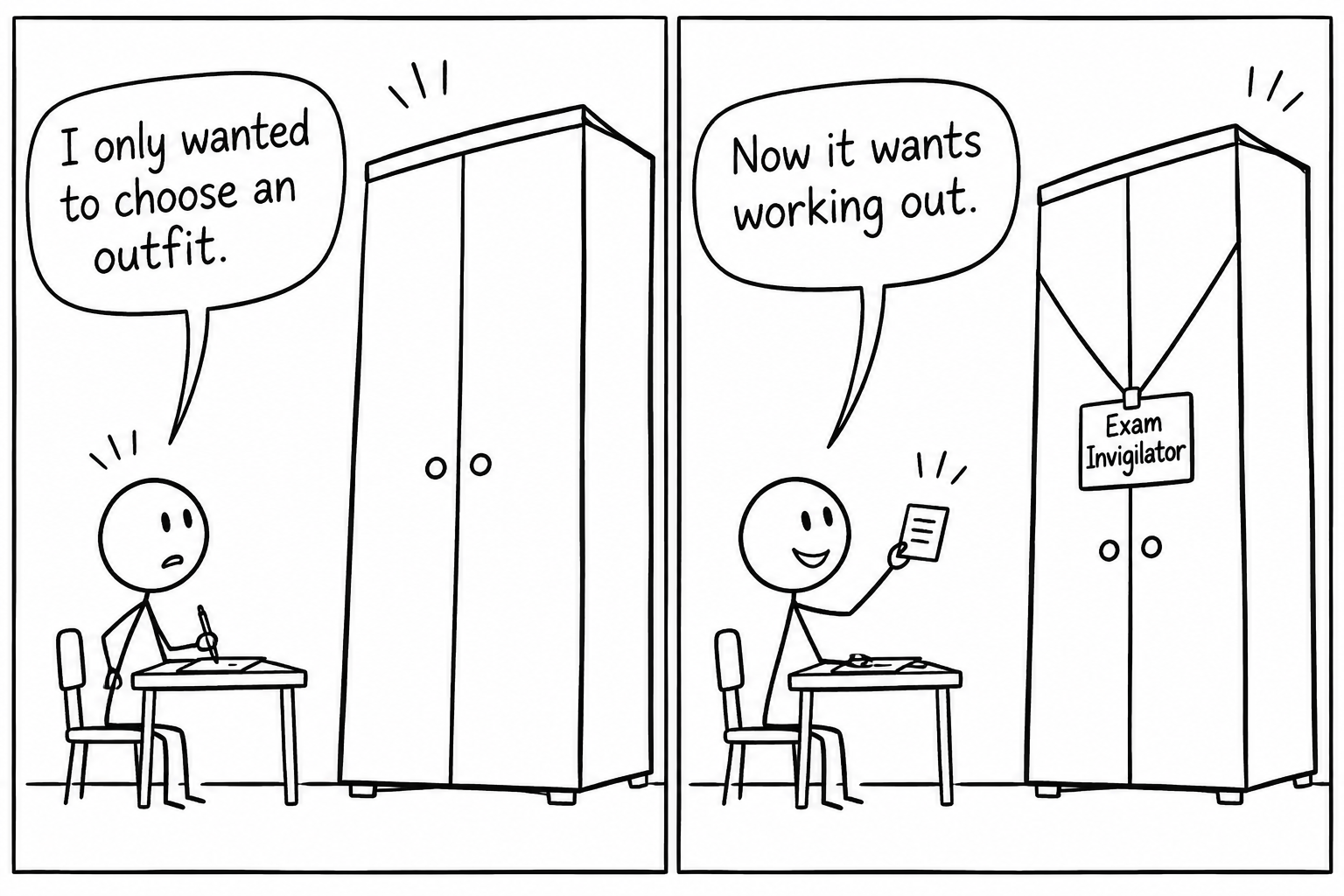 A stick figure discovers that choosing an outfit has become mock revision
A reliable method for mock questions
When a counting problem looks complicated, draw one short line or box for each stage. Then write the number of choices above it.
Ask these questions in order:
- What is being chosen first?
- What is chosen next?
- Can an option be used again?
- Does any position have a special restriction?
- Would choosing a restricted position first simplify the problem?
Once the available choices are clear, multiply them. A useful working structure is:
total outcomes=choices at stage 1×choices at stage 2×⋯\text{total outcomes} = \text{choices at stage 1} \times \text{choices at stage 2} \times \cdotstotal outcomes=choices at stage 1×choices at stage 2×⋯Do not rush straight to a calculation. A few seconds spent identifying the stages can protect several marks.
Exam-style question: choosing a meal
A café meal consists of one main course, one side and one drink. There are 555 main courses, 333 sides and 444 drinks.
How many different meals can be chosen?
Step one: identify the stages
There are three separate decisions:
- choose a main course;
- choose a side;
- choose a drink.
Step two: write the number of choices
The numbers of choices are 555, 333 and 444.
Step three: apply the product rule
5×3×4=605 \times 3 \times 4 = 605×3×4=60Therefore, there are:
60\boxed{60}60different meals.
This is a straightforward product rule question because choosing one item does not reduce the choices available at another stage. The main course and drink are different categories, so repetition is not relevant.
Exam-style question: a code with restrictions
A three-digit code is made using the digits 111, 222, 333, 444, 555 and 666.
No digit may be repeated, and the final digit must be even.
How many different codes are possible?
This question has two restrictions. The final digit must be even, and each chosen digit is then unavailable for the remaining positions.
Step one: deal with the restricted position
The even digits are 222, 444 and 666, so there are 333 choices for the final position.
Step two: count the remaining choices
After the final digit has been selected, 555 digits remain for the first position. Repetition is not allowed, so there are then 444 digits left for the middle position.
Step three: multiply
3×5×4=603 \times 5 \times 4 = 603×5×4=60Therefore, the number of possible codes is:
60\boxed{60}60The positions could be written in their usual order as 5×4×35 \times 4 \times 35×4×3. The result is unchanged. However, thinking about the final position first makes the restriction easier to manage.
Notice why 6×5×46 \times 5 \times 46×5×4 would be wrong. That calculation counts codes ending in odd digits as well as even digits. It handles the no-repetition condition, but ignores the final-digit condition.
When repetition changes the calculation
The phrase repetition is allowed means a choice remains available after it has been used. If a four-digit PIN can use any of 101010 digits in every position, including repeated digits, its number of possible arrangements is:
10×10×10×10=10410 \times 10 \times 10 \times 10 = 10^410×10×10×10=104If repetition is not allowed, the number of choices falls after each selection:
10×9×8×710 \times 9 \times 8 \times 710×9×8×7This distinction is central to the product rule for counting mock revision. Never assume that repetition is allowed or forbidden. Read the wording and build the calculation from what the question actually says.
Slips examiners see most often
Adding instead of multiplying
Students sometimes calculate 5+3+45+3+45+3+4 for the meal question. Addition would be appropriate when choosing one option from separate alternatives, such as one main course or one side. A complete meal requires a main and a side and a drink, so the stages are multiplied.
Ignoring no repetition
If there are 666 available digits and one has already been used, only 555 remain. Keeping 666 choices at every stage counts invalid arrangements.
Missing a restricted position
Words such as even, odd, greater than, begins with and ends with affect particular positions. Deal with the most restricted position first whenever that makes the choices clearer.
Treating arrangements as selections
Choosing three students for a group is different from assigning a captain, vice-captain and secretary. In the second situation, the roles make order important. Your stages should represent the distinct roles.
Giving only a final answer
Even when the arithmetic is simple, show the product that produced your answer. A line such as 3×5×4=603 \times 5 \times 4=603×5×4=60 demonstrates the method and may earn method marks if the final arithmetic goes wrong.
A focused plan before December mocks
Begin with one short revision lesson and make a card containing just two prompts: What are the stages? and Does each choice remain available? Then complete a small set of questions without notes.
Mark the questions immediately. Sort every error into one of three categories: identifying stages, handling restrictions or arithmetic. This matters because repeating ten similar questions will not help much if the real problem is misreading the phrase “without repetition”.
Use the Edexcel GCSE Maths question bank for targeted exam-style practice, then revisit worked or video solutions when your method differs from the mark scheme. MathsGenie's free revision resources and mini tests can help you combine this topic with the rest of your mock preparation.
A week later, test the skill among unrelated topics. That is closer to a real paper, where the question will not announce which rule to use. The MathsGenie revision planner can give that practice a place in your wider schedule.
Turn one weak topic into a stronger mock
Counting questions often feel uncertain because the calculation is short but the interpretation matters. Slow the question down. Separate the stages, check the restrictions and then multiply the available choices.
When you are ready, use the MathsGenie Mock Exam Builder to build a targeted practice paper from past-paper questions. Sit it under timed conditions, use the mark schemes and video solutions to diagnose each slip, and add any remaining weakness to your revision plan. That is how a vague worry before December becomes a skill you can rely on in the mock.















