

Product Rule for Counting Exam Questions: GCSE Guide
Product rule for counting exam questions explained through three GCSE examples. Learn to handle restrictions, show your method and practise with confidence.
You understand multiplication. Then an exam question mentions passwords, meal deals or digits that cannot repeat, and suddenly you are unsure what to multiply. Product rule for counting exam questions become manageable when you identify each choice, count the options available at that stage, and multiply. If restrictions create different cases, count each case separately and add the totals.
Imagine a student working through three questions. Their first instinct is to list every possibility. As the questions become harder, they learn to write something shorter and more useful: a calculation that shows how the choices fit together.
The product rule for counting: your checklist
The product rule says that if there are mmm choices for one stage and nnn choices for the next, with nnn options available after every first choice, then:
Total outcomes=m×n\text{Total outcomes}=m\times nTotal outcomes=m×nThe same principle extends to more stages. The number of options can decrease, provided you count what remains correctly.
Before calculating, ask:
- What stages make up one complete outcome?
- Does order matter?
- Can an option be used again?
- Are there restrictions on particular positions?
- Do I need separate, non-overlapping cases?
This is GCSE Higher tier content. Systematic listing is a useful foundation, but multiplication saves you from writing out a long list.
Question one: choosing a meal
A café offers 444 sandwiches, 333 drinks and 555 snacks. A meal contains one of each. How many different meals are possible?
Our imagined student starts listing meals, then notices that every sandwich can go with every drink and every snack.
Step one: identify the choices
There are three stages: choose a sandwich, choose a drink, then choose a snack. Choosing one item does not remove options from either of the other categories.
Step two: multiply
4×3×5=604\times3\times5=604×3×5=60There are 606060 different meals.
Where marks come from: the product 4×3×54\times3\times54×3×5 demonstrates the method; 606060 gives the correct answer. Exact mark allocations depend on the question’s mark scheme. The comments here describe evidence of method, rather than promise particular marks.
Adding the choices would count the items available, not the complete meals. That distinction is the first thing the student writes beside their answer.
If you want to see this explained visually, the MathsGenie product rule for counting lesson brings together the topic’s lessons and practice resources.
Question two: a code without repeated digits
A code contains one letter followed by two digits. Any of the 262626 English letters may be used. The digits are chosen from 000 to 999, and the two digits must be different. How many codes are possible?
The student recognises three positions again. This time, though, the available choices change.
Step one: count each position
The letter has 262626 possibilities. The first digit has 101010 possibilities, including zero. After choosing it, only 999 digits remain for the final position.
Step two: write the complete calculation
26×10×9=234026\times10\times9=234026×10×9=2340There are 234023402340 possible codes.
Where marks come from: using 999 for the final position shows that the repetition restriction has been applied. Writing the full product makes that reasoning visible, even if a later arithmetic slip occurs.
Zero is allowed here because this is a code. A number described as three-digit cannot begin with zero. The wording determines the choices.
Now that you can label positions and adjust the available choices, use MathsGenie’s Lessons and Question Bank to practise spotting those changes in unfamiliar questions.
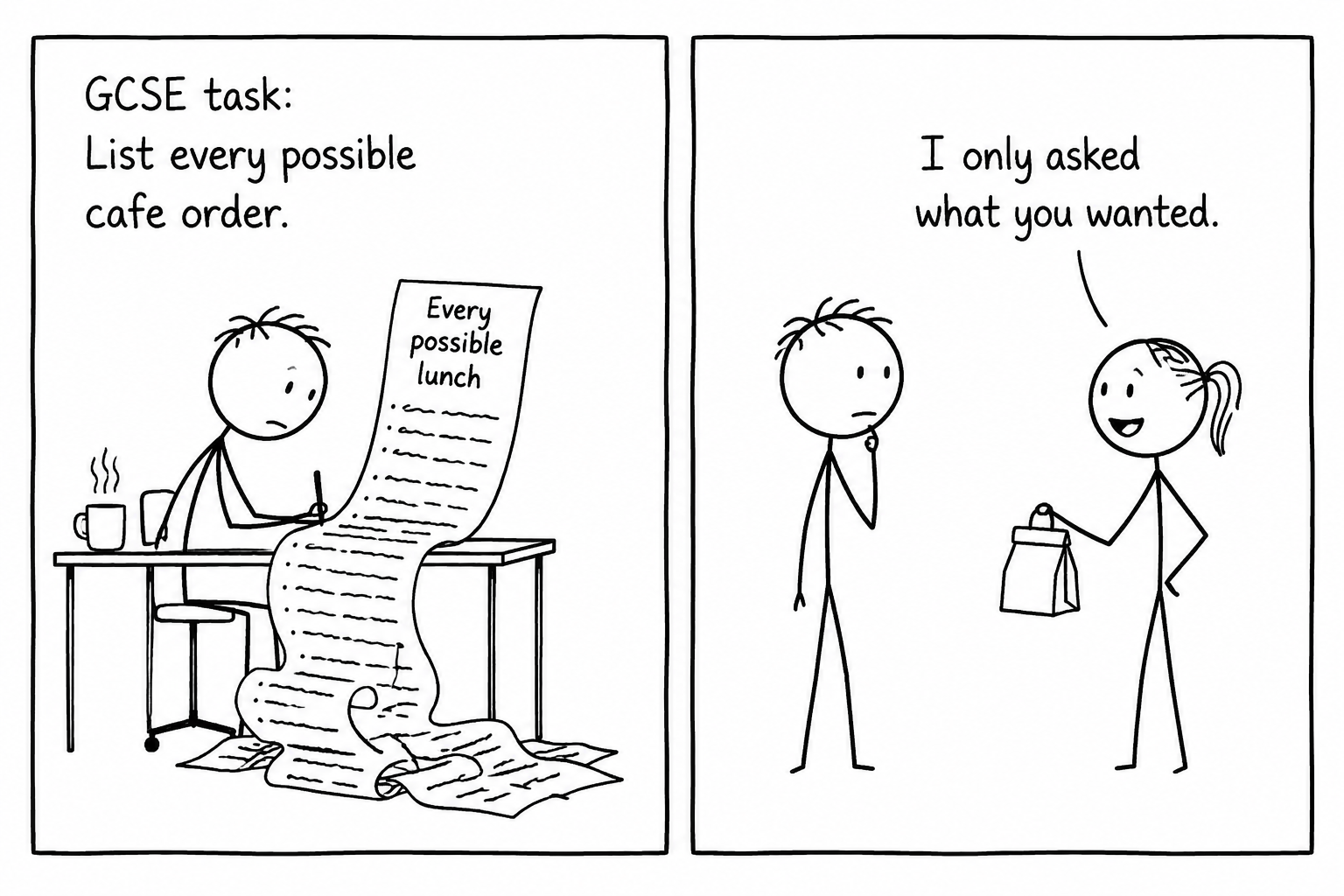 A stick-figure student lists every possible lunch while a friend only wants to know what they want to eat
Question three: restrictions that need separate cases
How many three-digit even numbers can be made from 000, 111, 222, 333 and 444, without repeating a digit?
The student pauses before multiplying. The first digit cannot be zero, and the final digit must be even. Choosing the final digit first makes the restrictions easier to manage.
Case one: the number ends in zero
With zero already used, the hundreds digit has 444 choices. The tens digit then has 333 remaining choices.
4×3×1=124\times3\times1=124×3×1=12Case two: the number ends in another even digit
The units digit has 222 choices: 222 or 444.
For either choice, the hundreds digit has 333 options: it cannot be zero or the digit already used. The tens digit then has 333 remaining options, including zero.
2×3×3=182\times3\times3=182×3×3=18Combine the cases
Every valid number belongs to exactly one case, so add:
12+18=3012+18=3012+18=30There are 303030 possible numbers.
Where marks come from: the case calculations show how both restrictions are handled. Adding their totals completes the count. Clear labels help an examiner follow the method; an unexplained final answer gives less evidence if it is wrong.
The key insight is that the number of hundreds-digit choices changes depending on whether zero has already been used.
Common mistakes in counting questions
Multiplying before reading every restriction. Underline phrases such as “different digits”, “even” and “without replacement” before filling the positions.
Assuming choices always stay the same. Repeated choices may be allowed in a password, but forbidden in another question. Check rather than assume.
Confusing order with selection. A captain and vice-captain have different roles, so swapping the people creates a different outcome. Selecting an unordered pair requires care because counting both orders would duplicate it.
Adding overlapping cases. Cases must cover all valid outcomes without counting any twice. “Ends in zero” and “ends in a non-zero even digit” work because they cannot overlap.
Writing only an answer. Show your factors and label restricted cases. This makes your reasoning checkable.
Exam-style practice
Try these before reading the answers:
- A lunch deal offers 777 mains and 444 desserts. Choose one of each. How many deals are possible?
- How many three-digit odd numbers can be formed from 111, 222, 333, 444 and 555 without repetition?
Answers: the lunch deal gives 7×4=287\times4=287×4=28. For the numbers, choose the odd final digit first: 3×4×3=363\times4\times3=363×4×3=36.
For further practice, MathsGenie has topic exam booklets with answers, an AQA counting lesson page, and an OCR counting lesson with worked solutions. When tackling product rule for counting past paper questions, check how the mark scheme rewards the setup as well as the result.
Turn the method into a habit
Our imagined student now has a repeatable approach: label the choices, apply restrictions, then multiply within cases and add between them. Your next task is recognising that structure without a prompt. Start with the product rule for counting Lessons, then practise the technique in the MathsGenie Question Bank.















