

Prime Numbers Exam Questions: GCSE Worked Examples
Prime numbers exam questions explained through three GCSE worked examples, method-mark tips, common mistakes and focused practice for every student today.
A prime number question can look almost too simple. Then the list includes 111, an even number slips past unnoticed, or a problem asks for prime factors before finding an HCF or LCM.
The safest way to answer prime numbers exam questions is to identify what the question wants, use the appropriate method, and give a clear answer. Here, we follow a hypothetical student, Sam, through three GCSE questions. Suggested mark breakdowns are illustrative: exact awards depend on the exam board and paper.
These questions reward careful reading as much as calculation. Selecting primes, finding a prime factorisation and calculating an HCF use related ideas, but they ask for different answers. Before starting, underline the instruction and notice whether the examiner wants a list, a product or a single number.
Your prime number exam checklist
Before answering, remember:
- A prime number has exactly two positive factors: 111 and itself.
- The number 111 is not prime.
- The number 222 is the only even prime.
- A composite number has more than two positive factors.
- Prime factorisation expresses a number as a product containing only prime factors.
- For an HCF, choose the lowest shared prime powers.
- For an LCM, choose the highest power of every prime present.
Review these GCSE foundation and higher tier skills in the Prime Factors, HCF and LCM lesson.
How to recognise a prime number
Sam begins with the definition. Useful divisibility checks include:
- Even numbers greater than 222 are composite.
- A number whose digit sum is divisible by 333 is divisible by 333.
- Numbers ending in 000 or 555, other than 555 itself, are not prime.
For an integer n>1n>1n>1, test prime divisors up to n\sqrt{n}n. Factors come in pairs: if both factors exceeded n\sqrt{n}n, their product would exceed nnn. Finding no prime divisor within that limit establishes that nnn is prime.
You do not need to test every smaller whole number. Composite divisors already contain prime factors, so testing the primes covers them. However, passing the quick checks for 222, 333 and 555 alone does not always establish primality. Continue until you have covered every prime up to the square root.
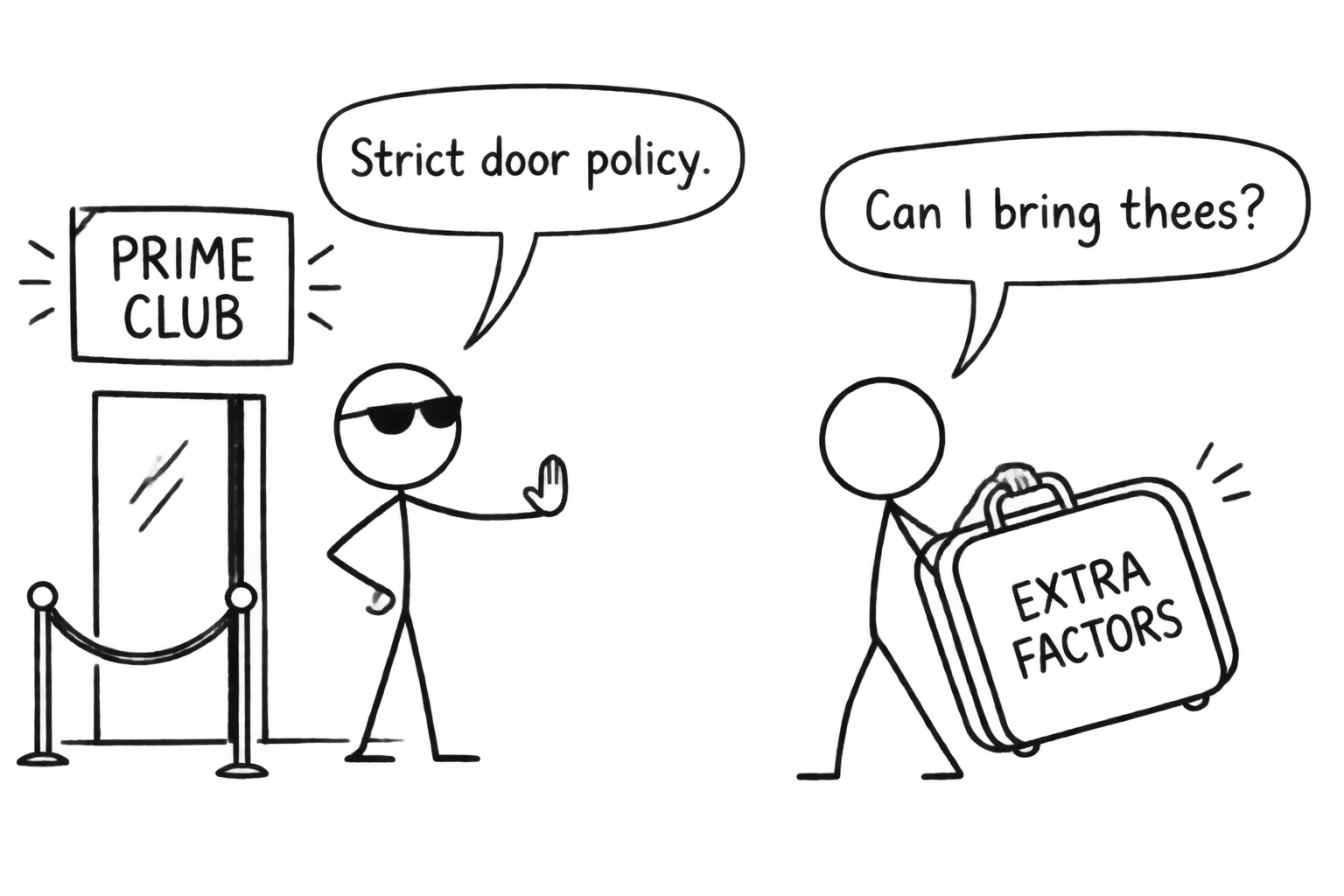 A stick-figure bouncer enforcing the Prime Club's strict policy on extra factors
Question one: selecting prime numbers
Exam-style question: Write down all the prime numbers in this list.
1, 2, 9, 17, 21, 291,\ 2,\ 9,\ 17,\ 21,\ 291, 2, 9, 17, 21, 29Sam crosses out 111, then checks the remaining numbers:
- 222 has exactly two positive factors, so it is prime.
- 9=3×39=3\times39=3×3, so it is composite.
- 171717 is not divisible by 222 or 333, the primes below its square root.
- 21=3×721=3\times721=3×7, so it is composite.
- 292929 is not divisible by 222, 333 or 555, the primes below its square root.
Therefore:
2, 17, 29\boxed{2,\ 17,\ 29}2, 17, 29Where the marks come from
Short selection questions commonly award accuracy marks. Partial credit, where available, depends on the precise mark scheme and any incorrect choices. Sam puts only the requested primes on the answer line, keeping checks in the working area.
Question two: writing a number as prime factors
Exam-style question: Express 360360360 as a product of its prime factors. Give your answer in index form.
Sam starts a factor tree:
360=36×10360=36\times10360=36×10Each branch must finish with prime factors:
36=6×6=2×3×2×336=6\times6=2\times3\times2\times336=6×6=2×3×2×3 10=2×510=2\times510=2×5Collecting the endpoints gives:
360=2×2×2×3×3×5360=2\times2\times2\times3\times3\times5360=2×2×2×3×3×5In index form:
360=23×32×5\boxed{360=2^3\times3^2\times5}360=23×32×5Where the method marks come from
Depending on the mark scheme, a valid factor tree or repeated division method may earn credit despite a later error. Show each stage clearly, then check by multiplying:
23×32×5=8×9×5=3602^3\times3^2\times5=8\times9\times5=36023×32×5=8×9×5=360Different starting branches can produce the same correct factorisation. What matters is preserving every factor and continuing until all endpoints are prime.
Question three: using prime factors for HCF and LCM
Exam-style question: Two numbers have prime factorisations
A=24×32×5A=2^4\times3^2\times5A=24×32×5and
B=22×3×52.B=2^2\times3\times5^2.B=22×3×52.Find their HCF and LCM.
Sam decides which powers are needed before calculating. The HCF must divide both numbers, so use the lowest shared powers:
HCF=22×3×5=60\operatorname{HCF}=2^2\times3\times5=\boxed{60}HCF=22×3×5=60The LCM must contain enough of every prime factor to be divisible by both numbers. Choose the highest powers:
LCM=24×32×52\operatorname{LCM}=2^4\times3^2\times5^2LCM=24×32×52 LCM=16×9×25=3600\operatorname{LCM}=16\times9\times25=\boxed{3600}LCM=16×9×25=3600A useful final check is to compare sizes. The HCF cannot exceed the smaller original number, while the LCM cannot be smaller than the larger original number. These checks can expose a swapped answer, although they do not prove that every selected prime power is correct.
Where the method marks come from
Writing the selected prime powers makes the reasoning visible. A correct product may earn method credit even if the final multiplication is wrong, depending on the mark scheme.
For prime numbers past paper questions, distinguish choosing the factors from calculating their product. The Edexcel prime factors revision page brings topic resources together. Related support is available for AQA prime factors revision, Eduqas prime factors revision and the OCR prime factors lesson.
Common mistakes in prime numbers exam questions
Misremembering the definition
The number 111 is neither prime nor composite. The number 222 is prime, despite being even. Return to the number of positive factors whenever uncertain.
Ending a factor tree too early
A branch ending in 666 is unfinished. Split it into 2×32\times32×3, then check that every endpoint is prime.
Ignoring the requested answer form
If index form is requested, collect repeated factors into powers. Count occurrences carefully: the exponent records how many times that prime appears.
Reversing HCF and LCM
Use the lowest shared powers for HCF and the highest powers for LCM. Write the product before multiplying to make your choice clear.
Practise, check and return
Attempt Prime Factors Question 14 and Prime Factors Question 32 independently. AQA students can also use Prime Factors Question 35.
Check your method against the available solutions. Identify whether any error came from recognising primes, collecting factors, selecting powers or multiplying. Then retry the question without looking back.
Keep a brief note of the correction you needed, such as checking unfinished branches or reading the requested answer form. In your next revision session, attempt a fresh question using that reminder. This makes the feedback something you can act on independently.
Turn the method into exam confidence
Sam now has a repeatable approach: test, factorise, select powers and check. Build that consistency with MathsGenie's free revision lessons and practice questions. Start with the linked lesson, attempt questions independently, and use the solutions to decide what to practise next.















