

Pomodoro Technique for GCSE Drama: Does It Work?
Pomodoro technique GCSE Drama: learn when timed sprints help with recall and writing, when rehearsals need longer, and how to build a balanced plan.
Revision can look productive long before it becomes useful. A timer is running. Notes are open. The desk is unusually tidy. Yet none of this proves that anything will be remembered in the exam.
So, does the Pomodoro technique GCSE Drama students often use actually work? The short answer is: it can help you begin, concentrate and manage written revision, but strict 252525-minute blocks are not ideal for every Drama task. Learning terminology, recalling a set text and planning exam responses fit short bursts well. Rehearsing a scene, developing a character or completing a timed response may require longer, uninterrupted sessions.
That distinction matters if you are balancing Drama with GCSE maths. The timer is only a container. What you do inside it determines whether your revision improves.
A quick Pomodoro checklist for GCSE Drama
Use a timed revision block when you can answer these questions clearly:
- What is the task? Choose one precise outcome, such as recalling staging configurations or planning one set-text paragraph.
- Does the task fit the block? Factual recall may fit 202020 to 252525 minutes; rehearsal and full exam practice may not.
- Will you produce something? A retrieval sheet, paragraph plan, recorded rehearsal or corrected answer is better than passive reading.
- How will you check it? Compare your response with notes, teacher feedback, the specification or a mark scheme.
- When will you return to it? Revisit important knowledge on another day rather than relying on one intense session.
The same principles support maths revision. MathsGenie’s GCSE Maths revision hub makes it easy to select one topic, practise it and check your answer without spending the first half of a session deciding what to do.
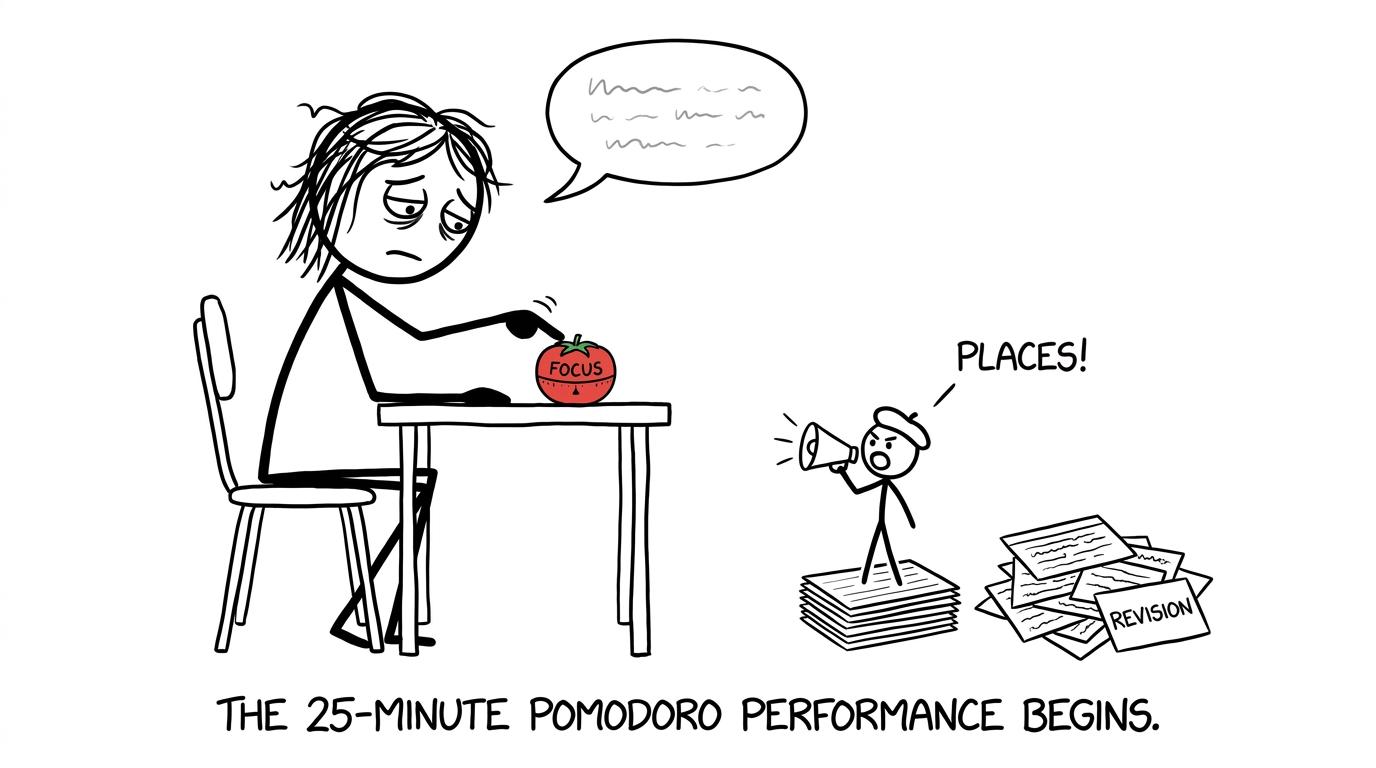 A GCSE student starts a revision session with a tomato timer while a tiny theatrical director calls places
What the Pomodoro Technique actually does
The traditional approach uses 252525 minutes of focused work followed by a 555-minute break. After several cycles, you take a longer break. You can adapt those timings, but the underlying idea stays the same: make the next period of concentration finite and protect it from interruptions.
This can help with procrastination. “Revise Drama” feels vague and potentially endless. “Recall costume choices for one character for 202020 minutes” has a visible finish line. Starting becomes less intimidating because you are not promising to work all evening.
However, the technique is not a learning method by itself. A student can spend four beautifully timed blocks copying notes and retain little. The benefit comes when the structure supports effective activities such as retrieval, deliberate practice, feedback and later review.
Recent studies of university students do not show that Pomodoro is universally superior to self-regulated breaks. Some research has found benefits for concentration, mood or efficiency, while other research has found no meaningful overall difference in productivity, task completion or learning performance. The evidence is also not specific to GCSE Drama students.
The sensible conclusion is modest: Pomodoro is a useful attention-management tool, not a guaranteed grade-improvement formula.
Why short bursts suit some GCSE Drama revision
GCSE Drama mixes knowledge, analysis, evaluation, creative decisions and practical performance. That variety is why a single revision rhythm cannot suit everything.
AQA and Edexcel, for example, both include a written examination worth 40%40\%40% of the qualification alongside devising and performance components. Their precise questions and component rules differ, so always follow your own exam board’s specification and your teacher’s guidance. OCR and Eduqas students should do the same rather than borrowing an online plan designed for another board.
Recall and terminology
Short sessions work well for bounded knowledge. You might retrieve theatre roles, staging configurations, vocal skills, physical skills, design terminology or contextual details about a set text.
Begin with a blank page rather than your notes. Write what you remember, check it afterwards and correct omissions in another colour. This is retrieval practice: the mental effort of bringing knowledge back, not simply seeing it again.
A useful block could contain:
- 333 minutes setting a precise question;
- 121212 minutes recalling without notes;
- 777 minutes checking and correcting;
- 333 minutes choosing what to revisit next time.
The timing is not magical. Its value comes from giving recall and feedback a defined place.
Planning written responses
A short block can also be used to plan one response about acting, directing, design or live theatre. Focus on selecting precise evidence and explaining its effect on the audience. You do not need to write a full answer every time.
Over several sessions, alternate between planning and timed writing. This prevents revision from becoming a collection of attractive plans that have never survived exam conditions.
For maths, the equivalent is moving from a revision lesson to actual questions. MathsGenie’s twenty-minute maths revision routine uses the same principle: recall, practise, mark and decide the next target.
Reviewing a devising process
Pomodoro blocks can help you organise reflections about artistic intentions, collaboration, development and evaluation. Give each block one purpose. For example, identify two important changes to the piece, then explain why they were made and whether they communicated the intended meaning.
Be careful not to invent retrospective detail. Your school’s permitted evidence, portfolio format and assessment requirements depend on the specification. Use your genuine process notes and teacher guidance.
When GCSE Drama needs longer sessions
Some work becomes worse when a timer interrupts it. Drama is embodied and collaborative. Concentration is not always visible as a completed page.
Rehearsal and character development
A scene needs time to warm up, establish rhythm, repeat sections and respond to feedback. Stopping every 252525 minutes may break momentum just as the performance begins to feel truthful.
For practical work, use a longer block of perhaps 454545 to 606060 minutes, with a clear rehearsal objective and a natural stopping point. A useful sequence is:
- warm up;
- run the section;
- identify one performance issue;
- repeat with a deliberate adjustment;
- record brief reflections.
If you are rehearsing with other people, agree breaks together. One person’s timer should not repeatedly disrupt the group.
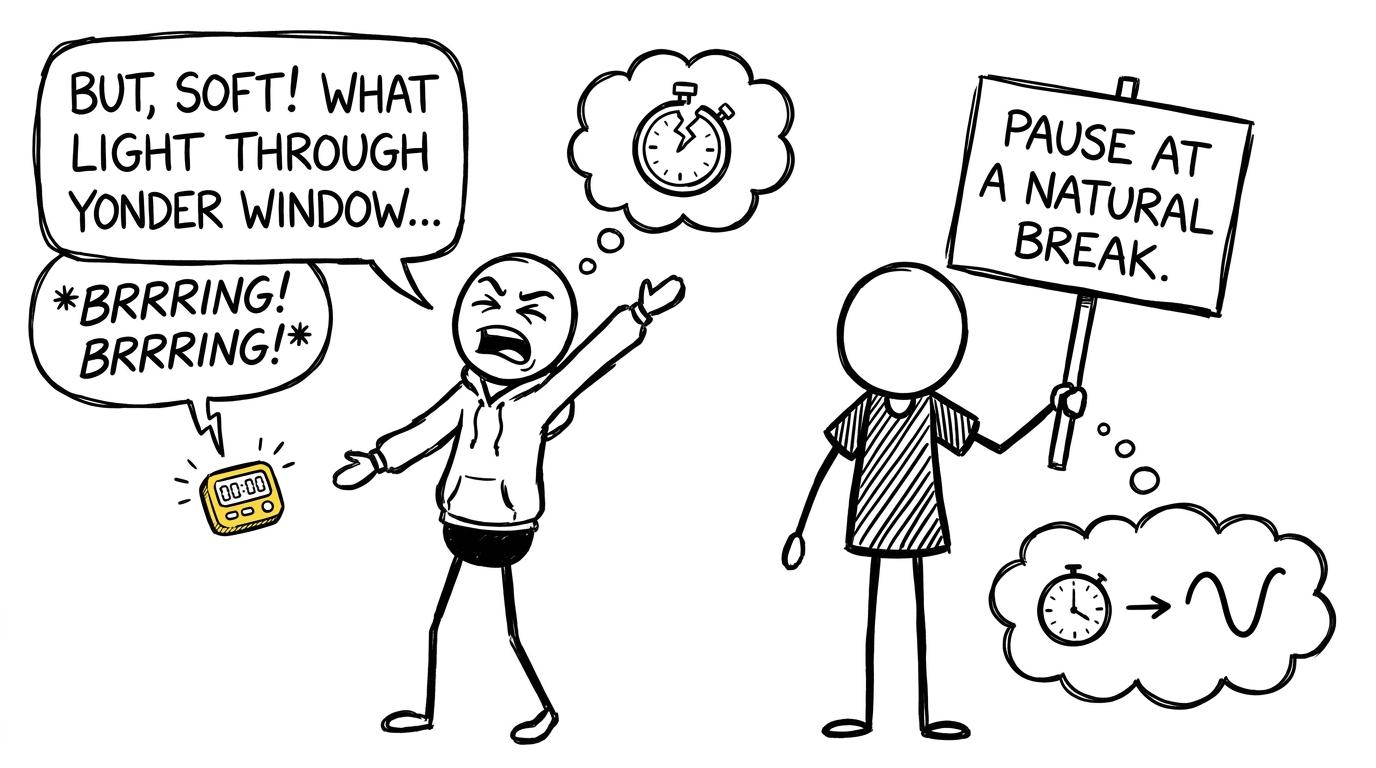 A timer interrupts a dramatic monologue while another student recommends pausing at a natural break
Full written exam practice
A complete paper or extended timed response must eventually be practised without artificial pauses. Exam stamina is partly task-specific: you improve it by writing continuously, selecting evidence under pressure and managing the actual paper structure.
Use short blocks to build knowledge first. Then remove the breaks for realistic practice. This is also essential in maths. GCSE past papers on MathsGenie help you practise sustained decision-making, while the accompanying mark schemes show where marks are earned.
Creative exploration
Devising does not always progress in neat units. An idea may need discussion, improvisation and rejection before the useful version appears. A rigid alarm can encourage premature decisions simply because the block is ending.
Instead, use flexible timing: set a minimum focus period, continue while the group is making productive progress, and pause at a natural transition. The timer should protect attention, not command the creative process.
A flexible Pomodoro plan that works across subjects
Try treating session length as a decision based on the task.
| Revision task | Suggested focus period | Best evidence of progress |
|---|---|---|
| Drama terminology recall | 151515 to 252525 minutes | Corrected retrieval sheet |
| Set-text paragraph planning | 202020 to 303030 minutes | Structured plan with precise evidence |
| Practical rehearsal | 454545 to 606060 minutes | Improved recorded run or feedback notes |
| Maths topic practice | 202020 to 303030 minutes | Marked questions and an error note |
| Full paper practice | Official paper timing | Marked script and repair list |
These are starting points, not rules. If you consistently lose focus after 181818 minutes, shorten the block and remove distractions. If a 252525-minute alarm interrupts productive concentration, extend the session.
Between blocks, stand up, get water or look away from the screen. Avoid opening short-form video or social media “for five minutes”. Those platforms are designed to make stopping difficult, which defeats the purpose of a controlled break.
For maths, use GCSE mini tests inside shorter cycles and save full papers for uninterrupted sessions. If you are unsure what deserves attention, the guide to finding your weakest GCSE topics explains how to turn lost marks into specific revision priorities.
How to tell whether the technique works for you
Do not judge the method by how organised you felt. Test the result.
For one week, record:
- the task completed;
- the focus length;
- whether you became distracted;
- what you could recall the following day;
- what improved after feedback.
Then compare different session types. You may discover that 202020 minutes is enough for Drama terminology, 353535 minutes suits maths topic questions and rehearsal works best in hour-long sessions.
The important measure is not the number of timers completed. It is whether you can remember, apply and communicate more accurately.
Maths students can make this visible by following the cycle in how to use GCSE past papers properly: complete a paper, mark it, repair weaknesses and retest. For Edexcel students, GCSE Maths predicted papers provide further timed practice once topic gaps have been addressed.
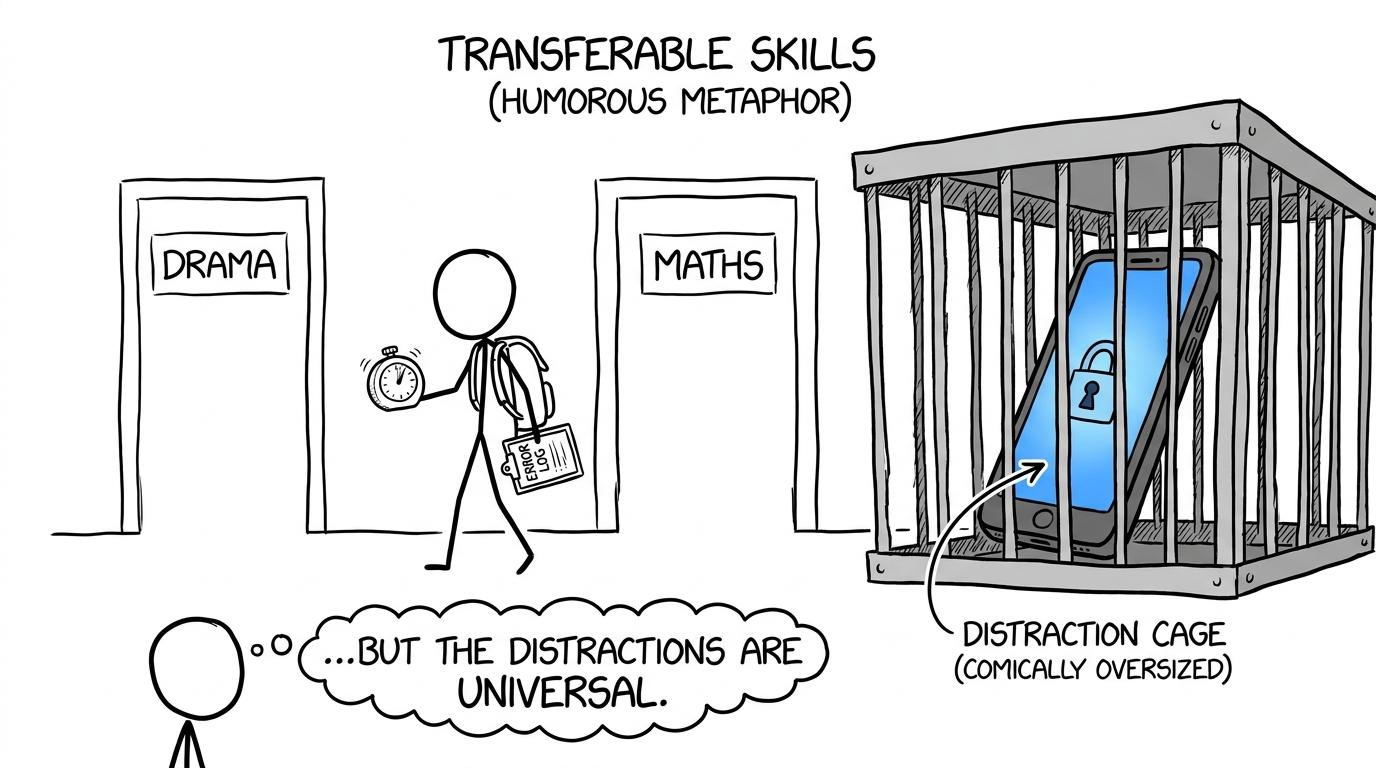 A student carries the same timer and error log between Drama and Maths while a phone remains locked away
Common Pomodoro mistakes in GCSE revision
Timing passive activities
Highlighting, copying and rereading may fill a session without strengthening recall. Begin with a question or task that produces evidence.
Treating 252525 minutes as compulsory
The original interval is a default, not a law. Adapt it to the task, your concentration and any access arrangements you use.
Stopping during productive flow
If you are deeply focused and the task benefits from continuity, finish the natural unit before taking a break. This is especially important during rehearsal and extended writing.
Using breaks as phone sessions
A break should restore attention. Notifications and scrolling often replace one source of mental demand with another.
Counting sessions instead of checking learning
Completing six blocks sounds impressive, but marks come from knowledge and performance. Use retrieval checks, teacher feedback, practice questions and mark schemes.
Never practising full exam conditions
Short bursts build consistency, but they cannot replace sustained papers. Gradually combine focused topic work with complete timed responses and papers.
The verdict: structure the task, not just the clock
The Pomodoro Technique can work for GCSE Drama when the task is small, clearly defined and easy to check. It is particularly useful for starting revision, recalling terminology, reviewing set texts and planning written answers. It is less suitable when rehearsal, creative exploration or full exam practice needs uninterrupted thought.
That lesson transfers neatly to maths. Use short sessions for revision lessons, practice questions and mini tests; use longer sessions for past papers and predicted papers; then study the mark scheme and video solution rather than merely recording a score.
Start with the free MathsGenie GCSE Maths revision hub. Choose your exam board and tier, select one weak topic and complete one focused block today. The timer may help you begin. MathsGenie’s revision lessons, practice questions, mark schemes, video solutions, mini tests, past papers and predicted papers will help make that time count.











